 Write to the booksellers
POMEY,F.
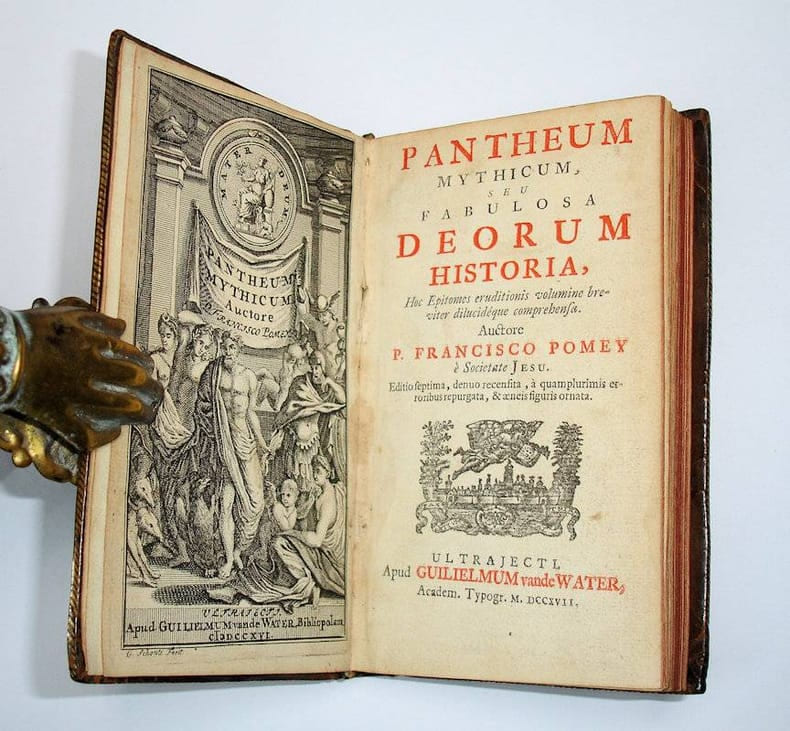
Pantheum mythicum, seu fabulosa deorum historia, hoc epitomes eruditionis volumine breviter dilucideque comprehensa. Auctore P. Francisco Pomey e Societate Jesu. Editio septima, denuo recensita, a quamplurimis erroribus repurgata, & aeneis figuris ornata.
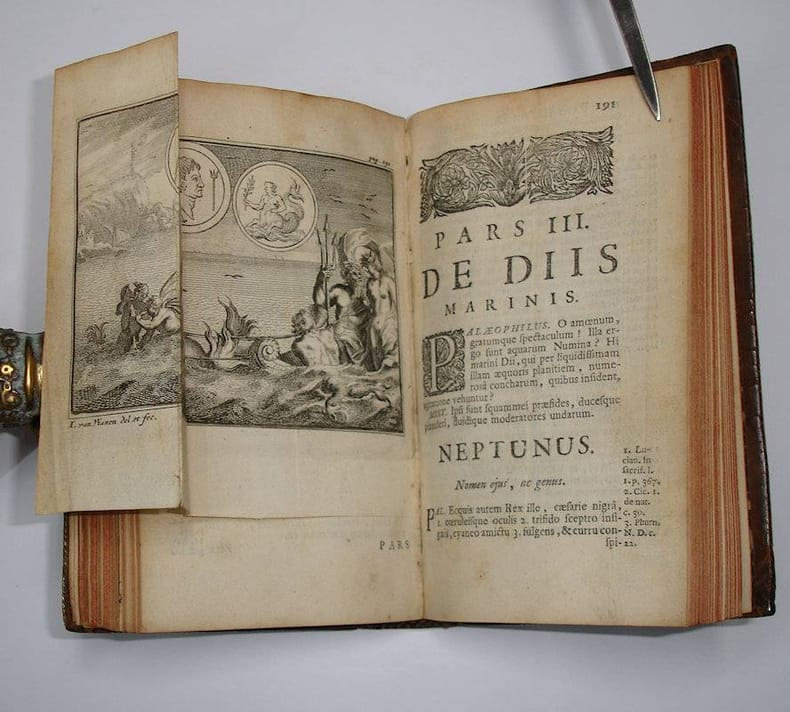
Utrecht (Ultrajecti), Apud Guilielmum vande Water, 1717.
Reference : 120456
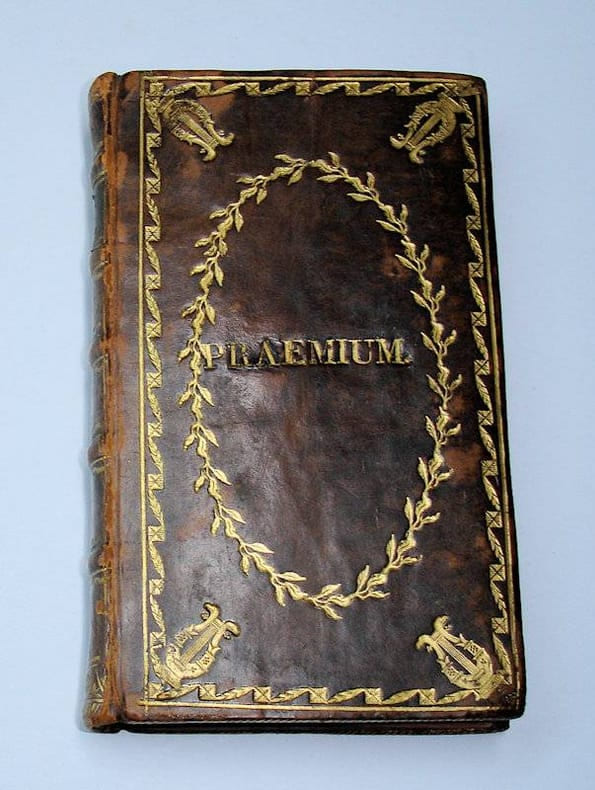
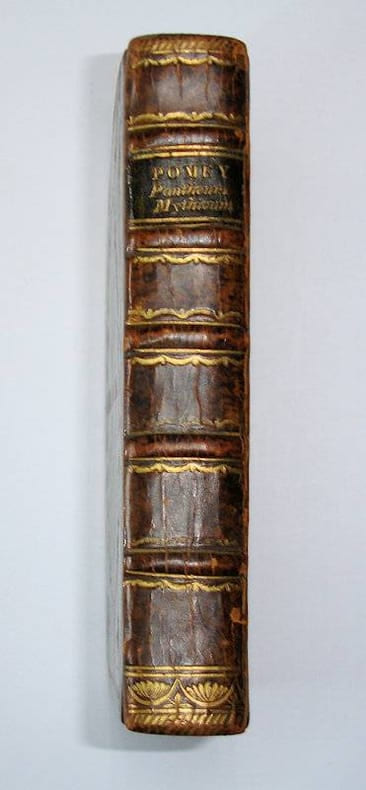
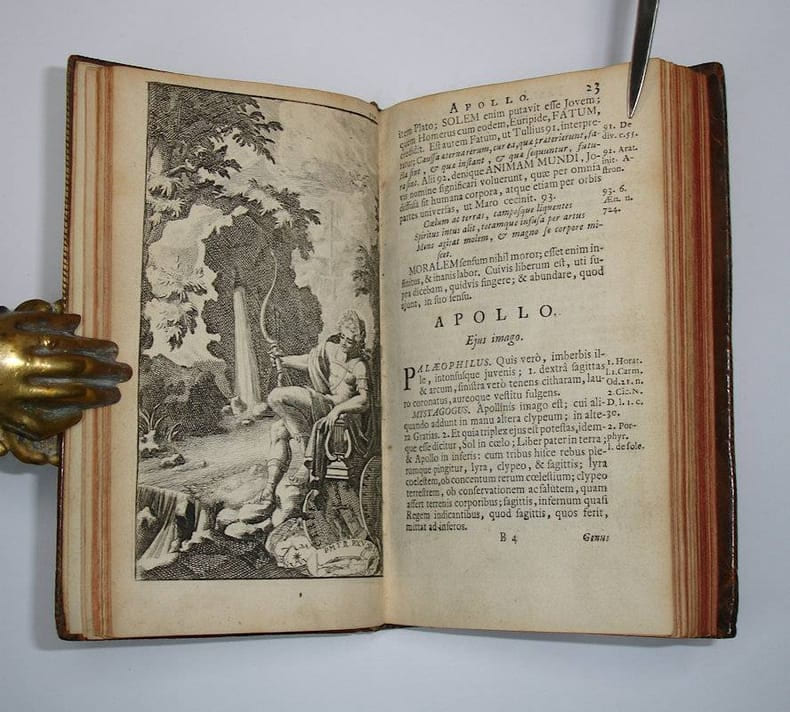
8vo. (XVI),298,(14) p., frontispiece & 26 engraved plates. Calf. 16 cm "Prize copy' (Ref: STCN ppn 20819178X; Brunet 4,793; Michaud 34 p. 12: 'la meilleure édition est celle qu'a publiée Sam. Pitiscus') (Details: Prize copy, probably of a Belgian Jesuit College. Back with 5 raised bands between gilt fillets & floral rolls. Black morocco gilt lettered shield in the second compartment. Boards with gilt fillet borders. Within the fillet border a gilt row consisting of ears of corn and quadrangles. A gilt lyre in all 4 corners. A gilt oval laurel wreath with in its center the gilt text PRAEMIUM. Edges of the boards gilt. Marbled endpapers. Title in red & black. Woodcut printer's mark on the title. Engraved frontispiece depicting deities. 26 engraved plates with mythological scenes) (Condition: Wear to extremes, back somewhat rubbed. Prize gone. Front hinge cracking, but still hanging on 2 ties) (Note: This is the 6th edition of the most popular and authoritative mythology manual of the 17th and 18th century. It was first published in Lyon in 1659. There are more than 40 editions, and it was translated into English, French, Spanish and Polish. The manual was produced by the French Jesuit schoolmaster François Antoine Pomey, 1618-1673, who lectured humanities and rhetoric at several colleges. He is also the author of a number of schoolbooks and dictionaries. His 'Pantheum Mythicum' became to be regarded as an essential work which provided the indispensable ornaments of formal discussion. It was also popular as a schoolbook, for the stories formed a body of moral precepts, hidden under the mask of agreable fiction. 'Perinde quasi, alius esse debeat, cum omnibus, tum mihi maxime, ac studium & propagatio Divinae gloriae?'; In the praefatio to this 6th edition the Dutch classicist of German origin, Samuel Pitiscus (Samuel Petiski), 1636-1727, tells the reader that the publisher had sold within 4 years 1300 copies of the 5th edition of 1697. To surpass this tremendous success he asked him to produce a new edition purged from all erroneous inventions and extensions of later editors, and mistakes of ignorant printers. Pitiscus really was the expert for the job. He produced editions of several Roman historians, and did also lexicographic work. He was well acquainted with the 'Romanae Antiquitates' of Rosinus and Dempster, and in 1713 he published an encyclopaedic 'Lexicon Antiquitatum Romanarum') (Collation: *8, A-T8 V4 (Photographs on request)
Bookseller's contact details
Antiquariaat Fragmenta Selecta
+31 20 418 55 65
Payment mode

Sale conditions
Terms of Sale All items offered are subject to prior sale. Your order will be final after you have received our confirmation, with a specification of the availability of the items and the shipping costs. All books are complete and in good antiquarian condition, unless otherwise described. Prices are in EURO. Postage and insurance are not included. Postage will be calculated at cost (no extra charges). Returns Books may be returned within 14 days of receipt, if returned in the same condition as sent, and packed, shipped and insured as received (please always notify us). We will refund the shipping costs of a return shipment only if our descriptions were not correct. How to pay Pre-payment is necessary for new customers. Our order confirmation will provide detailed information and a specification of the shipping costs. Customers who are known to us and libraries will be invoiced as usual. We accept Visa and Mastercard. You can submit your card information through our SECURE PAYMENT FORM. PayPal: we will send you a personal link to the PayPal website. Banktransfers: payment can be made into our bank account in The Netherlands.
1 book(s) with the same title
Pantheum mythicum, seu fabulosa deorum historia, hoc epitomes eruditionis volumine breviter dilucideque comprehensa. Auctore P. Francisco Pomey e Societate Jesu. Editio septima, denuo recensita, a quamplurimis erroribus repurgata, & aeneis figuris ornata.
Utrecht (Ultrajecti), Apud Guilielmum vande Water, 1717.
8vo. (XVI),298,(14) p., frontispiece & 26 engraved plates. Calf. 16 cm 'Prize copy, including the manuscript prize' (Ref: STCN ppn 20819178X; Brunet 4,793; Michaud 34 p. 12: 'la meilleure édition est celle qu'a publiée Sam. Pitiscus'; Spoelder p. 635, Maastricht 3) (Details: Prize copy, with the prize. 5 thongs laced through the joints. Boards with gilt borders, corner pieces, and the gilt coat of arms of the city of Maastricht. Title-page printed in red & black. Woodcut printer's mark on the title. Engraved frontispiece depicting a number of deities. 26 engraved plates with mythological scenes) (Condition: Vellum age-tanned. Gilt slightly fading. All 4 decorative silk fastening ribbons at the rims of the boards worn away. Library stamp on the front pastedown. Paper yellowing) (Note: This is the 7th edition of the most popular and authoritative mythology manual of the 17th and 18th century. It was first published in Lyon in 1659. There are more than 40 editions, and it was translated into English, French, Spanish and Polish. The manual was produced by the French Jesuit schoolmaster François Antoine Pomey, 1618-1673, who lectured humanities and rhetoric at several colleges. He is also the author of a number of schoolbooks and dictionaries. His 'Pantheum Mythicum' became to be regarded as an essential work which provided the indispensable ornaments of formal discussion. It was also popular as a schoolbook, for the stories formed a body of moral precepts, hidden under the mask of agreable fiction. 'Perinde quasi, alius esse debeat, cum omnibus, tum mihi maxime, ac studium & propagatio Divinae gloriae?'; In the praefatio to this 7th edition the Dutch classicist of German origin, Samuel Pitiscus (Samuel Petiski), 1636-1727, tells the reader that the publisher had sold within 4 years 1300 copies of the 5th edition of 1697. To surpass this tremendous success he asked him to produce a new edition purged from all erroneous inventions and extensions of later editors, and mistakes of ignorant printers. Pitiscus really was the expert for the job. He produced editions of several Roman historians, and did also lexicographic work. He was well acquainted with the 'Romanae Antiquitates' of Rosinus and Dempster, and in 1713 he published an encyclopaedic 'Lexicon Antiquitatum Romanarum') (Provenance: The prize was awarded for his diligence to Matt. Brull, by the curators of the Maastricht Protestant Gymnasium (Reformatae religionis Trajecti ad Mosam) on August 13, 1726. It is signed by the curators P. Hermes, H. Pesters, and ? Ghijsen, and the rector Jan Jacob Levericksvelt. On the internet we found a Matthaeus Brull, who was from 1708 until 1763 notary at Maastricht. Perhaps the father of our Matthaeus? One Mat(t)hijs Brull was ca. 1756 drossaerd (bailiff) van Pais en Nederein, probably a village near Beek in Limburg. On the pastedown the stamp: 'Bibliotheca C.SS.R Trudonopoli, Armarium'. This book once was property of the Seminary Library of the Roman Catholic Congregation of the Most Holy Redeemer (Congregatio Sanctissimi Redemptoris; CSSR), also known as the Redemptorists, of Sint Truiden in the Belgian province Limburg, not far from Maastricht. An 'armarium' is a book chest. The Congregations established itself in Sint Truiden in 1833, and organised an Seminary for the education of future priests. On the pastedown also in ink 'ex lib. ?.?.T. van Brienen') (Collation: *8, A-T8, V4 (Photographs on request)

