 Write to the booksellers
PETIT,P.
Petri Petiti, Philosophi & Doct. Medici, De Amazonibus dissertatio, qua an vere extiterint, necne, variis ultro citroque conjecturis & argumentis disputatur. Multa etiam ad eam gentem pertinentia, ex antiquis monumentis eruuntur atque illustrantur. Editio secunda, auctior & correctior.
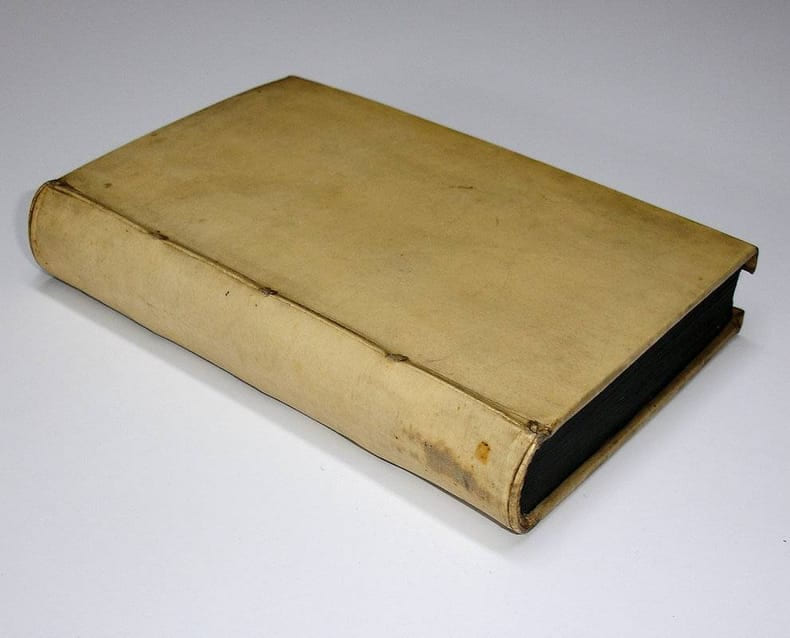
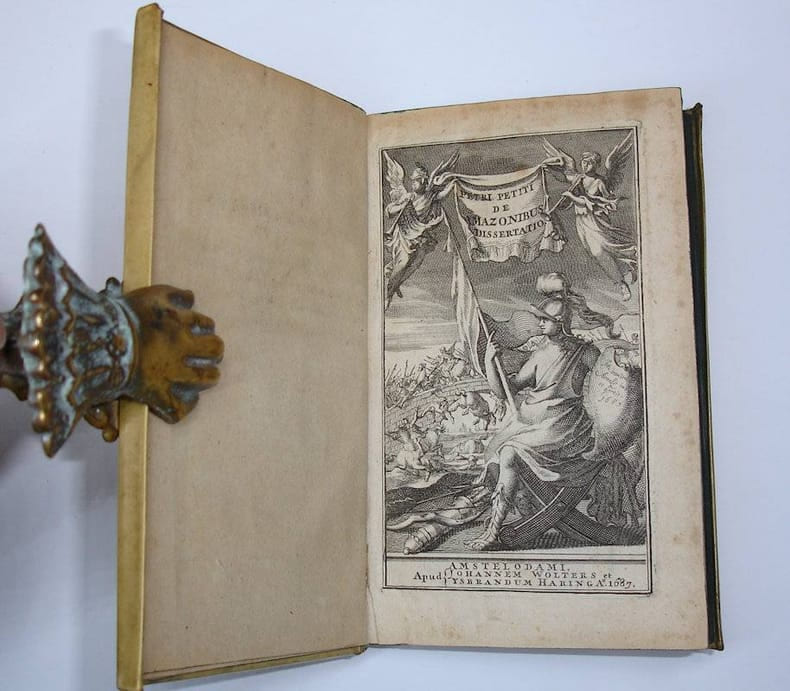
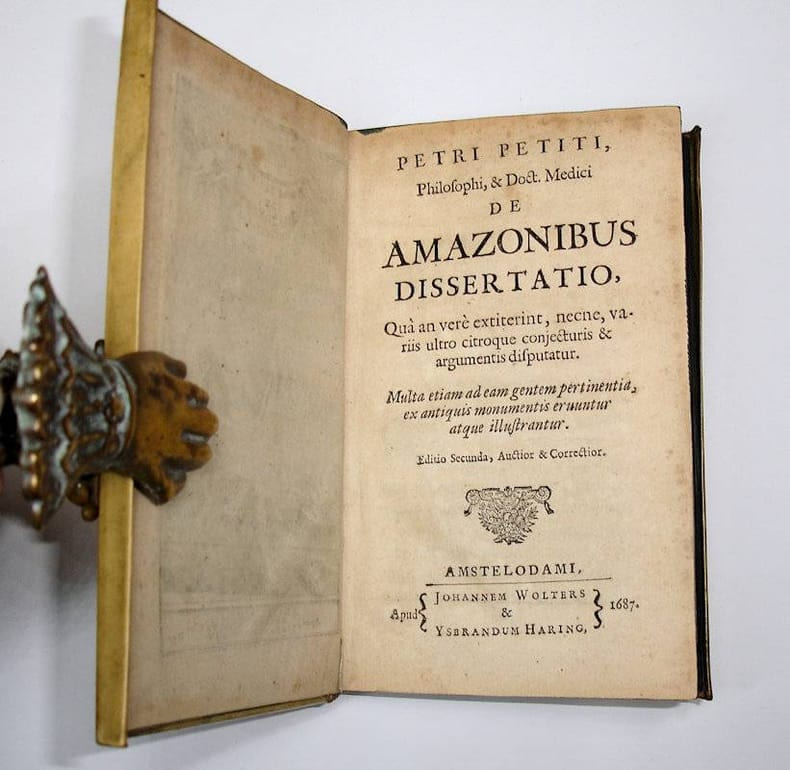
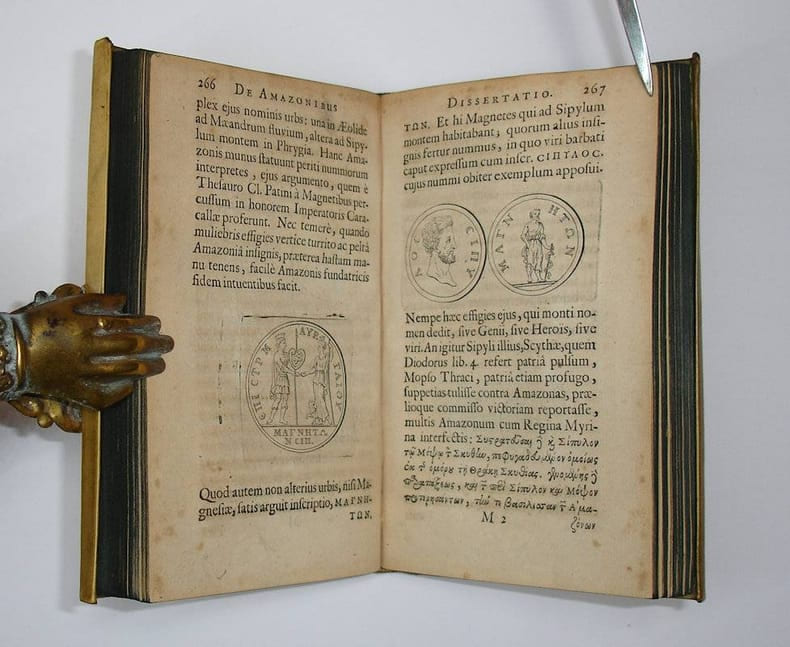
Amsterdam (Amstelodami), Apud Johannem Wolters & Ysbrandum Haring, 1687.
Reference : 120431
12mo. (XII),398,(3 addenda),(1 blank),(8 index) p., more than 50 engraved text illustations on 39 p., of which one is full page; folding map, frontispiece. Overlapping vellum 16.5 cm (Ref: STCN ppn 102316597; Brunet 4,1 529; Graesse 5,219) (Details: 5 thongs laced through the joints. The frontispiece, designed and executed by Joh. van den Aveele, depicts a seated Amazone, in the background a battle scene, obviously inspired by Rubens' painting 'Battle of the Amazons', or 'Amazonomachia'. The map, 24x18, depicts the Eastern Mediterranean) (Condition: Neat ink inscription on the front flyleaf, name on the front pastedown. Some gatherings yellowing, some at the end browning) (Note: Greek mythology situated the nation of the Amazons, a tribe of virile warrior-women, on the borders of the ancient world, somewhere along the Danube. Homer, for instance, tells that their queen Penthesilea came to the help Priamus after Hector's death, and that she was killed on the battlefield by Achilles. The heros Heracles campaigned against the Amazons to get their queen's girdle, and Plutarch tells how king Theseus was besieged by the Amazons, and how their queen Hippolyta came close to conquer Athens. Herodotus located the tribe in the land of the Sarmatae, or Sauromates on the Balkan. The Amazons, a female nation skilled in the masculine art of warfare, caught the fancy not only of Greek authors, but also of sculptors and painters. They were very popular in art from the 7th century B.C. The female warriors wore short tunics, sometimes Scythian trousers, and often showed one breast. After the Renaissance the epithet 'Amazon' designated a woman on horseback, and was usually offered as a compliment. Jeanne d'Arc fought like an Amazon, and as proof of military might the Flemish painter Rubens painted Maria de Medici in the guise of 'Minerva Victrix', her right breast bared. The female military prowess however was also considered to pose a threat to civilization. In Germany some protestant demonologists drew a link between Amazons, witches and witchcraft. There was however no consensus in modern Europe as to the historical existence of the Amazons. There were reports of Amazon societies in the New World, others maintained that because Hippocrates, a most reliable source, spoke of them, the story of Amazons could not be mere legend. In his 'De Amazonibus dissertatio' Pierre Petit, or Petrus Petitus, tried to prove with the help of the reports of ancient historians, of old coins, medals, reliefs and monuments, that the warrior-women of Greek myth really existed in antiquity, but that the 'Amazons were never a nation of self-sufficient women. Petit points out (correctly) that although Hippocrates describes the Amazons on horseback, wielding arms, and killing men, he also characterizes them as the wives of the Sauromates. In the late 17th century, improved philology gave rise to skepticism with regard to the historical existence of a tribe composed exclusively of warring woman, another skeptical current, which Petit traces back to the Greek geographer Strabo (ca. 58-25 B.C.), dismissed the Amazons as legend because of the impossible (male/female) inversion they presented'. (R.M. Wilkin, 'Women, Imagination and the Search for Truth in Early Modern France', Aldershot 2008, p. 48) To the 20th century the Amazons have become a topic of feminist studies, subject of Broadway productions, inspriration for television series and the game industry. The French scholar Pierre Petit, 1617-1687, published on medical subjects, e.g. on blood transfusion, canibalism, the history of tears through the ages, and on some classical authors. His 'De Amazonibus dissertatio' was first published in 1685 by the Parisian printer Cramoisy. A French translation was published in 1718 in Amsterdam) (Provenance: On the front pastedown: 'M. Johannes Sartorius'. This Sartorius also wrote on the front flyleaf: 'Petrus Petit, de Amazonibus scripsit tanta diligentia, quantam expectari fas erat a doctissimo viro, qui nihil quod in hisce nummis ad Historiam, vel ad Geographiam pertineret, inexplanatum relinquere voluit'. The source of this quote has been added: 'Anselmus Banduri in Bibliotheca Nummaria, p. 57'. This work was published in Hamburg in 1719. The owner probably was M(agister) Johannes Sartorius, 'Polyhistor und Schulmann', 1656-1729. He took his Magister degree in 1678 at the University of Wittenberg, and was appointed Professor at the Gymnasium in Thorn. In 1699 he became Rector of the Gymnasium in Elbing. He left in 1704 for a professorship 'der Poesie und Beredtsamkeit' at the academic Gymnasium in Danzig. (Allgemeine Deutsche Biographie 30 (1890), p. 388) (Collation: pi2, *4; A-P12, Q10, R12 (leaf R11 verso blank, minus blank leaf) chiR12), R4) (Photographs on request)
Bookseller's contact details
Antiquariaat Fragmenta Selecta
+31 20 418 55 65
Payment mode

Sale conditions
Terms of Sale All items offered are subject to prior sale. Your order will be final after you have received our confirmation, with a specification of the availability of the items and the shipping costs. All books are complete and in good antiquarian condition, unless otherwise described. Prices are in EURO. Postage and insurance are not included. Postage will be calculated at cost (no extra charges). Returns Books may be returned within 14 days of receipt, if returned in the same condition as sent, and packed, shipped and insured as received (please always notify us). We will refund the shipping costs of a return shipment only if our descriptions were not correct. How to pay Pre-payment is necessary for new customers. Our order confirmation will provide detailed information and a specification of the shipping costs. Customers who are known to us and libraries will be invoiced as usual. We accept Visa and Mastercard. You can submit your card information through our SECURE PAYMENT FORM. PayPal: we will send you a personal link to the PayPal website. Banktransfers: payment can be made into our bank account in The Netherlands.

