 Write to the booksellers
LIPSIUS,J.
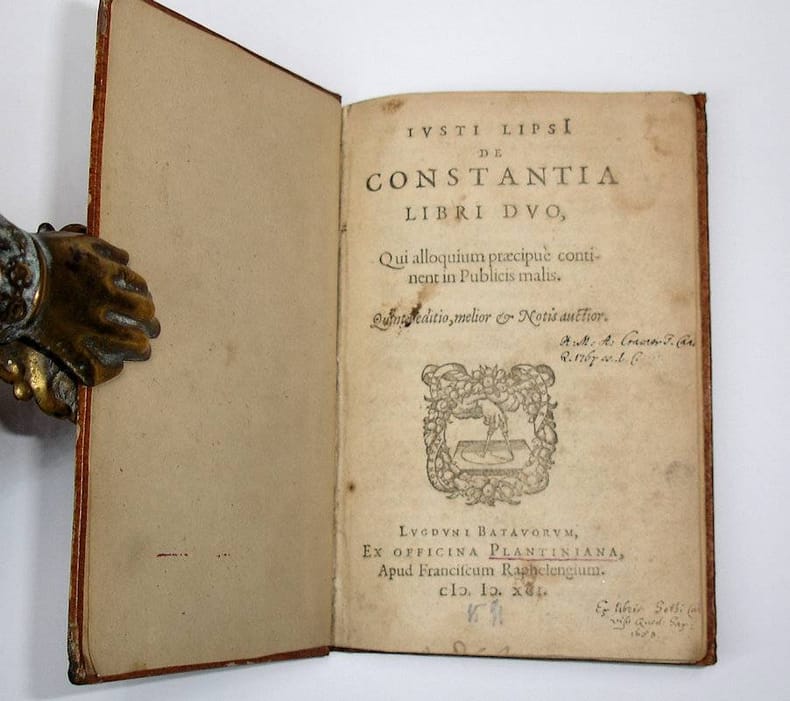
Iusti Lipsii De constantia libri duo. Qui alloquium praecipue continent in publicis malis. Quinta editio, melior & notis auctior.
Leiden (Lugduni Batavorum), Ex officina Plantiniana, apud Franciscum Raphelengium, 1591.
Reference : 120430
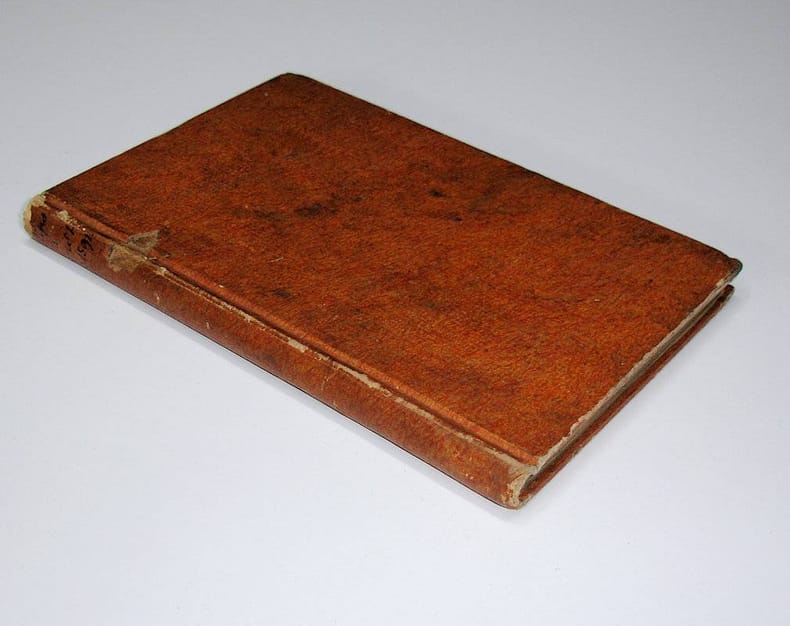
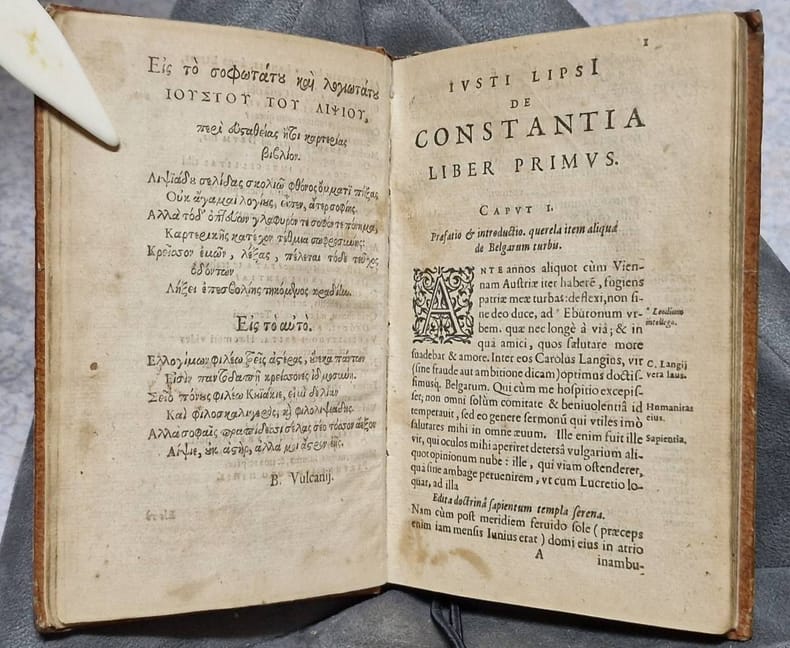
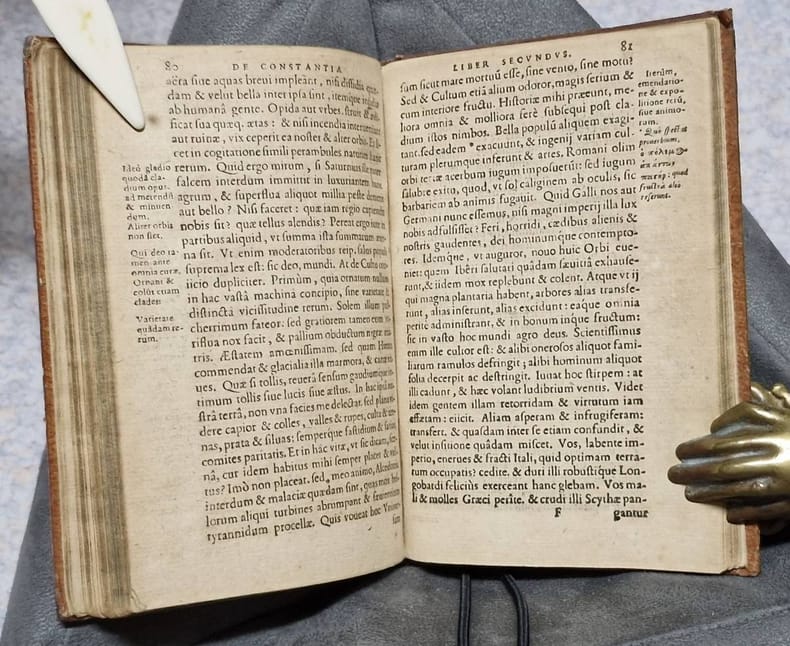
8vo. (XVI),119,(8),(1 blank) p. 18th century boards. 16 cm. 'Lipsius' De Constantia (1584) was a perfect answer to the sorrows of his time'. (Ref: STCN ppn 114587760; USTC 423043; cf. Brunet 3,1093; cf. Graesse 4,220) (Details: Plantin's woodcut printer's device on the title. The preliminaries contain a dedication to the council of Antwerp, and a laudatory poem by Janus Dousa on Lipsius. The last leaf of the preliminary pages is a cancel; on the verso of this cancel is a poem in Greek by B. Vulcanius. The index at the end is preceded by a one page prayer by Lipsius to thank God for the recovery of a long illness when he was 32) (Condition: Binding worn, especially on the extremes. Head of the spine chafed. Back superficially damaged. 2 old ownership entries on the title. Title soiled. Paper yellowing, some foxing) (Note: Justus Lipsius, 1547-1606, the greatest Latin scholar of his time in the Netherlands, came in 1579 to the recently founded University of Leiden (1575) to teach Latin. He resided there with great distinction as honorary Professor of History from 1579 till 1591. These were the years of his greatest productivity. It was during this time that he prepared his Seneca, and perfected, in successive editions, his Tacitus, and brought out a series of other works. Some were pure scholarship, some were collections from classical authors, and others were of general interest. Lipsius' greatest strength lay in textual criticism and exegesis. 'His masterpiece in this respect was his Tacitus, of which 2 editions appeared in his life-time.' (J.E. Sandys, History of Classical Scholarship, N.Y., 1964, vol. 2, p. 303). Lipsius edited only Latin prose writers. Lipsius wrote a number of works which were to revive the philosophy of ancient Stoicism in a form that was acceptable to Christianity. The earliest and most famous of these is De Constantia in publicis malis (On constancy in times of public calamity), first published Leiden/Antwerpen 1584. Twenty years later (1604) Lipsius returned to this subject in a manual Manuductio ad Stoicam Philosophiam. His form of Stoicism created the intellectual movement of Neostoicism, and had a direct influence on many contemporary, seventeenth and eighteenth-century authors, among whom Montesquieu, Bossuet and Francis Bacon. Lipsius published his De Constantia in the first decades of the Eighty Year's War, 1568-1648, the Dutch war of independence, a bloody political and religious rebellion of the United Provinces of the Netherlands against the king of Spain Philip II, the sovereign of The Netherlands. After 1591, the year of this 5th edition, Lipsius ate his words, and sided with the Spaniards. King Philip nominated him even Historiographus Regius. In the ultima edition of 1599 Lipsius suppressed in a chapter in the second book (II,7) some lines directed against the Spanish warlord the duke of Alva. De Constantia is a fictional dialogue, and describes a two day meeting held in June 1571 between Lipsius and his host Karel de Langhe, latinized as Carolus Langius, canon of the Saint-Lambert cathedral. Lipsius tells in the beginning of the dialogue that he is on the run for the turmoil in war-stricken Flanders (fugiens patriae meae (Leuven) turbas). Langius explains Lipsius that the unrest caused by war is a 'morbus animi', and that a sick soul, (caput 2) can only be cured by wisdom. (remedia a Sapientia & Constantia petendum, page 5) Constantia is defined as 'rectum et immotum animi robur, non elati externis, aut fortuitis, non depressi'. (p. 8) One should follow the Recta Ratio, which leads to Constantia and avoid Opinio, which leads to Levitas. (caput 5) De Constantia had a great impact. Hear what David Chytraeus, a professor at Rostock, advised his students: 'Kauffets ihr Studenten und lesets, dann in tausent Jahren ist dergleichen Buch in Philosophicis nicht geschrieben oder gesehen worden'. (A.M. van de Bilt, Lipsius' De constantia en Seneca, Nijmegen/Utrecht 1946, p. 40) Later scholars were less enthousiast, and spoke of the work as a series of commonplaces and derivations from Seneca and Epictetus. Others praised Lipsius' endeavour to reach a compromise between Stoic philosophy and Christian faith. De Constantia went between 1584 and 1700 through more than 50 editions, published in 22 cities in West and Central Europe, and was translated into Dutch, French, German, English, Spanish, Italian and Polish) (Provenance: Provenance Quedlinburg. On the title: 'Ex libris Sethi Cal/ visii Qued. Sax. 1658'. This is Sethus Calvisius (Kallwitz), born Leipzig 1596, died Quedlinburg 1663. He was an evangelical theologist, from 1637 'Oberpfarrer an der Nikolaikirche in Quedlinburg'. (See Pfarrerbuch der Kirchenprovinz Sachsen, Bd. 2 (2004), p. 152) The second owner's inscription: 'H.M.A. Cramer ... Q. 1767 et ...' This is Heinrich Matthias August Cramer, 1745-1801, pastor in Quedlinburg, who translated a book on the New Testament into German (Halle 1776), and is the author of several theological works. Q. of course stands for Quedlinburg. He might have found inspiration in 'De Constantia' for his book 'Unterhaltungen zur Befördering der häuslichen Glückseligkeit', (Dessau 1782)) (Collation: *8, A-H8 (leaf H8 verso blank)) (Photographs on request)
Bookseller's contact details
Antiquariaat Fragmenta Selecta
+31 20 418 55 65
Payment mode

Sale conditions
Terms of Sale All items offered are subject to prior sale. Your order will be final after you have received our confirmation, with a specification of the availability of the items and the shipping costs. All books are complete and in good antiquarian condition, unless otherwise described. Prices are in EURO. Postage and insurance are not included. Postage will be calculated at cost (no extra charges). Returns Books may be returned within 14 days of receipt, if returned in the same condition as sent, and packed, shipped and insured as received (please always notify us). We will refund the shipping costs of a return shipment only if our descriptions were not correct. How to pay Pre-payment is necessary for new customers. Our order confirmation will provide detailed information and a specification of the shipping costs. Customers who are known to us and libraries will be invoiced as usual. We accept Visa and Mastercard. You can submit your card information through our SECURE PAYMENT FORM. PayPal: we will send you a personal link to the PayPal website. Banktransfers: payment can be made into our bank account in The Netherlands.

