 Write to the booksellers
VELLEIUS PATERCULUS.
C. Velleii Paterculi quae supersunt. Nicolaus Heinsius Dan. F. recensuit et castigationum libellum addidit.
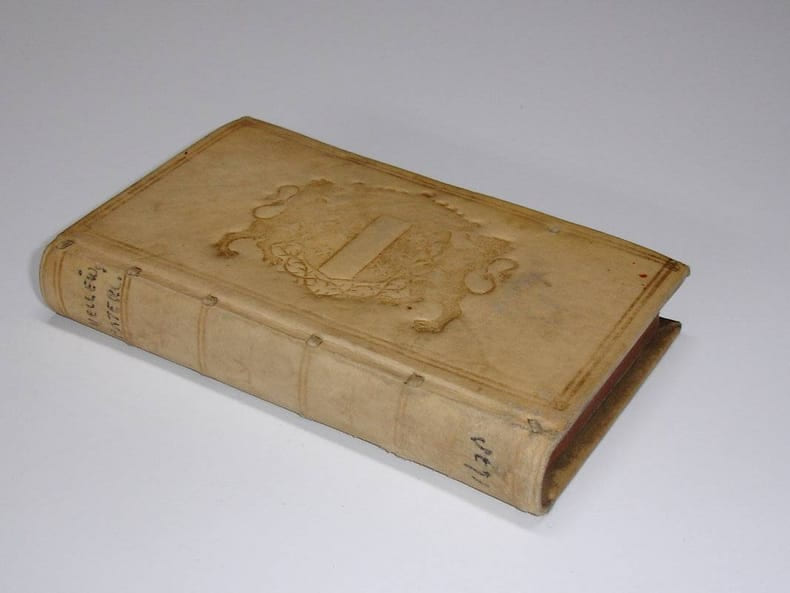
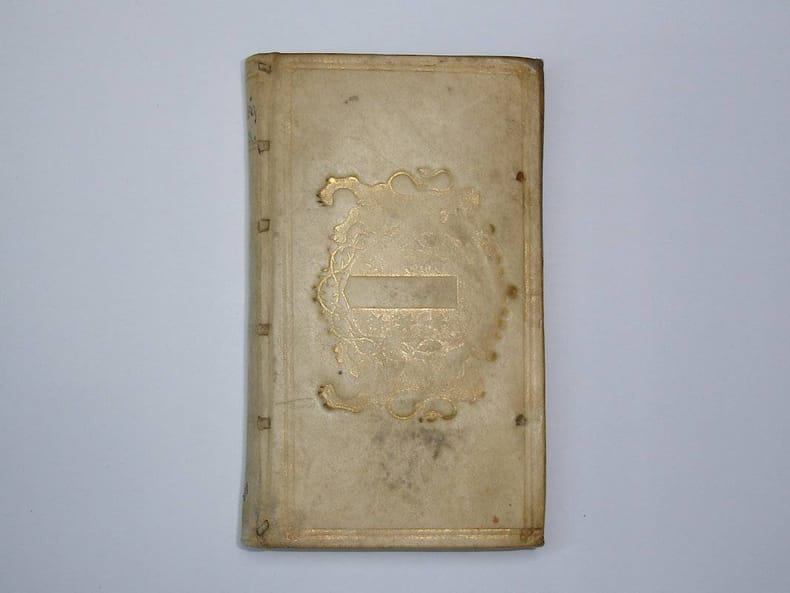
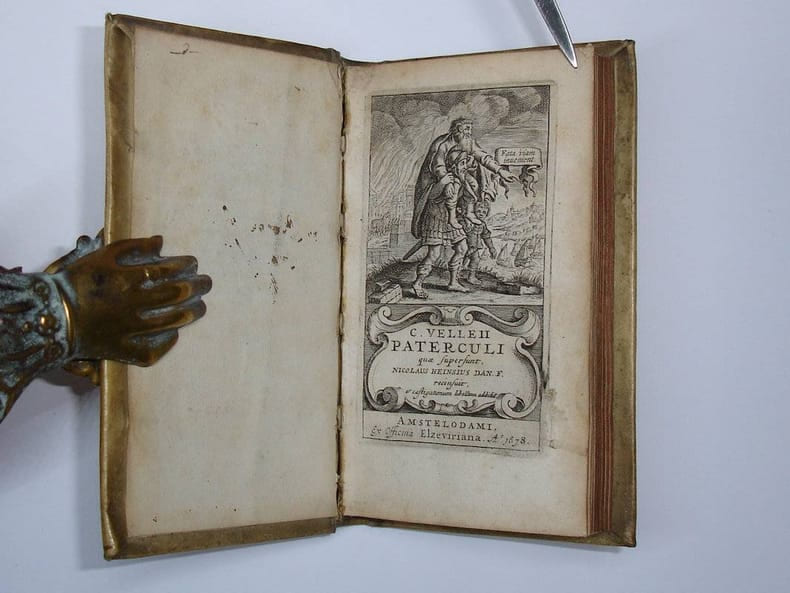
Amsterdam (Amstelodami), Ex officina Elzeviriana, 1678.
Reference : 120414
12mo. (XXIV),115,(29 index);108,(12 addenda & index) p., engraved title. Vellum 14 cm Prize copy Gouda (Ref: Willems 1550: 'Des 5 éditions de Paterculus données par les Elzevier, celle-ci est la plus estimée. Elle présente un texte nouveau revu par N. Heinsius'; Berghman 2110; Rahir 1686; Schweiger 2,1128; Brunet 4,430: 'édition préférable'; Fabricius/Ernesti 2,20; Graesse 5,162; Ebert 23478; Prize copy: Spoelder Gouda 2, p. 568) (Details: 6 thongs laced through the joints. Back ruled gilt. Boards with double fillet gilt borders. Gilt coat of arms in the centre of the boards. Engraved title, it depicts Aeneas with his father Anchises on his shoulders, and holding the hand of his son Ascanius; Anchises shows the way, he points at the motto: Fata viam invenient, a quote from Vergil's Aeneid Book X, verse 113; in the background burns Troy. The first part, 115 pages contains the text, the second part, 108 pages, the notes of Heinsius) (Condition: Without the prize. Vellum age-tanned. Gilt fading. Ownership entry on the front pastedown. Inscription on the front flyleaf. Right margin of the title slightly soiled. Occasional pencil stripes in the Latin text) (Note: The work of the Roman historian Velleius Paterculus, ca. 19 BC - after 30 AD, commonly called Historia Romana, is a valuable source for the reigns of the Roman emperors Augustus and Tiberius. It is the only history written by a witness of their time. Paterculus, who served 'under Tiberius in many of his most important campaigns, seems to have conceived an unbounded admiration for him and the whole imperial family, in whose men he could see nothing but sublime virtues, while the enemies were compact of every possible vice'. (H.J. Rose, 'A handbook of Latin literature, London, 1967, p. 355) Velleius' adulatory type of history was however condemned by the later historian Tacitus, who ignores him. The Historia Romana, consists of 2 books. The beginning of the first is lost, from the founding of Rome to the battle of Pydna in 168 BC, in which the Romans defeated the Macedonian kingdom. What remains of book one ends with the fall of Carthago in 146 B.C. Book 2 is of greater importance. 'Book 2, covering the period 146 BC to AD 30, becomes more detailed as it approaches the author's own day, doubtless because, as he tells us, he projected a fuller history from the Civil War onwards.' (OCD 2nd edition p. 1111/12). Velleius' style is less polished, but we are to remember that he was more a soldier than a rhetorician or scholar. Still, long time the work of Velleius was considered to be a kind of rhetorical patchwork produced by an opportunistic court historian. However 'erst seit kurzem arbeitet man intensiv an einer Neubewertung des Velleius, und seines Oeuvre als eines 'interpretationsfähigen und interpretationsbedürftigen Textes sui generis'. (Neue Pauly, 12/1, 1170/71) The Dutch neolatin poet and classical scholar Nicolaas Heinsius, 1620-1681, is to be ranked, in the opinion of the Dutch Latinist Petrus Burman, among the best interpreters of this historian. David Ruhnkenius however, who allowed Heinsius 'every praise as an editor of the Latin poets, thinks him greatly deficient' in his edition of Velleius. (Dibdin) The suggestions, notes and emendations of Heinsius are frequently discussed in the normative Cambridge edition of Velleius Paterculus of A.J. Woodman, who observes that Velleius was certainly not a panegyrist, but that modern historians sided with Tacitus, and have 'invariably tended to accept the criteria which Tacitus laid down for judging the early empire and its rulers. There is no reason why these should be the only valid criteria. The writing of history is an interpretation of various items of evidence: Velleius' own lifetime coincided with the period which he covers in the Tiberian narrative, and it is almost always possible to corroborate from other ancient sources the statements which he makes concerning contemporary events. What objection can there be to an historian who recognised the benefits inherent in the imperial system, and who devoted his rhetorical skill to the production of a corresponding interpretation of events'. (A.J. Woodman, 'Velleius Paterculus, the Tiberian narrative', Cambridge 1983. p. 53, Cambridge Classical Texts and Commentaries 25)) (Provenance: On the front pastedown in a modern hand: 'G. Henderson, Essex Court, Temple'. Essex Court lies in the Temple, an area of central London, in the vicinity of Temple Church. Henderson, probably a jurist, also made the inscription on the front flyleaf. On the front pastedown also an older name: 'Vad: Platii Pigotiani e dono S. fratris 1877'. A mystery)(Collation: *12, A-L12) (Photographs on request)
Bookseller's contact details
Antiquariaat Fragmenta Selecta
+31 20 418 55 65
Payment mode

Sale conditions
Terms of Sale All items offered are subject to prior sale. Your order will be final after you have received our confirmation, with a specification of the availability of the items and the shipping costs. All books are complete and in good antiquarian condition, unless otherwise described. Prices are in EURO. Postage and insurance are not included. Postage will be calculated at cost (no extra charges). Returns Books may be returned within 14 days of receipt, if returned in the same condition as sent, and packed, shipped and insured as received (please always notify us). We will refund the shipping costs of a return shipment only if our descriptions were not correct. How to pay Pre-payment is necessary for new customers. Our order confirmation will provide detailed information and a specification of the shipping costs. Customers who are known to us and libraries will be invoiced as usual. We accept Visa and Mastercard. You can submit your card information through our SECURE PAYMENT FORM. PayPal: we will send you a personal link to the PayPal website. Banktransfers: payment can be made into our bank account in The Netherlands.

