 Write to the booksellers
HORATIUS.
Quinti Horatii Flacci Opera. Cum novo commentario ad modum Joannis Bond.
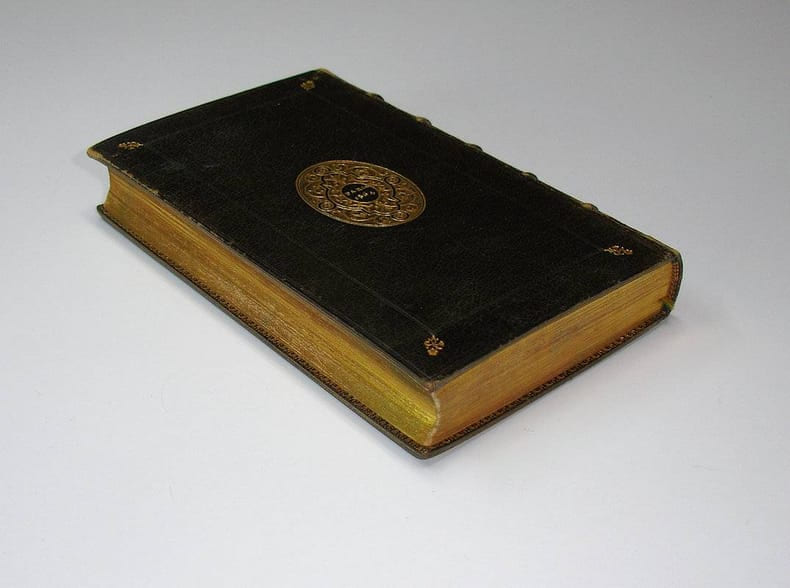
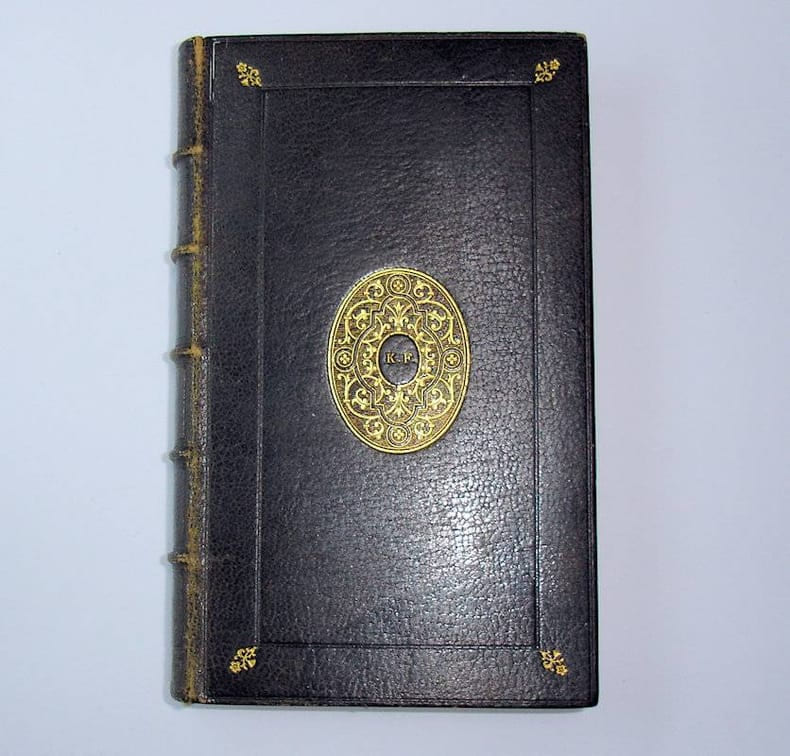
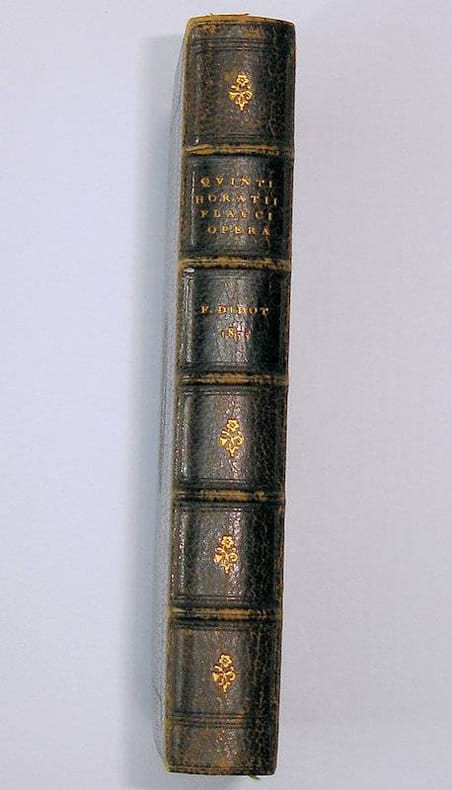
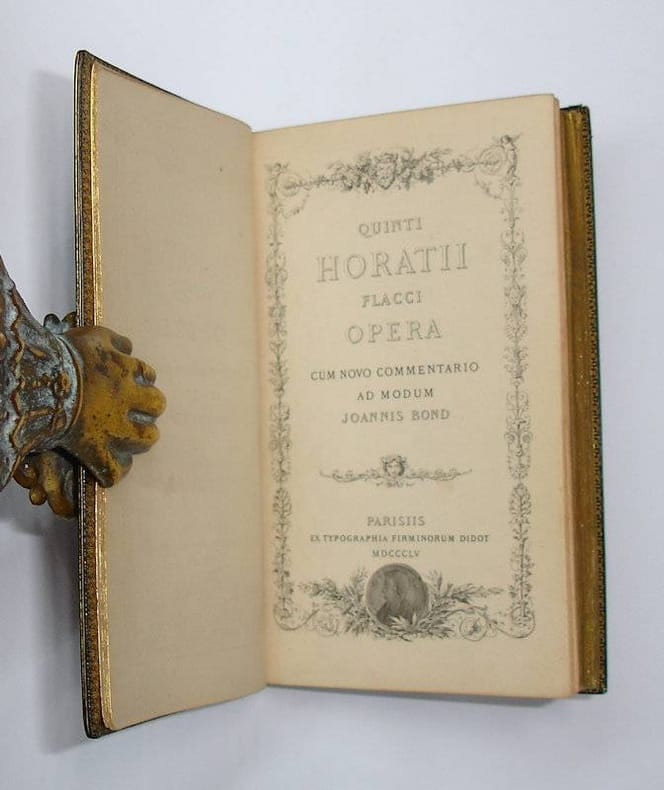
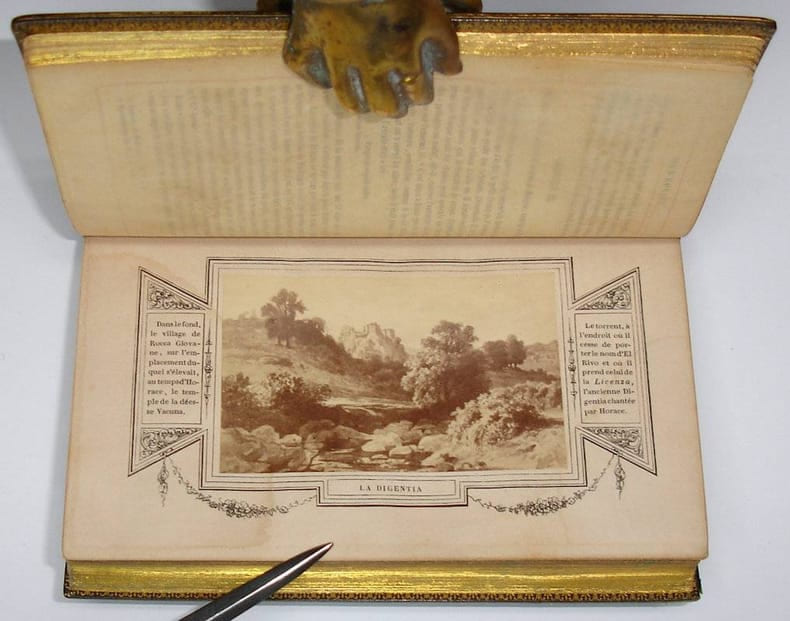
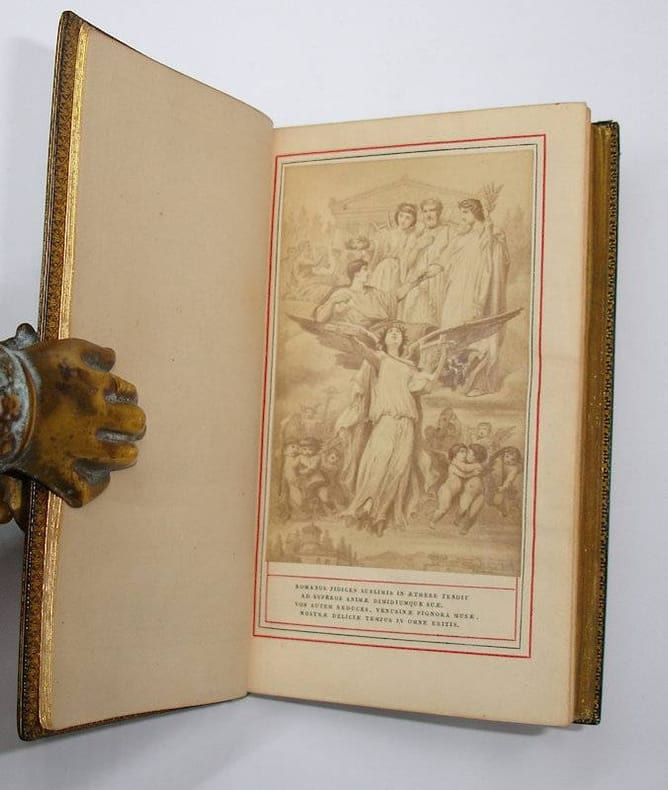
Paris (Parisiis), Ex typographia Firminorum Didot, 1855.
Reference : 120391
12mo. (VIII),46,299,(1 blank) p., including a frontispiece, engraved title, 6 photo-lithographs, 11 lithographed vignette headpieces, 2 double page maps. Brown morocco 14 cm 'Pour quelques exemplaires, la photographie, cette merveille de notre siècle, a reproduit les dessins mêmes de M. Barrias'. (Ref: Brunet 3,325; Graesse 3,357) (Details: Signed binding by the French bookbinder Lortic. Back with four raised bands, lettered, and with four gilt fleurons; gilt short title and imprint in the second and third compartment. Borders of the boards tooled in blind, with in the corners a gilt floral element. A fine gilt centerpiece on both boards. Gilt inside dentelles, edges gilt. Marbled endpapers. Engraved titlepage within floral borders. Photo-lithographed frontispiece made by the painter and illustrator Félix-Joseph Barrias, 6 full page photo-lithographs of Horatian sceneries painted by Jean-Achille Benouville, 11 lithographed vignette headpieces especially painted for this Didot edition by Barrias, 2 double page maps designed by the engineer Rosa. All pages have rubricated borders. Dated binding, 1864, signed by Lortic. The Database of bookbindings of the British Library shows 37 copies bound by Lortic) (Condition: Cover a bit worn at the extremes. Some almost invisible discolouring near the outer margin of the upper board. Bookplate on the front pastedown. The right lower corner is partly and very faintly dampstained) (Note: This book is of interest for several reasons, the binding is signed and dated, and foremost, it is one of the first works of a classical author which is illustrated with photographs. (The first book with photographs ever dates from 1844) In the preface to this work of Horace the publisher, Ambroise Firmin Didot, tells that 'pour quelques exemplaires, la photographie, cette merveille de notre siècle, a reproduit les dessins mêmes de M. Barrias'. (Au lecteur p. IV). These photographically reproduced copies of pictures were separately printed and then mounted onto blank pages, and they are protected by facing tissue guards. The pictures include a full-page frontispiece, 6 landscapes of places associated with Horace and 11 scenes from the daily life in ancient Rome at the beginning of each book. This must have been an expensive production method, for the firm Didot brought also cheaper copies on the market with engravings of the illustrations. In the preface Didot boasts about the excellence of this edition and about the brilliance of its typography. The Didot brothers wanted to equal the beauty of the the edition of Horace, published in 1676 by the Elzevier brothers, which was edited and commentated upon by Johannes Bond, (Willems 1517). John Bond, 1530-1612, was an English classical scholar, famous as editor and commentator of Horace. His work is incorporated in many following editions of Horace. Bond's text & commentary were, for this 1855 edition, updated by the French scholar F. Dübner. The paintings photographed were made by Félix-Joseph Barrias (1822-1907), an eminent French artist, who was a teacher of Edgar Degas, and who was very esteemed in his time, and by the wellknown landscape painter Jean-Achille Benouville) (Provenance: 'Austrian provenance': The first owner has done this chef-d'oeuvre of the Didot brothers justice, because he had it beautifully bound. The binding is signed by the Parisian master binder P.M. Lortic (1822-1892). Before the title has been added a leaf with a dedicatory text, printed in red & black: 'Oloris Venusiani opera/ Carolo Fidlero/ paris refert/ G. Comes ab Enzenberg'. The 'Olor Venusianus' (The swan of Venusia) is of course Horace, who was born in Venusia on the 8th of dec. 63. B.C. The book was donated by a 'Graf G. (Wilhelm?) Von Enzenberg' to one 'Karl Fidler' to equal a debt, service or gift. The gilt centerpiece on the boards has in its center the initials K.F. There is a Karl Fidler, from Gallicia, born 1818, died in Vienna in 1887, who was from 1849 till 1886 a high official of the Austrian Ministery of Internal Affairs. In 1873 Karl Fidler and one 'Graf Enzenberg, k.k. Ministerial-Concipis't were members of the 'Anthropologischen Gesellschaft in Wien'. Fidler is indicated here as 'Fidler, Carl Ritter v., Sectionschef im k.k. Ministerium für Cultus und Unttericht'. In 1886, one year before his death, he was succeeded as 'Sections-Chef' by Dr. Arthur Graf von Enzenberg. A coincidence? On the front pastedown the bookplate of 'Wilhelm Jerusalem'. This is most probably Wilhelm Jerusalem, an Austrian Jewish philosopher and pedagogue, born in 1854, who died in 1923 in Vienna. 'He studied classical philosophy at the University of Prague and did a doctorate on the theme The Inscription of Sestos and Polybios. Until 1887 he was a teacher at grammar schools in Prague and Nikolsburg. In 1888 he became a member of the staff of teachers at the grammar school 'k.k. Staatsgymnasium im VIII. Bezirk' in Vienna. In 1891 he was an outside lecturer (Privatdozent) at the University of Vienna. (...) After World War I he became an associate professor (außerordentlicher Professor) of philosophy and educational theory at the University of Vienna . In 1919 he became one of the teachers of the 'Schönbrunner Schule' (Schönbrunn School) which came about after the Vice Mayor of Vienna Max Winter had obtained a considerable part of the Viennese Schönbrunn Palace to be used for the advancement of the education of young women, and a small number men, to become educators and teachers. In 1923, Jerusalem became a Professor of the University of Vienna. He died of a heart attack. In 1954 a street, the Jerusalemgasse, in the 21. 'Bezirk' of Vienna was named after him. (Source Wikipedia English & German)
Bookseller's contact details
Antiquariaat Fragmenta Selecta
+31 20 418 55 65
Payment mode

Sale conditions
Terms of Sale All items offered are subject to prior sale. Your order will be final after you have received our confirmation, with a specification of the availability of the items and the shipping costs. All books are complete and in good antiquarian condition, unless otherwise described. Prices are in EURO. Postage and insurance are not included. Postage will be calculated at cost (no extra charges). Returns Books may be returned within 14 days of receipt, if returned in the same condition as sent, and packed, shipped and insured as received (please always notify us). We will refund the shipping costs of a return shipment only if our descriptions were not correct. How to pay Pre-payment is necessary for new customers. Our order confirmation will provide detailed information and a specification of the shipping costs. Customers who are known to us and libraries will be invoiced as usual. We accept Visa and Mastercard. You can submit your card information through our SECURE PAYMENT FORM. PayPal: we will send you a personal link to the PayPal website. Banktransfers: payment can be made into our bank account in The Netherlands.
5 book(s) with the same title
Quinti Horatii Flacci Opera cum novo commentario ad modum Joannis Bond, 1855, livre illustré par des photographies collées
1855 Reliure en plein maroquin, dos à cinq nerfs ornés de fleurons, titre et nom de l'éditeur F. Didot daté 1855. Plein maroquin à vanne, dos orné d'un double listel à froid frappé de fleurons d'angle à l'or et d'un cartouche central à l'or à l'imitation des médaillons renaissance. Importante et fine dentelle intérieure signée dans l'entrefilet LORTIC, signature répétée sur la première contre-garde, doré sur tranche. (1) faux-titre, (1) titre, Quinti Horatii Flacci Opera cum novo commentario ad modum Joannis BOND. Page de titre encadrée d'une composition gravée en encadrement du texte et de X photographies collées sur papier albuminé. Une prouesse typographique sortie des presses de Firmin Didot en 1855 précédée d'une adresse aux lecteurs dans laquelle Ambroise Firmin Didot fait le genèse de cette édition. Cette nouvelle édition des Poésies d'Horace s'appuie sur l'édition donnée par les Elzévirs en 1676. Améliorée quant au texte et au commentaire par les travaux de Jean Bond parut à Londres en 1606. Un projet longuement mûri car F. Didot signale qu'il fut un des projets de son enfance. Il avait à cet effet en 1805, fait graver les caractères destinés à cette entreprise, mais la vie, les révolutions reportèrent l'exécution du projet jusqu'à ce jour. Après une savante présentation et différentes versions des poésies d'Horace Simon de Colines, Les Aldes et Robert Estienne, F. Didot s'emploie à citer toutes les améliorations que les érudits au fil des siècles apportèrent à cette oeuvre tant en France qu'à l'étranger. Pour parfaire son travail "au mérite littéraire de cette édition, nous avons voulu, mon frère et moi, joindre quelques améliorations" ainsi parait pour la première fois la Vie d'Horace. Ses nouvelles recherches ont incité l'éditeur à dépêcher un dessinateur sur les lieux même où vécu Horace. Le peintre Barrias a dessiné les ornements et pour quelques exemplaires "la photographie, cette merveille de notre siècle a reproduit les dessins même de Monsieur Barrias". Pour les exemplaires de tirage courant, ces dessins ont été gravés par un procédé galvanoplastique, c'est dire le désir de modernité que F. Didot voulut employer à cette édition précieuse.Enfin, le papier fut fabriqué spécialement pour cette édition extrêmement solide et à l'abri des piqûres ou pour la première en France le papier, au moyen d'une toile métallique elliptique est sortie illimitée dans sa longueur. Le soin extrême porté à cette édition portative des poésies d'Horace justifie l'intervention des l'un des plus prestigieux relieurs du Second Empire, Lortic. Marcelin LORTIC
Quinti Horatii Flacci Opera. Cum novo commentario ad modum Joannis Bond.
Horace, Quinti Horatii Flacci Opera. Cum novo commentario ad modum Joannis Bond. [Paris, Firmin Didot] Parisiis, Ex Typographia Firminorum Didot, 1855. In-16, [4]-XLVI-299p. Belle édition en petits caractères, exemplaire sur papier jonquille. Il y eut trois éditions différentes (voir Vicaire IV, 167-168), dont deux - dont la nôtre - avec les têtes de chapitres gravées sur bois par Huyot d'après les dessins de Barrias (et non photographiées). Notre exemplaire est donc un tirage avec le texte encadré d'un filet noir, avec les entêtes gravés sur bois. Vicaire en signale des exemplaires sur chine, papiers jaune, vert, vert d'eau et chamois. Notons que Didot mis un grand soin à cette édition et que la version avec les photographies, qui comporte - en plus - des hors-texte, est un des premiers livres illustrés par la photographie. Provenance : R de Nanteuil, avec une signature sur la couverture et la date 1871. On trouve un Roger de Nanteuil (1857-1951). Reliure signée Petit, successeur de Simier, demi-maroquin rouge à coins, dos à nerfs, tête dorée, couvertures muettes conservées (d'un jaune un peu plus intense). Un coin un peu écrasé. Exemplaire peu rogné (témoins encore visible en queue). Très bel exemplaire.


Quinti Horatii, Flacci Opera. Cum novo commentario ad modum Joannis Bond - Incunable de la photographie.
1855 Parisiis, ex typographia Firminorum Didot, 1855 (Paris, Firmin Didot). In 12 pleine percaline tabac,dos lisse titré,date en pied ,de LXVI (Vie d'Horace par Noël des Vergers, et gendre de F. Didot) + 299 pages + 1 plan de la villa d'Horace et des environs par Ross + 1 plan topographie de la vallée de la Digentia par Mr Pietro Rosa. Édition ornementé de 18 photographies contrecollées sur page d'explication avec feuillet de protection. Il s'agit là de la reproduction (en mieux d'après Didot) des Poésies d'Horace éditées en 1676 par les Elzeviers. Dans sa présentation au lecteur de 4 ff, Firmin Didot précise qu'il n'y a eu que quelques exemplaires avec photographies, d'autres reproduites en gravures par différents moyens. Notre exemplaire possède les plans en photographie.Rare.Cet ouvrage est l'un des premiers livres illustrés par la photographie.Incunable de la photographie. Très rare. Vicaire IV, 167-168. OCLC 458098787. Graesse III, 357. Brunet III, 325;
Tirage de luxe illustre en tout de 18 photographies reproduisant des vignettes de Barrias et des vues de Denouville. Il existe un tirage de cette edition, orne uniquement de vignettes gravees sur bois par Huyot, d’apres Barrias. Texte encadre de filets rouges.Un des premiers livres illustrés par la Photographie.Exemplaire avec fillets rouges d'encadrement de cette charmante édition illustrée de dix vignettes, deux plans et le frontispice photographiés, plus les six vues photographiées et contrecollées.Les photographies sont originales, tirées en sépia et contrecollées ce qui fait toute la valeur de l'illustration. Premier des 3 volumes de Didot illustrées par la photographie avec Virgile et Anacréon.Édition de luxe sur papier vélin réglée de filets rouges et contenant des photos. On trouve habituellement cette édition illustrée de gravures, mais certains exemplaires (dont le notre) furent illustrés de photos de tableaux collés dans le texte. À la p. iv de « Au Lecteur », Ambroise Firmin Didot déclare que: « c'est comme adieu à la typographie, si chère en tout temps à notre famille, que nous donnons cette édition d'Horace, » et mentionne: « Pour quelques exemplaires, la photographie, cette merveille de notre siècle, a reproduit les dessins mêmes de M. Barrias ». Cet ouvrage est l'un des premiers livres illustrés par la photographie.] Très rare. Vicaire IV, 167-168. OCLC 458098787. Graesse III, 357. Brunet III, 325; Bon exemplaire, malheureusement avec quelques rousseurs.Il faut croire que cette initiative editoriale a recu un bon echo de la part des clients et bibliophiles, puisqu’il a publie Horace en 1855, avec 18 photographies, ensuite Virgile en 1858 avec 27 photographies, puis Anacreon en 1864, avec 54 photographies ; manifestement, cet essai de livres illustres de photographies collees, a rencontre un echo dans les milieux erudits, Ambroise Firmin- Didot etait lui-meme un helleniste distingue. Il dirigeait la maison d’edition avec son frere Hyacinthe.- (Brunet, III, 325).The publisher famously substituted in some copies mounted photographs of the engravings, which he announces in the introduction: "For a few copies photography, that marvel of our century, reproduced the very drawings of Mr. Barrias.". Bulletin of the NYPL, Early Works Illustrated with Photographs, 11.History of photography ; Reel 93, no. 999 Remise de 20% pour toutes commandes supérieures à 200 €
Quinti Horatii Flacci Opera. Cum novo commentario ad modum Joannis Bond
Paris, Firmin Didot, In-12 (14,3 x 9,3 cm), XLVI,299 pp. Reliure plein chagrin rouge, médaillon or au centre des plats, dos à 5 nerfs orné de filets à froid, initiales A.G., double filet de coupes, dentelle intérieure, tête dorée (reliure de l'époque). Titre gravé, texte encadré d'un filet rouge, frontispice, 6 gravures photographiques, 11 vignettes d'en-tête gravées et 2 plans à double page localisant la maison d'Horace dans la vallée de la Digentia, dressés par Mr Pietro Rosa, Archuitecte (Quelques piqûres).
QUINTI HORATII FLACCI OPERA CUM NOVO COMMENTARIO AD MODUM JOANNIS BOND
FIRMIN DIDOT. 1855. In-18. Relié cuir dos-coins. Bon état, Couv. convenable, Dos satisfaisant, Intérieur frais. 299 pages. Nombreuses gravures en noir et blanc dans le texte et hors texte. Ouvrage en latin. Première de couverture brochée conservée. Tranche en-tête dorée. Titre, auteur, filet dorés sur le dos cuir. Petites épidermures.. . . . Classification Dewey : 470-Langues italiques. Latin
Classification Dewey : 470-Langues italiques. Latin

