 Write to the booksellers
ARISTOPHANES.
ARISTOPHANOUS KÔMÔiDIAI iá. Aristophanis comoediae undecim, graece & latine, cum indice paroemiarum selectiorum, et emendationibus virorum doctorum praecipue Josephi Scaligeri. Accesserunt praetera Fragmenta ejusdem ineditarum comoediarum Aristophanis.
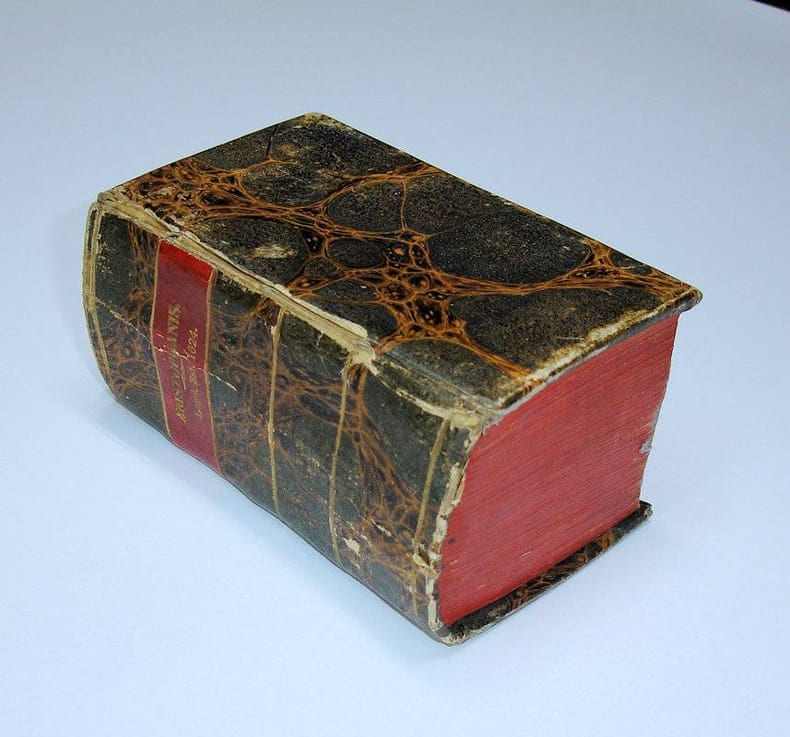
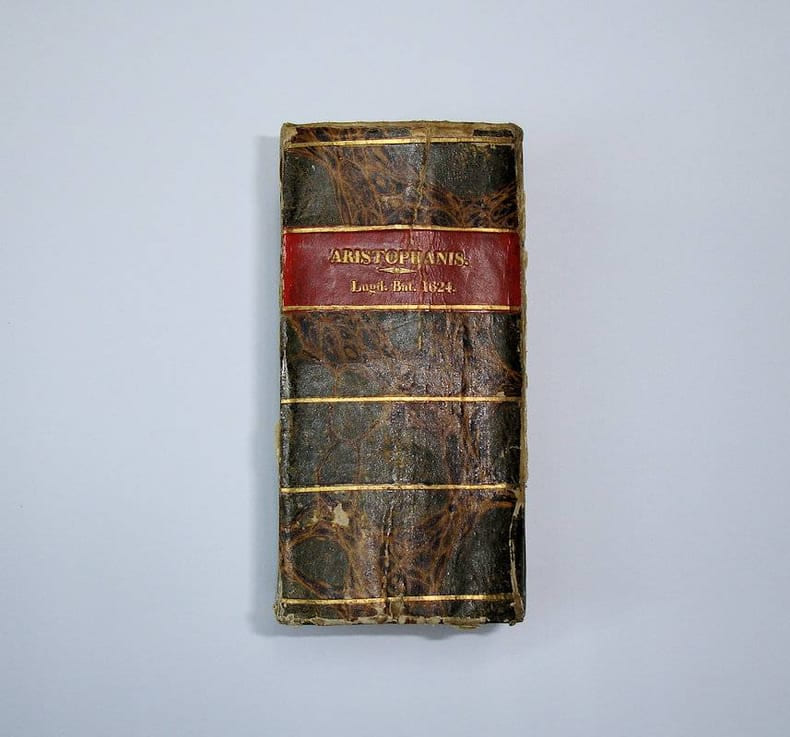
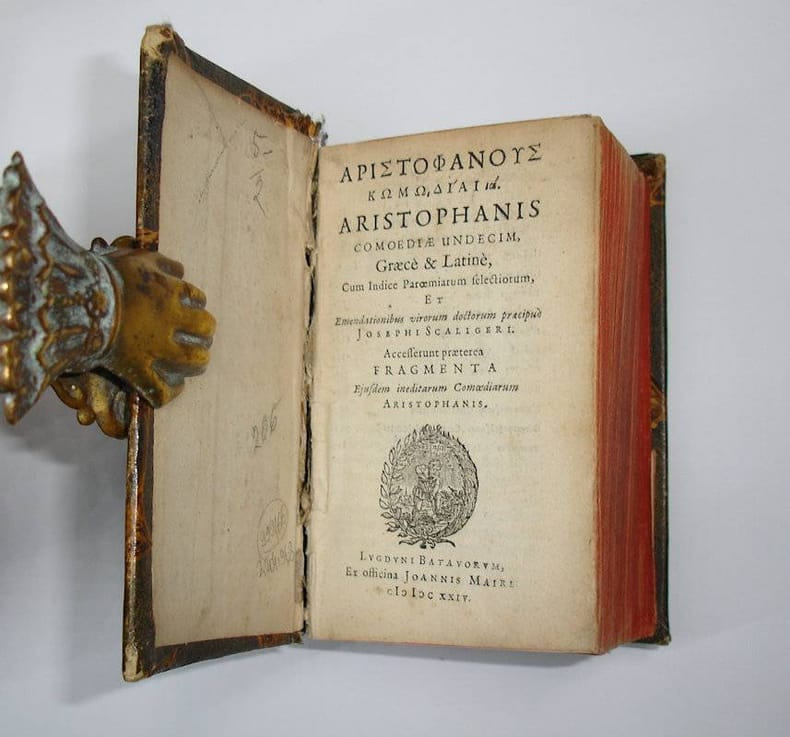
Leiden (Lugduni Batavorum), Ex officina Joannis Maire, 1624.
Reference : 120381
12mo. (XXIV),935,(1),56 (recte 60) p. Contemporary boards 14 cm (Ref: Breugelmans 1624,2, with a note on the date, he suggests a date after 1626; Hoffmann 1,254, a very elaborate description; Dibdin 1,299; Smitskamp, The Scaliger Collection 5; Brunet 1,453; Moss 1,94: 'a beautiful edition'; Graesse 1,207; Ebert 1090) (Details: Greek text and Latin translation. Binding: marbled paper over boards. Back ruled gilt, and with a red letter label. Edges dyed red. Printer's device on the title: a shoveling farmer, above his head the motto 'fac & spera'. 6 woodcut initials) (Condition: Binding worn at the extremities. Paper on both joints split. Back rubbed. Front flyleaf gone. Inner hinge a bit weak. The title leaf shows two small tears in the gutter) (Note: This edition has been praised by some critics; it contains a few short but useful notes by the famous French scholar Joseph Scaliger, 1540-1609. Of the Greek comic playwright Aristophanes, ca. 455-385 BC, born in the radical democracy of Athens, survive 11 plays. In a less free society his genre became obsolete in his own time, and was later replaced by the harmless plays of Menander. 'Aristophanes' comic mode- a dramatic free form with an almost improvisational feel, great poetic and linguistic inventiveness, highly topical satire (public figures being named and personated on stage), and obscenity, beyond almost any subsequent standard of acceptability'- never again became a major theatrical tradition'. (The classical tradition, Cambridge Mass., 2010, p. 69) This opinion seems outdated. Aristophanes sounds very much like modern satyric comedy. He seems to be the creator of his own genre. The 2nd edition of the OCD, 40 years older, sounds more sympathetic. 'He had a keen eye and ear for the absurd, and the pompous; his favoured media are parody, satire, and exaggeration to the point of phantasy, and his favourite targets are men prominent in politics, contemporary poets, musicians, scientists and philosophers, and (...) for a wide public'. (OCD 2nd ed. p. 113) Serious scholarly work on the text of Aristophanes begins in the 16th century, with Petrus Victorius, J.J. Scaliger and his friend Willem Canter. A new edition with Scaliger's notes was published posthumously in 1624 by Maire in Leiden, this edition. That Scaliger, a man with a sharp tongue, who had loads of ennemies, was an admirer of the comic playwright is no wonder. The following epigram can be read in the introduction to Scaliger's text of 1624: Ut templum Charites quod non labatur, haberent,/ invenere tuum pectus Aristophanes (The Graces have found for themselves a temple that would not fall down, your breast, Aristophanes). (p. *8 verso) The notes of Scaliger originate from two printed editions once owned by the great man himself, and furnished for publication by the Dutch scholar G.J. Vossius, 1577-1649 The Latin verse translations of the Plutus, Nubes, Ranae, Equites and Archanenses were made by Nicodemus Frischlinus, that of the Vespae, Pax and Lysistrata by Q, Septimius Florens Christianus, and a prose translation of the Aves, Ecclesiazusae and Thesmophoriae by Andreas Divus. (Typographus lectori p. *2 recto). After the Greek text of Aristophanes' plays starts at page 898 a 16 page section 'Index vocum et versuum proverbialium', followed by 18 pages with 'Notae excerptae ex variis lectionibus, emendationibus, et coniecturis virorum doctorum, ac potissimum duobus exemplaribus manu Josephi Scaligeri emendatis, e Bibliotheca Gerardi Vossii.' At the end we find the 56 (recte 60) page Fragments section, which was once edited by the Dutch scholar Willem Canter, or Gulielmus Canterus, with a preface of Andreas Schottus and now produced by the Dutch theologian Willem van der Codde, or Gulielmus Coddaeus, 1574- after 1625) (Collation: *12, A-2Q12, A-B12, C6 (Pagination irregular in the fragments part at the end, between the gatherings A and B. The page numbers jump back from 24 at the end of A to 21 at the beginning of B, else all correct) (Photographs on request)
Bookseller's contact details
Antiquariaat Fragmenta Selecta
+31 20 418 55 65
Payment mode

Sale conditions
Terms of Sale All items offered are subject to prior sale. Your order will be final after you have received our confirmation, with a specification of the availability of the items and the shipping costs. All books are complete and in good antiquarian condition, unless otherwise described. Prices are in EURO. Postage and insurance are not included. Postage will be calculated at cost (no extra charges). Returns Books may be returned within 14 days of receipt, if returned in the same condition as sent, and packed, shipped and insured as received (please always notify us). We will refund the shipping costs of a return shipment only if our descriptions were not correct. How to pay Pre-payment is necessary for new customers. Our order confirmation will provide detailed information and a specification of the shipping costs. Customers who are known to us and libraries will be invoiced as usual. We accept Visa and Mastercard. You can submit your card information through our SECURE PAYMENT FORM. PayPal: we will send you a personal link to the PayPal website. Banktransfers: payment can be made into our bank account in The Netherlands.

