 Write to the booksellers
ESTIENNE,H.
Apologie pour Hérodote, ou traité de la conformité des merveilles anciennes avec les modernes par Henri Estienne. Nouvelle Édition, faite sur la première, augmentée de tout ce que les posterieures ont de curieux, et de remarques par Mr. Le Duchat, avec une table alphabétique des matieres.
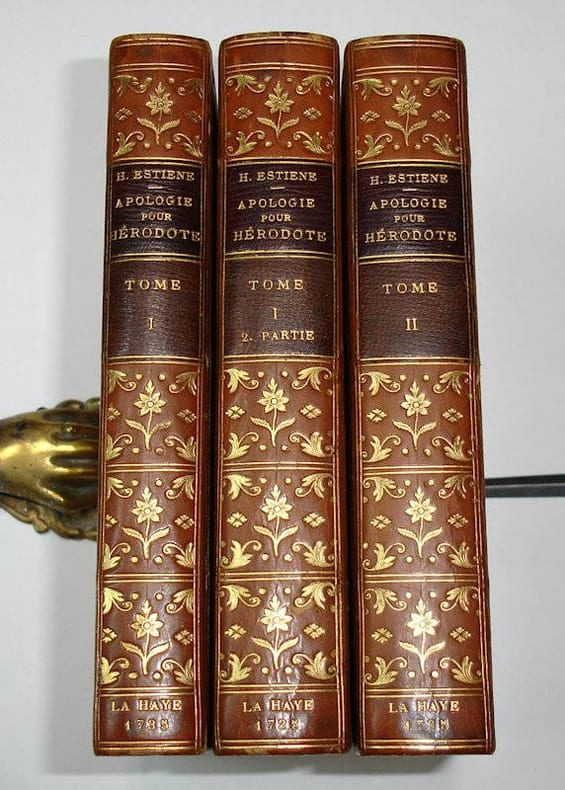
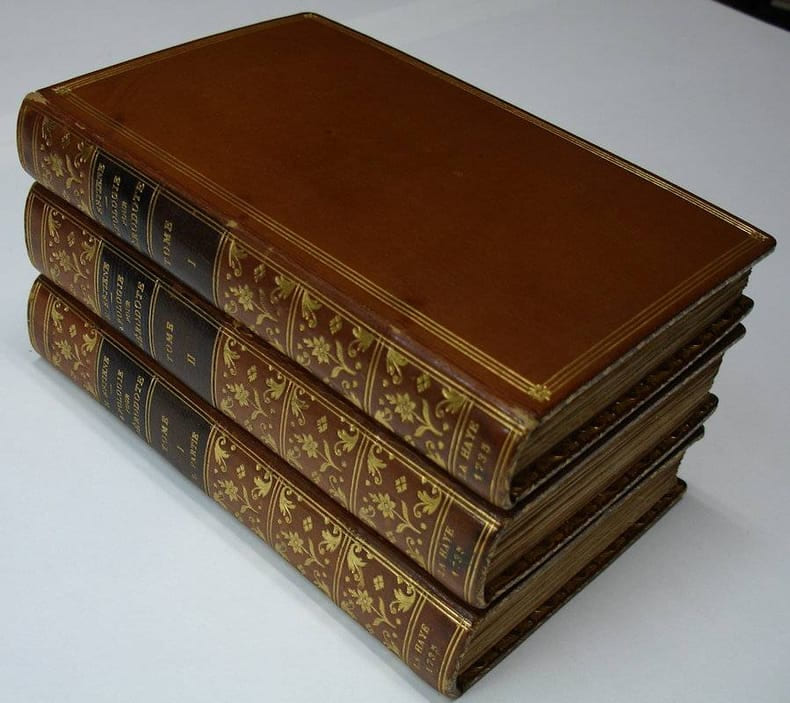
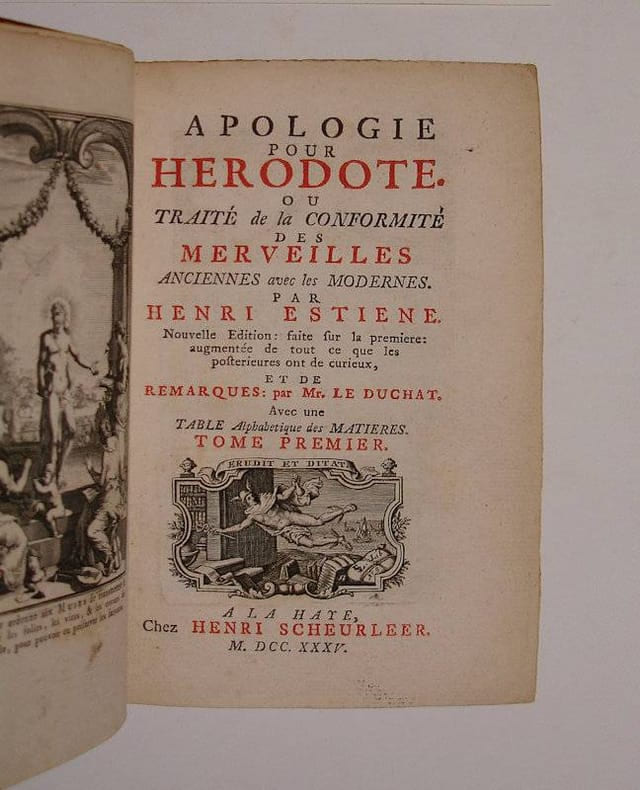
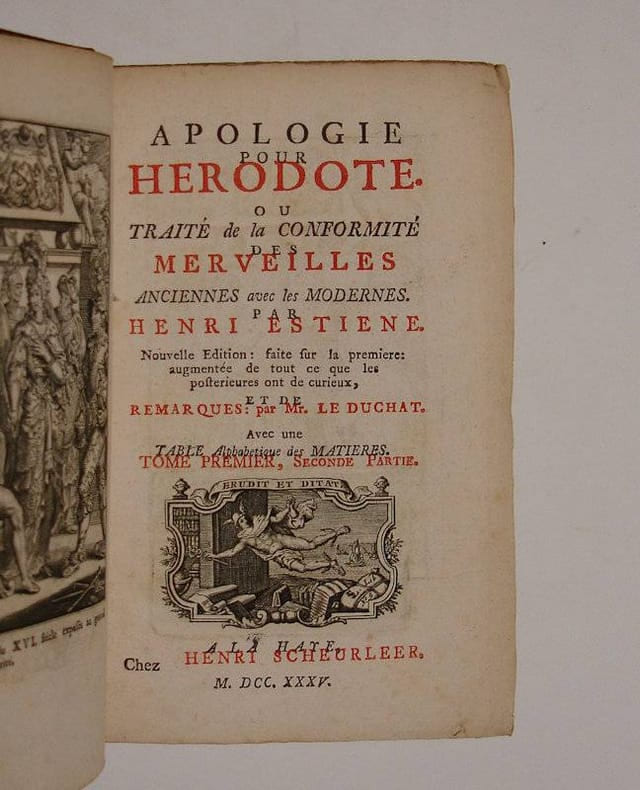
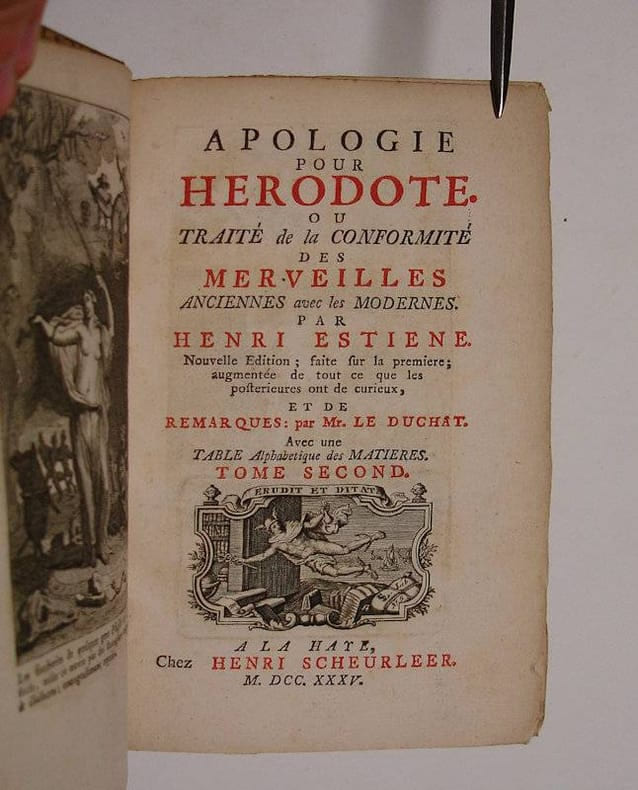
The Hague (à La Haye), Chez Henri Scheurleer, 1735.
Reference : 120327
8vo. 2 volumes in 3: (IV),XXXVI,200,(48 index); (IV), p. 201 - 624; (IV),(IV),434 p., 3 engraved frontispieces. 19th or 20th century calf. 17 cm 'Stephanus plays an important role in the reception of Herodotus' (Ref: STCN ppn 213119420; Hoffmann 2,242/43; Brunet 2,1077; Graesse 2,506; Ebert 6972: 'Unmutilated and enlarged edition with good observations'; Renouard p. 126/28, who calls this 1735 edition 'bien imprimée' and 'la seule complète') (Details: Tasteful binding in antique style: backs elaborately gilt, and with one brown and one dark red morocco shield on each back. Boards with gilt triple fillet borders. Gilt inner dentelles, Edges of the boards also gilt. Marbled endpapers. The three frontispieces are satirical against the catholic church. Titles in red & black. The engraved printer's marks depict a flying Mercurius, with a helmet and a caduceus, the motto reads: 'Erudit et ditat'. Edges of the bookblock uncut) (Condition: Nice copy. Some slight wear to the bindings) (Note: In 1566 the French scholar/printer Henri Estienne, latinized as Henricus Stephanus, ca. 1530-1598, published a revised Latin translation of Herodotus' 'Historiae' made by Lorenzo Valla. In the introduction, 'Apologia pro Herodoto', Estienne tried to defend the veracity of Herodotus as a historian. Valla's translation was first published in 1474. 1502 saw the 'editio princeps' of the Greek text. In the same time the work of the ancient detractors and critics of this Greek historian came on the market, especially Plutarch's 'De Herodoti malignitate' (1509), but also works of Aristotle (Herodotus is ignorant), Flavius Josephus (he is a liar), Strabo (he likes to tell simple stories), Lucianus (does not tell the truth), Gellius (he invents stories). The supporters of Herodotus were in the minority. We only mention Cicero, who called him 'Pater historiae'. So, after Henri Estienne had published this revised Latin translation of Valla, he decided to try his talents as a critic on Herodotus, and wrote in the historian's defence in French his 'Apologie pour Hérodote', more or less to accompany the revised Latin translation of Valla. With the above mentioned 'Apologia pro Herodoto', a treatise in Latin full of philological niceties, and quotations from Greek and Roman authors, to be read by a humanist forum, and his 'Apologie pour Hérodote', written for a much broader public, Henri Estienne plays an important role in the history of the reception of Herodotus. Estienne's 'Apologie' became a famous libel against the catholic church, and belongs now to the French literature of the 16th century. The pretext and point of departure is whether Herodotus is reliable. In the text is to be found a flood of abuse, obscene stories, bitter attacks on monks, and smut meant to discredit the catholics. The magistrats of Geneva, the city where the book was printed, forced Henri Estienne to withdraw coarse stories and expressions and to replace them with more readable stories. (See Renouard) Estienne was exiled, and spent the rest of his life in several cities in France and Germany. All the changes, and the omitted and censured passages in the following editions after the edition of 1566, have carefully been collected in this edition of 1735, 'qui est bien imprimée, point très rare, et la seule complète'. Brunet: 'cette édition est préférable aux précédents à cause des remarques qu'elle contient. Le 21e chapitre y est entier'. Chapter 21 contained an article 'Concubinage'. This offensive passage is summarized in the introduction of this 1735 edition as follows: 'Il s'y agit d'un Cordelier (a Franciscan monk) de Venize, lequel par charité mena une jeune fille dans son couvent, & l'y entretint sécrétement pendant plusieurs années. Que l'on croie que la charité fût le seul motif qui engageât le Cordelier à en agir de la sorte, c'est ce que nous n'exigeons point de nos lecteurs, d'autant qu'au raport de H. Estienne, la fille étoit de corps assés gentil,& de beauté on a mépriser; aussi cette prétendue charité fut elle tres mal récompensée. Les curieux verront de quelle maniere en jetant les yeux sur l'article même'. (Vol. 1, Avertissement p. IX & X) The 'Apologie pour Hérodote' saw, according to Hoffmann, and the editor of the 1735 edition, 13 (revised) reissues. This 1735 edition is the last and most complete) (Collation: Volume 1,1: pi2, *-2*8, 3*2; A-P8, Q1/4 (the second half of this gathering is at the beginning of volume 1,2), a4, e8, i8, o4. Volume 1,2: pi2, Q5/8, R8-2T8. Volume 2: pi2, *2, A-L8, M6, chi1, N-Q8, R6, 2chi1, S-Y8, Z6, 3chi1, 2A-2D8, 2E4) (Photographs on request)
Bookseller's contact details
Antiquariaat Fragmenta Selecta
+31 20 418 55 65
Payment mode

Sale conditions
Terms of Sale All items offered are subject to prior sale. Your order will be final after you have received our confirmation, with a specification of the availability of the items and the shipping costs. All books are complete and in good antiquarian condition, unless otherwise described. Prices are in EURO. Postage and insurance are not included. Postage will be calculated at cost (no extra charges). Returns Books may be returned within 14 days of receipt, if returned in the same condition as sent, and packed, shipped and insured as received (please always notify us). We will refund the shipping costs of a return shipment only if our descriptions were not correct. How to pay Pre-payment is necessary for new customers. Our order confirmation will provide detailed information and a specification of the shipping costs. Customers who are known to us and libraries will be invoiced as usual. We accept Visa and Mastercard. You can submit your card information through our SECURE PAYMENT FORM. PayPal: we will send you a personal link to the PayPal website. Banktransfers: payment can be made into our bank account in The Netherlands.

