 Write to the booksellers
HORATIUS.
Q. Horatii Flacci Odarum sive Carminum libri quatuor. Epodon liber unus, cum annotatiunculis quam antea auctoribus in margine adiectis, quae brevis commentarii vice esse possint. Nicolai Perotti libellus non infrugifer de metris Odarum Horatianarum. (Bound with:) Q. Horatii Flacci Epistolarum libri duo. Sermonum sive satyrarum libri duo, ad Mecaenatem. Ars poetica, ad Pisones. cum annotatiunculis quam antea auctoribus in margine adiectis, quae brevis commentarii vice esse possint. (And:) Iunii Iuvenalis Aquinatis Satyrae decem et sex. Cum annotatiunculis in margine adiectis, quae brevis commentarii vice esse possint. (And:) Auli Persii Flacci Satyrae sex. Cum annotatiunculis in margine adiectis, quae brevis commentarii vice esse possint.
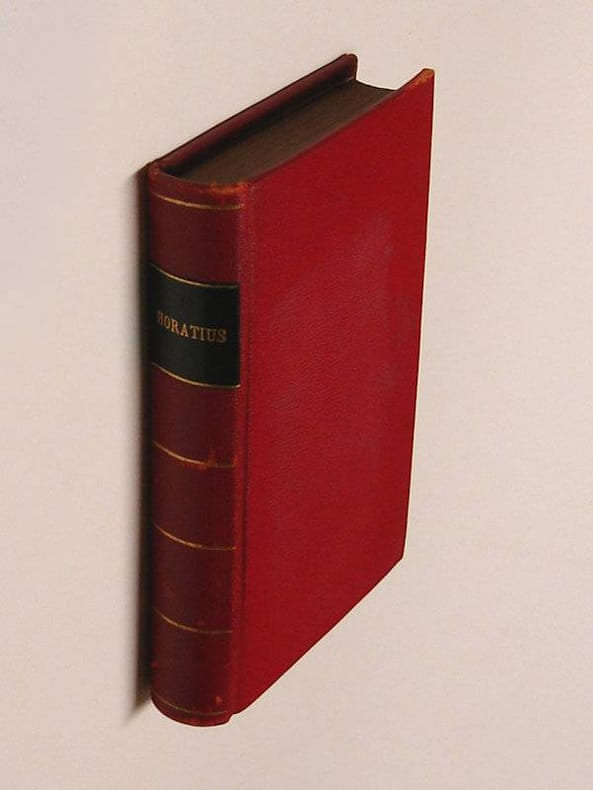
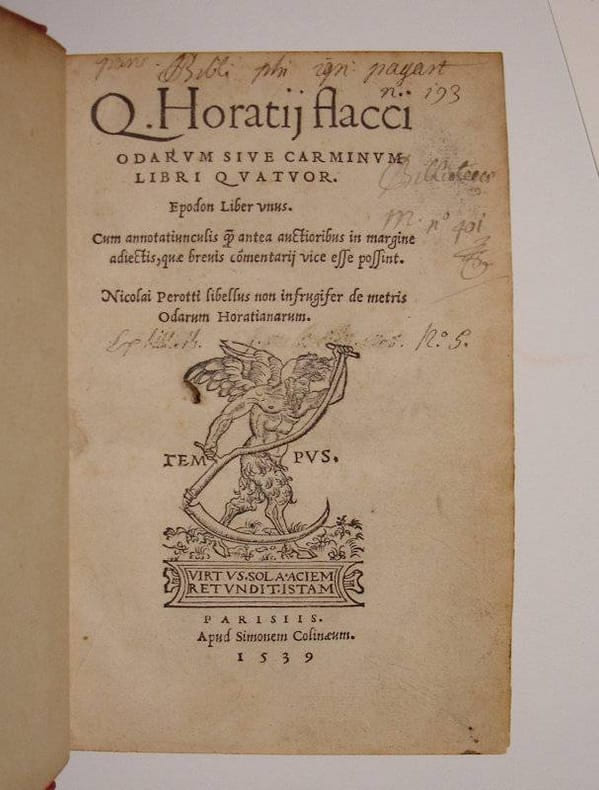
Paris (Parisiis), Apud Simonem Colinaeum, 1535 - 1541. (Ad 1 & 2: 1539. Ad 3: 1535. Ad 4: 1541)
Reference : 120259
8vo. 4 volumes in 1: 96,75,64 & 12 leaves. 20th century red morocco. 8vo. 17.5 cm (Ref: Ad 1: Schweiger 2,420, reissue of the edition of 1533. Brunet 3,314: 'Texte d'Alde, édition correcte'. Dibdin 2,93. Moss 2,12. Graesse 3,350. Ebert 10154) Ad 2: Schweiger 2,426. Brunet 3,314. Dibdin 2,93. Moss 2,12. Graesse 3,350. Ebert 10154. Ad 3: Schweiger 2,503 & 508, reissue edition of 1528, Brunet 3,630. Dibdin 2,153. Graesse 3,519. Ebert 11224. Ad 4: Schweiger 2,709. cf. Moss 2,259. Dibdin 2,153. Graesse 5,212) (Details: Back ruled gilt, and with a black morocco shield. Each of the four titles shows Colinaeus' woodcut printer's mark: the Great Reaper, Tempus, swaying his scythe; 'Father Time', in the shape of a winged Satyr, moves on a broad pedestal, above which are shown flowers and grass cut down; behind this figure we read word 'Tempus'; upon the pedestal is the motto: 'Virtus sola aciem retundit istam'. All 4 copies printed completely in Italics. Dibdin on this Italic letter: 'To the curious, this will be an additional incitement to purchase the work, as Colinaeus is thought, perhaps not very justly, to have surpassed Aldus himself in the Italic type'. Woodcut initials) (Condition: Wear to the extremities. Back slightly rubbed. 3 small & old inscriptions on the first title, which is somewhat soiled; one of the names has been erased. Small wormhole in the first four leaves. Occasional old ink underlings and annotations) (Note: This convolute contains 4 titles that were published by Simon de Colines, who was one of the greatest typographers, printers and publishers of Renaissance Paris. He was active in Paris between 1520 and 1546, and cut lucid and elegant roman and italic types and a beautiful Greek type, superior to its predecessors. Colines was associated with the elder Henri Estienne I, and continued his work after his death in 1520. He married the widow of Henri Estienne, and was in charge of the press until Estiennes son Robert I entered the business in 1526, by which time Colines had set up his own shop nearby. In 1528 he began to use italic type. Colines published many Greek and Latin classics. In 2012 K. Amert published a monograph: 'The Scythe and the Rabbit: Simon de Colines and the Culture of the Book in Renaissance Paris'. All four titles in this binding form more or less a unity, not only with respect to content, the best of Latin poetry, but also in appearance. Colines chose for all four good quality paper, the same type, and the same layout. Even the appearance and the wording of the title pages show similarity. Colines did not only have taste, but he had also a sharp eye for good scholarship. He chose to reissue editions of the Venetian printer Aldus Manutius, whose books were amongst the best of his age, sometimes for centuries to come. The Horace volumes were first published by Colines in 1528. At the end Colines placed a short metrical treatise of the Italian humanist Nicolaus Perrotti, 1429-1480, his 'libellus de metris Odarum Horatiarum'. In the margins of his Juvenal Colines repeated the marginal notes that were printed in the Horace/Juvenal edition of 1524, published by the Basle publisher Valentin Curio. (In aedibus Valentini Curionis) In Blackwell's Companion to the ancient world, 'A Companion to Persius and Juvenal' edited by S. Braund & J. Osgood, Oxford 2012, chapter 'Renaissance scholarship on Juvenal and Persius', these marginal notes in the edition of Valentin Curio are erroneously attributed to the Italian humanist Celio Secondo Curione, in Latin Caelius Secundus Curio, 1503-1569. This misunderstanding probably arises from the fact that Caelius Secundus Curio published a folio edition of the satires with commentary of Juvenal & Persius in Basel (Froben/Episcopius) in 1551. (See Schweiger 2,509)) (Provenance: At the upper edge of the title: 'phi ign: pagart, no. 193'. We found a Philippe Ignace Pagart in 'Coutumes locales tant anciennes que nouvelles des bailliages, ville et echevinage de Saint-Omer', Paris 1744, p. 16. He is referred to as one of the 'Officiers du Roi au Bailliage de Saint-Omer'. On the internet we found further: 'messire Philippe-Ignace Pagart, sieur du Buis, 1969-1760, nommé conseiller au bailliage de Saint-Omer, 1723') (Collation: a-m8; a-i8, k3 (leaf k3 blank); a-h8; a8, b4) (Photographs on request)
Bookseller's contact details
Antiquariaat Fragmenta Selecta
+31 20 418 55 65
Payment mode

Sale conditions
Terms of Sale All items offered are subject to prior sale. Your order will be final after you have received our confirmation, with a specification of the availability of the items and the shipping costs. All books are complete and in good antiquarian condition, unless otherwise described. Prices are in EURO. Postage and insurance are not included. Postage will be calculated at cost (no extra charges). Returns Books may be returned within 14 days of receipt, if returned in the same condition as sent, and packed, shipped and insured as received (please always notify us). We will refund the shipping costs of a return shipment only if our descriptions were not correct. How to pay Pre-payment is necessary for new customers. Our order confirmation will provide detailed information and a specification of the shipping costs. Customers who are known to us and libraries will be invoiced as usual. We accept Visa and Mastercard. You can submit your card information through our SECURE PAYMENT FORM. PayPal: we will send you a personal link to the PayPal website. Banktransfers: payment can be made into our bank account in The Netherlands.

