 Write to the booksellers
CASAUBON,I.
Isaaci Casauboni De Satyrica Graecorum Poesi, & Romanorum Satira libri duo. In quibus etiam poetae recensentur, qui in utraque poesi floruerunt. (Accedit: Cyclops Euripidae latinitate donata, a Q. Septimo Florente Christiano)
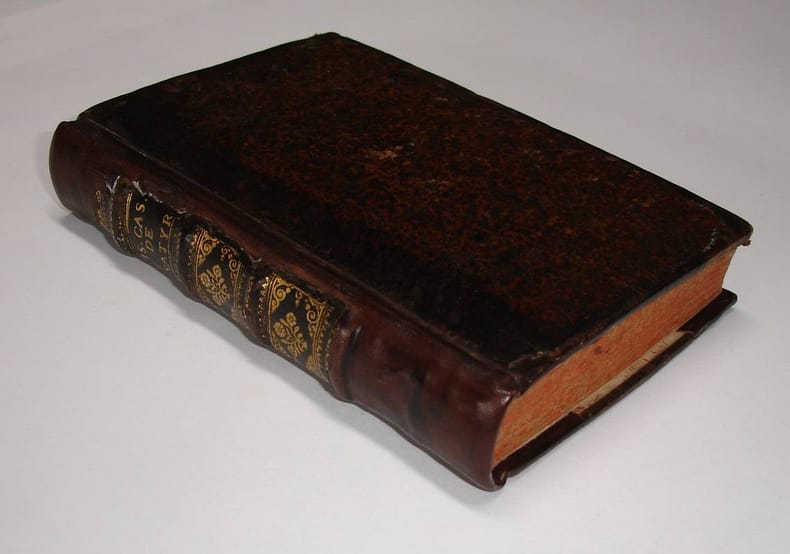
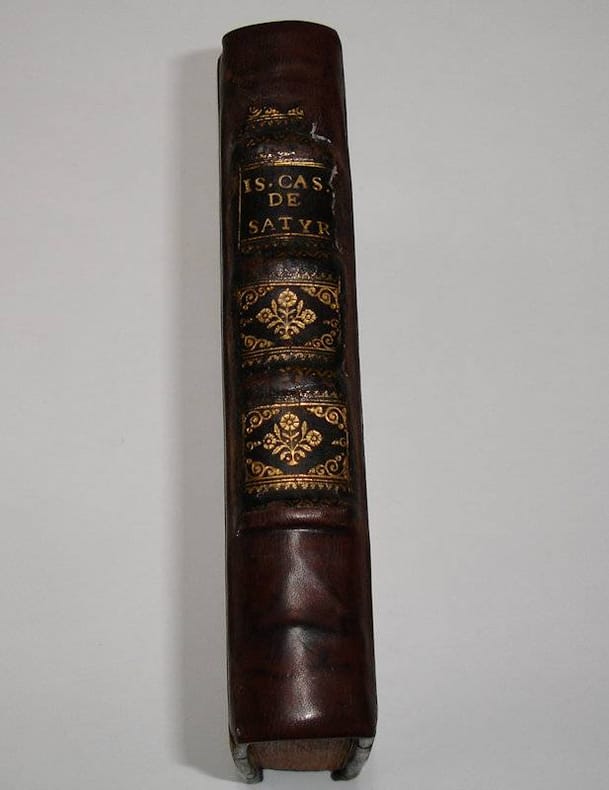
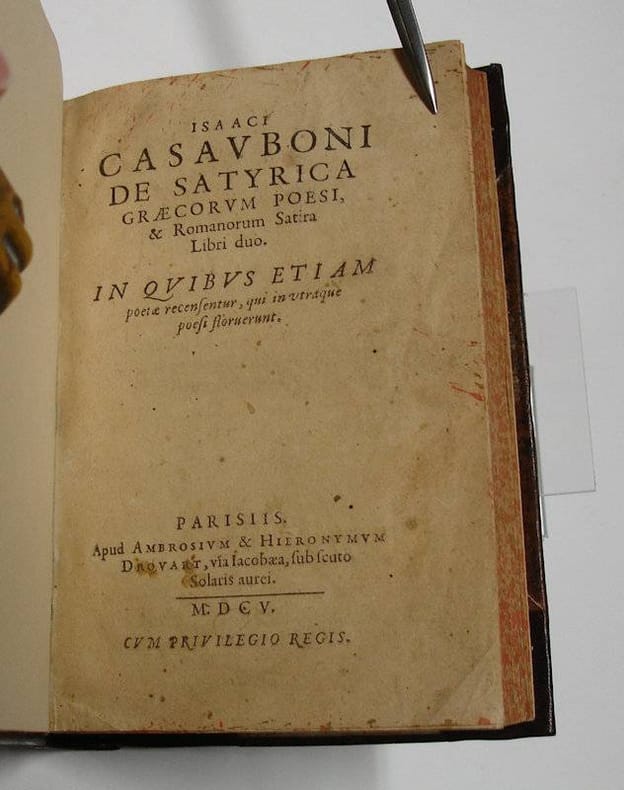
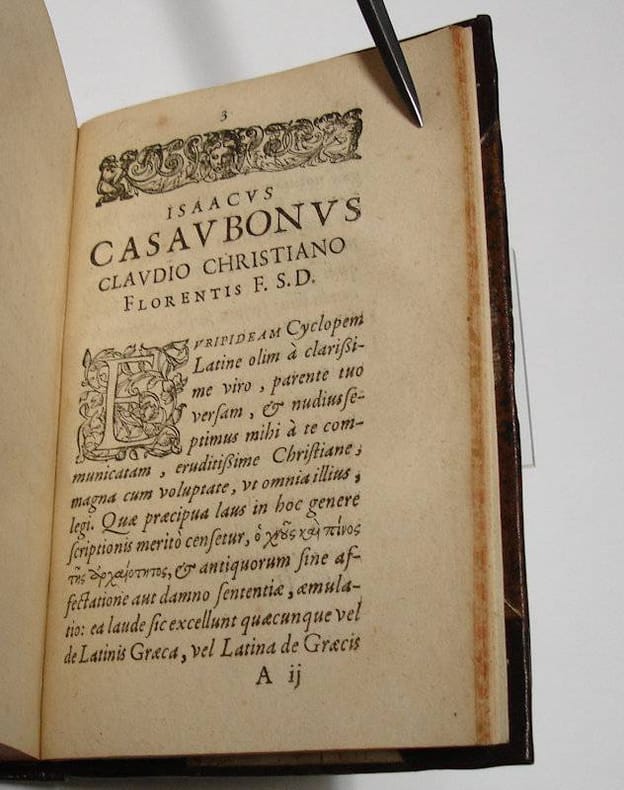
Paris (Parisiis), Apud Ambrosium & Hieronymum Drouart, 1605.
Reference : 120212
8vo. (XVI),356,(2 addenda),(2 blank),38,(2 blank) p., 1 text engraving. Restored full calf 17 'Casaubon produced the first critical survey of literary history in his 'De Satyra Graecorum Poesi & Romanorum Satira', which has gone through many editions and can fairly be called a model of its kind'. (Wilamowitz) (Ref: Brunet 1,1613/14; Ebert 3628) (Details: Binding tastefully and expertly restored, antique style. Back with 4 raised bands. The remains of the original gilt back skillfully attached to the spine. An engraving of an ancient gem on p. 67) (Condition: Title slightly spotted; paper slightly yellowing) (Note: The French scholar Isaac Casaubon, latinized as Casaubonus, 1559-1614, was of Huguenot parents. He studied in Geneva, where he succeeded the Cretan Franciscus Portus as professor in 1582. In 1596 he left for Montpellier to teach. In 1599 the king of France invited him to come to Paris, to aid in a proposed 'restoration' of the university. 'At Paris he had the title 'Lecteur du Roi', but owing doubtless to his remaining true to his protestant principles, he was not appointed to an actual professorship'. (Sandys 2,207) After the murder of Henry IV he had to leave France, and accepted an invitation to come to England, where he was given a pension. He produced many important and often still unsuperseded editions and commentaries, such as Diogenes Laertius (1583), Aristotle (1590), Athenaeus (1596-1600), Historiae Augustae (1603) and Persius (1605). Isaac Casaubon's 'De Satyrica Graecorum Poesi et Romanorum Satira libri duo' is the central text in the Renaissance theory of satire, and still is from a modern point of view. It's importance for modern scholarship lies in the decisive disentanglement of the Greek and the Roman satiric traditions. Casaubon proved with massive learning that the literary genre of the satire had nothing to do what so ever with Greek Satyrs, as was believed by great scholars as J. Scaliger and D. Heinsius, who insisted that Greek and Roman satire formed a single tradition, and that this genre was essentially a dramatic form, descended from Satyr plays. Casaubon's view that the satire derives from 'satura' or 'satira', meaning 'full', as in 'satira/satura lanx', has been accepted by modern scholarship as accurate. A 'satura lanx' was a plate full of all kinds of first fruits, i.e. religious offerings of the first agricultural produce to the gods. ('De Satyrica', liber II, p. 318) Such plates (lances) were simply called 'saturas', medleys full of different things. (Idem p. 319) 'Sic apud Latinos quaelibet mixtura specierum diversarum 'satura' sit dicta'. (Idem p. 321) Laws with interpolations were also called 'saturas'. The 2nd century Roman linguist Sextus Pompeius Festus Pompeius, Casaubon adds, observed: 'Satura est lex multis aliis legibus conferta'. (Idem p. 321) So 'simillime igitur & poëmatia quo breviter multi perstringebantur, SATURAE, vel, ut posterius coeptum pronuntiari, SATIRAE dictae sunt'. (p. 323) At the end has been added a Latin translation of the Cyclops of Euripides, made by Q. Septimus Florens Christianus. The translation is preceded by a short praefatio, which is dedicated to Claudius Christianus, son of Florens. Casaubon praises the father, and tells that he has proven (in caput VI of liber I, p. 207/29) that the Cyclops is a Greek Satyr play, the only one that survived completely. Florens Christianus, Florent Chrétien, was a French poet, born in 1541, who was the author of satires against Ronsard. He translated also several classical authors) (Collation: a8, A-Y8, Z4 (leaf Z4 blank), A-B8, C4 (leaf C4 blank)) (Photographs on request)
Bookseller's contact details
Antiquariaat Fragmenta Selecta
+31 20 418 55 65
Payment mode

Sale conditions
Terms of Sale All items offered are subject to prior sale. Your order will be final after you have received our confirmation, with a specification of the availability of the items and the shipping costs. All books are complete and in good antiquarian condition, unless otherwise described. Prices are in EURO. Postage and insurance are not included. Postage will be calculated at cost (no extra charges). Returns Books may be returned within 14 days of receipt, if returned in the same condition as sent, and packed, shipped and insured as received (please always notify us). We will refund the shipping costs of a return shipment only if our descriptions were not correct. How to pay Pre-payment is necessary for new customers. Our order confirmation will provide detailed information and a specification of the shipping costs. Customers who are known to us and libraries will be invoiced as usual. We accept Visa and Mastercard. You can submit your card information through our SECURE PAYMENT FORM. PayPal: we will send you a personal link to the PayPal website. Banktransfers: payment can be made into our bank account in The Netherlands.

