 Write to the booksellers
VALERIUS FLACCUS.
Caii Valerii Flacci Argonautica. Ioan. Baptistae Pii carmen ex quarto Argonauticon Apollonii. Orphei Argonautica, innominato interprete.
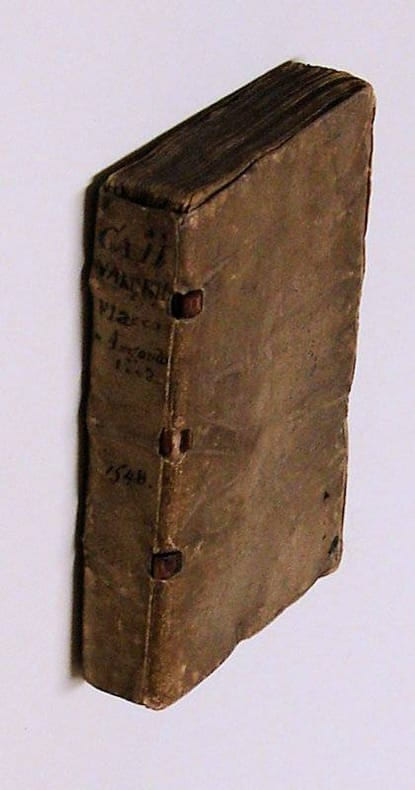
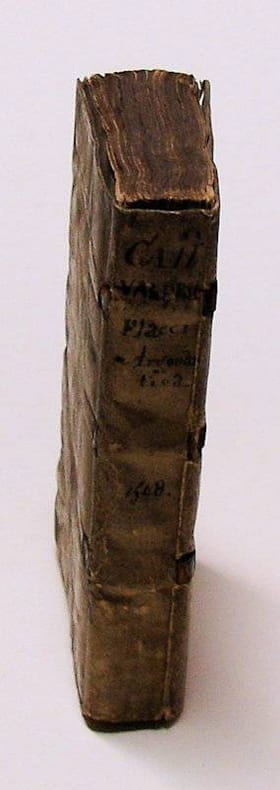
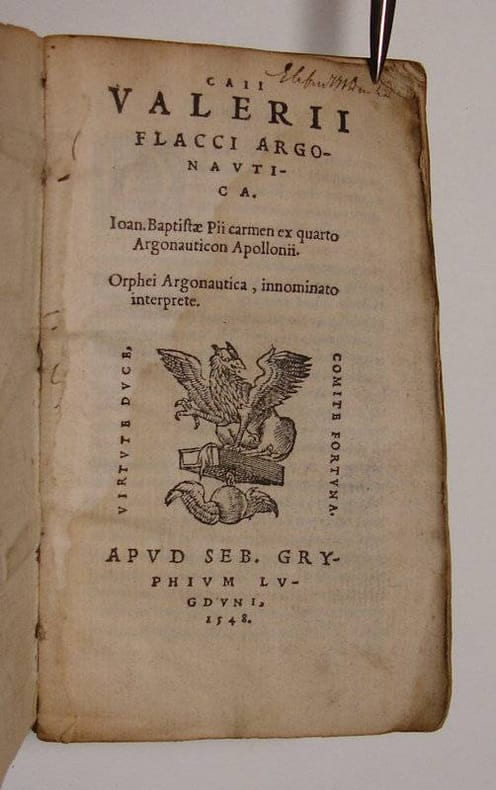
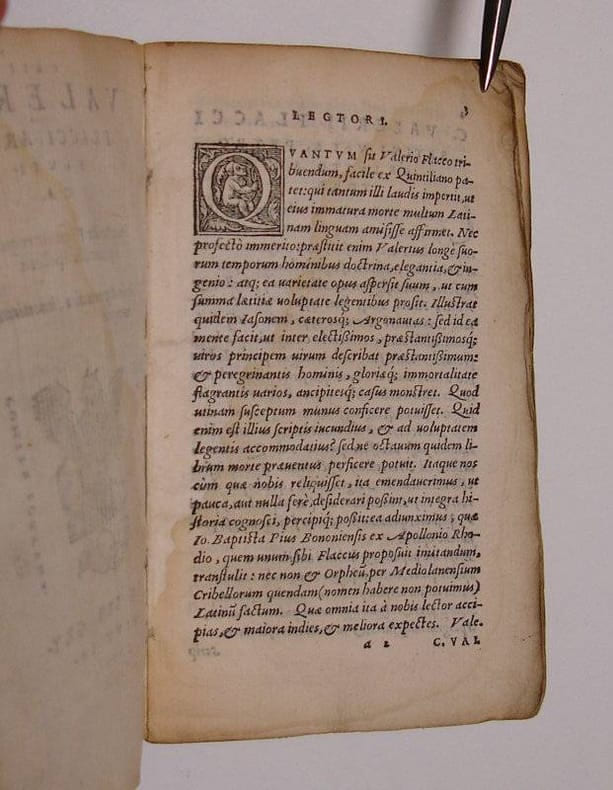
Lyon (Lugduni), Apud Seb. Gryphium, 1548.
Reference : 120178
16mo. 308,(1 colophon),(1 blank) p. Limp vellum 11.5 cm (Ref: USTC 149936; Schweiger 2,1099, incorrect (See note): 'Nachdruck der Strassb. Ausg. Die Vorrede der Aldine u. die des Engentinus sind mit abgedr.'; Graesse 6/2 241; Ebert 23289; cf. Brunet 5,1045) (Details: Printed completely in italics. On the title the printer's mark of Sebastianus Gryphius, depicting a griffin, which mythological animal symbolizes courage, diligence, watchfulness, and rapidity of execution, used as a pun of his family name Gryph or Greif. From the claws of this creature hangs a big rectangular stone, symbolizing Constancy, beneath which hangs a winged globe, symbolizing Fortune. The motto is 'Virtute duce / comite fortuna', 'Virtue thy leader, fortune thy comrade', a quote from a letter of Cicero to Plancus (Epistulae ad Familiares, liber X,3)) (Condition: Vellum soiled and wrinkled. All four textile fastening ties gone. Both pastedowns damaged and detached. Front hinge partly loosening, but holding. Front flyleaf removed. Faint dampstain in the first 5 quires. Some small old ink annotations. Right upper corner of leaf d3 (p. 53/4) torn off without loss of text. Corners slightly bruised) (Note: The bibliographies of Schweiger, Ebert and Graesse state that this 'Argonautica' edition of 1548, published by Sebastianus Gryphius, is a reissue of the Valerius Flaccus edition of 1525, edited in Strassburg by Philippus Engentinus. This is not correct. In the first place, this Gryphius has exactly the same title as the Aldus edition of 1523, which was produced by the Italian humanist scholar Giovan Battista Pio, latinized as Ioannes Baptista Pius. It contains also the same text, that is, the preliminary pages, the 'Argonautica' of Valerius Flaccus book I-VIII verse 467, and also a continuation of book VIII, taken from Apollonius Rhodius' earlier Greek version of the 'Argonautica', translated into Latin by Ioannes Pius. At the end we find a Latin translation of an unknown hand of the 'Orphei Argonautica'. Pius' continuation of Book VIII to X starts where a premature death overtook Valerius Flaccus, and prevented him to finish the epic. The poem breaks off abruptly with the pursuit of the Argo by Absyrtus, brother of Medea. This continuation is repeated in our Gryphius edition of 1548, but is absent in the Strassburg edition of Engentius, as are the preliminary pages. Furthermore, the Strassburg edition ends at verse 466 of book VIII: 'Temptat & ipse gemens, & tempora currere dictis. FINIS'. This line is the last but one in The Gryphius and Aldus edition, in both the last verse is (467): 'mene aliquid metuisse putas? me talia velle?' The bibliographers were probably mislead by the adoption at the end by Gryphius of the dedication of Philippus Engentinus, dated 1525, from his Strassburg edition. Not much is known about the Roman poet Valerius Flaccus, who wrote an epic 'Argonautica', and who died in 92 or 93 A.D. It is agreed by 'practically all modern authorities that the 'Argonautica' was never completed, and that its imperfect conclusion must not be put down to mutilation of a manuscript or omission to complete a copy. There is plenty of internal evidence of unrevised work, both in the language and the details of the plot and incidents. As to the former, there are many passages where it is necessary to mark a lacuna or to supply a line to complete the sense'. (Valerius Flaccus, with an English translation by J.H. Mozley, Cambr. Mass., 1972, p. VIII) As all the poets of his time Valerius Flaccus was strongly influenced by Vergil, but he 'is a better poet than they, in so far he is less excessively rhetorical than Lucan, and a more original genius than Statius'. (OCD 2nd ed. p. 1105) His 'Argonautica' is indebted to the 'Argonautica' of the Greek poet Apollonius Rhodius, who flourished ca. 200 B.C., but it is certainly not a close imitation. The differences are in the portrayal of the characters and the incidents in the story. 'The 'Orphei Argonautica' (Orphic Argonautica) was once believed to be among the oldest Greek poems, but today it is known that the poem is the work of a late Antique author working in the fourth century CE or later and writing in a form of Greek that consciously imitated (often wrongly) the diction and vocabulary of Homer. The poem of 1,376 hexameter verses takes the form of a first-person account of the Argonauts' voyage from the mouth of Orpheus, who views himself as the hero, addressing the poem to his disciple Musaeus. The poem (...) found fame in the early modern period along with other Orphic poetry as a prefiguration or distortion of Biblical truths'. (The Orphic Argonautica, translated by Jason Colavito) (Collation: a-t8, u4 (minus blank leaf u4; u3 verso blank) (Photographs on request)
Bookseller's contact details
Antiquariaat Fragmenta Selecta
+31 20 418 55 65
Payment mode

Sale conditions
Terms of Sale All items offered are subject to prior sale. Your order will be final after you have received our confirmation, with a specification of the availability of the items and the shipping costs. All books are complete and in good antiquarian condition, unless otherwise described. Prices are in EURO. Postage and insurance are not included. Postage will be calculated at cost (no extra charges). Returns Books may be returned within 14 days of receipt, if returned in the same condition as sent, and packed, shipped and insured as received (please always notify us). We will refund the shipping costs of a return shipment only if our descriptions were not correct. How to pay Pre-payment is necessary for new customers. Our order confirmation will provide detailed information and a specification of the shipping costs. Customers who are known to us and libraries will be invoiced as usual. We accept Visa and Mastercard. You can submit your card information through our SECURE PAYMENT FORM. PayPal: we will send you a personal link to the PayPal website. Banktransfers: payment can be made into our bank account in The Netherlands.

