 Write to the booksellers
JUSTINUS.
Justini Historiae Philippicae. Variantes lectiones adjecit P. Burmannus.
Leiden (Lugduni Batavorum), Apud Samuel. Luchtmans, 1722.
Reference : 120091
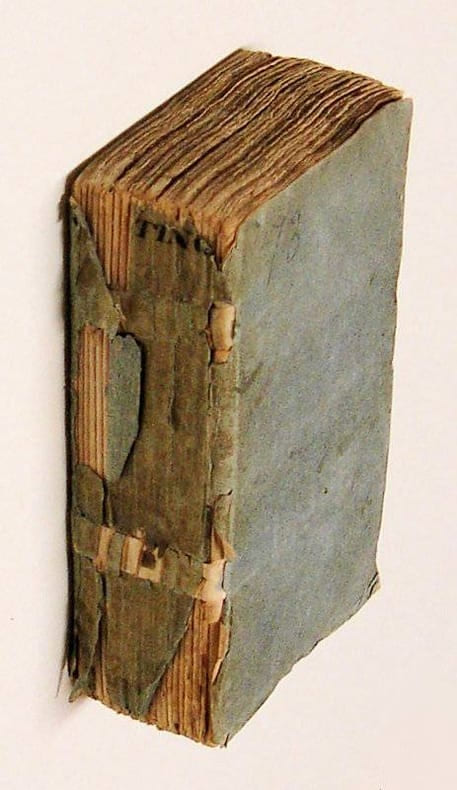
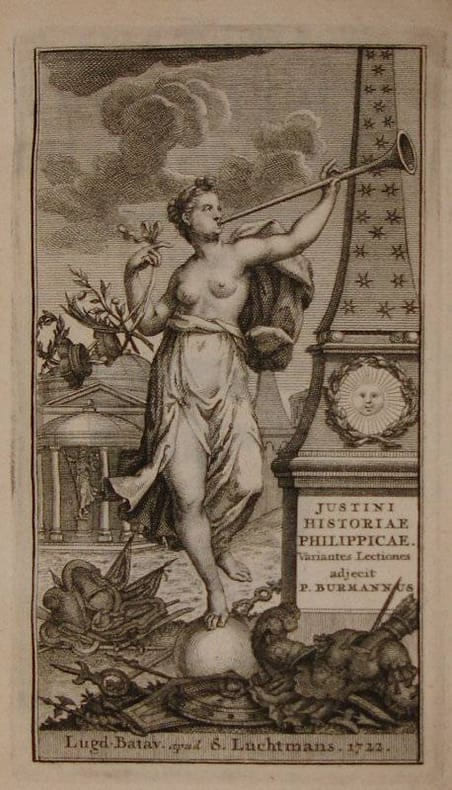
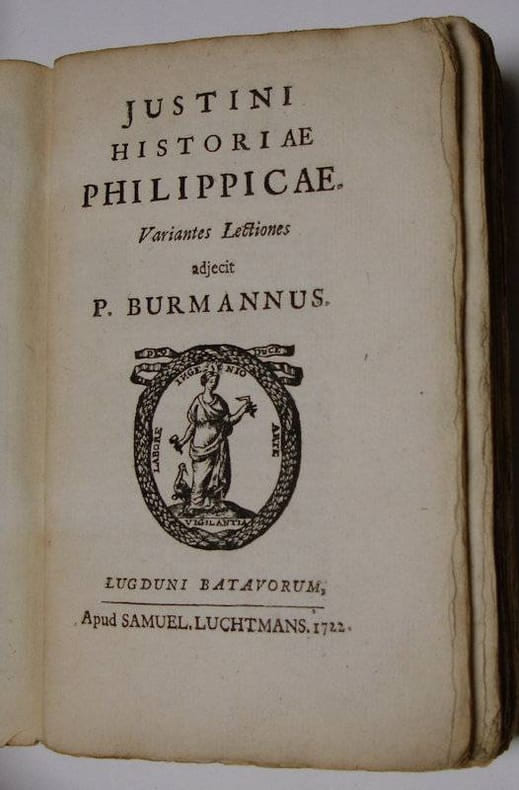
12mo. Frontispiece, (XXIV),443,(62 index),(1 blank) p. Contemporary stiff wrappers. 14 cm (Ref: Schweiger 2,492; Fabricius/Ernesti 3,66; Graesse 3,513; Ebert 11155) (Details: Margins uncut. Engraved frontispiece, depicting a half naked woman, who blows a trumpet that she holds in her left hand; in her right hands she holds a string to which are attached 2 crowns and a laurel wreath; she stands on a globe, amidst all kinds of spolia; right of her is a monument with celestial symbols, stars and a radiant sun. Is she a combination of Fama, Dea Roma, Juno Caelestis? On the title a woodcut printer's mark, that shows a standing woman within an oval wreath; she hold in her right hand a hammer, in her left a hook, a little flame burns on her head, at her feet is a crane, that holds a stone in one of its claws. The motto is: 'Deo duce ingenio arte vigilantia labore)(Condition: Paper on the back partly gone) (Note: This is an epitome made by one Justinus, probably in the third century A.D., of the 'Historiae Philippicae' of the Augustan historian of Gaulish descent Pompeius Trogus, who got his nomen because his grandfather was given Roman citizenship by the Roman military leader Pompeius Magnus after his campaign against Sertorius in Spain. Important parts of Trogus' 'Historiae Philippicae', which numbered 44 books, only survive in this epitome of Justin, who boiled it down, it is estimated, to 1/10th or 1/6th. (Neue Pauly 10, p. 115) Trogus produced a universal history of the peoples outside Italy. He seems to have used no other sources than Greek historians, and his story runs from Ninus king of Assyria to the absorbtion of the other nations into the Roman empire, and the establishment of the 'Pax Augusta'. Books 7/12 describe the rise of Philip II and of Macedonia. Books 13/40 treat the Hellenistic kingdoms. 41/42 contain the history of Parthia, 43 of Italy, and 44 the history of Spain. Inserted are many historical and geographical excursus, for example on the history of Armenia or the Jewish wars. The leading concept of Trogus' history was the so-called 'translatio imperii', which conceived history as a linear succession of empires under a singular ruler or emperor. The narrative is elaborate, dramatic and moralizing. Trogus was, according to Rose, an very passable stylist, who arranged his second hand material intelligently, and showed 'some original views how to write history. (...) Even in this diminished condition (the epitome) the history is interesting reading, often containing facts not to be met with elsewhere, and one of our much too scanty sources for the history of the eastern Mediterranean and the adjacent countries'. (H.J. Rose, 'A Handbook of Latin literature', 'London 1967, p. 312/13) The epitome of Justin was widely read in the Middle Ages. This Justinus edition was produced by the Dutch classical scholar Pieter Burman, or Petrus Burmannus, 1668-1741, from 1696 professor of Eloquence at Utrecht, and from 1715 at Leyden. As an editor he confined himself to the Latin classics. He produced editions of the Roman poets Ovid, Lucan, Claudian, and Valerius Flaccus. Of prose the writers he edited Petronius, Velleius Paterculus, Justin, Quintilian and Suetonius'. (J.E. Sandys, 'A history of classical scholarship', N.Y.1974, vol. 2, p. 445) Burman was not an original scholar, but more an industrious manufacturer of so-called 'Variorum' editions (from 'cum notis Variorum'), editions with a 'textus receptus' which was widely accepted, accompanied by an overload of often ill-digested commentaries, excerpts and annotations of various specialists and other leading scholars. This Justinus is an exception, it is mean and lean; it offers a text (borrowed from Graevius), without commentary, but with occasionally variant readings that were taken from earlier editions of Aldus, Giunta, Bongarsius, Graevius, Hearne et alii)(Collation: *12, A-X12) (Photographs on request)
Bookseller's contact details
Antiquariaat Fragmenta Selecta
+31 20 418 55 65
Payment mode

Sale conditions
Terms of Sale All items offered are subject to prior sale. Your order will be final after you have received our confirmation, with a specification of the availability of the items and the shipping costs. All books are complete and in good antiquarian condition, unless otherwise described. Prices are in EURO. Postage and insurance are not included. Postage will be calculated at cost (no extra charges). Returns Books may be returned within 14 days of receipt, if returned in the same condition as sent, and packed, shipped and insured as received (please always notify us). We will refund the shipping costs of a return shipment only if our descriptions were not correct. How to pay Pre-payment is necessary for new customers. Our order confirmation will provide detailed information and a specification of the shipping costs. Customers who are known to us and libraries will be invoiced as usual. We accept Visa and Mastercard. You can submit your card information through our SECURE PAYMENT FORM. PayPal: we will send you a personal link to the PayPal website. Banktransfers: payment can be made into our bank account in The Netherlands.

