 Write to the booksellers
JUSTINUS.
Iustini Historici Clarissimi In Trogi Pompeii historias libri quadragintaquatuor, a Ioan. Sichardo summa diligentia recogniti & illustrati. Quibus adiecimus, certo consilio, Sex. Aurelium Victorem, qui Caesarum vitas a D. Augusto ad Theodosium usque, historia prosequutus est. Cum indice.
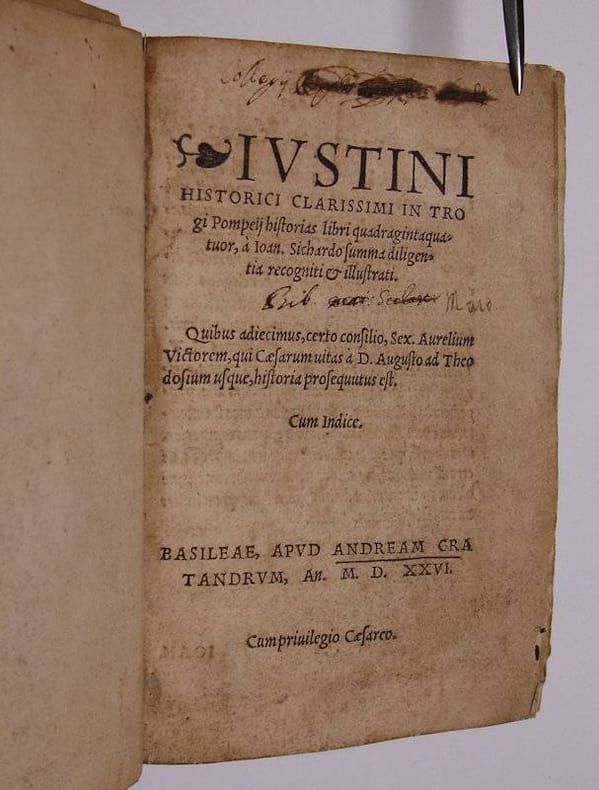


Basel (Basileae), Apud Andream Cratandrum, 1526. Cum privilegio Caesareo. (Colophon at the end: 'Basileae, per Andream Cratandrum, Mense Ianuario, anno 1526')
Reference : 120090
8vo. (VIII),371,(41 index, errata, colophon) p. 20th century overlapping vellum 14.5 cm (Ref: VD16 T 2050; Schweiger 2,487; Graesse 3,512; Ebert 11134) (Details: Printed completely in italic letters. Woodcut printer's mark on the last page, it depicts an almost naked Fortuna with winged feet standing on a globe, which is divided in four parts; in her right hand she hold a opened razor blade, with her left hand she makes a gesture as if she wants to grab something; the back of her head is shaven bald, and the long lock in front is blown to the right; Fortuna stand in an architectural alcove. There is no motto. This variant of Cratander's printer's mark is not mentioned by A. Wolkenhauer, 'Zu schwer für Apoll, die Antike in humanistischen Druckerzeichen des 16. Jahrhunderts', Wiesbaden, 2002) (Condition: Title dustsoiled, and showing a thumbed right edge. Two small holes in the right lower corner of the title. Old ownership entry at the top of the title erased. Old name on the title. Paper somewhat yellowing. Occasional old ink notes and underlinings; right margin cut rather short) (Note: This is an epitome made by one Justinus, probably in the third century A.D., of the 'Historiae Philippicae' of the Augustan historian of Gaulish descent Pompeius Trogus, who got his nomen because his grandfather was given Roman citizenship by Pompeius after his campaign against Sertorius in Spain. Important parts of his 'Historiae', which numbered 44 books, only survive in this epitome of Justin, in which it was boiled down, it is estimated, to 1/10th or 1/6th. (Neue Pauly 10, p. 115) Trogus produced a universal history of the peoples outside Italy. He seems to have used no other sources than Greek historians, and his story runs from Ninus king of Assyria to the absorbtion of the other nations into the Roman empire, and the establishment of the 'Pax Augusta'. Books 7/12 describe the rise of Philip II and of Macedon. Books 13/40 treat the Hellenistic kingdoms. 42/42 contain the history of Parthia, 43 of Italy, and 44 the history of Spain. Inserted are many historical and geographical excursus, for example on the history of Armenia or the Jewish wars. The leading concept of Trogus' history was the so-called 'translatio imperii', which conceived history as a linear succession of empires under a singular ruler or emperor. The narrative is elaborate, dramatic and moralizing. Trogus was, according to Rose, an very passable stylist, who arranged his second hand material intelligently, and showed 'some original views how to write history. (...) Even in this diminished condition (the epitome) the history is interesting reading, often containing facts not to be met with elsewhere, and one of our much too scanty sources for the history of the eastern Mediterranean and the adjacent countries'. (H.J. Rose, 'A Handbook of Latin literature', 'London 1967, p. 312/13) The epitome of Justin was widely read in the Middle Ages, because it seemed to legitimize the 'translatio imperii' to the Pope, but also the emergence of the Holy Roman Empire, as legitimate continuation of the Roman Empire. (See for 'translatio imperii' English Wikipedia) After the Historiae Philippicae has been added the 'Vitae Caesarum' of the late antique Roman historian Aurelius Victor, biographies of Roman emperors from Augustus to Constantius (360 A.D). It treats biographical material in a moralizing fashion, and is based for the first emperors on Suetonius. The German jurist Johannes Sichard, 1499-1552, was from 1535 till his death professor of Roman Law at the University of Tübingen. This representative of humanistic jurisprudence published on the Codex Iustinianus, but also some important legal texts of Germanic peoples, especially the 'Breviary of Alaric' (Breviarium Alaricianum) (1528), laws of the Ripuarian Franks, Alemanns and Bavarians (1530). He was also a legal counselor in lawsuits for the Dukes of Württemberg in their legal controversies with Ferdinand, king of the Holy Roman empire. This Justinus seems to have been his only edition of a Roman author. (ADB 34, 143/46) It was reissued by Cratander in 1530) (Provenance: On the front flyleaf in pencil: '13 Oc. 1962', written by the Flemish linguist Walter Couvreur, 1914-1996, who was an Orientalist, and professor of Indoeuropean linguistics at the University of Gent. It indicates the date of aquisition. The place of acquisition he wrote on the flyleaf at the end: 'Luik, Halbart'. The ownership entries on the title are made illegible) (Collation: a4, b-z8, A-C8, D6) (Photographs on request)
Bookseller's contact details
Antiquariaat Fragmenta Selecta
+31 20 418 55 65
Payment mode

Sale conditions
Terms of Sale All items offered are subject to prior sale. Your order will be final after you have received our confirmation, with a specification of the availability of the items and the shipping costs. All books are complete and in good antiquarian condition, unless otherwise described. Prices are in EURO. Postage and insurance are not included. Postage will be calculated at cost (no extra charges). Returns Books may be returned within 14 days of receipt, if returned in the same condition as sent, and packed, shipped and insured as received (please always notify us). We will refund the shipping costs of a return shipment only if our descriptions were not correct. How to pay Pre-payment is necessary for new customers. Our order confirmation will provide detailed information and a specification of the shipping costs. Customers who are known to us and libraries will be invoiced as usual. We accept Visa and Mastercard. You can submit your card information through our SECURE PAYMENT FORM. PayPal: we will send you a personal link to the PayPal website. Banktransfers: payment can be made into our bank account in The Netherlands.

