 Write to the booksellers
LIPSIUS,J.
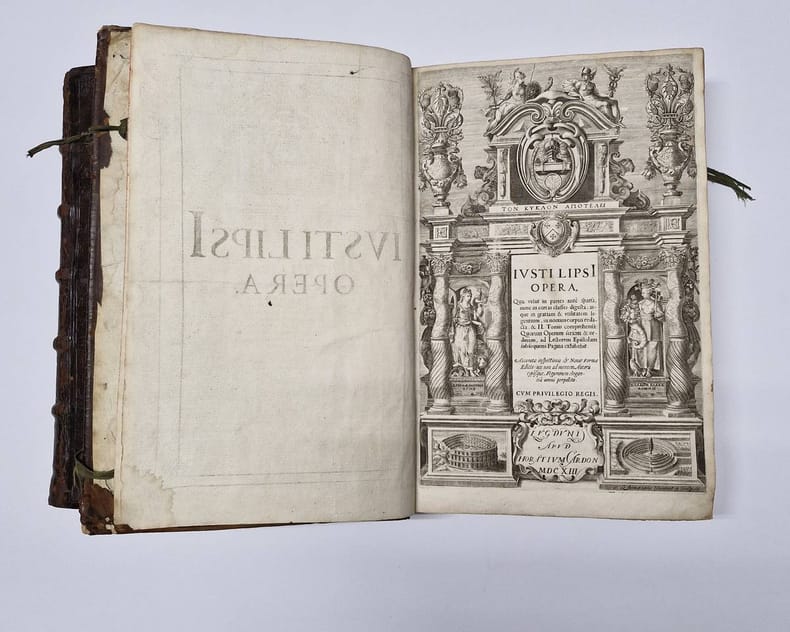
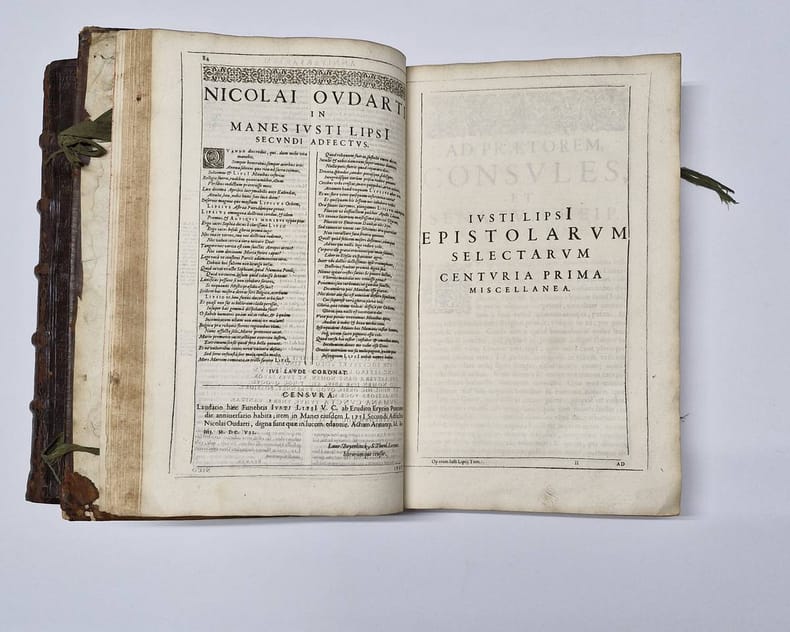
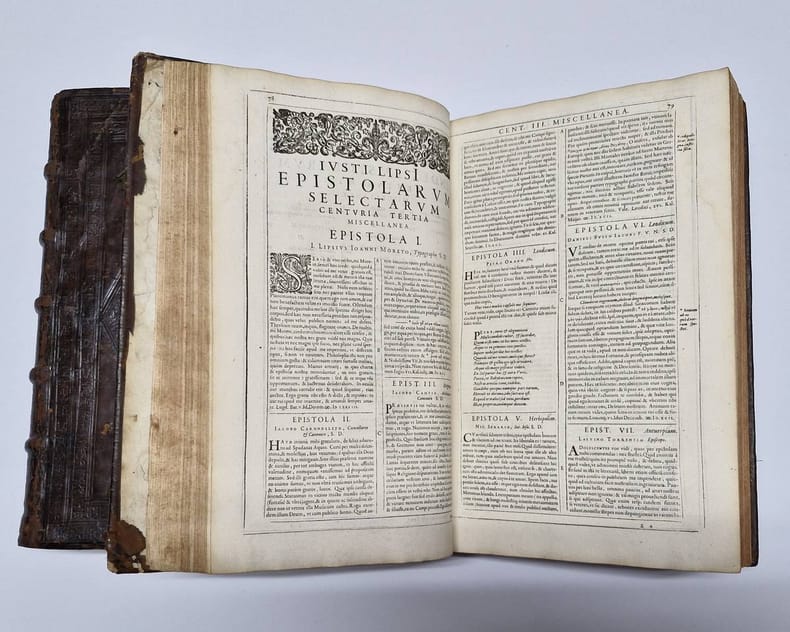
Iusti Lipsii opera, quae velut in partes ante sparsa, nunc in certas classes digesta; nunc in gratiam & utilitatem legentium, in novum corpus redacta, & II Tomis comprehensa. (...) Accuratae inspectionis & novae formae editio; nec non ad mentem autoris typosque, figurarum elengantia omni perpolita. Cum privilegio Regis.
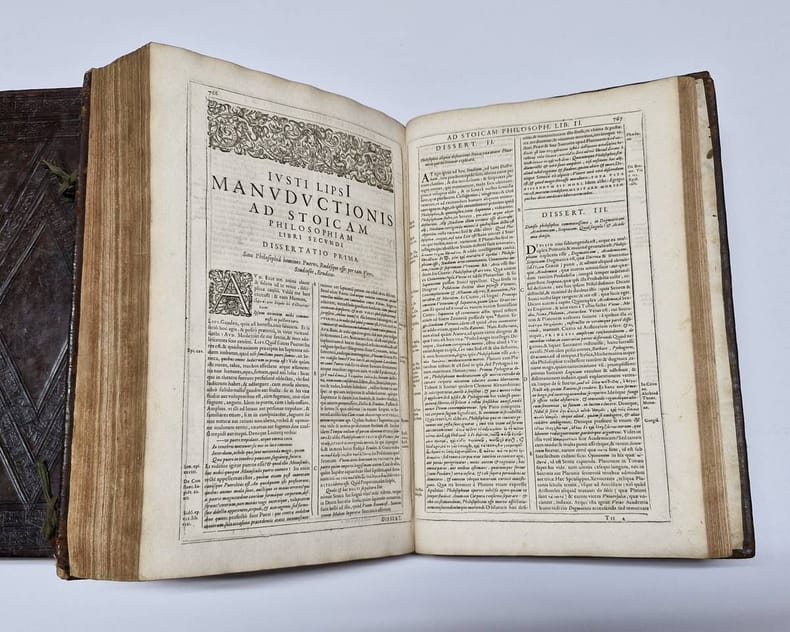
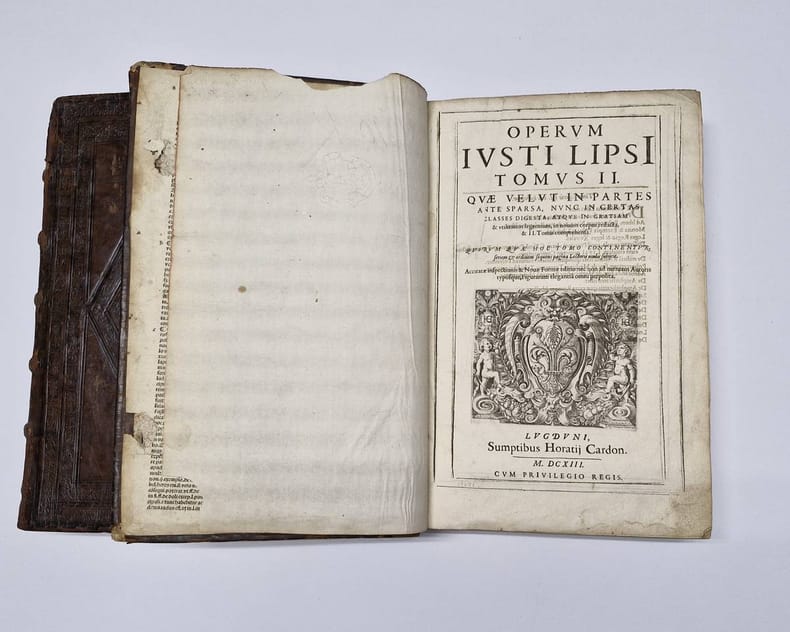
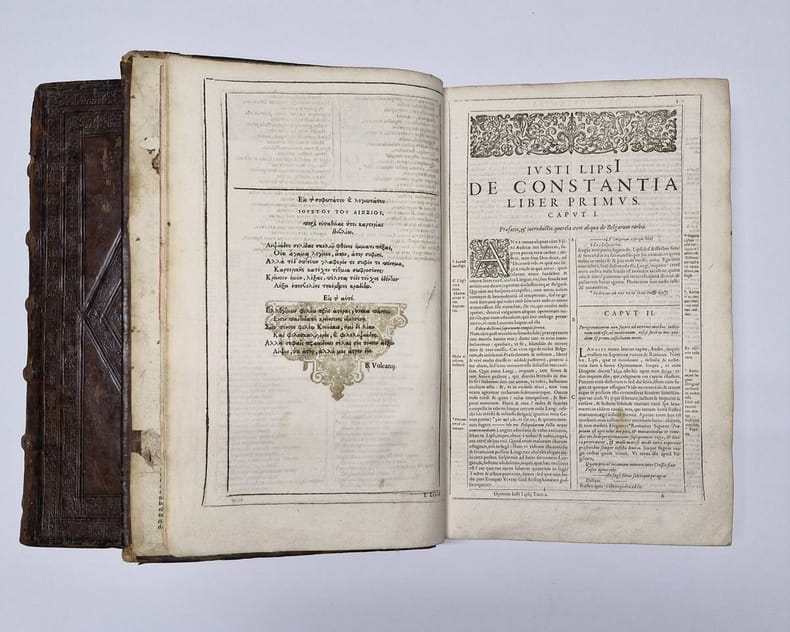
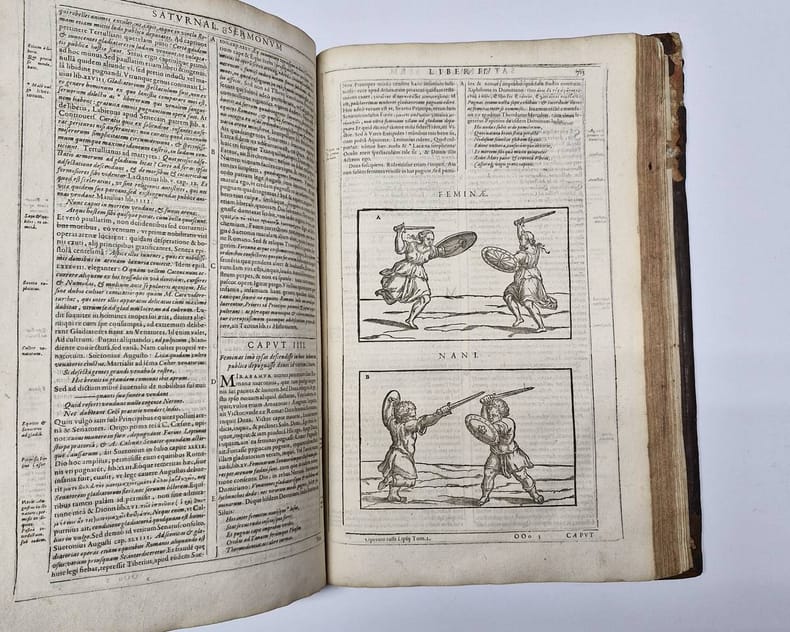
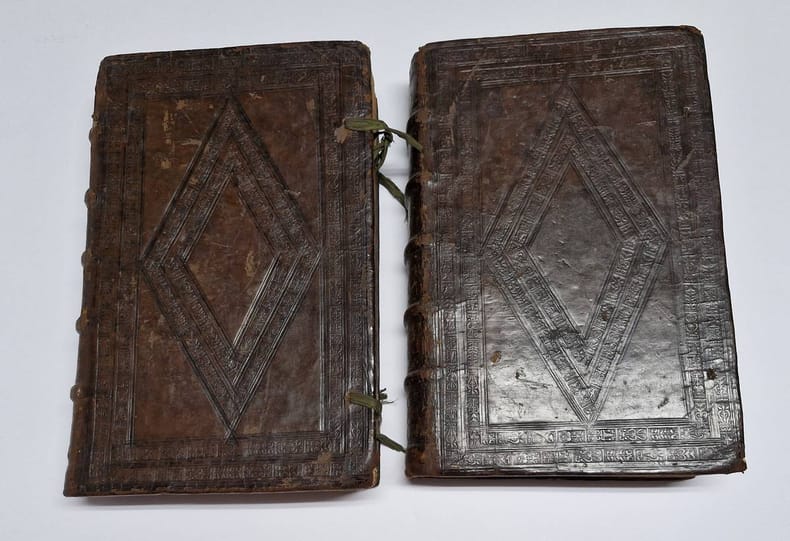
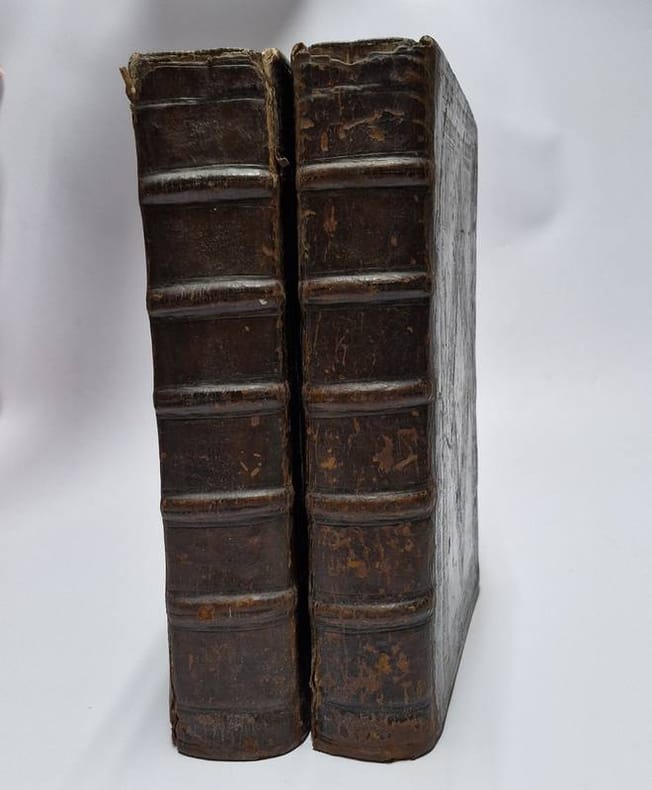
Lyon, Apud Horatium Cardon, 1613.
Reference : 11182
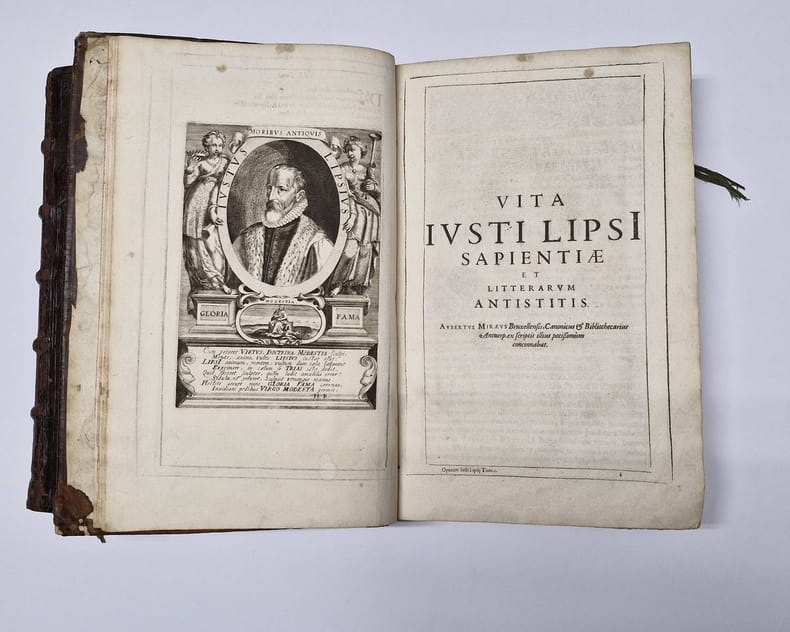
Folio. 2 volumes: (XII),84,(8),882 (recte 884),(2 blank); (XII),899,(1 blank) p., engraved title, portrait, illustrations. Calf. 36 cm 'The First Opera Omnia edition' (Ref: Bibliotheca Lipsiana Bruxellensis, p. 96, no.66) (Details: Backs with 5 raised bands. Boards decorated with rows of blind-stamped rolls, comprising floral motives. The somptuous architectural title to the first volume was engraved by Jacques de Fornazeris. It depicts a kind of triumphal arch, overloaded with symbols of power, abundance and wisdom; left and right of the way through stands between pillars a statue, of the goddess Roma, and a woman personifying Greece and Athens; on top of the arch a scene that looks like the 'deification' of 'the book'. De Fornazeris also engraved a full-page portrait of Lipsius. The title of volume 2 shows Cardon's printer's mark, also by De Fornazeris. Many engravings and woodcut illustrations in the text) (Condition: Bindings scuffed. Heads of the spines chafed. Joints of the first volume splitting at the head of the spine. Boards scratched, corners bumped. Some remnants of the original 4 green ties. As pastedowns have been used 4 leaves from an incunable (?) of the 'Speculum Iudiciale' of the French bishop of Mendo Guillaume Durand (William Durand). Both front flyleaves are worn) (Note: Justus Lipsius, 1547-1606, was the greatest Latin scholar of his time in the Low Countries. In 1579 he came to the recently founded University of Leiden (1575) to teach Latin. He resided there with great distinction as honorary Professor of History from 1579 till 1591. These twelve years were the period of his greatest productivity. It was during this time that he prepared his Seneca, and perfected, in successive editions, his Tacitus, and brought out a series of other works. Some were pure scholarship, some were collections from classical authors, and others were of general interest. Lipsius' greatest strength lay in textual criticism and exegesis. 'His masterpiece in this respect was his Tacitus, of which two editions appeared in his life-time (1574, 1600)' (J.E. Sandys, History of Classical Scholarship, N.Y., 1964, vol. 2, p. 303) Lipsius left the Dutch republic, converted to Catholicism, and finally settled in Leuven to teach as professor of Latin in the 'Collegium Buslidianum'. In an autobiographical letter to his pupil Johannes Woverius, dated 1 Oct. 1600 Lipsius presents himself 'as a true humanist, whose uneventful life is filled by reading, teaching and writing. His life, he tells, was not to be compared to that of real great men, whose political or military deeds (res gestae) merit description. He kept away from politics, depicting his scholarly career as a succession of political innocent travels to interesting places like Italy, Vienna and Jena, and then returning to his beloved fatherland for which he had really longed for all this time. His long stay at Leiden University he portrayed as a period spent in refuge while the civil war was raging in the Netherlands. In the end he felt forced to return to his native country, the Southern Netherlands. He tells us in the autobiographical letter that this decision was mainly inspired by the religious condition of the rebellious provinces and by the attacks he had to suffer on his reputation (Religio et Fama)'. (N. Mout, 'Justus Lipsius between war and peace', in 'Public Opinion and Changing Identities in the Early Modern Netherlands', Leiden/Boston 2007, p. 150) Lipsius lived in turbulent times. He wrote a number of works which were to revive the philosophy of ancient Stoicism in a form that was acceptable to Christianity. The earliest and most famous of these is 'De Constantia in publicis malis' ('On constancy in times of public calamity'), first published Leiden/Antwerpen 1584) The appearance of the 'Opera Omnia' of Lipsius in Lyon took the Antwerp publisher's firm of Plantin/Moretus, that had published nearly all works of Lipsius, by surprise. There existed a great demand for Lipsius' works after his death, but the firm was reluctant to publish the complete works, because it still had great quantities of separate titles of Lipsius in stock. Furthermore the firm believed that his works were protected from competition of other publishers by their 'privilegium'. Plantin/Moretus' counter offensive came a year later, with a quarto edition of the 'Opera Omnia' in 5 parts. In it the firm simply swept together the old separate titles, and added a new title page, dated 1614. ('Lipsius en Leuven', Leuven 1997, p. 317/18)) (Provenance: On the flyleaves: 'Godfi. Bosvile, 1681'. This must be one Godfrey (Geoffrey) Bosvile, a member of the noble Bosvile family, who owned between the 16th and 19th centuries Ravenfield Park, Ulverscroft, Leicestershire, Thorpe Hall, Lincolnshire, and other estates. Godfrey bought this book in 1681 for 1 pound and 5 shillings. On the front flyleaf in ballpoint the name of 'Lennart Hakanson', 1939-1987, professor of Latin at the university of Uppsala) (Collation: Volume 1: +6 (Portrait on leaf +6 verso); â6, ê6, î6, ô6, û6, ââ6, êê6, îî4; A-3P6, 3Q4 (leaf 3Q4 blank, is not included in the page numbering), 3R-4D6, 4E8 (leaf 48 blank). Volume 2: *6, A-4F6 (leaf 4G6 verso blank)) (Heavy set, may require extra shipping costs)
Bookseller's contact details
Antiquariaat Fragmenta Selecta
+31 20 418 55 65
Payment mode

Sale conditions
Terms of Sale All items offered are subject to prior sale. Your order will be final after you have received our confirmation, with a specification of the availability of the items and the shipping costs. All books are complete and in good antiquarian condition, unless otherwise described. Prices are in EURO. Postage and insurance are not included. Postage will be calculated at cost (no extra charges). Returns Books may be returned within 14 days of receipt, if returned in the same condition as sent, and packed, shipped and insured as received (please always notify us). We will refund the shipping costs of a return shipment only if our descriptions were not correct. How to pay Pre-payment is necessary for new customers. Our order confirmation will provide detailed information and a specification of the shipping costs. Customers who are known to us and libraries will be invoiced as usual. We accept Visa and Mastercard. You can submit your card information through our SECURE PAYMENT FORM. PayPal: we will send you a personal link to the PayPal website. Banktransfers: payment can be made into our bank account in The Netherlands.

