 Write to the booksellers
Raymond Feraud
La Vida de Sant Honorat
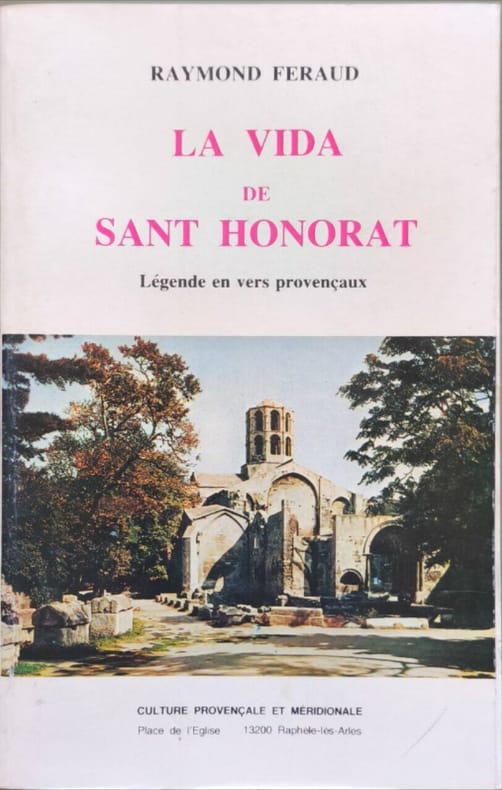
CULTURE PROVENÇALE ET MÉRIDIONALE 1981 220 pages in8. 1981. Broché couverture rempliée. 220 pages. La vida de Sant Honorat est une légende en vers provençaux du XIIIe siècle écrite par le troubadour niçois Raymond Féraud. Elle raconte la vie et les miracles de saint Honorat évêque et fondateur de l'abbaye de Lérins. L'ouvrage a été publié avec des notes explicatives par A.-L. Sardou et réédité par Culture provençale et méridionale en 1981
Reference : 13997
Bon état
Bookseller's contact details
Maison Vallon Librairie
Madame Vallon Emilie
maisonvallonlibrairie@gmail.com
07 46 22 77 51
Payment mode
Sale conditions
Bonjour, Nous vous remercions pour votre commande. Nous acceptons les paiements par chèque, à envoyer à l’adresse suivante : 12, 270 avenue Alphonse Lavallée 84250 Le Thor À l’ordre de Mme Vallon Brisson. Les virements bancaires peuvent être effectués sur le compte suivant : Mme Vallon Brisson IBAN : FR76 1130 6000 8448 1102 1058 519 Les frais de port pour la France métropolitaine sont forfaitaires : 6,90 € pour le premier livre. Pour le reste du monde, un tarif forfaitaire sera appliqué en fonction du nombre d’ouvrages commandés. Les ouvrages sont expédiés dès réception du règlement. Nous vous souhaitons une agréable lecture et à bientôt. L’équipe de Maison Vallon Librairie
3 book(s) with the same title
La VIDA de SANT HONORAT, La VIE de SAINT HONORAT
Un ouvrage de 220 pages, format 135 x 210 mm, broché couverture couleurs rempliée, publié en 1981 (d'après l'édition originale de 1874), C.P.M., bon état
Texte en provençal, notes en français. Légende en vers provençaux. L'auteur était troubadour niçois du XIIIe siècle
Phone number : 04 74 33 45 19
La Vida de Sant Honorat. Légende en vers provençaux.
Marseille Genève Laffitte reprints Slatkine reprints 1974 in-8 (15 X 23 cm) cartonnage marron de l'éditeur. XX + 208 pp.
Réimpression de l'édition de Nice, 1879. Excellent état.


Vida de Sant Honorat,
Turnhout, Brepols, 2008 Paperback, VI+772 p., 15,6 x 23,4. ISBN 9782503524047.
Visitors to the Isle de Lerins, just off Cannes, can see not only the island but also what today is a Cistercian abbey founded about 410 A.D. by St. Honoratus (350-429), hermit, monk and bishop of Arles. Scarcely nothing has changed physically, and the wild unforgiving landscape of the place explains the nature of many of the events described in this verse text, especially the terrifying massacre of the community after the death of Honoratus, which contains horrifying details very rare in mediaeval narratives. Given the importance of this story, based on nine manuscripts, it is astonishing that a complete edition has not appeared before this date. The late Ingegard Suwe Ericsson, a Swedish scholar, had undertaken an edition of the first two books, approximately the first half of the work, for her doctorate, published in 1943, in a volume which is naturally difficult to find in libraries. Thereafter, she had hoped to create a complete edition, but, sadly, her profession as a teacher, the care she gave her husband and, in later years, her own ill-health prevented her from continuing the work. In 1988, she contacted Regina af Geijerstam, emeritus professor of Spanish, University of Stockholm, to ask if she would find an editor who would finish the work, for which Suwe Ericsson had a text of the last three books. In 1989, Peter Ricketts made the journey to Ostersund, where Suwe Ericsson was living, and he decided to undertake the work himself. She died in 1991. In 2000, Cyril Hershon offered his support to bring the whole project to fruition, and the edition will shortly be ready to go to press. Not only have Association Internationale d?Etudes Occitanes and Brepols given their approval for the publication of the second half of the work, dealing with the miracles performed by Honoratus after his death, but also for the addition of the work of Ingegard Suwe Ericsson, to give the mediaeval Occitan work in its entirety in one volume. Ingegard Suwe Ericsson?s 1943 edition has been respected, apart from the occasional correction to the text. Her introduction considers the manuscript tradition, the language of the scribe in a full linguistic analysis, with examples taken from the first 4127 lines, and only minor elements, such as a resume in French of this part and a list of errors found in the venerable edition by Sardou have been omitted. Thereafter, there is a complete integration of the first and second parts: the text, accompanied by footnotes, followed by notes to the text, a selective glossary, a table of proper names, and an updated bibliography. The whole is a text which repays reading and will fill a gap in the repertoire of important mediaeval texts. Languages : French, Occitan.

