 Write to the booksellers
Modes Parisiennes
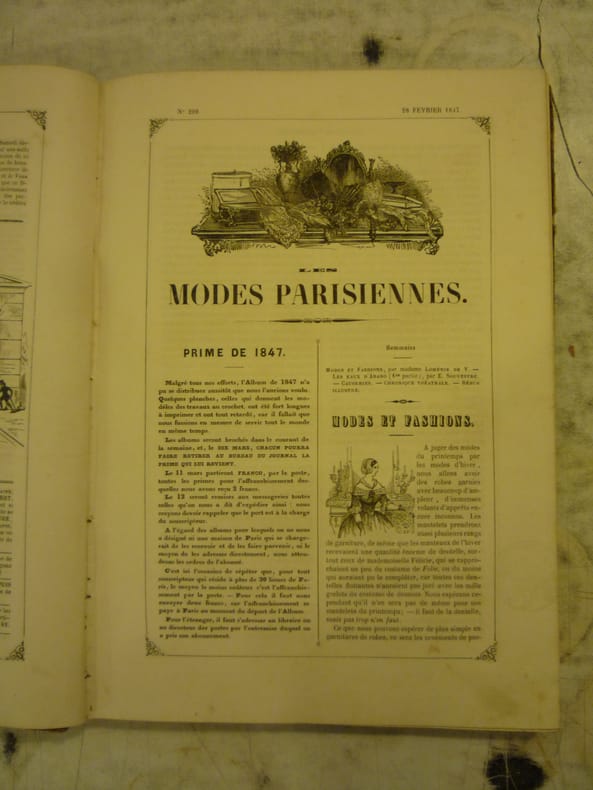
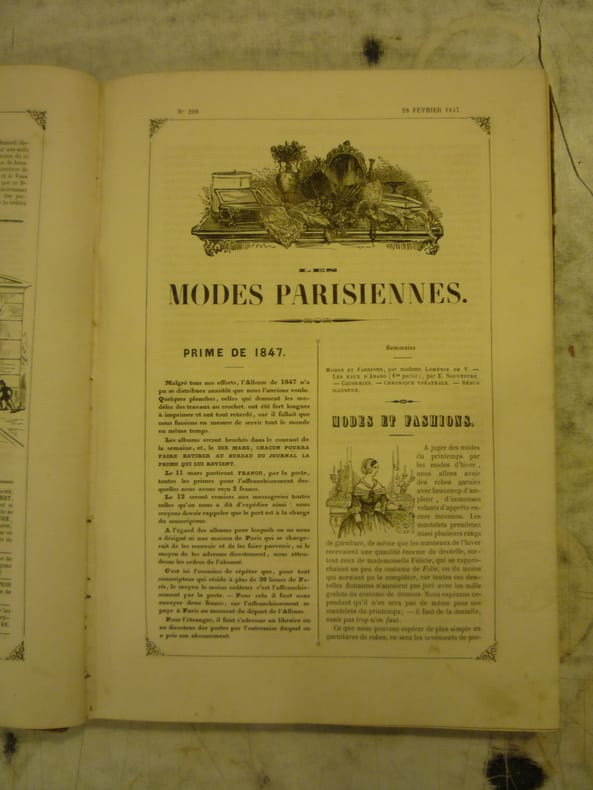
Modes Parisiennes, Paris, 1847, In French. The listing price of $99 is for a single issue of the periodical. Several issues are available during the period indicated in the listing title. Please inquire about availability of specific issues, id3-009678
Reference : id3-009678
Bookseller's contact details
BiblioEra
Payment mode
Sale conditions
We are based in the US and operate internationally. Our standard delivery times are quite long -- up to 45-60 business days – they are based on availability, normal processing and delivery companies. International orders may be subject to the customs fees and import duties of the country to which they are shipped. These charges are always the recipient’s responsibility. If your order includes heavy items, oversized items, and/or multi-volume sets, you may be required to pay additional shipping costs. If additional costs are required, we will provide you with a shipping quote for approval prior to processing your order. 30 day return guarantee, with full refund including original shipping costs for up to 30 days after delivery if an item arrives misdescribed or damaged.
5 book(s) with the same title
Ensemble de 95 planches extraites de la revue Les Modes parisiennes
Paris, Aubert et Cie, s.d. In-4, 95 ff., demi-basane noire de l'époque, dos lisse orné de quadruple filets dorés, titre doré au dos (reliure frottée, coiffe supérieure manquante, rousseurs).
Planches des Modes parisiennes, rehaussées de couleurs et parfois d'or, la plupart gravées par G. Montant d'Oloron d'après Compte Calix, Edmond Morin . Elles sont numérotées de 353 à 448. La revue Les Modes parisiennes a été créée en mars 1843 et a paru jusqu'en 1896, exceptée pour la période allant d'octobre 1870 à mars 1871. Elle a paru de façon hebdomadaire de 843 à 1879 et bimensuelle à partir de 1880. Originellement publiée en format in-folio, elle sera rétrécie à un in-4 afin d'éviter les pliures lors des envois postaux. Ex-libris Gabriel Puaux. * Voir photographie(s) / See picture(s). * Membre du SLAM et de la LILA / ILAB Member. La librairie est ouverte du lundi au vendredi de 14h à 19h. Merci de nous prévenir avant de passer,certains de nos livres étant entreposés dans une réserve. La librairie ferme ses portes pour quelques jours et rouvrira le 18 août. Nous reviendrons vers vous dans les meilleurs délais./ The bookstore will be closed for a few days and will reopen on August 18th. We will get back to you as soon as possible.
[Aus: Allgemeine Moden-Zeitung & Les Modes Parisiennes Réunis]. Collection of 100 engraved and coloured fashion-plates. - [HIGH FASHION FROM PARIS - 100 COLOURED PLATES]
[Leipzig, Industrie-Comptoir / Baumgärtner etc.], (1833-1856). Small queer-folio (22 x 28,5) cm. Nice later light brown half calf from ca. 1900 with five raised bands and gilt lines to spine (Carl Petersens Enke). Slight wear to extremities. 100 engraved plates, in contemporary colouring. A bit of even browning and occasional offsetting. A few plates with more browning. Some plates with tiny holes in blank margin, from original stiching (having been vertically bound with text-leaves). Occasional light creasing. One plate with a tear (no loss). A few plates signed A. Brückner, most plates numbered and dated, and some plates having ""Extra-Kupfer"" or ""Les Modes Parisiennes Réunis"" (the last five) underneath.
A lovely collection of 100 beautiful contemporarily coloured engraved fashion-plates from between 1833 and 1856, importing the highest Parisian fashion of the time to Germany. This beautiful collection magnificently documents the clothing fashion and development of two decades, primarily for women, but also for children and men. Also in the mid-19th-century, Paris was seen as the quintessence of elegance and style. The Allgemeine Moden-Zeitung kept the German-speaking public up to date with the latest fashions from Paris. The magazine “Les modes parisiennes reunites” did the same"" that too was produced for the German public, despite its French title. As well as outfits for appearing in high society, eg. at the theatre, the fashion plates collected here show clothes and notably also accessories for almost all other parts of life - paying and receiving social calls, going for walks, attending different events, musical siorées, going out with the children, etc. “As part of her evening wardrobe, every fashionable lady simply had to have elegant dresses in brightly coloured silks and satins, with frills and lace, bows and flounces, tight bodices, natural waistlines and exposed shoulders, which gave the female figure an hour-glass silhouette. The first thing that strikes one about these ladies’ fashions are the stiff, voluminous underskirts. Horsehair crinolines (invented in 1850) supported wide, sweeping skirts, which could measure up to two or two-and-a-half metres in diameter and made the upper body look even slimmer.” (Deutsches Historisches Museum). ""From the 1820s onwards, and particularly under the ostentatious Second Empire (1852–1870), the classicising taste of the Napoleonic era changed completely. Instead, fashion now drew inspiration from the elegance of the Rococo period, so much so that the period became known as the “second Rococo”. The waistline returned to its natural level but was awkwardly styled – at least from a health point of view: agonisingly tight corsets emphasised the so-called “wasp waist”. Ostensibly guided by aesthetics, on closer inspection this fashion trend also had social consequences: with styles that afforded women so little freedom of movement, fashion focused on the ostentatious requirements of ladies from the upper echelons of society, who didn’t have to work. Practicality was not its concern. This ostentatious and – certainly from the perspective of the 21st century – inconvenient fashion style appealed not only to the fine ladies of high society, but also to women from the middle classes and the petty bourgeoisie. The expansion of the textile industry and the rise of the chemical industry made the production of dyes, fabrics, lace, and embroidery and the processing of raw materials and textiles imported from the colonies both quicker and cheaper.” (DHM)
Les Modes Parisiennes [ Recueil de texte avec 47 planches en couleurs ]
1 vol. in-4 reliure demi-basane marron, Les Modes Parisiennes, s.d. [ circa 1855 - 1856 - 1857 ] pp. 1177 à 2808 (non suivi) avec 47 planches en couleurs (numérotées entre 517 et 700)
Joli recueil réunissant, de manière non suivie, plusieurs livraisons et 47 très belles planches en couleurs. Bon état (reliure et coins lég. frottés, bon exemplaire par ailleurs)
Modes Parisiennes - 1855
Aux Bureaux des Modes Parisiennes] 21 x 28 Couverture rigide Paris] 1855 Volume in-4, reliure demi-basane de l'époque, dos lisse avec filets dorés, titre et année de publication dorés, p. [1885] à 2508, 52 numéros de l'hebdomadaire, 53 gravures de mode coloriées hors texte, dont deux dépliantes (Maison Gagelin et robes et manteaux de M. Delisle), sur papier fort signées Compte-Calix et gravées par G. Montaut, A. Portier. Chaque numéro comporte 12 pages et une gravure. Les rubriques sont : Modes, Fashions et causeries / Détails du dessin / Histoire de .../ [feuilleton] / Poésie / Chronique musicale et théatrale. A noter publicité pour la prime de 1856 et pages consacrées aux souvenirs de l'exposition universelle de 1855. Gravures en bon état, quelques rousseurs, reliure modeste et usée.(ApC132) PHOTOS NUMERIQUES DISPONIBLES PAR EMAIL SUR SIMPLE DEMANDE-DIGITAL PHOTOGRAPS MAY BE AVAILABLE ON REQUEST Livre
Satisfaisant

Costumes Suédois dessinés par MM. Camino et Regamey d'après les dessins originaux communiqués par M. de D....L et gravés par Charles Geoffroy. ‘Prime du Journal les Modes Parisiennes’.
Paris, Plon (pour) Modes Parisiennes, Toilette de Paris, Journal Amusant et Petit Journal pour Rire, (pl. imprimées par Moine et Falconer), s.d. (ca. 1860), gr. in-4to, 20 planches gravées sur acier finement coloriées à la main, avec papier serpent, très lég. rousseurs insign. dans qqs planches princip. marg., lég. rousseurs sur toute la planche nr. 20, minime trou dans l'extrémité du coin supér., brochure originale avec titre, tachée, haut et bas du dos abîmés (déchir.).
Collection of 20 charming steel-engraved and finely handcoloured beautiful traditional Swedish costumes, from the various regions: 16 plates each one representing a women, 1 plate of a women with a child, two plates of one man, and one plate showing a young girl. Very light and rare foxing in just a few plates mainly mar., the last plate (the one of the young girl) with overall very light foxing. Wrappers with title cover, stained, tears to spine. Colas 511; Lipperheide Haa 24. Image disp.

(SLACES, NVVA)
Phone number : 41 (0)26 3223808

