 Write to the booksellers
SALOMON
The Song of Songs
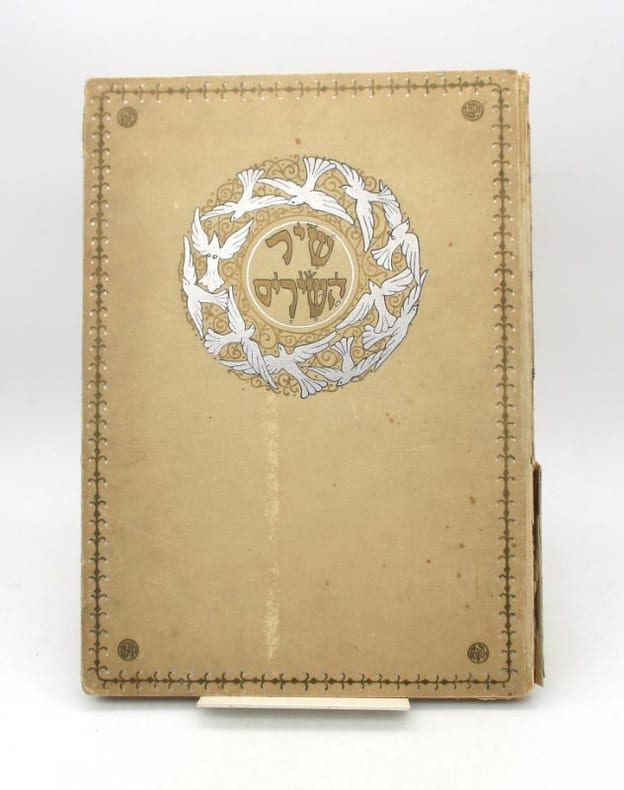
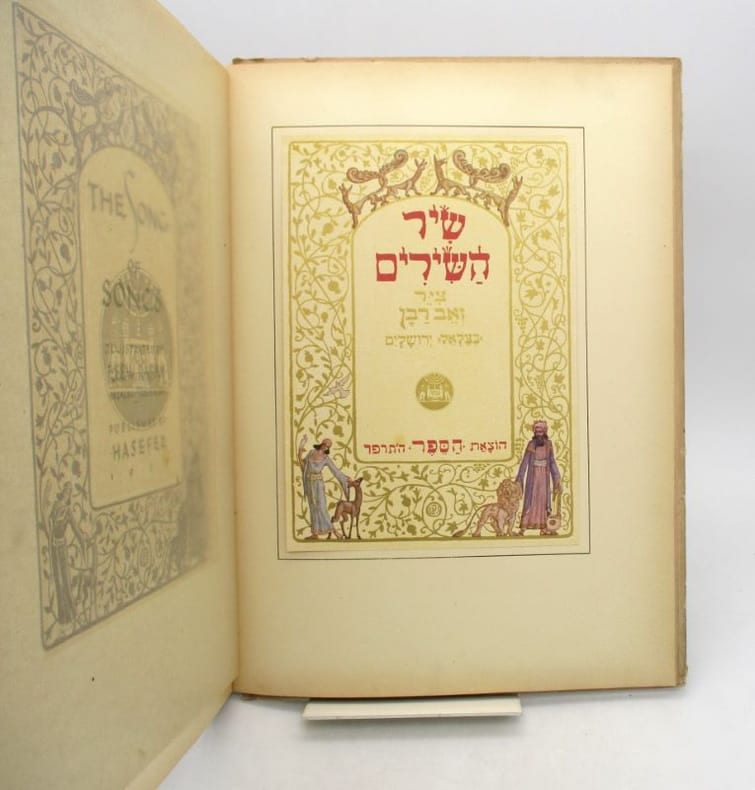
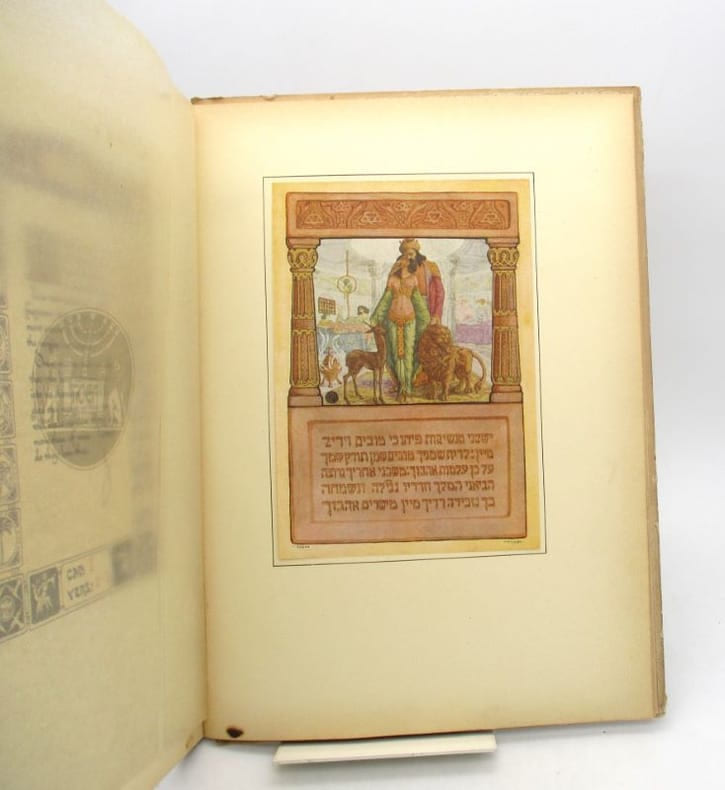
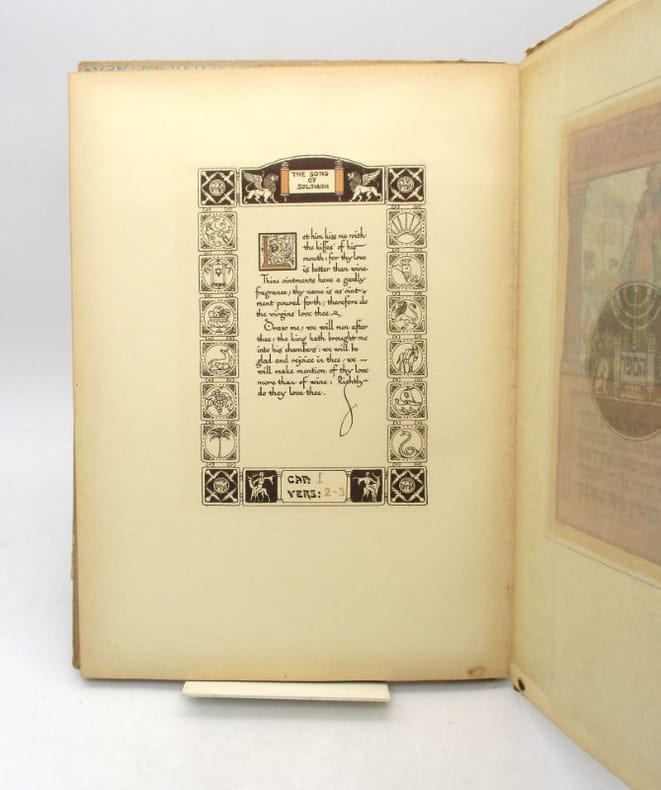
Jérusalem, Hasefer, 1923. In-folio, non paginé, percaline beige de l'éditeur, frise dorée en encadrement sur les plates, fleuron doré et argenté sur un plat, petit cartouche noir à l'autre, dos long orné de frises argentées et fleurons noirs (manques au dos, taches au cartonnage).
Reference : 21165
Jolie édition du Cantique des cantiques illustrée par Zeew Raban. La page de droite comprend le texte en hébreu dans un encadrement dans le goût des anciens manuscrits enluminés hébraïques, en regard se trouve la traduction en anglais et entre les deux, des serpentes illustrées. * Membre du SLAM et de la LILA / ILAB Member. La librairie est ouverte du lundi au vendredi de 14h à 19h. Merci de nous prévenir avant de passer,certains de nos livres étant entreposés dans une réserve.
Bookseller's contact details
L'Ancienne Librairie
M. Alban Caussé
3 Rue Pierre l'Ermite
75018 Paris
France
librairie.ancienne.paris@gmail.com
09 78 81 38 22
Payment mode


Sale conditions
conforme aux règles du SLAM
5 book(s) with the same title
Commentary on the Song of Songs
, Brepols, 2026 Paperback, Pages: 389, Size:156 x 234 mm, Language(s):English, Latin. ISBN 9782503623924.
Summary The Benedictine abbot Rupert of Deutz (d. 1129) was among the most prolific, innovative, and influential of medieval theologians. Well-positioned in time and space to respond to the unfolding of the twelfth-century reform of European religious life, he actively engaged with proponents of the lay piety movement and the new religious orders as an apologist for monastic tradition. The bulk of Rupert's surviving writings, however, addresses biblical and liturgical texts. His inventive Commentary on the Song of Songs offers a window into both his ecclesiastical context and his own role in the formation of the cult of the Virgin. Here, the Benedictine represents the famously obscure Song of Songs as the love-story of God the Father and the Virgin Mother of His Son, the first fully Marian interpretation of the ancient biblical canticle. Rupert's Commentary on the Song of Songs, presented here in full English translation, projects his voice to modern communities of learning and inspiration far beyond the medieval studies and theological audiences to whom he has already been well known. With facing Latin, it will now be accessible to those interested in biblical interpretation, the history and theory of gender, and Christian spritual tradition. This volume is based on the authoritative critical edition of Rupert's commentary by Raban Haake, O.S.B., published as CCCM 26 in 1974. Its introduction reviews the vibrant scholarship on Rupert and the tradition of Song commentary published in the intervening decades, most importantly by John Van Engen, E. Ann Matter, and Rachel Fulton Brown. TABLE OF CONTENTS Abbreviations Introduction Rupert and the Twelfth Century Rupert in Li ge and Beyond The Song Commentary Tradition Rupert as Commentator Rupert, Reading, and Spirituality Rupert and his Struggle with Scripture Manuscript Tradition Translation Conventions Text and Translation Select Bibliography of Works Pertaining to Rupert's Song Commentary
Cantiques Salemon The Song of Songs in MS Paris BNF fr. 14966,
Turnhout, Brepols, 2006 Hardback, VIII+256 p., 160 x 240 mm. ISBN 9782503518060.
This volume contains the first critical edition of the latest of the three medieval French adaptations of the Song of Songs. There are three medieval French adaptations of the Song of Songs, each reflecting a distinct exegetical tradition. The latest of these three, here edited for the first time (from BNF fr. 14966), adopts the tropological interpretation according to which the Song depicts the relationship of the individual soul with God. The mystical, contemplative approach owes much to Bernard of Clairvaux, William of St Thierry, and Thomas the Cistercian, and this Cistercian tradition also has close links with the Beguines, a connection which receives detailed exploration in the editor's extensive Introduction. Writing in the late-thirteenth century in north-eastern France, the author of the Cantiques is aware of such an association and not only engages in the familiar procedures of allegorization, but, more originally, inserts into his commentary eight lyrics which are modelled on known secular chansons which receive full attention from the editor. Within the text, which covers Song 1. 1 to Song 3. 11 in 2544 octosyllables arranged in eight-line stanzas, speeches are assigned to Sponsus, Sponsa, Magister, and Religio. The Cantiques Salemon is the work of a poet rather than of a theologian, reflecting many elements associated with 'la courtoisie mystique', which in turn is characteristic of writing for the Beguines. The editor provides a detailed summary of the text, full glossary and notes as well as an account of the language. To these is added a study of the poet's principal literary techniques, involving both the varied processes of translation and the elaboration of a network of links between stanzas together with the imprint of a personal, lyric quality on the whole. Languages : English, Middle French.
Solomonis panaretos or, A commentarie upon the books of Proverbs, Ecclesiastes, and the Song of Songs.
London, John Bellamie, 1650. 4to. In contemporary full calf with four raised bands and triple ruled fillets to boards. Small paper-label pasted on to top of spine. Upper front hinge split and spine-ends with a few tears. Inner hinges split. Boards slightly soiled. Both font free end-paper with annotations in contemporary hand. Internally with occassional light marginal browning but generally nice and clean. (14), 374, (2), 32, 35-58, 61-76, 83-234, 239-334 pp.
First edition of Trapp’s commentary and interpretation on three books from the Old Testament of the Bible: Proverbs, Ecclesiastes, and the Song of Songs.
Reference : 40599aaf
The song of songs. Copper engravings by Ru van Rossem.
London, Folio Society, 1967, in-4°, frontispiece + 22 p. + 5 engravings reproductions + 1 ll, orig. clothbound, slipcase,
The illustrations were engraved in 1949 for a small limited edition of ‘The Song of Songs’, published by the Collectors' Book Club.

(SLACES, NVVA)
Phone number : 41 (0)26 3223808
The Song of Songs and the Ancient Egyptian Love Songs.
Wisconsin, University of Wisconsin Press, (1985). Orig. full cloth. VIII,454 pp.

