 Write to the booksellers
LAMARTINE (Alphonse de)
Raphaël
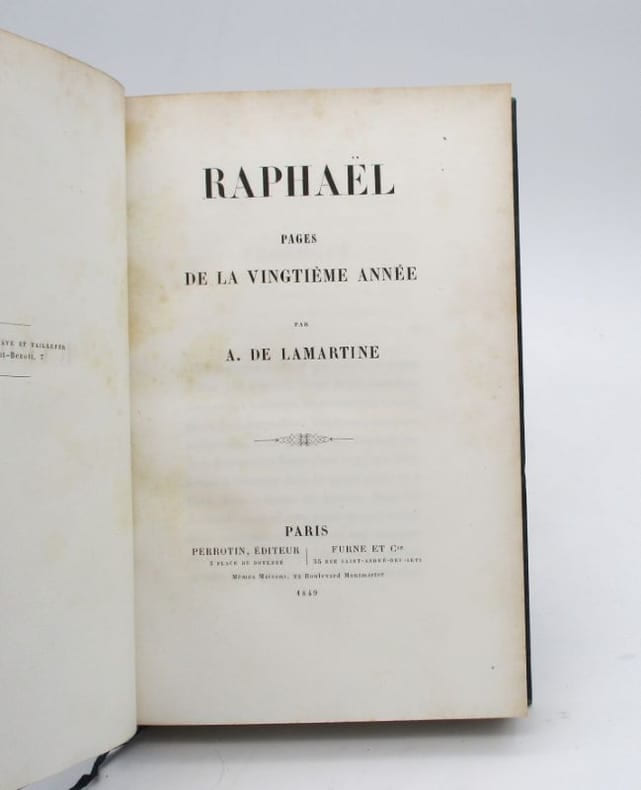
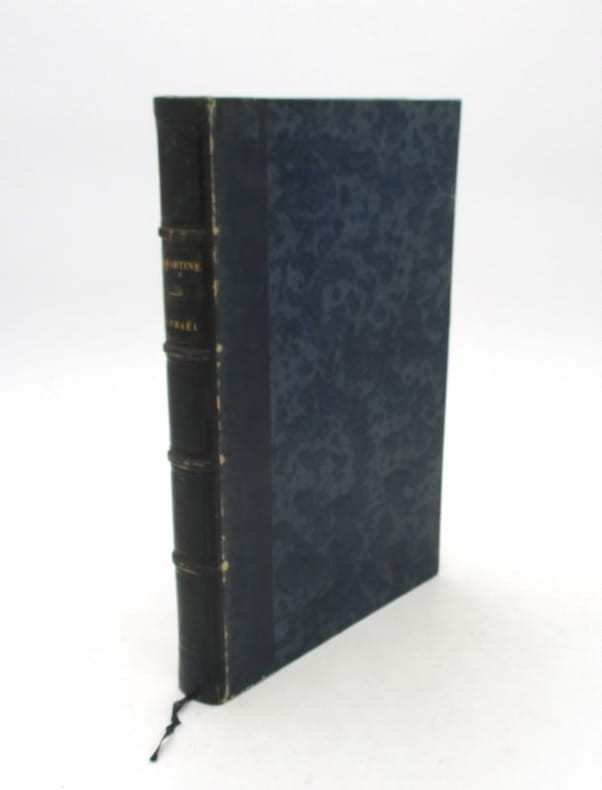
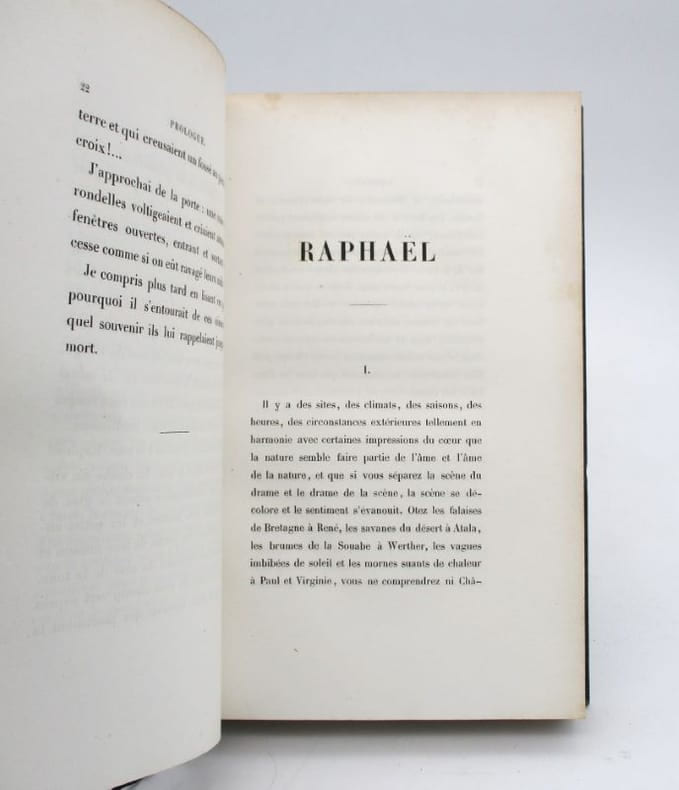
Paris, Perrotin, Furne & Cie, 1849. In-8, 354 pp., demi-veau bleu marine de Capé, dos à nerfs orné de caissons à froid, tranches mouchetées (dos éclairci, petites épidermures, pâles rousseurs, quelques petites taches).
Reference : 18635
Édition originale de ce roman autobiographique sous-titré "Pages de la vingtième année" dans lequel il raconte sa rencontre avec Julie et l'amour qui lui porte. Elle décède peu de temps après. Lamartine l'immortalise ici sous son vrai prénom, comme dans les Méditations poétiques sous le nom Elvire. Vicaire, IV, 990. Voir photographie(s) / See picture(s) * Membre du SLAM et de la LILA / ILAB Member. La librairie est ouverte du lundi au vendredi de 14h à 19h. Merci de nous prévenir avant de passer,certains de nos livres étant entreposés dans une réserve.
Bookseller's contact details
L'Ancienne Librairie
M. Alban Caussé
3 Rue Pierre l'Ermite
75018 Paris
France
librairie.ancienne.paris@gmail.com
09 78 81 38 22
Payment mode


Sale conditions
conforme aux règles du SLAM
5 book(s) with the same title
[Raffaello Sanzi or Santi, called Raphael] - Mason, Rainer Michael, and Mauro Natale
Reference : 121320
(1984)
Raphael et la Seconde Main. Raphael dans la gravure du XVIe siecle. Simulacres et proliferation. Geneve et Raphael
Mason, Rainer Michael, and Mauro Natale: Raphael et la Seconde Main. Raphael dans la gravure du XVIe siecle. Simulacres et proliferation. Geneve et Raphael. Exhibition: Geneva, Cabinet des Estampes, 1984. 290 pages. Paperback. 25 x 24cms. Text in French.
Text in French

[Raffaello Sanzi or Santi, called Raphael] - Brown, David Alan
Reference : 069819
(1983)
ISBN : 0894680641
Raphael and America
Brown, David Alan: Raphael and America. Exhibition: Washington, National Gallery of Art, 1983. 208pp with 19 colour plates and 118 monochrome illustrations. Paperback. 28x23cms. Catalogue of 103 works divided into two sections: early American artists and collectors influenced by Raphael; Raphael's creativity as shown by his paintings in America.
Catalogue of 103 works divided into two sections: early American artists and collectors influenced by Raphael; Raphael's creativity as shown by his paintings in America. Text in English
[Raffaello Sanzi or Santi, called Raphael] - Wouk, Edward H.; Leslie A. Geddes, Lisa Pon et al.
Reference : 115117
(2016)
ISBN : 9781526109569
Marcantonio Raimondi, Raphael and the Image Multiplied
Wouk, Edward H.; Leslie A. Geddes, Lisa Pon et al.: Marcantonio Raimondi, Raphael and the Image Multiplied. Exhibition: Manchester, Whitworth Art Gallery, 2016. 240 pages; illustrated. Paperback. 28 x 24.7cms.
[Raffaello Sanzi or Santi, called Raphael] - Brown, David Alan and Jane van Nimmen
Reference : 082056
(2005)
ISBN : 0300108249
Raphael and the Beautiful Banker. The Story of the Bindo Altoviti Portrait
Brown, David Alan and Jane van Nimmen: Raphael and the Beautiful Banker. The Story of the Bindo Altoviti Portrait. London and New Haven: Yale University Press, 2005. 262pp with 28 colour and 142 monochrome illustrations. Cloth. 26.3x20cms.
Text in English
"(FIBIGER, MATHILDE) + (JULIUS CHRISTIAN GERSON) (+) (PETER VANDAL)
Reference : 63447
(1851)
Clara Raphael. Tolv Breve, udgivne af Johan Ludvig Heiberg. Andet Oplag (+) Fem Breve til Clara Raphael fra en Ung Hustru (+) Blik paa det verdenshistoriske Værk ""Clara Raphael"" og den derved fremkaldte Damelitteratur.
Kjøbenhavn, 1851. 8vo. In recent blue paper covered boards with white paper title-label to front board. Annotations in pencil to pasted down front end-paper. Internally with light occassional brownspotting. X, 110, 35, (1), 71 pp.
A most interesting sammelband containing the scarce second edition, published the same year as the first, of the first feminist novel in Denmark, the highly controversial and influential ""Clara Raphael"", which is the work that sparked the battle for women's rights in Denmark. Bound together is one of the most important responses to it from the same year (“Fem Breve til Clara Raphael”) as well as Drejer’s (under the pseudonym Vandal) critical commentary. Fibiger’s novel caused enormous controversy. The intellectual elite was in uproar. Within the first year of its publication, ca 25 responses to it were published in newspapers and periodicals and ca 10 brochures and pamphlets pertaining to it. The novel caused vexation in all political camps. The demands for equality between the sexes were scrutinized in all regards, and many politicians began singing the praises of “the woman of the home”. It is in this strain of thought that the famous author of children’s books, Julius Christian Gerson, wrote his significant contribution to the feud, “Five Letters to Clara Raphael from a Young Wife”, also published in 1851. Using the pseudonym “A Young Wife”, he claims, in the voice of this fictitious woman, that Fibiger’s novel had violated the female gender and that the emotions and the striving that are presented as those most pertinent for the woman, are completely foreign to the true woman. He lets his fictitious female author praise herself for being “a young mother who wishes for nothing and wishes to be nothing outside of her circle.” The debate that arose following the publication of ""Clara Raphael"" was very harsh indeed, and the whole public debate was hard on Mathilde Fibiger. Her views were lost on almost all notable men of the period, but she clearly needed to defend herself. ""Clara Raphael"" is the main work of feminism in Denmark and the first Danish governess novel. It founded an entirely new genre of women's novels hitherto unknown in Denmark. The work, which constitutes the break-through of feminism in Denmark, was greatly controversial and immediately caused great furore. It resulted in the so-called Clara Raphael Dispute, in which for instance N.F.S. Grundtvig defended Mathilde Fibiger. Due to the controversial contents of the work, Mathilde Fibiger published it anonymously, and only J.L. Heiberg (1791-1860, perhaps the most famous cultural persona during the Danish Golden Age. He played a more significant role than any other author or thinker during this period) is mentioned on the title-page, as the editor. No publisher had wanted to touch this highly controversial work, and it was only after the appearance of ""Jane Eyre"" that a publishing house dared take it on. As Mary Wollstonecraft had pioneered feminist philosophy with ""A Vindication of the Rights of Women"" from 1792 and argued for education as the means to liberate women, so Mathilde Fibiger surprised her Danish contemporaries with her groundbreaking novel ""Clara Raphael. Twelve Letters"", from 1851, in which she made the connection between the national-democratic movement and the liberation of women. With this book, which deals with the inequality of the sexes and the lack of possibility for women to develop themselves, Mathilde Fibiger became the first notable advocate of the emancipation of women in Denmark. It was not only the political controversy caused by the request of equality that made the book so extremely controversial, it was also the ability of the merely 20 year old author to clearly and precisely state and substantiate the essential problems. When reading the book, it is not difficult to see why it came to have the effect that it did, and why it caused the furor that it did. For instance, Clara Raphael, when despairing at the position of women in society, writes: ""Our position in society is tragic, and why? What right does man have to suppress us? For subjugated we are, despite the chains being gilded."" She understands that casting off these chains will be no easy matter, and that it will not only be a matter of politics, but also of consciousness and mindset: ""When the peasants were granted their freedom, some of them wept, begging for permission to keep things as they had been."" One of the beaming sentences of the novel is Clara's response to her friend when asked what she is actually fighting for: ""I will fight and live for what I understand by the emancipation of women."" Her hope of breaking with the existing patriarchal system of society required national and democratic self-awareness, which for her constituted a promise of freedom. In 1871, Frederik Bajer (1837-1922) and Matilde Bajer (1840-1934) founded the Danish Women's Society, the first women's organisation in Denmark. Mathilde Fibiger was one of the earliest members of the Society. When the Danish Women's Society was established, it did not demand female suffrage. It was not until 1906 that a majority of the members were in favour of making that demand the official policy of the Society. In Denmark, women were not allowed to vote in parochial church council elections until 10+3" not until 1908 were they allowed to vote in parish council and local council elections, and not until 1915 in the Folketing and the Landsting elections. It was not until then that women became fully-fledged citizens in a political sense.

