 Write to the booksellers
NICOLAI, FRIEDRICH.
Versuch über die Beschuldigungen welche dem Tempelherrenorden gemacht worden, und über dessen Geheimniss. 2 vols. - [SEMINAL WORK ON THE KNIGHTS TEMPLAR - PRESENTATION-COPY]
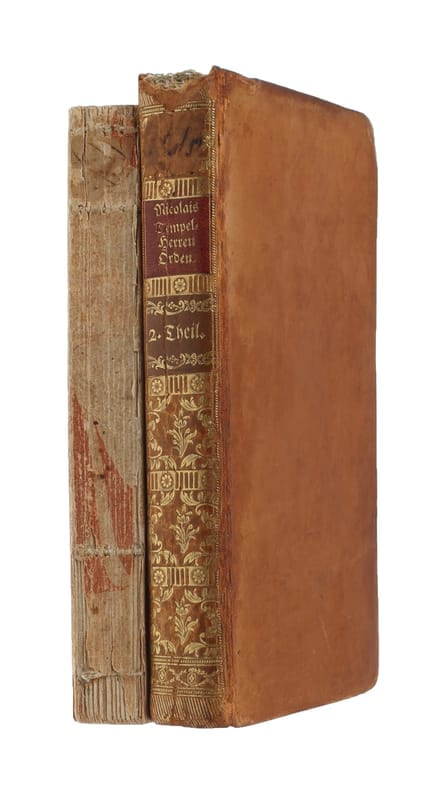
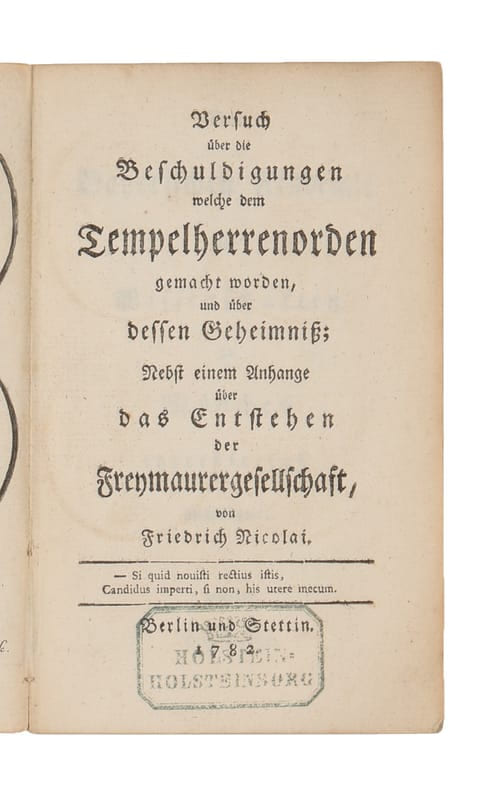
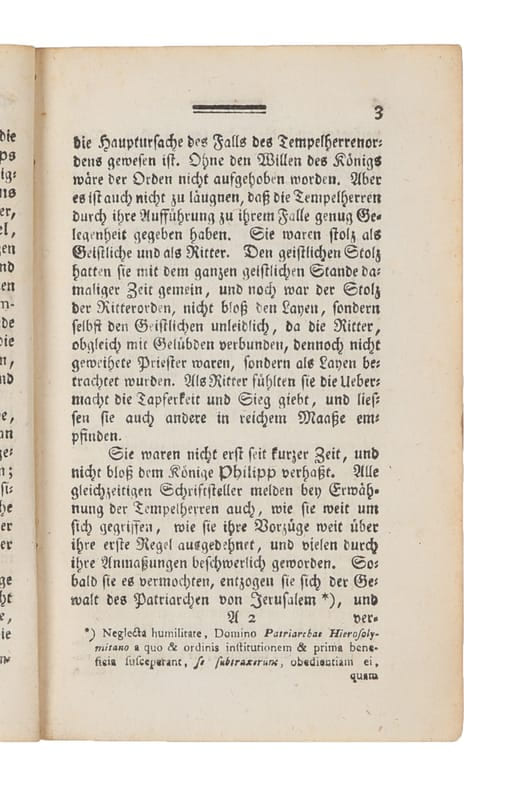
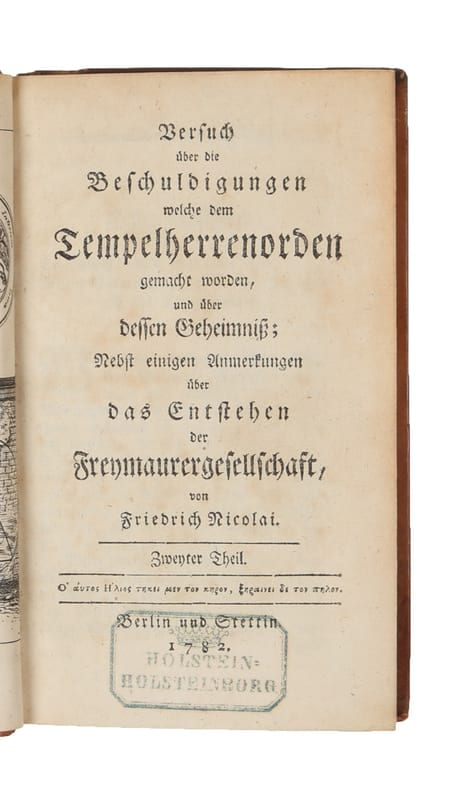
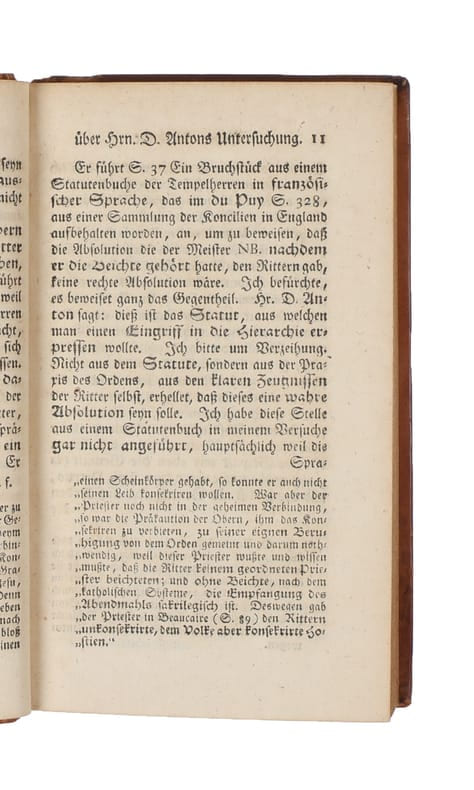
Berlin & Stettin, 1782. 8vo. Two volumes, vol. 1 in the original marbled paper covered boards. With author's presentation inscription to verso of front board. Ex-libris to verso of front board and stamp to title-page. Internally very nice and clean. Printed on good paper. (4), II, 215, (1) pp.Volume 2 in contemporary full calf with richly gilt spine. With author's presentation inscription to front free end-paper. Internally very nice and clean. Printed on good paper. Stamp to title-page. 249, (5) pp. + frontispiece.
Reference : 63013
Presentation copy of first edition of this seminal work on the Knights Templar. The present work presents a critical re-examination of the accusations brought against the Templars during the suppression of the Order rejecting the previous sensational and conspiratorial interpretations in favour of a rational, source-based historical analysis - hence being one of the earliest works to treat the Templars systematical and histiographical way. Of particular interest is the essay on the origins of Freemasonry in which Nicolai addresses and partly reject the widely held notion of a direct continuity between the Templars and the Masonic fraternity. The second part was published only because the first volume caused several counter-writings on the one hand because Nicolai assigns the Templars a share of responsibility for their downfall, and on the other because he allegedly cast Freemasonry in a negative light. In the second part he defends his investigations. Christoph Friedrich Nicolai (also spelled Nickolai) (1733–1811), German writer, publisher-bookseller, historian and a leading representative of the Berlin Enlightenment. As a Freemason he was a member of the Berlin lodge “Zu den drei Weltkugeln.” “Nicolai wrote many independent works. His “Charakterischen Anekdoten von Friedrich II” (1788–92), an account of events in the court of Frederick II the Great, has some historical value. His romances are forgotten, although “Das Leben und die Meinungen des Magisters Sebaldus Nothanker” (1773–76 “The Life and Opinions of Master Sebaldus Nothanker”) and his satire on Goethe’s Werther, “Die Freuden des Jungen Werthers” (1775 “The Joys of Young Werther”), were well known in their time.” (Encyclopedia Britannica). Nicolai’s alternative “happy ending,” of Werther prompted Goethe to immortalize him in the satirical poem “Nicolai auf Werthers Grabe”. Goethe later caricatured him again in “Faust”. Kloss 2232Wolfstieg 5138
Bookseller's contact details
Herman H. J. Lynge & Son
William Schneider
Silkegade 11
1113 Copenhagen
Denmark
+45 33 155 335
Payment mode
Sale conditions
All items may be returned for a full refund for any reason within 14 days of receipt.

