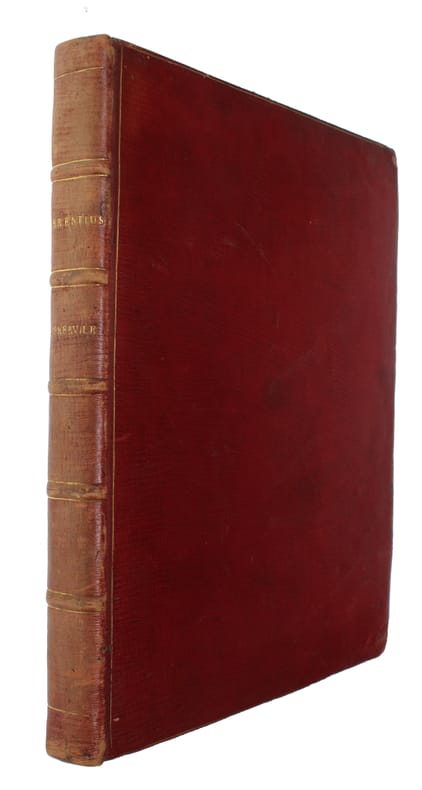
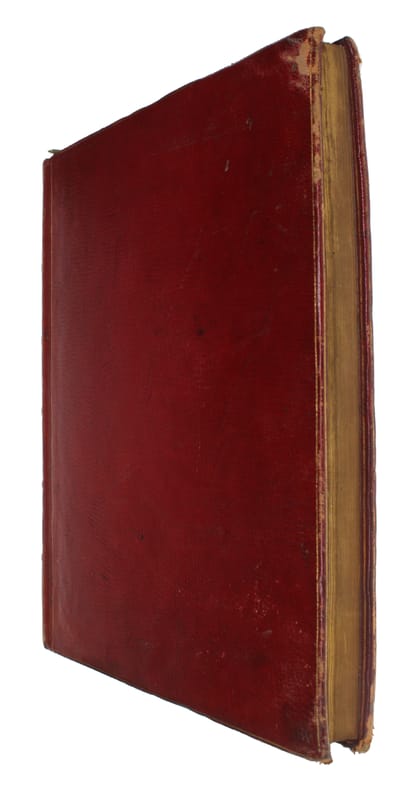
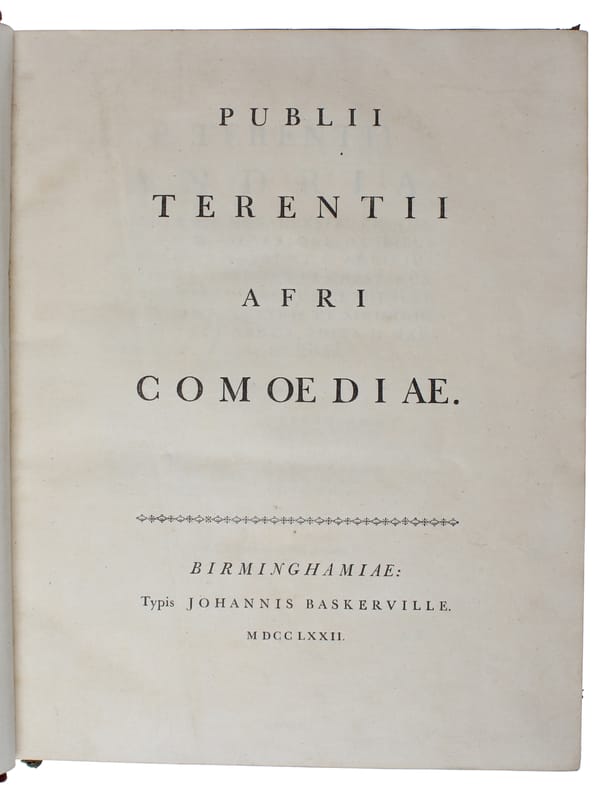
Birmingham, Baskerville, 1772. 4to. In full red morocco with five raised bands. Spine with sunning and light wear to extremities, otherwise a nice an clean copy. (2), 364 pp.
Reference : 60183
Baskerville-edition of Terence's famous comedies. His plays were heavily used to learn to speak and write in Latin during the Middle Ages and Renaissance Period, and in some instances were imitated by Shakespeare.
Herman H. J. Lynge & Son
William Schneider
Silkegade 11
1113 Copenhagen
Denmark
+45 33 155 335
All items may be returned for a full refund for any reason within 14 days of receipt.
Paris Le Loup & Mérigot 1753
Deux volumes in-12 (179 x 109 mm), demi-maroquin rouge, coins, dos à cinq nerfs orné, tête dorée, non rogné (reliure milieu XIXe siècle). Illustrations de GRAVELOT, dont le portrait de Terence en médaillon sur chaque titre, 7 figures hors texte dont une en frontispice, 37 vignettes et 28 culs-de-lampe, gravés par Delafosse, J.P. Lebas et D. Sornique. Exemplaire sur Hollande, avec les figures avant la lettre. De la collection des classiques Barbou. (Cohen 982). (quelques menus frottements, rousseurs). // Two 12o volumes (179 x 109 mm), red three-quarter morocco, spine tooled raised on five bands, top edge gilt, uncut (middle of 19th-cent. binding). Illustrations by GRAVELOT, including the vignette portrait of Terence on both title pages, 7 plates (one in frontispiece), 37 vignettes and 28 culs-de-lampe, engraved by Delafosse, J.P. Lebas and D. Sornique. Copy on Holland paper, with the engravings before lettering. From collection "classiques Barbou". (Cohen 982). (some minor rubbings, brownings).
PUBLIUS TERENTIUS AFER [PUBLII TERENTII AFRI] (LEMAIRE N.E., ed.)
Reference : K72024
(1827)
Parisiis [Paris], Lemaire 1827-1828 complete in 3 volumes: cciii,470 + 362 + viii,437pp., 22cm., in the series "Bibliotheca classica latina sive collectio auctorum classicorum Latinorum cum notis et indicibus", cart.cover (spine in cloth, marbled plates), few foxing, text in Latin, Good condition, K72024
Basileae (Basel), Sumptibus Jacobi Decker - Typis Philippi Jacobi Dannbach 1797, 335x255mm, 492pages, reliure pleine veau-marbré de l’époque. Filets, fleurons et titre dorés au dos à faux-nerfs. Encadrements dorés sur les deux plats. Coiffes et charnières usées.
texte en latin, Pour un paiement via PayPal, veuillez nous en faire la demande et nous vous enverrons une facture PayPal
Frankfurt (Francofurti), In Bibliopolio Heringiano, 1623.
4to. (XX),666 (recte 664) p. Modern plain and tasteless boards. 22 cm (Ref: VD17 1:043236K; Graesse 6/2 58/59; Ebert 22504; Schweiger 2,1064; Fabricius/Ernesti 1,58: 'editio insignis atque reliquis praeferenda') (Details: Title printed in red & black. An engraved portrait of Terentius on the title. Bookblock in good condition) (Condition: Binding plain and very shabby. Bookblock loose in the binding. Front flyleaf loose, front pastedown gone. Title dustsoiled. Paper yellowing) (Note: The 6 plays of the Roman playwright Publius Terentius Afer, ca. 190-159 B.C, remained from antiquity through the Middle Ages, and in later centuries an example of style, and a rich source for moral sentences. In the 15th and 17th century his plays were frequently staged in schools. He was born in the Roman province Africa and came as a slave in the houshold of the senator Terentius Lucanus. He adopted his name when he was manumitted. Terentius is the author of 'fabulae palliatae', which means 'plays in Greek cloths'. He adapted Greek plays, especially those of the Greek playwright Menander, to the taste of the Romans. Six of his comedies have survived. For later generations he became a model for elegant Latin. His style was closer to everyday conversation than Plautus, an earlier contemporary comic playwright, whose style was more extravagant. He was quoted by Cicero, Horace, Persius and the Church Fathers. Ever since antiquity he lived also a long and influential life in schools as a model for Latin language and rhetoric. In the Middle Ages Terentius was read for his moral sentences. He was imitated by the German abbess Hrotsvitha of Gandersheim, ca. 935 - ca. 973 in her 'Dramenbuch', with which she wanted to create a Christian alternative for the pagan comedies. With the coming of humanism Terentius enjoyed a renaissance in the classroom and on stage. Scholars rejected the 'barbaries' of Medieval Latin and chose the elegance of Cicero and Terentius as their model. In his 'De ratione studii' (1511) the Dutch humanist Desiderius Erasmus, 1466-1536, encouraged the study of Terentius, whom he thought congenial to youth. Thus they could master a pure Latin style, and learn at the same time good morals. Erasmus seems to have learned the whole of Terentius by heart in his youth. He admired the author for his 'latinitas' and his civilized humor. His ideal as a humanist and pedagogue was the creation of better men with the help of the classics. Erasmus held the opinion, that schoolboys should read the edifying comedies of Terentius over and over again. So did also the Dutch Jewish philosopher Spinoza. He must have studied his Terentius very thoroughly. In his work hundreds of quotations and borrowings from Terentius can be traced. Spinoza used them to define and illustrate human feelings, weaknesses and passions. (F. Akkerman, Spinoza's tekort aan woorden, Leiden, 1977, p. 3) This Frankfurt edition of 1623 is a revised edition of the edition Paris 1602, which was produced by the German scholar Heinrich Lindenbrog, 1570-1642. He added to the text the commentaries of the Roman grammarian and rhetorician Aelius Donatus, 4th century AD, and the 6th century AD grammarian Eugraphius. The last commentary deals especially with the rhetorical aspects of the comedies. Lindenbrogius studied classics in Leiden under the famous J.J. Scaliger. After his studies he made a tour which brought him and his friend Johannes van Wouweren to France, to the monastery of St. Victor. It was told, that they stole there with the help of a monk 16 manuscripts. They became known as 'Les Corsaires de Hamburg'. He was arrested, but came free with the help of the French scholar Pierre Dupuy (Puteanus), 1582-1651, the son of the humanist and famous bibliophile Claude Dupuy, who was a great collector of manuscripts. Little is known of the rest of his life. From 1610 onward till his death, Lindenbrog was the librarian of the Duke Johann Adolf von Holstein, who had assembled in Gottorp a great collection of books. (ADB 18,693) In the preface Lindenbrogius confesses that he also was imbibed with Terentius as a schoolboy. 'Quem (Terentium) enim pueri amavimus, eiusdem amoenitate ac venere vel hac quoque aetate nos capi, non erubescimus'. (Lectori p. a2 recto)) (Collation: a-b4, c2, A-4O4. Pagination skips at 584 2 numbers)) (Photographs on request)
The Hague (Hagae-Comitum), Apud Thomam Johnsonium, 1726.
4to. 2 volumes: (XII),LXXXIX,(5); 1240; 244, (379 index),(1 blank) p.; 2 frontispieces, portrait of Terentius. Vellum. 26.5 cm (Ref: STCN ppn 310362857; Cupaiuolo, 'Bibliografia Terenziana', no. 863; Schweiger 2,1068; Dibdin 2,475: 'A sumptuous and valuable edition'; Moss 2 673/74: 'the best edition which has yet been published'; Brunet 5,717: 'Édition fort recherchée à cause des commentaires et du bon index'; Fabricius/Ernesti 1,62; Graesse 6/2,60; Ebert 22519) (Details: Backs with 6 raised bands. Boards blind tooled. The 2 frontispieces are the same, they are made by P. van Cuyk; they depict a kneeling poet (Terentius), who offers a scroll to a seated Apollo, who offers him in return a laurel wreath; up in the sky hovers Fama, blowing her horn. Terentius' full page portrait is engraved after a portrait from the so-called 9th century Vatican Terence (Terentius Vaticanus, or Codex Vaticanus Latinus 3868)) (Condition: Bindings age-tanned and somewhat soiled. Vellum damaged at the lower edge of the upper board of the 2nd volume. Endpapers detached. Tiny wormhole at the upper margin of the last 2/3 of the first volume, sometimes nibbling at a letter. The paper of 13 gatherings (more than 100 pages) in the index is browning) (Note: The late antique grammarian Aelius Donatus (4th century A.D) wrote a short biography of the Roman playwright Publius Terentius Afer, ca. 190-159 B.C, in which he tells that Terentius was born in the Roman province Africa and that he came as a slave in the houshold of the senator Terentius Lucanus. He adopted his name when he was manumitted. Terentius is the author of 'fabulae palliatae', which means plays in Greek cloths. He adapted Greek plays, especially those of the Greek playwright Menander, to the taste of the Romans. Six of his comedies have survived. For later generations he became a model for elegant Latin. His style was closer to everyday conversation than Plautus', an earlier contemporary comic playwright, whose style was more extravagant. He was quoted by Cicero, Horace, Persius and the Church Fathers. Ever since antiquity Terentius lived also a long and influential life in schools as a model for Latin language and rhetoric. In the Middle Ages he was read for his moral sentences. He was imitated by the German abbess Hrotsvitha of Gandersheim (ca. 935 - ca. 973) in her 'Dramenbuch', with which she wanted to create a Christian alternative for the pagan comedies. With the coming of humanism Terentius enjoyed a renaissance, on stage and in the classroom as textbook. He was studied enthousiastically by scholars, students and schoolboys. Scholars rejected the 'barbaries' of Medieval Latin and chose the elegance of Cicero and Terentius as their model. In his 'De ratione studii' (1511) the Dutch humanist Desiderius Erasmus encouraged the study of Terentius for his language and moral utility. 'Among Latin writers, who is more valuable as a standard of language than Terence? He is pure, concise, and closer to everyday speech and, by the very nature of his subject matter, is also congenial to youth'. (The Classical Tradition, 2010, p. 930) Erasmus seems to have learned the whole of Terentius by heart in his youth. He admired the author for his 'latinitas' and his civilized humor. His ideal as a humanist and pedagogue was the creation of better men with the help of the classics. He held the opinion, that schoolboys should read Terentius over and over again. Thus they could master a pure Latin style, and learn at the same time good morals. From the 15th till the 17th century Terentius' plays were frequently staged in schools. The German scholar Arnold Heinrich Westerhoff, latinized as Arnoldus Henricus Westerhovius, ca.1677-1738, was rector of the Schola Latina of the Dutch city Gouda from 1711. In 1726 he published in two fat quarto volumes this sumptuous and very scholarly edition, with a copious index. It remained popular throughout the 18th century. It should be admired, according to Dibdin, more 'for elaborate care and research, than for exhibiting any critical niceties of construction of the text'. The edition contains the commentary of the 4th century A.D. Roman grammarian and teacher of rhetoric Aelius Donatus, the observations from the commentary of the 6th century grammarian Eugraphius, and the learned notes the German scholar Heinrich Lindenbrog, 1570-1642. Lindenbrogius (also named Lindenbruchius) studied classics in Leiden under the famous J.J. Scaliger. After his studies he made a tour which brought him and his friend Johannes van Wouweren to France, to the monastery of St. Victor. It was told that they stole there with the help of a monk 16 manuscripts. They became known as 'Les Corsaires de Hamburg'. He was arrested, but came free with the help of the French scholar Pierre Dupuy (Puteanus), the son of the humanist and famous bibliophile Claude Dupuy, who was a great collector of manuscripts. Little is known of the rest of his life. From 1610 onward till his death, Lindenbrog was the librarian of the Duke Johann Adolf von Holstein, who had assembled in Gottorp a great collection of books. (ADB 18,693) In the preface to his Terentius edition of Frankfurt 1623, Lindenbrogius confesses that he also was imbibed with Terentius as a schoolboy, and still loved to read him. 'Quem (Terentium) enim pueri amavimus, eiusdem amoenitate ac venere vel hac quoque aetate nos capi, non erubescimus'. (Edition 1623: Lectori p. a2 recto)) (Collation: pi2, dagger4, *-12*4 (minus blank leaf 12*4); A-5P4, 5Q2 (verso leaf 5Q2 blank); 2pi2, 5R-7R4, 7S2; A-2G4, 2H2; a-3a4, 3b2 (leaf 3b verso blank)) (Photographs on request) (Heavy book, extra postage may be needed)