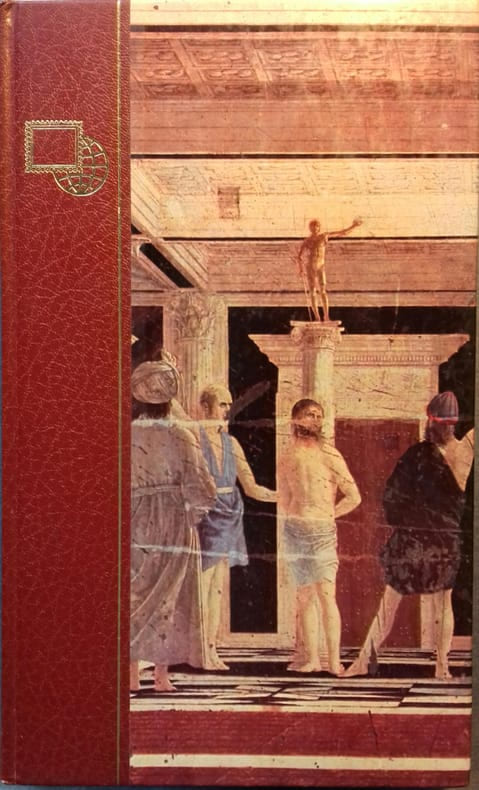
Couverture rigide. Reliure de l'éditeur. 206 pages.
Reference : 133418
Livre. Cercle du bibliophile (Collection : Histoire intégrale de l'art), 1966.
Librairie et Cætera
Mme Sophie ROSIERE
sophie@librairie-et-caetera.com
+33 (0) 5 56 88 08 45
Envoi par la Poste à réception du paiement. Paiement par virement, chèque ou CB (Stripe) PAS DE PAIEMENT SUR LE SITE. Je vous enverrai les informations de paiement en validant votre commande. EXPEDITIONS du lundi au vendredi en courrier ordinaire ou suivi, sous étuis recyclables et/ou réutilisés. Les livres sont nettoyés, réparés si besoin, et couverts de papier cristal. FRAIS D'EXPEDITION : Pour un livre standard (moins de 500g): FRANCE : de 5 à 7,50 € en courrier suivi. EUROPE : de 14 € en colissimo de 6 à 10 € pour le spays desservis par Mondial Relay PAYS HORS UE : 35 € en colissimo Pas d'envoi aux Etats-Unis RETOUR : Conformément à la législation sur la vente à distance, vous disposez d'un droit de retour des ouvrages pendant 14 jours. Les frais de port restent à votre charge lorsqu'il s'agit d'une erreur de commande de votre part et à notre charge si le livre n'est pas conforme à notre description.
[On the final colophon:] Venice, Bartholomeus de de Zanis for Octavianus Scotus, 1499. [at the end of first leaf and of each section: Vale. Venetiis. 1480, except for the second last (de Insoniis, which says: Vale. Venetiis. 1478). Small folio. Nice, elegant late 18th century half calf. Binding with a few traces of wear. A very nice, clean, and fresh copy with just a bit of light dampstaining to upper margin of about 20 leaves. Numerous pretty, woodcut initials throughout. Woodcut printer's devise to colophon. Last leaves with tiny, barely noticeable wormhole. Contemporary handwritten inscription to title-page: ""Ex libris advocati Dunis = 1480"". (1), 115 ff. (pagination erroneous at end: 113, 116, 114). Without final blank.
The very rare second printing of Ermolao Barbaro's seminal Latin translation of Themistios' paraphrases of Aristotle's ""Posterior Analytics"", ""Physics"", ""De Anima"", ""On Memory"", and ""On Dreams"", a groundbreaking key text of the Renaissance, ""which opened a new period in the interpretation of the Greek philosopher [i.e. Aristotle]"" (Lohr, p. 25). The work was partly responsible for the development of Renaissance Aristotelianism and thus Renaissance thought in general. The combination of the fact that we here have the paraphrases by one of the greatest ancient Greek commentators of the key texts of the most significant philosopher of all times, rendered into Latin by perhaps the most significant translator of the period and printed at the most crucial time for the development of early modern thought, makes this one of the most significant philosophical publications of the Renaissance. There can be no doubt as to the influence that the present publication came to have on the development Renaissance philosophy. ""The publication of Barbaro's translation of Themistius inaugurated a new period in the study of Aristotelian philosophy. In his version of Themistius' ""Paraphrases"" we encounter not simply a translation occasioned by contemporary controversies, as was often the case in the Middle Ages. Rather, Barbaro's version brings together a corpus of the commentaries of Themistius on Aristotelian philosophy: the ""Posterior Analytis"", ""Physics"", ""De anima"" and ""Parva naturalia"". (Lohr, p. 26).The first printing of the work appeared in 1480 (the same year stated at the end of each section in the present edition), and in 1499 this second printing appeared. Both printings are of the utmost scarcity and almost impossible to find. After these two incunable-editions, at least 9 new printings appeared before 1560, bearing witness to the great impact of the text, and in 1570 Hieronymus Scotos printed a new edition. ""With reference to those works of Aristotle which were and remained the center of instruction in logic and natural philosophy [i.e. The Posterior Analytics, Physics, etc.], the most important changes derived from the fact that the works of the ancient Greek commentators became completely available in Latin between the late fifteenth and the end of the sixteenth centuries and were more and more used to balance the interpretations of the medieval Arabic and Latin commentators. The Middle ages had known their works only in a very limited selection or through quotations in Averroes. Ermolao Barbaro's complete translation of Themistius and Girolamo Donato's version of Alexander's ""De Anima"" were among the most important ones in a long line of others. When modern historians speak of Alexandrism as a current within Renaissance Aristotelianism that was opposed to Averroism, they are justified in part by the fact that the Greek commentators, that is, Alexander and also Themistius, Simplicius, and many others, were increasingly drawn upon for the exposition of Aristotle."" (Kristeller, p. 45).""Equally important [as the recovery of Aristotle's ""Mechanics"" and ""Poetics""] for the continued growth of the Peripatetic synthesis was the recovery and diffusion of the Greek commentaries on Aristotle... The most important of the two dozen commentators were Alexander of Aphrodisias, Ammonius, Simplicius, Themistius, and John Philoponus. Of these five, only Alexander and Themistius were Aristotelians..."" (Copenhaver & Schmitt, p.68).Already in the Middle Ages, scholars had been aware of and used commentaries on and paraphrases of the key texts of Aristotle, but their knowledge of this was primarily based on some Latin translations and allusions, fragments, and summaries in the writings of the Muslim philosophers, e.g. Averroes. But with the emergence and translations into Latin of the ancient Greek commentators [Alexander and Themistios being the primary ones] and their paraphrases of Aristotle's texts, the Renaissance came to discover an Aristotle that would influence almost all thought of the period. The ancient Greek commentators not only had a much more thorough knowledge of classical Greek thought than would have been possible for a medieval writer, but they also had access to works that were later lost and through these ancient commentators rediscovered in the Renaissance. By the middle of the 16th century, almost all of these texts had been printed in both Greek and Latin, and these publications were of the utmost importance to the development of almost all Renaissance thought. ""Their recovery, publication, and translation took some time, but almost all circulated in Greek and Latin by the 1530'ies. They do not cover all of Aristotle, but several treat such key texts as the ""Organon"", the ""Physics"", and ""De anima"", thus making them useful ammunition in such controversies as the immortality dispute provoked by Pietro Pomponazzi and his colleagues."" (Copenhaver & Schmitt, p. 69).Among the most important texts in this tradition that influenced all thought of the era, were Themistios' paraphrases of Aristotle's seminal texts, in particular ""De Anima"", ""Posterior Analytics"", and Book Lambda (XII) of the ""Metaphysics"". ""We possess part of his [Themistios'] early work, his ""Paraphrases of Aristotle"", the portion still extant being a somewhat prolix exposition of the ""Later Analytics"", the ""Physics"", the ""De Anima"", and some minor treatises."" His paraphrase of the ""Metaphysics"", Book ""lambda"" [i.e. XII], was translated into Arabic (in century IX), and hence into Hebrew (1255), and Latin (1576)."" (Sandys, I:352).There can be no doubt about the groundbreaking character of Hermolao Barbaro's translation into Latin of almost all of Themistios' paraphrases of Aristotelian texts. Not only was Themistios considered one of the most important renderers of Aristotle's text, but Barbaro was perhaps the most influential translator of the time. His translation of Themistios' paraphrases came to dominate, directly or indirectly, almost all Aristotelian thought of the high Renaissance (from late 15th century) and he was responsible for many of the most important and influential positions on the seminal question of the immortality of the soul that dominated philosophical thought at the time. ""Through the first two-thirds of the fifteenth century, Pomponazzi's predecessors at Padua seem not to have used the ancient commentators, but philosophers of the next generation - most notably Nicoletto Vernia and Agosto Nifo - began to consult them in new translations by Ermolao Barbaro and others. Barbaro's charge that Averroes had lifted his doctrines of the soul from the commentators surely helped excite interest in them."" (Copenhaver & Schmitt p. 69). See: Kristeller, Renaissance Thought and its Sources, 1979" Copenhaver & Schmitt, Renaissance Philosophy, 1992" Charles C. Lohr, ""Latin Translations of the Greek Commentaries on Aristotle"", in: Humanism and Early Modern Philosophy, Edt. byKraye and Stone, 2000.Graesse VII:112 (erroneously stating 1491 in stead of 1499)" Brunet V:778 Hain-Copinger: 15464.
Strassburg, Knobloch, 1506-7 + 1511 4to. Bound in one very nice full mottled calf binding from ab. 1800, with five raised bands to richly gilt spine. A bit of wear to extremities. Occasional browning, but all in all very nice and clean. 289 ff (without the white blanks) + (4), xcvi, (7), (4, -index & errata).
Scarce first edition of Giovanni Francesco Pico's seminal ""Opera"", issued by Pico himself, in which some of his most important works appear for the first time, e.g. ""De Rerum Praenotatione"", ""De fide ordine"" and the ""Staurostichon"" as well as his translation of Justin the Martyr's ""Admonitio"", here bound with the highly important second edition of the ""Hymni heroici tres"". The present publication occupies a central place in the development of Renaissance thought. Through the ""Opera"" of Pico, skepticism came to play a dominant role in the development of early modern thought. ""Telesio, Bruno, Galileo, and others also employed the same arguments which Pico had brought to the consciousness of Renaissance Europe. Gianfrancesco Pico's skeptical techniques did not die with him, but lived on to produce a tangible, recognizable influence on the intellectual ambience of early modern Europe."" (Schmitt, p. 7). This seminal ""Opera"", published 13 years before the publication of Pico's magnum opus (""Examen Vanitatis"") and 26 years before his death, is of the utmost importance to the development of Pico's thought and to the development of Renaissance thought in general - ""a study on the philosophy of Gianfrancesco Pico della Mirandola would furnish an important addition to our knowledge of the philosophy of the Italian Renaissance"" (Schmitt, p. (VII)). The many important works in the present publication are known under the joint title ""Opera aurea & bracteata"" or ""Liber imaginationis"". The publication is made up of 9 parts, all of which were also intended for separate sale (and which all have separate paginations). The works included are: ""De rerum praenotatione etc."", ""De fide et ordine credenda"", ""De morte Christi & propria cogitanda libri tres"", ""De studio divinae & humanae philosophiae, libri duo"", ""De imaginatione"", ""Vita Io. Pici patrui. Eiusdem de uno & ente/ defensio & alia quaepiam"", ""Epistolarum libri quattuor "", the translation of Justini's "" Admonitio "" - together with ""Saurostichon/de mysterijs Germaniae Heroico carmine"" and ""Expositio tex. decreti de con. dis.ii. Hilarii"", and then follows "" Ad lectorum "" - 6 of the works here are FIRST PRINTINGS. The second edition of the ""Hymni heroici"" is of the utmost scarcity. It originally appeared in 1507, but only the second edition also contains Pico's famous poem ""Staurosticon"".This magnificent collection of works by ""the first modern sceptic"" and ""the only serious student of Sextus before the middle of the sixteenth century"" (Copenhaver & Schmitt) constitutes a milestone in Renaissance thought. The seminal work ""De rerum praenotatione"", which appears here for the first time, is among the most important that Pico wrote. It constitutes a fierce attack upon superstition, and a defense of the true religious truths - theories that underpin ALL of his later thought and are of fundamental importance to his later works, including the ""Examen"". ""This is a lengthy work (second in length only to the ""Examen Vanitatis"" among Pico's works) against pretended modes of prophesy. It is of the same genre as Giovanni Pico's work against astrology and is dedicated to the author's cousin and protector, Alberto Pio. It was first printed in the ""opera"" of 1506-07… There is no substantial portion of the work extant in manuscript."" (Schmitt, p. 192). The ""de fide et ordine"", which also appears here for the first time, is likewise one of Pico's significant works, although not as philosophical as the previous work. ""This is a work of medium length, principally theological, but of some philosophical importance. It was dedicated to Pope Julius II in the first printed edition of 1506-07"" (Schmitt, pp. 193-94).The ""Staurostichon"" is Pico's most famous poem, dedicated to Emperor Maximilian. In spite of the few pages it takes up, it has been the subject of much debate and interpretation throughout the centuries. Apparently ""[t]he extant manuscript seems to have been made after the first printed edition [i.e. the present]."" (Schmitt, p. 196).Pico's translation of the ""Admonitio"" (which is no longer attributed to Justin the Martyr) is of great importance. ""The first printing of the translation, which is dedicated to Zanobi Acciaiuoli, was in the ""opera"" of 1506-07. It was often reprinted, remaining a standard translation for most of the sixteenth century."" (Schmitt, p. 200). The four books of Pico's letters are also printed here for the first time. ""In the three editions of the ""Opera"" are printed four books of letters. These were prepared for the edition of 1506-07 and were reprinted with few additions in the later editions. Consequently, it seems that the bulk of Pico's personal letters written after 1505 have not come down to us."" (Schmitt, p. 200). Giovanni Francesco [Gianfranceso] Pico della Mirandola (1470-1533), not to be confused with his uncle Giovanni Pico della Mirandola (1463-1494) was a highly important Renaissance thinker and philosopher, who was strongly influenced by the Neoplatonic tradition, but even more so by the preaching of Girolamo Savonarola, whose thought he defended throughout his life. Just like his uncle, Gianfrancesco Pico devoted his life to philosophy, but being a follower of Savonarola and having a Christian mission, he made it subject to the Bible. He even depreciated the authority of the philosophers, above all of Aristotle. ""At the very beginning of the 16th century, Gian Francesco Pico, the nephew of Pico della Mirandola, had predicted the final failure of all attempts at reconciliation of the different philosophical movements. Gian Francesco Pico was a thinker of very considerable stature and a follower of Savonarola. There was a touch of tragedy about his personality. For his life was suspended, as it were, between the scaffold of Savonarola and incessant family feuds - in the course of one of which he was finally killed. No wonder that he borrowed from the scepticism of Sextus Empiricus in order to destroy philosophy to make more room for religion."" (Garin, p. 133). Gianfr. Pico, a learned scholar and apt reader of classical texts, was the first Renaissance thinker that we know to have seriously studied and used the works of Sextus Empiricus, which were not printed until the 1560'ies, causing a revolution in Renaissance thinking. ""The printing of Sextus in the 1560s opened a new era in the history of scepticism, which had begun in the late fourth century BCE with the teachings of Pyrrho of Elis. [...] Before the Estienne and Hervet editions, Sextus seems to have had only two serious students, Gianfrancesco Pico at the turn of the century and Francesco Robortello about fifty years later."" (Copenhaver & Schmitt, pp. 240-41). ""No significant use of Pyrrhonian ideas prior to the printing of Sextus' ""Hypotyposes"" has turned up, except for that of Gianfrancesco Pico della Mirandola [...] His writings may seem isolated from the main development of modern skepticism that began with the publication of the Latin translations and modernized formulation of ancient scepticism offered by Michel de Montaigne. However, they represent a most curious use of skepticism that reappears in the early seventeenth century with Joseph Mede and John Dury and the followers of Jacob Boehme and in the early eighteenth century in the writings of the Chevalier Ramsay, the first patron of David Hume, to fortify or justify prophetic knowledge."" (Popkin, p. 20). Gianfr. Pico develops his sceptical arguments to their fullest extent in his ""Examen"" (1520), which is considered his main work. However, the foundation of all these ideas are laid in his earlier works, all the significant of which are present here, in his seminal ""Opera""-collection. Together, they constitute the earliest printed testimonies to the use of scepticism and a premonition of the role that scepticism came to play in Renaissance thought, primarily after the first printings of Sextus in the 1560'ies. ""The revival of ancient philosophy was particularly dramatic in the case of scepticism. This critical and anti-dogmatic way of thinking was quite important in Antiquity, but in the Middle Ages its influence faded [...] when the works of Sextus and Diogenes were recovered and read alongside texts as familiar as Cicero's ""Academia"", a new energy stirred in philosophy"" by Montaigne's time, scepticism was powerful enough to become a major force in the Renaissance heritage prepared for Descartes and his successors."" (Copenhaver & Schmitt, pp. 17-18).""Throughout the early modern period, from Ficino and Pico to Newton and Leibniz, such convictions supported a pattern of historiography that could never have emerged without the humanists, even though it did not preserve their fame for modern times. Other myths of classicism and Christianity outlived the fable of ancient theology because they conflicted less flagrantly with the findings of historyThe purpose of the ancient theology was to sanctify learning by connecting it with a still more ancient source of gentile wisdom that reinforces sacred revelation. Rather than baptize the heathens as Ficino or the older Pico wished, some early modern critics damned them, and one of the most aggressive thinkers of this school was the younger Pico. He saw an impassable gulf between Christian and pagan belief where his uncle had tried to build bridges."" (Copenhaver & Schmitt, p. 337). Schmitt Appendix Section I: nrs. 4, 13, 14, 26, 50"51 Section II: nr.11See:Charles B. Schmitt: Gianfrancesco Pico della Mirandola (1469-1533) and his critique of Aristotle. 1967.Copenhaver & Schmitt: Renaissance Philosophy. 1992.Eugenio Garin: Italian Humanism. Philosophy and Civic Life in the Renaissance. Translated by Peter Munz. 1965.Richard H. Popkin: The History of Scepticism. From Savonarola to Bayle. 2003.
Paris, 1855. 8vo. Very nice contemporary diced half calf with gilt spine. Cracks to upper and lower hinges, and inner front hinge weak, but overall a very nice copy. A bit of brwning and soiling to first and last leaves and dampstaining to inner margin of first ab. 20 leaves. (10), CLX, 334 pp
First edition of this seminal work - the third in Michelet's series of ""The History of France"" - in which he coins the term ""Renaissance"" and uses it for the period of the sixteenth century as an historical period in its own right.The humanists of the period that we now call the Renaissance had a strong sense of being and doing something that was very different from that of the centuries before them"" they clearly thought of themselves as living in and creating a new epoch, re-inventing and re-using the classical Greek and Roman values. Once again they gave birth to the humanistic arts, literature, philosophy, painting, sculpting, etc. It is not a new invention of later times to view this historical epoch as something new and still something different, something worthy of the term ""Re-birth"", acknowledging both the source from which inspiration was drawn as well as the achievements of the new era.Thus, Michelet is not the first to understand what went on in this period, but still he changed our concept of it for ever - he invented the term which has not only determined this perioed ever since, but which has also been used to explain and understand all that went on in this most crucial period for modern man. It is in the present work by Michelet that he uses for the first time the noun ""Renaissance"" for this epoch and lets it refer to the discovery of world and of man in the 16th century. He not only lets the term refer to the artistic or scholarly part of the period, he lets it refer to the entire complex of changes that were taking place in this period, and he thus gives birth to the period as that of the mind and spirit of man, instead of just that of painting and learning. Michelet's work appeared at a time that allowed for it to exercise the greatest of influence. From the end of the 16th century until the middle of the 18th century, the history of the Renaissance was a field that barely existed. Only with Voltaire was some focus put on this period that we ever since Michelet have called the ""Renaissance"". Only with Michelet are we given the vocabulary to sum up this period and to describe it properly and in detail. When he publishes his work in 1855, historians and thinkers are ready to view this period as something in itself and as something worth noticing. That which Michelet thus began is that which Burchardt takes up in his ""Cultur der Renaissance in Italien"" (1860), in which ""Renaissance"" is finally characterized as the birth of modern humanity. Both Michelet and Burckhardt believed that modern, secular man is a product of the ""Renaissance"".""The terms ""restauratio"" or ""resttitutio"" had been applied by fourteenth-century Italian humanists to the revival of ancient languages and literatures, that of ""rinascita"" by Ghiberti and Vasari to the new blossoming art and architecture. In the eighteenth century Voltaire and Gibbon first saw the Italian civilization of the fourteenth to sixteenth centuries as an entity and as a determining factor in the whole course of European history. Michelet (324) in 1855 first used the term ""renaissance"" for this period as an historical epoch in its own right. Burckhardt, an admirer of both Voltaire and Gibbon, supplied the final synthesis."" (Printing and the Mind of Man, p. 211)
Basel, 1860. 8vo. A little later green half cloth with a recent printed paper title-label to spine. Brownspotting to some leaves. Some underlinings and maginal annotations, all in pencil. Near contemporary annotations/description pasted on to verso of dedication-leaf. (4), 576 pp.
The scarce first edition of Burckhardt's main work, the groundbreaking work on the culture of the Renaissance, which helped found the historical study of this previously much overlooked era. "" ""The most penetrating and subtle treatise on the history of civilization"", in Lord Acton's words, ""a mere essay"", as Burckhardt himself called it, ""The Civilization of the Renaissance in Ittaly"" has, for more than a century, determined the general conception of thirteenth- to fifteenth-century Italy."" (PMM p. 210)This classic of Renaissance historiography is of the greatest importance to the development of the history of the Renaissance and of history of art and culture in general. More specifically, Burckhardt here establishes the fact that the Renaissance came first in developing the human individuality to the highest degree. He places the earliest signs of ""the modern European Spirit"" in Florence, which was a great contributing factor to the comprehension of this city as representing one of the highlights of European culture.The Swiss historian of art and culture, Jacob Chrisoph Burckhardt (1818-1897), contributed seminally to the historiography of these two fields. He is considered the discoverer of the Renaissance, and with his main work he founded the study of thirteenth- to fifteenth-century Italy and thereby the historical study of the Renaissance, the society of which he dealt with all aspects of. In general, Burckhardt's works all constitute an original historical approach to the study of art, culture, social institutions etc. As a highly respected scholar of Greek civilization, Burckhardt, with his original historiographical approach, was highly admired by Nietzsche, who also attended his lectures. The two kept in contact and corresponded frequently. Like Nietzsche, Burckhardt was a great admirer of Schopenhauer, and he greatly opposed the Hegelian interpretations of history.""... as in the case of other great historians such as Gibbon, Ranke, Macaulay, no criticism of details can detract from the powerful spell which Burckhardt's book has exercised upon such widely different writers as Ruskin, Nietzsche and Gobineau, as well as upon innumerable lovers of the most magnificent period of European history."" (PMM).Printing and the Mind of Man 347.
Balsel, Sebastian Henricpetrus, (1562). 4to. Both volumes bound in one nice mid-19th century half calf with gilt spine. Title to lower edge in contemporary hand. Ex libris to inside of front board. Some browning and brownspotting, and first title-page frayed at edges and with a repaired hole (presumably removing an old owner's name), not affecting printing and a small repaired hole in imprint (affecting the ""Pe"" of ""Per Sebastianum...""). 1) Somniorum Synesiorum: (42) pp., 1 blank leaf, 278 pp., 1 blank leaf. +2) Opera quaedam lectu digna (with a separate title-page and separate pagination): (36), 413, (1, -errata) pp. - lacking the final leaf with printer's devise only (no text).
The extremely rare first edition of the most important Renaissance work on dreams, arguably the most important book on dream interpretation up until Freud. (Appended thereto as the second part of a collection of earlier works by Cardano, gathered here for the first time. This part lacks the leaf with the printer's device). ""Cardano is unusual among Renaissance writers on dreams, in that he both records a good many of his own dreams, displaying keen interest in them, and has a highly developed theory about the causation of dreams and the method of interpreting them. His book on dreams, ""Somniorum Synesiorum Libri IIII"", comprises an exhortation to interpret dreams, an account of how dreams are caused, classifications of them, advice on how to interpret them, and a final chapter describing fifty-five of his own dreams."" (Alice Brown, Girolamo Cardanos's Somniorum Synesiorum Libri III, 1979). Girolamo Cardano/Hieronymus Cardanus (1501 -1576) was an extremely important Renaissance polymath, being an influential mathematician, physician, biologist, physicist, chemist, astrologer, astronomer, philosopher, writer, - and gambler. He is often referred to as the greatest mathematician of the Renaissance and was one of the key figures in the foundation of probability as well as the one whointroduced binomial coefficients and the binomial theorem to the Western world. His great work on dreams was also extremely influential and has always been considered of the utmost importance to the understanding of his scientific theories and world view. His theories about dreams are closely connected to his scientific theories about the world and bridges the gap of our understanding of his thoughts about certainty of knowledge. This great work on dreams, dream interpretation, and the cause of dreams, constitutes a fundamental attempt at understanding the mind and therefore the boundaries of our knowledge. ""Cardano admired experience and was a determined advocate of natural science. But at the same time he was aware of the insufficiency of empiricism and insisted upon the justice of the claims of mathematical reason. He even went so far as to stress that our knowledge can be protected against uncertainty only by the employment of a method that led from the one to the many. He held, however, that owing to the way in which the mind is tied to the body, the synthesis between reason and sensuous knowledge was most precarious and prevented a perfect understanding of those ideal and incorporeal essences which constitute the principles of bodies. It also makes it impossible for us to visualise adequately the original connections through which the separate things arise out of their principles. Our physical knowledge is a superficial knowledge. It makes us glide over things without probing their souls and is based upon analogies and parables... In short, Cardano was fully aware of the difficulty of the passage from the mental to the real, from ideas to things."" (Eugenio Garin: Italian Humanism, 1965, pp. 188-89). ""Girolamo Cardano conceived and outlined his four books on dreams according to Synesius' philosophy between 1535 and 1537. Originally divided into ten books, the volume underwent subsequent modifications until it was published in 1562. We know from Cardano's own testimony how the key episodes in his life were always heralded or accompanied by dreams. From this point of view, the 1562 summa on dreams reflects one of the most critical of such moments. As Jean-Yves Boriaud explains in the introduction to his new Latin edition and French translation of Somniorum Synesiorum libri quatuor, in the year prior to the composition of this work, Cardano was undergoing intense dream activity as a result of the tragic execution in 1560 of his son Giovanni Battista, who had been charged with poisoning his wife. From that moment on, the death of his son would represent a watershed moment in both his life and literary career. For this reason, too, Somniorum Synesiorum libri quatuor deserves to be considered as one of Cardano's most important writings and Boriaud's edition should be saluted as a notable accomplishment. (Giglioni, Guido (2010) Synesian Dreams. Giacomo Cardano on dreams as means of prophetic communication. Bruniana & Campanelliana, XVI (2). pp. 575-584.).The work is of the utmost scarcity. OCLC lists merely four copies: two in Switzerland, one in Germany, and one in The Netherlands.Adams: C:692" Wellcome: I:1305.