 Write to the booksellers
Roiter Fulvio:
Venice.
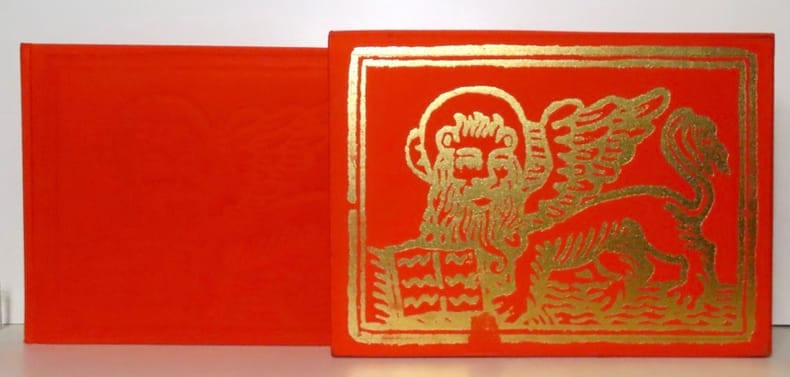
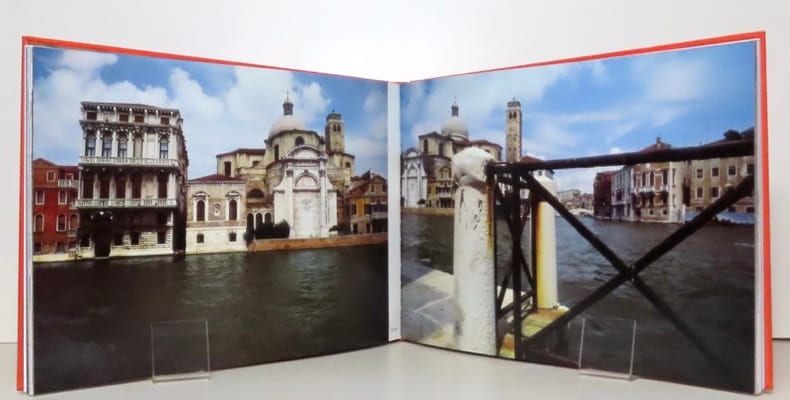
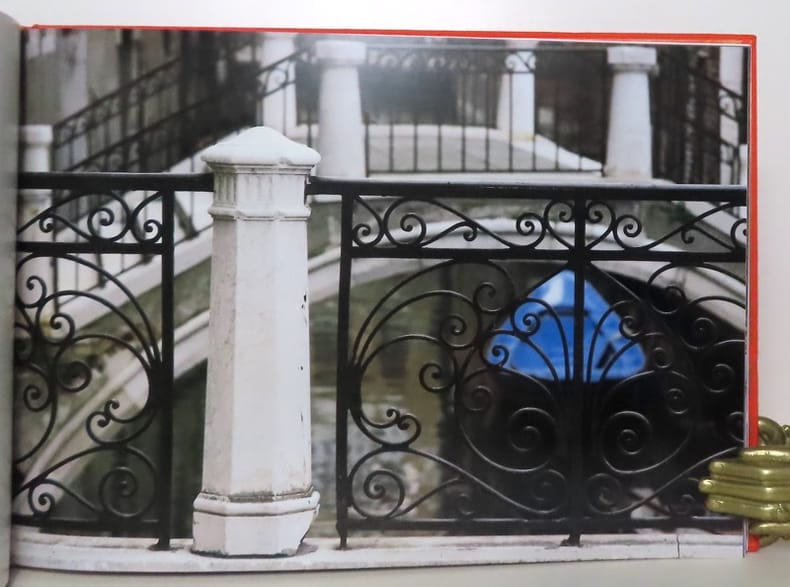
Biblos, 1986. In-4 à l'italienne, pleine toile rouge décorée à froid, étui de toile avec décor doré. Les textes sont en italien, anglais, français et allemand.
Reference : 21538
Bookseller's contact details
La Bergerie
Mme Aline Berger
Payment mode
Sale conditions
Paiement par virement bancaire en francs suisses ou en euros (sans frais), Twint et cartes de crédit. Les livres sont expédiés dans les jours suivant la réception du montant demandé.
5 book(s) with the same title
Contending Representations II: Entangled Republican Spaces in Early Modern Venice
, Brepols, 2024 Hardback, 192 pages, Size:216 x 280 mm, Illustrations:86 col., Language: English. ISBN 9782503605197.
Summary The volume addresses the issue of political celebration in early modern Venice. Dealing with processional orders and iconographic programs, historiographical narratives and urbanistic canons, stylistic features and diplomatic accounts, the interdisciplinary contributions gathered in these pages aim to question the performative effectiveness and the social consistency of the so called 'myth' of Venice: a system of symbols, beliefs and meanings offering a self-portrait of the ruling elite, the Venetian patriciate. In order to do so, the volume calls for a spatial turn in Venetian studies, blurring the boundaries between institutionalized and unofficial ceremonial spaces and considering their ongoing interaction in representing the rule of the Serenissima. The twelve chapters move from Palazzo Ducale to the Venetian streets and from the city of Venice to its dominions, thus widening considerably the range of social and political actors and audiences involved in the analysis. Such multifocal perspective allows us to challenge the very idea of a single 'myth' of Venice. TABLE OF CONTENTS Introduction 1. Giovanni Florio and Alessandro Metlica, Università degli Studi di Padova: Ritual and Popular Politics in the Republic of Venice 2. Giorgio Tagliaferro, Warwick University: The Meeting of Sebastiano Ziani withAlexander III in the Great Council Hall: Staging, Viewing, and Understanding the Body Politic in Late Sixteenth-Century Venice 3. Monique O'Connell, Wake Forest University: Representative Spaces of Republicanism: Constitutional Thinking, Virtue Politics, and Venice's Great Council Hall in Early Modern Europe 4. Massimo Rospocher, Istituto Storico Italo-Germanico di Trento: 'Una parola in piazza fa più male che dieci libri in un gabinetto': The Square as Political Space in Sixteenth Century Venice 5. Iseabail Rowe, European University Institute: 'From the Clocke to the Shore': Thomas Coryat's 'Streets' of Piazza San Marco 6. Evelyn Korsch, Universität Erfurt: A Republic Becomes Divine: The Sacred Role of Topography in Venetian Civic Ritual 7. Umberto Cecchinato: Beyond the Ceremonial City: Music, Public Revelries, and Urban Spaces in Everyday Renaissance Venice 8. Marco Bellabarba, Università di Trento: Power, Friendship, and Protection: Venetian Rectors in Verona Between the Sixteenth and the Seventeenth Centuries 9. Erika Carminati, Indipendent scholar: Celebrations of Venetian Terraferma's Rettori: From the Good Fama to its Subversion in the Public Ritual Sphere 10. Alfredo Viggiano, Università degli Studi di Padova: The Good Use of 'People' in Fifteenth-Century Venice: Reflections over a Controversial Term 11. Matteo Casini, University of Massachusetts: Venice Beyond Venice: The Foreign Approach to Venetian Rituals, 1400-1600s List of Abbreviations Bibliography Notes on Contributors
Renaissance Venice, Islam and Mahmud the Kurd: a metalworking enigma
Auld, Sylvia: Renaissance Venice, Islam and Mahmud the Kurd: a metalworking enigma. London: Altajir World of Islam Trust, 2004. 350pp with 210 monochrome illustrations. Cloth. 26.8x20.7cms. The name of Mahmud the Kurd (probably an itinerant master craftsman working in the second half of the 15th century) has been found on ten small, domestic objects of brass. All are exquisitely worked with intricate arabesques. On one, his signature appears in two forms in Arabic (or Persian), and in transliterated Roman script. Why? For whom was he working, and where? These are the questions which this book tries to answer. The widespread links between Renaissance Europe and Islam, which emerge as part of the trail, may come as a surprise to some readers. The objects listed in this book are not only fascinating in themselves but can be seen as a microcosm of the international exchanges and excursions of the period. Later, in 19th-century Europe, it was even assumed that Mahmud (and others working in the same style) were employed in Venice . This seems improbable following research in the archives, but so far no satisfactory explanation has been offered for Mahmud's double-language signature. Close examination of the objects shows that there are in fact three distinct styles. In the 15th century, against a backdrop of diplomatic intrigue in the face of Ottoman victories, Venice promoted links with their rivals, the Turcoman 'White Sheep' dynasty, whose capital then was at Tabriz . This explains a Persian element in the decorative detail of the first stylistic group. Some of the objects of a second group include a European shield as part of their decoration. Despite renewed papal bans, European trade with Islam continued unabated in the Eastern Mediterranean; Venice was the prime port for this commercial activity, and this accounts for the appearance of this second, Mamluk, group. The admiration in Europe and more particularly in Italy for the high quality of Islamic inlaid work explains the details of a third, western, group. Men like Benvenuto Cellini not only set out to emulate this technique, which they called 'azzimina, but to prove that they could do better.
The name of Mahmud the Kurd (probably an itinerant master craftsman working in the second half of the 15th century) has been found on ten small, domestic objects of brass. All are exquisitely worked with intricate arabesques. On one, his signature appears in two forms in Arabic (or Persian), and in transliterated Roman script. Why? For whom was he working, and where? These are the questions which this book tries to answer. The widespread links between Renaissance Europe and Islam, which emerge as part of the trail, may come as a surprise to some readers. The objects listed in this book are not only fascinating in themselves but can be seen as a microcosm of the international exchanges and excursions of the period. Later, in 19th-century Europe, it was even assumed that Mahmud (and others working in the same style) were employed in Venice . This seems improbable following research in the archives, but so far no satisfactory explanation has been offered for Mahmudâs double-language signature. Close examination of the objects shows that there are in fact three distinct styles. In the 15th century, against a backdrop of diplomatic intrigue in the face of Ottoman victories, Venice promoted links with their rivals, the Turcoman âWhite Sheepâ dynasty, whose capital then was at Tabriz . This explains a Persian element in the decorative detail of the first stylistic group. Some of the objects of a second group include a European shield as part of their decoration. Despite renewed papal bans, European trade with Islam continued unabated in the Eastern Mediterranean; Venice was the prime port for this commercial activity, and this accounts for the appearance of this second, Mamluk, group. The admiration in Europe and more particularly in Italy for the high quality of Islamic inlaid work explains the details of a third, western, group. Men like Benvenuto Cellini not only set out to emulate this technique, which they called âazzimina, but to prove that they could do better. Text in English

Venice Biennale Catalogue Series- Biennale Architettura 2025 Intelligens. Natural. Artificial. Collective.
, Silvana, 2025 Flexibound (Luxe paperback) Dimensions 270 x 210 mm, Illustrations throughout col.ill., 982 Pages, Language English ed. *new. ISBN 9788836661176.
The accompanying catalogue to the 19th International Architecture Exhibition, curated by Carlo Ratti, to be held from 10 May to 23 November 2025 in Venice, is titled Intelligens. Natural. Artificial. Collective. The 19th International Architecture Exhibition, curated by Carlo Ratti, to be held from 10 May to 23 November 2025 in Venice, is titled Intelligens. Natural. Artificial. Collective. The Exhibition, as the Curator himself explains, ?will search for a path forward, proposing that intelligent solutions to pressing problems can take many forms? and ?will present a collection of design proposals and many other experiments, exploring a definition of ?intelligence? as an ability to adapt to the environment with limited resources, knowledge, or power? (Carlo Ratti). The Catalogue is printed in two volumes and follows the Exhibition itinerary accompanying visitors and art lovers through the exhibition spaces of the Giardini and the Arsenale and presenting other projects on display in various locations around the city of Venice and Forte Marghera, in Mestre. Volume I of the Catalogue is dedicated to the International Exhibition, curated by Carlo Ratti. The first pages of the volume open with the statement by President Pietrangelo Buttafuoco and the presentation by the Artistic Director of the Architecture Department Carlo Ratti, and then presents the Circularity Manifesto. Volume I is then divided into two parts. Part one, titled Intelligens, is dedicated to presenting the sections of the International Exhibition, Natural Intelligence, Artificial Intelligence, Collective Intelligence, and Out. Each project on display in the Exhibition is accompanied by a critical text and a rich apparatus of photographs. Part two of the volume, titled Venice as a Living Lab, presents ?a number of special projects that will leverage Venice and the outdoor areas of the Biennale Exhibition venues as a Living Lab, merging interacting forms of intelligence?. The volume is enriched with a series of critical essays and interesting ?Impossible Conversations? that explore the themes of the Exhibition in depth. Volume I ends with the biographies of the participants and a detailed register of the projects on exhibit. The National Participations and the Collateral Events participating in the 19th International Architecture Exhibition are gathered in Volume II and presented with illustrated texts that explore the projects proposed by the National Pavilions and the Collateral Events at the Giardini, the Arsenale and in various spaces throughout Venice.
The Mosaics of San Marco in Venice: Part 1 : Eleventh and Twelfth Centuries (2 VOLS.; PART 2 : THE THIRTEENTH CENTURY)
University of Chicago Press 1984 1604 pages 34 54x14 99x35 56cm. 1984. Cartonné + emboîtage. 4 volume(s). 1604 pages. The Mosaics of San Marco in Venice: Part 1 : Eleventh and Twelfth Centuries (Text + Plates) + Part 2 : The thirteenth Century (Text + Plates)
Bon état bonne tenue couvertures et emboîtage un peu défraîchies intérieurs propres
Il Giaurro, frammento di novella turca, scritto da Lord Byron e recato dall'inglese in versi italiani da Pellegrino Roassi [relié avec] Lara, a tale. Jacqueline, a tale [relié avec] The prophecy of Dante [relié avec] Letter to **** ******, on the Rev. W. L. Bowles's strictures on the life and writings of Pope [relié avec] Marino Faliero, Doge of Venice, an historical tragedy. In five acts. With notes.
Ginerva, e si vende a Parigi / London, G.-J. Paschoud / Printed for J. Murray by T. Davison, 1818 / 1814 / 1821. In-12 de XXIV-93; [8]-128; [4]-VII-47; 81-[2]; [4]-XVIII-[1]-20 à 271 pages, demi-veau blond à petits coins, dos lisse orné de filets et titre dorés, étiquette de titre caramel. Coins et dos frottés, rares rousseurs. Ex-libris Charles de Constant-Rebecque.
Edition originale de "Lara, a tale. Jacqueline, a tale". La traduction de Rossi de "Il Giaurro" (The Giaour) est la toute première traduction d'un poème de Byron en italien. Sur le faux titre, il est inscrit à la plume: "dal traduttore". Pellegrino Rossi, originaire de Modème, participe à l'expédition anti-autrichienne de Joachim Murat pour la requonquête du trône de Naples. Après la chute de Muralt, il se réfugie à Genève ou il acquiert la bourgeoisie en 1820. L'année précédente il était devenu le premier professeur catholique de l'Académie. ll y enseigne le droit civil, le droit constitutionnel et l'économie politique ; il donne aussi un cours d'histoire romaine et (1831) d'histoire suisse. Il fréquente le salon de Madame de Staël à Coppet. Jolie provenance.

