 Write to the booksellers
Prévert Jacques:
Spectacle.
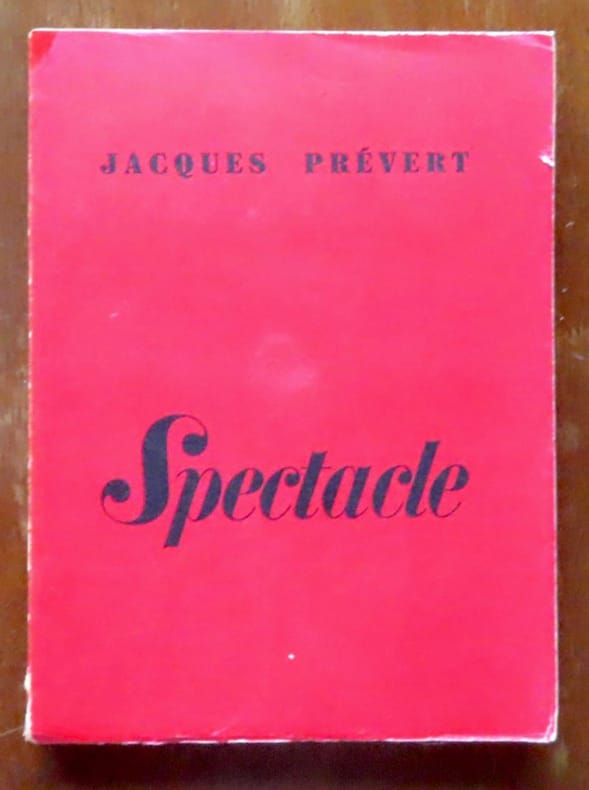
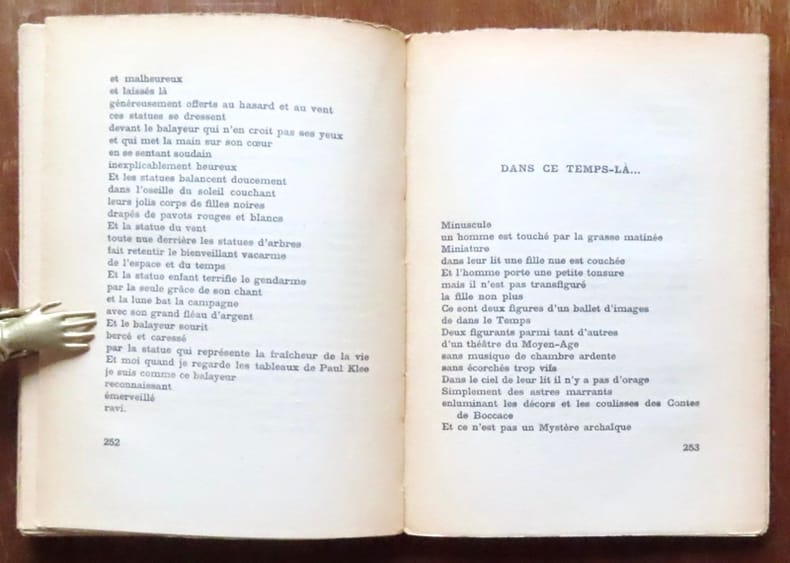
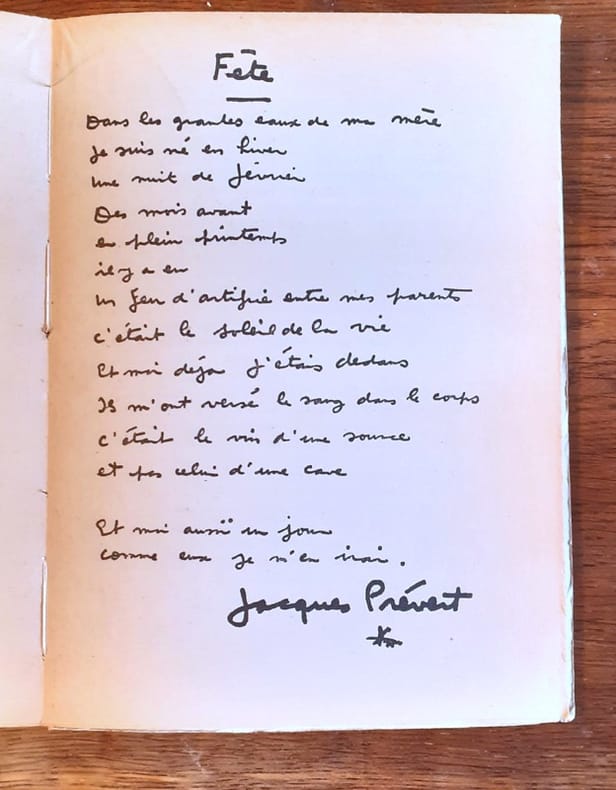
Gallimard, collection Le Point du Jour, 1951. In-8 broché, couverture rouge imprimée en noir, légèrement défraîchie. Un poème en fac similé autographe.
Reference : 17453
Fait la paire avec "Paroles".
Bookseller's contact details
La Bergerie
Mme Aline Berger
Payment mode
Sale conditions
Paiement par virement bancaire en francs suisses ou en euros (sans frais). Les paiements par PayPal ne sont plus acceptés, suite à un différend qui nous a décidés à nous passer de leurs services. Les livres sont expédiés dans les jours suivant la réception du montant demandé.
5 book(s) with the same title
Spectacle Benefaction and the Politics of Appreciation Case Studies from Italy, Gallia Narbonensis and Africa Proconsularis
, Brepols - Harvey Miller, 2025 Paperback, Pages: 358 pages, Size:156 x 234 mm, Illustrations:21 col., 15 tables b/w., Language(s):English, French, Latin, *New. ISBN 9782503613703.
In the remotest corners of the Roman Empire, large crowds were as beguiled by spectacles as their Roman counterparts. Provincial spectacles however, did not share the technical wonders of flying machines, elephant dressage and synchronised swimming seen at imperial extravaganzas. Is it this lack of the sensational that accounts for the relative paucity of scholarly attention paid to regional spectacles and in particular, their sponsors? When spectacles are viewed purely as entertainment, the messy realities of institutionalized social, economic and political power that regulated them are obscured. A clearer understanding of the spectacle can therefore be achieved by contextualizing it in the big picture of regional and provincial life against the backdrop of Roman power and control. The spectacle itself was highly political in its aims and intent. Access to sponsorship of a spectacle similarly relied on hierarchies of political power and privilege, and consequently required strategic negotiation of candidacy, promises, expenditure and recognition. Rivalry, competition and emulation was endemic. This epigraphic analysis, focusing on the western Roman Empire (Italy, Gaul and North Africa) during the Imperial period, identifies the milieux of provincial sponsors, their strategies and quest for public honours. TABLE OF CONTENTS Acknowledgements Introduction Chapter 1. The Context of the Provincial Spectacle Chapter 2. Becoming a Sponsor: Negotiating the Socio-political Hierarchy Chapter 3. De sua pecunia: The Sponsor Makes his Mark Chapter 4. Hierarchies of Recognition Chapter 5. Beyond Honorific Statuary: Self-celebration of Elites in the Private Sphere Chapter 6. Options for the Non-elite Conclusion. De sua pecunia: Spectacles, Sponsors and Civic Prominence Appendices Ancient Sources Bibliography
temps que nous partageons. Reflexions a travers le spectacle vivant 1 introduction, 3 actes et 2 interludes
, [BE] Fonds Mercator/ Mercatorfonds , 2015 Paperback, 240x170mm, 400p, 200 colour illustrations, French edition . ISBN 9789462300705.
Expo: May 2015 -celebration des 20 ans du Kunstenfestivaldesarts, Kunstenfestivaldesarts, Brussels Tout en partant de la celebration des 20 ans du Kunstenfestivaldesarts, ce livre ouvre un ensemble de perspectives critiques sur la memoire des arts du spectacle vivant. Il s'articule autour de questions cruciales abordees par des spectacles phares presentes au festival ainsi que dans de nombreux autres theatres et festivals a travers le monde. Chaque chapitre reunit des projets artistiques, a l'instar de points epars qui constituent une constellation. Celle-ci laisse emerger des questions specifiques dont certaines etaient au coeur des preoccupations mondiales durant ces vingt dernieres annees, la ou d'autres ont subsiste a l'ombre des discours et ideologies dominants dans la societe contemporaine. Chaque question fait surface dans une juxtaposition de materiaux divers : contributions ecrites d'artistes, croquis et photographies, descriptions ou traces ecrites de spectacles, contributions externes autour de questions analogues de la part de figures eminentes du domaine de la philosophie ou de la sociologie. Ce livre est une tentative de retrospective generale de la relation entre les arts du spectacle vivant et la societe, il ouvre une perspective particulierement large sur la maniere dont differentes creations sceniques ont contribue a donner corps a des questions specifiques et globales. Plus qu'un outil de memoire, ce livre est un instrument d'etude, un atlas qui permet au passe de s'ouvrir vers l'avenir, un outil general d'analyse des arts du spectacle vivant et, en fin de compte, de leurs facons de se rapporter au present.
Ralph Dekoninck, Maarten Delbeke, Annick Delfosse, Caroline Heering, Koen Vermeir (eds)
Reference : 66063
Cultures du spectacle baroque. Cadres, exp riences et repr sentations des solennit s religieuses entre Italie et anciens Pays-Bas
, Brepols, 2019 Paperback, 364 pages, Size:190 x 255 mm, Language: French. ISBN 9789074461931.
Summary Le pr sent volume rassemble une s rie d' tudes qui ont t men es et/ou pr sent es dans le cadre du programme de recherche Cultures du Spectacle Baroque entre Italie et anciens Pays-Bas financ par la Politique scientifique f d rale belge. Il se donne pour ambition de renouveler l'analyse historique et th orique des solennit s spectaculaires en s'int ressant tout particuli rement aux effets produits par les dispositifs d ploy s lors de ce type de manifestations. Par ailleurs, soucieux d' largir le champ d j bien explor des rituels civiques ou monarchiques, il porte essentiellement l'accent sur les solennit s religieuses. Tout en tenant compte de la circulation l' chelle europ enne et m me mondiale des mod les festifs, il veille galement privil gier la comparaison entre deux espaces culturels, les anciens Pays-Bas et l'Italie, qui, bien qu'ils d veloppent des cultures festives propres ancr es dans des traditions locales, n'entretiennent pas moins des changes qui s'acc l rent partir du XVIe si cle. Il ne s'agit cependant moins d'envisager les traces de ces influences que de mieux comprendre la fa on dont ces deux cultures ont pu construire, ind pendamment l'une de l'autre et/ou au contact l'une avec l'autre, de m mes conceptions de l'exp rience festive, au-del de la diff rence des moyens mis en oeuvre.
Spectacle for a Spanish Princess. The Festive Entry of Joanna of Castile into Brussels (1496)
, Brepols, 2024 Hardback, 440 pages, Size:178 x 254 mm, Illustrations:240 col., Language: English. ISBN 9782503594439.
Summary On the evening of 9 December 1496, Princess Joanna, Infanta of Castile, reaches the outskirts of Brussels where a procession of secular and ecclesiastical dignitaries welcomes her. After having been married to Philip the Fair in Lier, Joanna travelled to Brussels by herself. Equipped with torches and processional crosses, the citizens accompany her all the way to the heart of the city, the large market square with its magnificent town hall. The Berlin manuscript 78 D5 is the first illustrated report of an entry concentrating on one single lady. The manuscript is a treasure to all those interested in urban culture of the Early Modern period. The author of the festival booklet compares the well-lit city with the splendours of Troy and Carthage. Twenty-eight stage sets, or Tableaux Vivants, and an elaborate procession mirror the costly intellectual program presented to the sixteen-year-old princess. The carefully planned theatrical productions underscore themes of marriage, female virtues and the politics of war and peace. The program includes entertainments, soundscapes, and pyrotechnic amusements. The Latin texts are made available in English translation. The entire manuscript, with its sixty-three folios, is reproduced in colour. Eleven leading scholars present their new findings on this spectacular entry from an interdisciplinary approach. TABLE OF CONTENTS List of Illustrations List of Contributors Acknowledgements 1. Introduction. A Spectacle for a Spanish Princess (Dagmar Eichberger) 2. Joanna of Castile's first Residence in the Low Countries (1496-1501): the Transformation of a Trast mara Princess (Raymond Fagel) 3. Joanna, Infanta of Castile and Habsburg Archduchess. Recreating a Lost Wardrobe and Trousseau in 1496 (Annemarie Jordan Gschwend) 4. The Self-representation of Brussels in Times of Uncertainty (Claire Billen & Chlo Deligne) 5. 'In unam pacis accordantiam'. The Role of City Poet Jan Smeken and other Rhetoricians in Organizing the Brussels Entry (Remco Sleiderink and Amber Souleymane) 6. Role Models for a Queen?s Daughter (Wim Blockmans) 7. Arguing with the Old Testament. Moral and Political Lessons for Princess Joanna of Castile (Dagmar Eichberger) 8. 'Pour esmouvoir les cuers et coraiges des hommes a Joye et Recreation:' the Entry of Joanna of Castile as Entertainment (Laura Weigert) 9. The Brussels Town Hall. A Worthy Emblem for a Capital City (Sascha K hl) 10. Illustrating Contemporary Events in Watercolour on Paper. The Entry of Joanna of Castile as an Example for a new Genre of Memorial Books (Anne-Marie Legar ) 11. Ms 78 D5. A Codicological Description (Dagmar Eichberger) 12. Ms 78 D5. Short Descriptions of the Miniatures (Helga Kaiser-Minn) 13. Ms 78 D5. The Latin Text: Transcription and Translation (Verena Demoed) 14. Ms 78 D5 (fols 1r - 63v). Reproduction of Text and Images 15. Bibliography 16. Keywords
Art, Music and Spectacle in the Age of Rubens
, Brepols - Harvey Miller, 2013 Hardback, VIII 351 p., 203 b/w ill. 35 colour ill., CD, 210 x 280 mm Languages: English, Fine copy. ISBN 9781905375837.
This volume presents an interdisciplinary study of the triumphal entry of the Cardinal-Infante Ferdinand into Antwerp in 1635, and pays special attention to Rubens?s monumental arches and oil sketches that ornamented the entry. This volume deals with the triumphal entry of the Cardinal-Infante Ferdinand, brother of King Philip IV of Spain, into Antwerp in 1635, one of the largest and most spectacular festivals ever mounted in an early modern city. The outdoor festivities in honor of the city?s new governor included a citywide procession, performances, fireworks, music, and political speeches. Along the processional route appeared nine richly ornamented stages and arches designed by Peter Paul Rubens and executed by a group of local painters and sculptors, including Jacob Jordaens, Theodoor van Thulden, and Jan van den Hoecke. To commemorate the event, the city commissioned a lavish festival book, entitled the Pompa Introitus Ferdinandi (1641), which contains learned commentaries by Jan Gaspar Gevaerts, a city official and Latinist, as well as folio engravings by Theodoor van Thulden after Rubens's stages. More than a simple description of the event, Gevaerts? volume offers a rich compilation of references to ancient writers and reproductions of ancient coins.While most literature on the subject has focused on Rubens?s nine monumental arches and his twelve preparatory oil sketches for the designs, this volume will examine the entry and its accompanying festival book as a whole. A group of highly distinguished specialists from different disciplines will discuss the entry and Gevaerts? book from a myriad of viewpoints, including art, architecture, music, theater, history, politics, classical knowledge, and economic and intellectual networks. It is the first time that the entry will be examined from a truly interdisciplinary perspective. The book draws on a wide variety of primary sources, including Rubens?s preparatory oil sketches, Gevaerts? festival book, pamphlets describing the entry, and political songs from the period. Contributors: Jonathan Israel (Princeton), Peter Miller (Bard Graduate Center), Bart Ramakers (Groningen), Louis Grijp (Utrecht), Anne Woollett (Getty), Anna Knaap (Emmanuel College, Boston), Michael Putnam (Brown), Carmen Arnold-Biucchi (Harvard), Frank Fehrenbach (Hamburg), Caroline van Eck (Leiden), Ivan Gaskell (Bard Graduate Center) Table of Contents Introduction: Anna C. Knaap, Emmanuel College, Boston Part I: Historical Background and Intellectual Milieu 1. Rubens, Antwerp, and the Fight for Domination of the World Trade System (1572-1650)? Jonathan Israel, Institute for Advanced Study, Princeton 2. Peiresc, Rubens, and Visual Culture, c. 1620? Peter N. Miller, Bard Graduate Center, New York Part II: Music, Vernacular Theater and Performance 3. Ferdinand?s Triumph and the Vernacular Dramatic Tradition Bart Ramakers, University of Groningen 4. Music Performed in the Triumphal Entry of the Cardinal-Infante Ferdinand into Antwerp (1635)? Louis P. Grijp, Utrecht University Part III: Art and Enlivenment 5. The Unmoved Mover? Frank Fehrenbach, University of Hamburg 6. Animation and Petrifaction in Rubens?s Pompa Introitus Ferdinandi? Caroline van Eck, Leiden University Part IV: Classical Antiquity 7. Virgil and the Pompa Introitus Ferdinand ?Michael C. J. Putnam, Brown University 8. Coins and Classical Imagery in the Time of Rubens: The Stage of Welcome in the Pompa Introitus Ferdinand?Carmen Arnold-Biucchi, Harvard Art Museums Part V: Rubens?s Oil Sketches: Preparation and Display 9. The Burden of Invention: Rubens and the Stage of Welcome ?Anne T. Woollett, J. Paul Getty Museum 10. Being True to Rubens ?Ivan Gaskell, Bard Graduate Center, New York Appendix 1: Track list Audio CD performed by The Imperial Trumpets, La Caccia and Camerata TrajectinaAppendix 2: Explanation of Audio CD? Louis P. Grijp Appendix 3: Song texts of Audio CD with short introductions

