 Write to the booksellers
VELLEIUS PATERCULUS
Historiae Romanae quae supersunt.
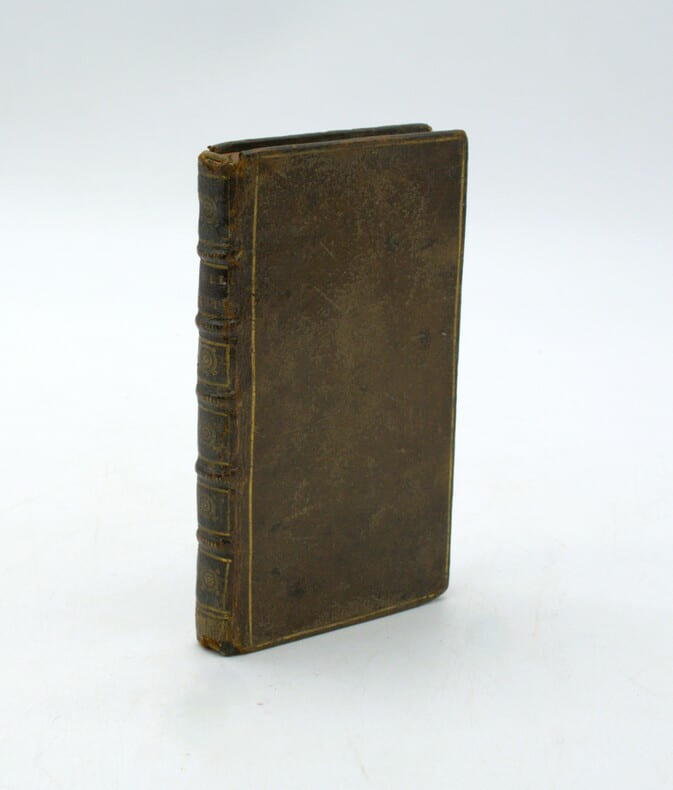
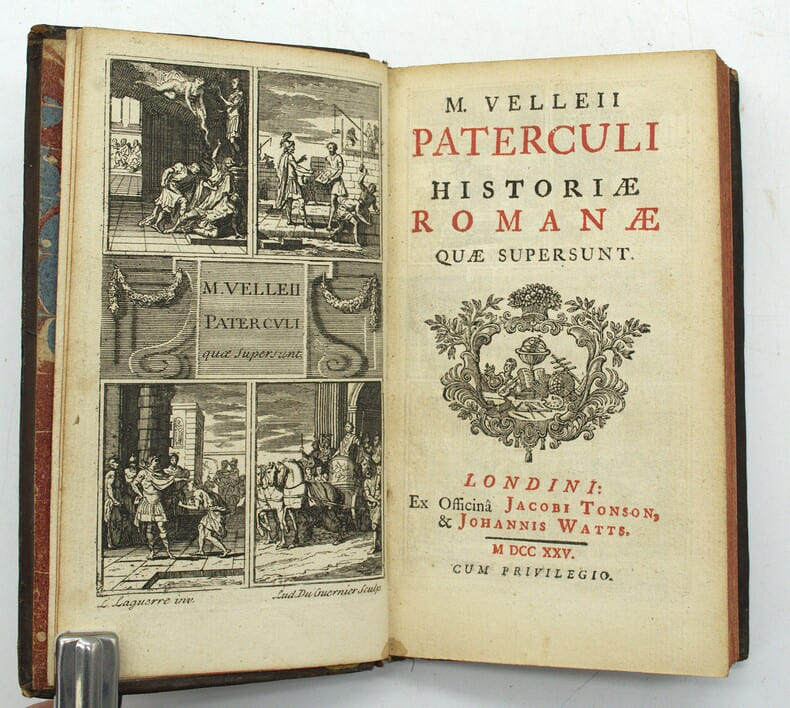
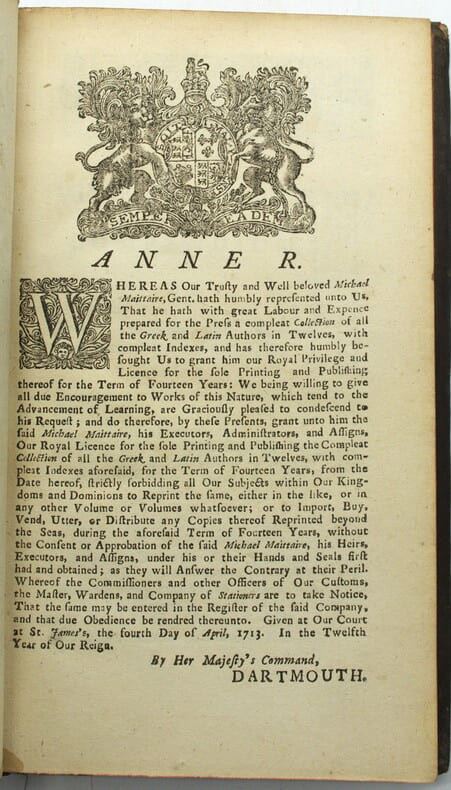
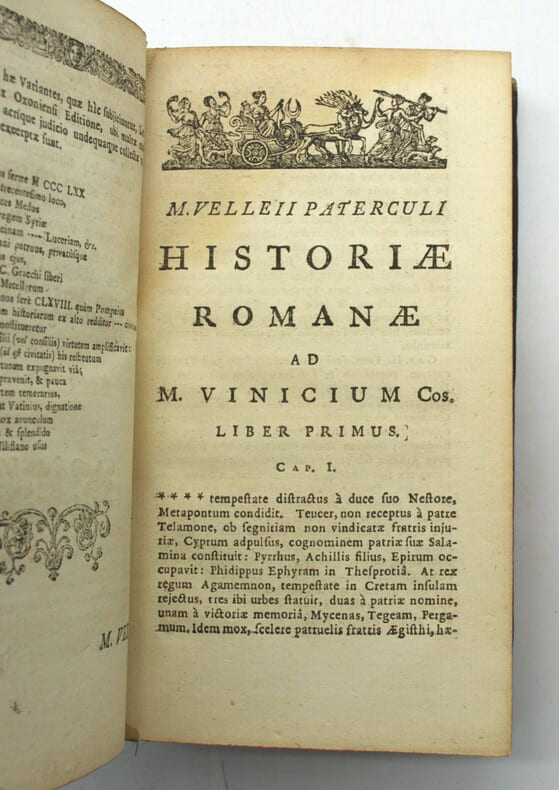
Londres, James Tonson, John Watts, 1725, in-12, 9ff.-84pp.-11ff., avec un titre-frontispice gravé par Du Guernier d'après Laguerre, relié pleine basane époque, dos à nerfs orné avec pièce de titre, filet aux plats, frottements et griffures, coiffes usées.
Reference : PHO-1861
Velleius Paterculus est un historien romain qui a vécu sous le règne de Tibère et a écrit une brève histoire de Rome, couvrant la période allant de sa fondation légendaire à son époque, remarquable pour son récit équilibré de l'histoire romaine depuis ses débuts mythiques jusqu'au règne de Tibère. Il est particulièrement précieux en raison de sa perspective contemporaine sur les événements du début de l’Empire romain. L'œuvre est un mélange de récit historique et de réflexion morale, et Velleius lui-même était sénateur et officier militaire, ce qui lui a donné un aperçu particulier de l'État romain et de son fonctionnement. M2-Et4
Bookseller's contact details
Librairie Voyage et Exploration
M. Stéphan Feldman
09 86 72 59 94
Payment mode

Sale conditions
Les colis sont soignés, possibilité d'envoi partout dans le monde avec COLISSIMO international, frais à définir selon le poids de l'ouvrage et l'assurance choisie.
5 book(s) with the same title
Historiae romanae, quae supersunt, Volumen I quod complectitur Fragmenta Librorum I - XXXV cum Annotationibus Maxime Henrici Valesii - Libros XXXVI - LIV, Integros cum Annotationibus Ioannis Alberti Fabricii ac Paucis Aliorum, Graeca ex Codicibus Mss. et Fragmentis supplevit emendavit Latinam Versionem Xylandro-Leunclavianam Limavit, Varis Lectiones Notas Doctorum suas cum apparatu et indicibus adiecit Hermannus Samuel Reimarus. Tome II : Quod complectitur Libros Dionis LV - LX. Passim Mutilos et breviatos cum Annotationibus Ioannis Alberti Fabricii et nonnullis aliorum, Libros item Dionis LXI - LXXX. Ex compendio IO. Xiphilini, cum annotationibus Hermanni Samuelis Reimari, qui et ubivis Fragmenta reperta suis logis inservit varias lectiones et annotationes subiecit versionem castigavit, Apparatum Annationum et emendationum cum indice Graeco et Latino adiunxit.
Hamburgi, Christian HEROLD, 1750, 2 volumes grand in-folio de 265x405 mm environ, tome I : (2) ff., faux-titre, titre, xxix (dedicatio, praefatio), 1 portrait pleine page du traducteur Johannes Albertus Fabricius, 767 pages, (2) ff., tome II : (1) f., faux-titre, titre (2) ff. (ad lectorem), 1 portrait pleine page de Hermanus Samuel Reimarus, pagination de 770 à 1708 (pagination continue), impression sur 2 colonnes par pages du texte grec avec traduction latine en regard, plein velin crème d'époque avec décor à froid sur les plats, titres manuscrits sur le dos, tranches finement mouchetées de rouge et brun. Mors abimés, erreur de pagination dans le tome II (1619 à 1626, répétition des chiffres mais texte cohérent et complet)un tampon ancien sur les pages de titre, rousseurs légères et pages brunies. Texte en grec et en latin.
Dion Cassius, en latin Lucius (ou Claudius) Cassius Dio (Cocceianus ?) (Nicée, Bithynie, v. 150-id., après 235) est un historien romain d'expression grecque.Dion Cassius est surtout connu pour son Histoire romaine, ouvrage de 80 livres qui retracent les 973 ans de la vie de Rome, de sa fondation à Alexandre Sévère en 229. Ne sont conservés intégralement que les livres 37 à 60, soit de 68 av. J.-C. à 47 apr. J.-C., les autres ne sont connus que par des abréviateurs comme les byzantins Xiphilin et Zonaras. Merci de nous contacter à l'avance si vous souhaitez consulter une référence au sein de notre librairie.
Cassii Dionis Cocceiani Historiae Romanae quae supersunt. (...) Cum annotationibus maxime Henrici Valesii, (...) Ioannis Alberti Fabricii ac paucis aliorum. Graeca ex codicibus MSS. et fragmentis supplevit, emendavit, Latinam versionem Xylandro-Leunclavianam limavit, varias lectiones, notas doctorum et suas cum apparatu et indicibus adjecit Hermannus Samuel Reimarus. (...)
Hamburg (Hamburgi), Sumtibus Christiani Heroldi, 1750 - 1752. (Colophon at the end of vol. 1: Hamburgi, Typis Joannis Georgii Piscatoris & Filii, 1749)
Folio. 2 volumes: (IV including portrait), XXIX,(1),768,(1 blank) p.; (VIII including portrait), p. 769-1708 (recte 1716 ); 2 portraits, of Fabricius & Reimarus; 1 plate. Contemporary gilt calf. 42 cm (Ref: Hoffmann 1,549; Brunet 2,712: 'Édit. la plus belle, la plus complète et la meilleure'; Moss 1,405/06: 'One of the most correct and valuable Greek works ever printed. The notes contain a treasure of erudition'; Dibdin 1,506/07; Ebert 6143; Graesse 2,393; Not yet in VD18) (Details: Back elaborately gilt, and with 7 raised bands. Red morocco shield in the second compartment. Boards with gilt borders and 2 gilt rectangles. Title printed in red and black. Beautiful full-page portrait of Fabricius after the first half title, engraved by Gustav Andreas Wolfgang, 1749. Big headpiece of 1/2 a page at the beginning of the dedication, designed and engraved by Christ. Fritzsch, showing a portrait of the dedicatee Cardinal Angelo Maria Quirini. Full-page portrait of Reimarus at the beginning of volume 2, also designed and engraved by Christ Fritzsch, 1751. Facsimile of a leaf from a Vatican Codex after leaf 5E4) (Condition: Bindings slightly scuffed. Head of the first volume somewhat chafed. Corners slightly bumped. The leather enclosed by the sides of the inner rectangle on the boards is affected by a colouring agent) (Note: Dio Cassius Cocceianus of Nicaea in Asia Minor was born ca. 164 A.D. He held several high state offices (twice consul). He wrote in Greek a Roman history (Rhômaikê Historia) in 80 books, from the founding of the city of Rome till 229 A.D, the year of his own second consulate. His work 'appears to be based on republican annalistic tradition, Livy, or Livy's sources (...), imperial annalistic tradition, and for contemporary events', the time of Marcus Aurelius and the Severian dynasty, 'his own high authority. Unreliably about republican institutions and conditions, from Caesar onwards he used his constitutional experience, at first colouring events with his ideas of imperial absolutism, (...) but later handling his material with full knowledge. Annalistic in arrangement (...) his narration concentrated on political aspects, in the manner of Thucydides, giving a rhetorical narrative in Atticist style'. (OCD 2nd ed. p. 345) The 'editio princeps' of Cassius Dio was published in 1548 by Robertus Stephanus. The first Latin translation appeared ten years later in Basel, and was made by the German scholar Xylander, in German Wilhelm Holzman, professor of Greek at the University of Heidelberg. His gifted pupil Johannes Leunclavius, or Hans Loewenclau revised and augmented Xylander's translation, and had it published in 1592. Leunclavius added also a collection of critical notes of his own. This edition of 1750/1752 is the next important edition. It was begun by the German bibliographer and classical scholar Johannes Albertus Fabricius, 1668- 1736, whose notes cover the books 35/60. On his death his son-in-law Hermann Samuel Reimar, 1694-1768, professor of philosophy at Hamburg, completed the edition. Reimar carefully inspected all earlier editions, and consulted and collated some excellent manuscripts, and he incorporated the entire notes of the earlier commentators in it. The fragments of Dio Cassius were adopted from the 'Excerpta Peiresciana', collected and published by the French scholar Henri de Valois (1634). The first volume also contains the surviving fragments of the epitome of Dio that was compiled by the 11th century byzantine scholar Joannes Xiphilinus. The second volume contains the prefaces and observations of Robertus and Henricus Stephanus, Xylander, Sylburg and Leunclavius. Here we find also the critical and explanatory notes of Dutch professors Lambertus Bos, Tiberius Hemsterhuis and Peter Wesseling, and of other leading scholars) (Provenance: Bookplate of A. Pitlo on the verso of the half title, with a riddle. On the foreground an opened book, and in the background a fuming volcano, in between the motto 'Del pasat la remembransa e la fe de l'an que ven'. The Dutch jurist Adriaan Pitlo, 1901-1987, was for 30 years professor of private and notarial law. At the beginning of the thirties of the 20th century he spent 3 years with his wife in Naples. Of this time the said later: 'Ik geef het U ook te doen, om met uitzicht op de Vesuvius het Juristenblad te raadplegen!' (It is tough job, to consult the Jurist Journal, while enjoying the view of the Vesuvius') The bookplate obviously illustrates this anecdote full of melancholy. In the background we see the ever-fuming Vesuvius, and in front the opened Journal. The motto seems to reflect this mood) (See the site "Resources Huygens ING") (Collation: Volume 1: a-d4 (portrait after a1; leaf a4 signed a3); A-5D4 (leaf 5D4 verso blank). Volume 2: pi4 (portrait after leaf pi1; minus blank leaf p4); A-4F4, 4G4 (between leaf 4G2 and 4G3 an extra leaf, also signed 4G3, on which leaf the 'Apparatus ad Cassium Dionem' begins), 4H4-5E4 (Extra leaf, not signed, not paginated, with a specimen of a Vatican Codex after 5E4), 5F-5P4, (5P)4, 5Q-6B4, 6C2 (leaf 6C2 blank)) (Heavy set, may require extra shipping costs) (Photograph on request)
Historiae Romanae quae supersunt.
Londres, James Tonson, John Watts, 1725 in-12, [14]-106 pp., [11] ff. n. ch. d'index, avec un titre-frontispice gravé par Du Guernier d'après Laguerre, typographie en petit corps, basane brune, dos lisse orné, simple filet doré sur les coupes, tranches marbrées (rel. du début du XIXe). Dos frotté, épidermures.
Reprise de l'agréable édition portative donnée chez le même éditeur en 1713. L'abrégé de cet auteur latin dans la veine de Salluste, mort vraisemblablement dans la proscription des amis de Séjan en 31, fut, malgré l'état très lacunaire dans lequel il nous est parvenu, considéré comme un modèle par nombre de compilateurs : "C'est le modèle inimitable des abrégés", d'après le Président Hénault.Brunet, IV, 430. - - VENTE PAR CORRESPONDANCE UNIQUEMENT - LIEN DE PAIEMENT, NOUS CONSULTER.


C. Velleii Paterculi Quae supersunt ex Historiae Romanae voluminibus duobus, cum integris animadversionibus doctorum, curante Davide Ruhnkenio.
Leiden (Lugduni Batavorum), Apud Samuel et Joann. Luchtmans, Academiae Typographos, 1779.
8vo. 2 volumes in 1: (II, frontispiece),(XXXII),CXXII,1262 (recte 1260),(99 index) p. Calf 21 cm (Ref: STCN ppn 241048281; Schweiger 2,1130: a long note, from which :'Sehr wichtige Ausgabe'; 'an offenbar corrupten Stellen nahm er Emendationen, fremde und eigene, auf'. 'Die Notae des Rhenanus und Burer liess er unverstümmelt unter dem Texte abdrücken und fügte ihnen seine Anmerkungen ... neue Emendationen .. hinzu'. 'Der zweite Theil enthält den vollständigen Apparat der Burmannischen Ausgabe'; Dibdin 2, 525: 'a very excellent edition'; The text is 'amended in many passages by the judgement of Ruhnkenius, and not according to the fanciful suggestions of preceeding editors'; Brunet 4,430: 'Très bonne édition'; Ebert 23482: 'Diese Ausgabe ist ein whares Muster krit. Tacts und grammat. Gelehrsamkeit, und bis jetzt die beste'. J. Bernays, 'Geschichte der klassischen Philologie, Hildesheim, 2008, p. 144: 'jetzt (ca. 1880) noch ausgezeichnet'; Spoelder p. 677, Tiel 1) (Details: Prize copy, including the manuscript prize dated 3rd july 1801 for Romboldus Brenkman Pitlo. Back gilt elaborately, and with 5 raised bands. Red morocco shield in the second compartment. Other compartments filled with gilt floral motives. Borders of the boards also ruled gilt with floral motives, and floral corner pieces. Gilt coat of arms of Tiel on both boards. Edges dyed red.The frontispiece designed by H. van der My and executed by F. v. Bleyswyk, depicting Rome, personified by an emperor, as a stronghold against chaos, under the protection of the Gods; in the middle stands the wise goddess Athena; she holds in her right hand the Palladion; Athena is the 'aquilifer' (Eagle-bearer) of Rome, for in her left hand she holds the 'Aquila', the standard of the Roman army; with a long chain she holds the destructive forces of civil war and chaos under control) (Condition: Corners slightly bumped. Head of spine very slightly damaged. All 4 ties gone) (Note: The work of the Roman historian Velleius Paterculus, ca. 19 BC - after 30 AD, is a valuable source for the reigns of the Roman emperors Augustus and Tiberius. Paterculus, who served 'under Tiberius in many of his most important campains, seems to have conceived an unbounded admiration for him and the whole imperial family, in whose men he could see nothing but sublime virtues, while the ennemies were compact of every possible vice' (H.J. Rose, 'A handbook of Latin literature, London, 1967, p. 355). Velleius' adulatory type of history was however condemned by the later historian Tacitus, who ignores him. The 'Historiae Romanae', consists of 2 books. The beginning of the first, from the founding of Rome to the battle of Pydna in 168 BC, in which the Romans defeated the Macedonian kingdom, is lost. What remains of book one ends with the fall of Carthago in 146 B.C. Book 2 is of greater importance. 'Book 2, covering the period 146 BC to AD 30, becomes more detailed as it approaches the author's own day, doubtless because, as he tells us, he projected a fuller history from the Civil War onwards.' (OCD 2nd edition p. 1111/12). His style is less polished, but we are to remember that he was more a soldier than an scholar. Velleius Paterculus was in good hands with the Dutch scholar of German origin David Ruhnken, or Ruhnkenius, 1723-1798. David Ruhnken was born in Pommern, and was sent by his parents in 1737 to the Friedrichscollegium in Königsberg, where he read Latin authors together with his friend Immanuel Kant. To finish his studies he went in 1744 to Leiden, to study Greek under Tiberius Hemsterhuis, whom he admired. He later told his biographer Wyttenbach that that he found in his teacher the combined gems of Leiden classical scholarship, Scaliger and Salmasius, in one person. Hemsterhuis wanted to create a worthy successor, and appointed him in 1757 to assist him as Reader in Greek. In 1761 Ruhnken succeeded the Latin chair vacated by Oudendorp. He became one of the leading scholars of his days. 'Die Führerstellung der Philologie erbte (...) von Hemsterhuys der Pommer David Ruhnken, der ganz zum Holländer ward und die vornehme und behäbige Würde eines Princeps criticorum zu wahren wusste. Als solchem hat ihm Fr.A. Wolf die Prolegomena gewidmet. (...) Musterhaftes Latein galt ihm soviel wie Wissenschaft. Aber als Lehrer muss er glänzend gewesen sein. (...) Alles was Ruhnken veröffentlicht hat, ist in seinen Grenzen tadellos'. (U. von Wilamowitz-Moellendorff, Geschichte der Philologie, Lpz./Bln. 1921, p. 39/40) The edition of 1779 begins with a dedication, and continues with the dedications and prefaces of previous editions, from the edition of Beatus Rhenanus of 1520 till that of Burmannus of 1719. Then follow 60 p. 'Annales Velleiani, seu vita Velleii Paterculi pro temporum ordine disposita ab H. Dodwello'. The rest of the volume is filled with the text and commentary of Ruhnkenius. Volume 2, beginning with page 500, contains the 'Variorum interpretum Notae'. (On Ruhnken: ADB 29, 615/24; and of course the dissertation of E. Hulshoff Pol, 'Studia Ruhnkeniana', Leiden 1953) (Provenance: Prize for Romboldus Brenkman Pitlo, on the occasion of his promotion to 'supremam Mediae Classis ordinem' as the best pupil of his year (primus). It is dated the 3rd of July 1801, and signed by the curators of the Gymnasium of Tiel, W. de Roo, G.J. Rink, P. Ten Bosch and J. Dijkmeester, and by 'Me Gymnasii Rectorem J. Posthuma'. A report of the prize ceremony can be found in 'Maandelijkse uittreksels, of Boekzael der geleerde waerelt', 1801, p. 353/4: 'Thiel. Na dat op den 3den July het gewoone Zomerexamen gehouden was, zyn op den eersten September eenige wakkere en veelbelovende jongelingen naar hoogere Classen bevorderd, en met aanzienlyke eerpryzen beschonken. De Rector J. Posthuma opende deze plechtigheid met eene Redenvoering 'over den staat der Letterkunde, vooral in de jongstafgelopen Eeuw in vergelyking met dezelve in de twee nog vroegere Eeuwen'. P.C. Stoltz, welke naar de hoogste Classe der Rectors School bevorderd wierd, hield hierop eene korte Redevoering over de spreuk by Vergilius 'nulla salus bello'; hierop hebben R. Brenkman Pitlo, Z.T. de Jong en F.H. Spiering, benevens J. de Roo en J. Post; als ook C.J.A. Spiering en T.G. van Lith de Jeude, hunne dankzeggingen voor de aanzienlyke eerpryzen, welke zy ontfingen, met veel bevalligheid afgelegd'. Remmet (Rombout, Romboldus) Brenkman Pitlo (1786-1861) was a prominent citizen in Tiel: he was a lawyer, a judge and a member of the city council. De Opregte Haarlemsche Courant of 30-10-1821 announces his marriage on the 25th of October with L.C. van Luttervelt in Tiel) (Collation: pi1, +2-+8, *-7*8, 8*6 (minus blank leaf 8*6); A-2H8, 2I8 (chi1, the title of the second volume, after 2I1), 2K-4Q8; between 2F and 2G the pagination jumps from 464 to 467, the catchword connect the gatherings correctly)) (Photographs on request)
C. Velleii Paterculi Quae supersunt ex Historiae Romanae Voluminibus Duobus Cum Integris Scholiis, Notis, Variis Lectionibus...
Rotterodami Apud Joh. Danielem Beman & Filium 1756 Fort in-8, rel. ép. vélin rigide, dentelle dorée encadrant les plats, armes dorées au centre, pièce de titre bordeaux au dos. Frontispice gravé daté 1744, 748 pp., et 60 ff. n. ch. d'index. Il s'agit de la même édition que celle de P. Burmanni, Lugd.-Bat. 1744, dont on a uniquement changé le titre, ainsi que le prouvent les indications portées sur le frontispice.
Reliure en mauvais état (dentelles et armes presque entièrement effacées), fort accroc au dos. Néanmoins, mérite une restauration compte tenu des éloges portés par Brunet et Graesse, quant à la qualité de cette impression.

