 Write to the booksellers
Marguerite Forest, fille du sénateur Charles Forest et belle-fille de l'écrivain Edouard Pailleron (propriétaire), Ex-libris.
Ex-libris.
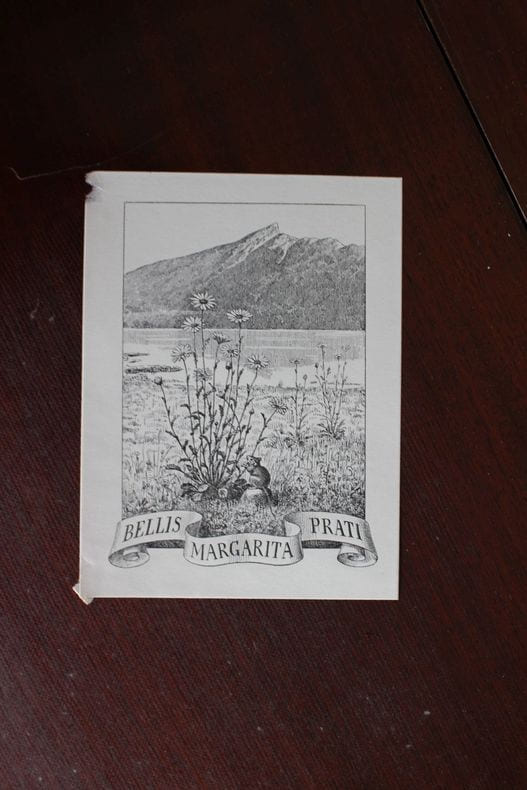
Ex-libris (106*79mmmm). Nous possédons cet ex-libris en 4 tirages différents.
Reference : 003994
Bookseller's contact details
Librairie Trois Plumes
Benoît Galland
131 rue du haut Pressoir
49000 Angers
France
+33 6 30 94 80 72
Payment mode

Sale conditions
Conditions de ventes conformes aux usages de la librairie ancienne et moderne
5 book(s) with the same title
L'Ex-Libris - Revue Internationale paraissant tous les deux mois, Puis tous les trois mois - Armoriaux - Blasons - Généalogies -Héraldique - Ordres de chevalerie - Reliures Armoriées - (Questions, Réponses, Mariages, Décès, Avis divers - Bibliographie)- 1929 - Les Ex-libris occultisres d'Henri Chapront - Sydney Hunt, graveur - Jules Grosfils - Le fer de Reliure du baron F. de chalençon-Rochebaron - Les Chevaliers de Malte - Ex-libris de louis XVII - Les Armoiries des soeurs de Saint-Jean l'Evangéliste d'Evreux - P.-L. Courier - Jeanne d'Arc - G. Granger, Peintre, Sculpteur & graveur d'Ex-libris - E. Jung-Daulte - H. Bacher - J.-M. Boulan - L'Abbé Xaupi.- 1930 - H. Heeren & la question des Ex-libris multiple - Héraldique belge - E. Lefebvre - Ex-libris de Catherine II de Russie - Les rose-Croix - J. Berszten Tiomakowski - La Légion d'honneur et le Clergé - Documents & Armoiries inédites - M.-C. Mittay - Famille Guirard - A. Ballet - Ex-libris d'aviateurs - Ex-libris italien - Blasons en exil : La chute d'un roi & la Grande Maîtrise de la toison d'Or (Espagne) - M. Grognot .- 1931 - A. Hinter - Edouard le Marant de Kerdaniel (Bretagne) - R.-J. Weissenbach - J. Carlu - Les comtes de Paris - Un bouquet d'Ex-libris offert au président Poincaré - Héraldique hongroise (hongrie) Mde G. Lantoine-Neveux - Etude sur l'Héraldique belge - Héraldique anglaise : le cimier, la devise, Armoiries modernes - A. Tardieur - J. Desthieux - Pour Goethe - La Bannière et les Compagnons de jeanne d'Arc - Les origines du drapeau belge - Ch-J. Hallo - Ex-libris de charles Le Goffic - Les Chevaliers pontificaux - Le Minitier Central des notaires de Paris - La sorbonne.- 1932/1933 - Ex-libris d'actualite : le Yo-Yo - L'Ordre de Malte - L'Ordre du Saint-Sépulcre - les Sanctions de l'Ordre de la Légion d'Honneur - Petit Musée d'Ex-libris féminin - Etude sur l'Héraldue Belge - Les Pénitents Noirs de Marseille - J. Aroud - A. Comtat, vice-Président suisse -Le Chevalier E. Salomon - La Croix Gammée ;: ses origines & les insignes hitlériens - Les Pénitents Blancs d'Avignon - Les Pénitents des Mines de Saint-Etienne en Forez .- 1934 - Les Ex-libris de Jean-Emile Laboureur (13 illustrations) Ex-libris suisses du XVI è siècle - E. ROEthlisberger - Quintoa et le Val d'Andorre - ex-libris de dentistes - L'Ordre de Malte - L'oeuvre graphique d'H. Grimm - en flanant dans Paris.
PARIS, chez H. Daradon, Libraire - Revue In-4 - 1 ère année 1929 - Tête de collection - Illustrations en texte, dans chaque numéro - Années 1929, 190 pages, 1930, 192 pages, 1931, 192 pages , 1932/1933, 192 pages, 1934 , 96 pages - Exemplaires non coupés, rousseurs, certains avec mouillures - Rare - Réf. 48213
Conformément à nos conditions générales de vente :Les frais de port sont affichés à titre indicatif. Il se peut que nous devions vous contacter pour vous informer du coût de laffranchissement supplémentaire en fonction du poids et du nombre de livres, surtout pour les envois internationaux Cependant vu l'augmentation des tarifs postaux à l'internationale, nous pouvons expédier les ouvrages en point relais MONDIAL RELAY pour les pays suivants : Allemagne, Autriche, Belgique, Espagne, Italie, Luxembourg, Pays-Bas, Pologne, et Portugal. Merci de nous indiquer en retour le point relais choisi ainsi que votre numéro de téléphone mobile & adresse Courriel pour assurer le suivi du colis.N'hésitez pas à nous interroger.In accordance with our general terms and conditions of sale:Shipping costs are displayed for informational purposes only. We may need to contact you to inform you of the additional postage costs depending on the weight and number of books, especially for international shipments.However, given the increase in international postal rates, we can ship books via Mondial Relay to the following countries: Germany, Austria, Belgium, Spain, Italy, Luxembourg, Netherlands, Poland, and Portugal. Please provide us with your chosen Mondial Relay point, as well as your mobile phone number and email address to ensure package tracking.Please feel free to contact us with any questions
Revue internationale de l'ex-libris héraldique, armoriaux, blasons, généalogies, reliures, ordres de chevalerie. Publicationa mensuelle. 4me année, no. 1-12 (en 6 fascicules).
Paris, H. Daragon, libraire-éditeur. 1920. In-4°. 190 p., 1 f. Broché.
No. 1-2, janvier-février: G. Paulian. Des Ex-libris Niçois (8 illustrations), B. Linnig. Des Ex-libris Belges (9 illustrations), e.a. - No. 3-4, mars-avril: G. Paulian. Des Ex-libris Niçois (17 illustrations), B. Linnig. Des Ex-libris Belges (3 illustrations), e.a. - No. 5-6, mai-huin: B. Linnig. Des Ex-libris Belges (22 illustrations), Bibliographie: 200 Ex-libris Guerre. - No. 7-8, juillet-août: B. Linnig. Des Ex-libris Belges (4 illustrations), E. Salomon. Un Ex-libris inédit du graveur lyonnais Aroux (1 planche), Ex-libris de Fréchencourt (1 illustration), P. Olivier. Ex-libris médicaux de la famille Arnaud, du Puy (5 illustrations), e.a. - No. 9-10, septembre-octobre: Mrquis de l'Eglise. Au pys de Grise-Gonelle (1 illustration), E. Salomon. Fers Lyonnais inédits (8 Illustrations), e.a. - No. 11-12, novembre-décembre: E. Salomon. Fers Lyonnais inédits (8 Illustrations), Ker-Frank-Houx. De la justification de l'Ex-libris (4 illustrations), e.a.

LES MARQUES ET EX-LIBRIS DES CORPORATIONS DU LIVRE
Leclerc.1909. Petit in-4 demi-toile.Ills.Ex.137.Couvs.conservées.TBE.

Verzameling van 7 ex-libris - gravures.
" Verzameling van 7 ex-libris, allen gesigneerd in potlood door de kunstenaar. Afgedrukt op dun (Japans ?) papier. Papiergrootte : 13 x 20 cm, plaatgrootte 95 x 70 mm. (voor 6), één is kleiner : 70 x 58 mm.Sommige ex-libris zijn ook gedateerd en gesigneerd in de plaat (zie hieronder). [1] Ex-libris Geo Kerkaert, gedateerd en gesigneerd in de plaat linksboven: 1937. [2] Ex-libris van de etser zelf; gedateerd in de marge van de plaat (rechtsonder) 1937. [3] Ex-libris Lisbeth Daenen. gesigneerd en gedateerd linksonder in de plaat; jaartal onleesbaar (1891 sic). [4] Ex-libris Henry De Geofroy (schilder !), niet gedateerd, wel gesigneerd. [5] Ex-libris Stanley Deason, gesigneerd en gedateerd, linksonder in de plaat, 1937. [6] Ex-libris, naam niet gegraveerd in banier hiervoor bestemd.Linksboven gesig. en gedat. , 1937. [7] Ex-libris, naam niet te lezen, kleiner formaat , niet gedateerd , noch gesig. (pril probeersel). In de oeuvre catalogus van De Coninck (AMVC - Pallemans, 1980) komt slechts één ex-libris voor (Item 9A). De reden dat deze gravures niet voorkomen in de catalogus wordt ook verklaard in zijn korte biografie. Op 3 november 1944 wordt zijn atelier op Antwerpen Linkeroever zwaar beschadigd door de inslag van een Duits V-1 cruise weapon. De meeste van zijn etsplaten worden vernield. Deze verzameling is een uiterst zeldzame getuigenis van de eerste stappen die de latere ''Meester'' van de Antwerpse Graveer Academie zette op het pad van graveer kunstenaar."
Ex-libris poeticis et verlainicis A. Herry. Plaque de bois gravée pour cet ex-libris (8,5 x 10,5 cm, 2 cm d’épaisseur.)
Ex-libris gravé par l’artiste pour sa collection de livres de Verlaine. C’est un portrait de Verlaine, signé du monogramme de Herrry.André Herry, 1899 - 1967, aviateur, ingénieur,dessinateur et graveur d'ex-libris fut un des fondateurs de l'AFCEL, Association Française de Collectioneurs d’Ex-Libris dont il fut président. “Résidant tantôt à Nancy, tantôt à Paris, il assura la liaison avec la capitale dont aucune société artistique ne peut se passer. Ingénieur dynamique et entreprenant il prit des contacts avec de nombreux milieux, souvent très influents et put graver, sur bois de fil ou lino, plus d’une centaine d’ex-libris de Madeleine Lagrange, de Germaine Bonnisien ou le sien.” Meyer Noirel p. 235.

