 Write to the booksellers
Zola, Emile.
Rome
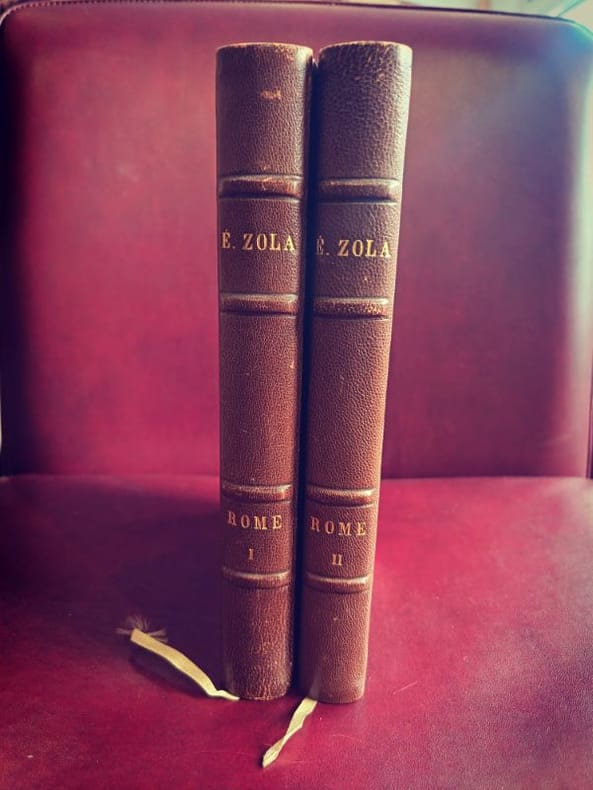
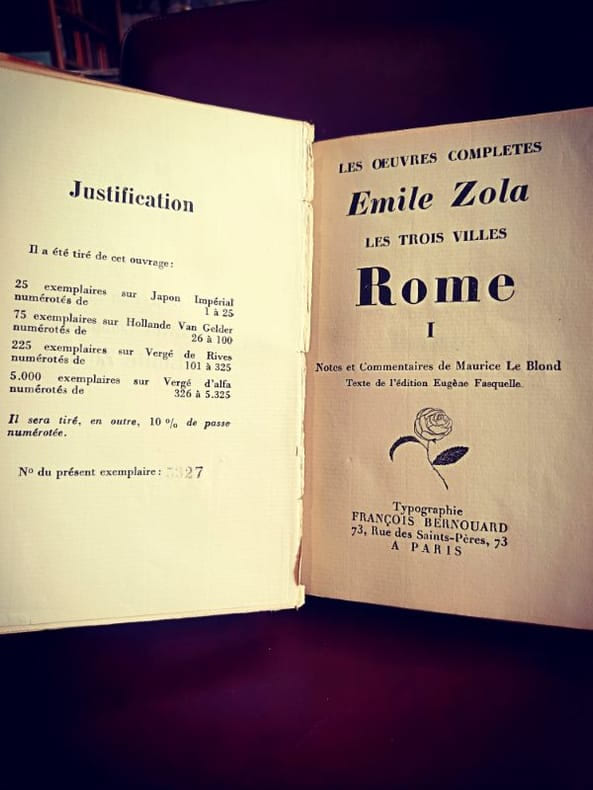
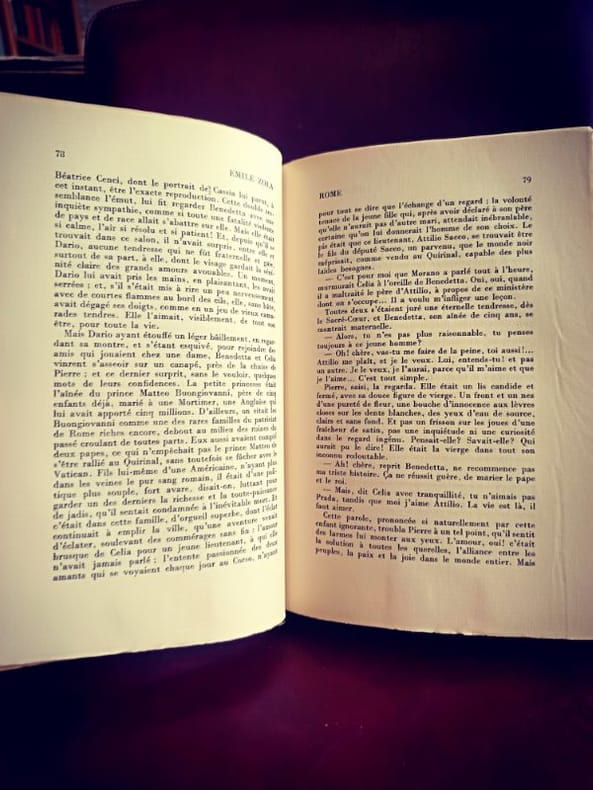
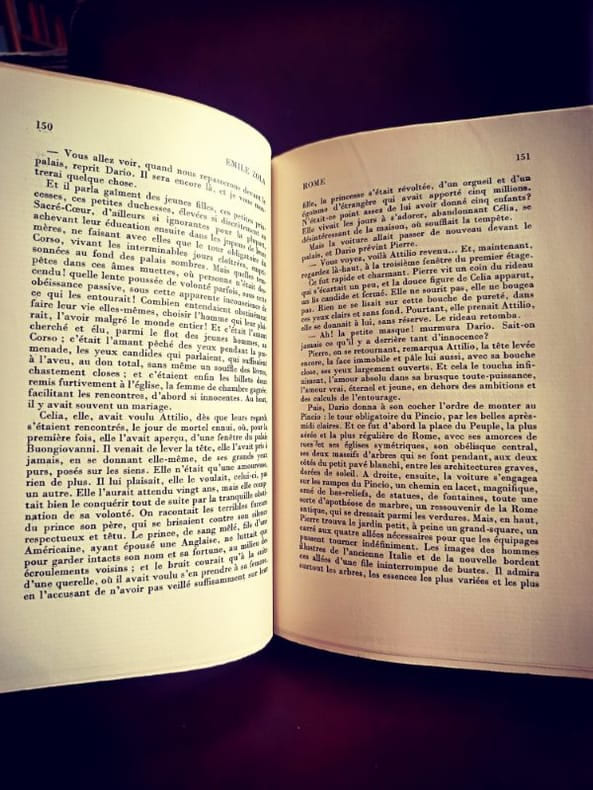
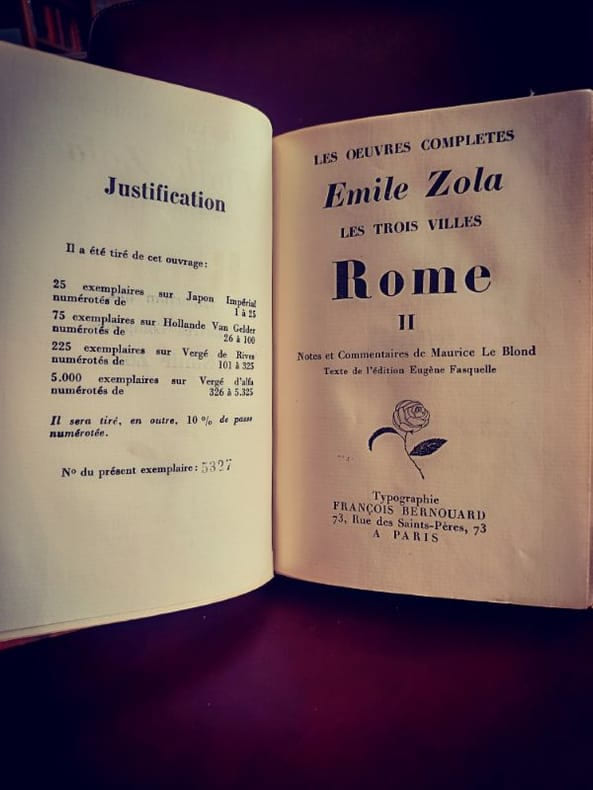
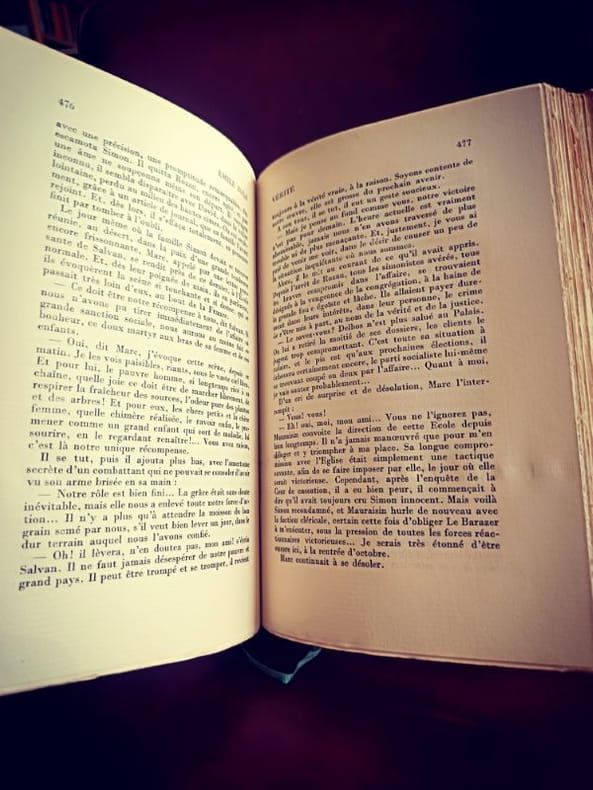
Paris Bibliothèque-Charpentier, Eugène Fasquelle / François Bernouard 1928 2 in -8 Reliure de l'époque en demi-chagrin, dos à nerfs ornés de caissons dorés, titres et tomaisons dorés 369 [p.p]718 [p.p] Deuxième volet de la trilogie, Rome suit l'abbé Pierre Froment dans la Cité éternelle. Venu plaider la cause de son livre auprès du Pape, il se heurte à l'immuabilité de l'institution catholique. Zola livre ici une fresque monumentale, confrontant la Rome antique, la Rome chrétienne et la Rome moderne (la "Troisième Rome") dans un duel intellectuel sur l'avenir de la religion face à la montée du socialisme et de la science.L'approche de Zola dans ce volume relève d'une hyper-focalisation architecturale. Il cartographie Rome comme un système de strates historiques superposées. Pour un esprit neuro-atypique, cette description quasi maniaque des palais et des hiérarchies vaticanes offre une structure rassurante et logique : chaque lieu correspond à un rouage du pouvoir. C'est une mise en ordre spatiale de la pensée politique et religieuse.À travers les intrigues de la noblesse romaine déchue, Zola analyse les mécanismes de l'aliénation. D'un point de vue féministe, le personnage de Benedetta Boccanera illustre tragiquement la force de l'engagement passionnel face aux interdits dogmatiques. Réhabiliter ce récit aujourd'hui permet d'observer comment les structures de pouvoir anciennes tentent de réguler les corps et les désirs au nom d'un ordre moral pétrifié. L'ouvrage appelle, en filigrane, à un développement de la liberté individuelle contre les carcans institutionnels.
Reference : LCI-6490
Très bien conservé Disponibilité sous réserve de vente en boutique, prix valable, frais de port en plus, La Poste ou Mondial Relay
Bookseller's contact details
Le Chef d'Oeuvre Inconnu
M. Jean-Claude Codevelle
20 rue Edouard Delesalle
59000 Lille
Hauts-de-France France
contact@lechefdoeuvreinconnu.com
07 71 61 83 27
Payment mode
Sale conditions
Librairie Ancienne Arts et Lettres Le Chef d'Oeuvre Inconnu SASU au capital de 3500 € SIREN : 810 817 916 APE : 4761Z Siège Social 47 rue Turgot 59000 Lille TVA non applicable - article 293 B du CGI http://vosdroits.service-public.fr/professionnels-entreprises/F21746.xhtml\#R24406 avant expédition cash
5 book(s) with the same title
Le Voyage à Rome
Bouquins / Laffont, 2004, Collection fondée par Guy Schoeller, in/8 broché, 954 pages.
"Pierre Grimal, dans Voyage à Rome, se fait pour nous ce " flâneur urbain " si cher à Walter Benjamin. Celui que les Romains nommèrent en 1993 " citoyen d'honneur de Rome " ne fut pas, en effet, seulement le grand historien qui dépeignit et pensa la Rome antique dans une somme impressionnante d'ouvrages, il fut aussi l'arpenteur et le contemporain de la ville d'aujourd'hui. Voyage à Rome se présente comme un " itinéraire ", au double sens de parcours intellectuel et de promenade : les textes de Pierre Grimal réunis ici, avec une foule d'inédits, sont une invitation à la promenade au gré des chapitres successifs de l'histoire de la Ville Éternelle, mais aussi à la distraction, à la flânerie et à l'amour.Dans le guide donné en annexe, Pierre Grimal revisite aussi les lieux et les monuments, les fontaines, les jardins et les églises qui l'ont émerveillé et orienté. Sans se vêtir, comme un Suarès, de révérence musquée, il nous introduit comme nul autre, par une mise en jeu du corps dans l'histoire, au devenir historique de la cité, à travers les plus grandes choses comme dans les plus minuscules détails, tels les carafes au col largement ouvert où l'on sert le vin blanc de Frascati ou les fameux gelati, héritiers du premier sorbet inventé par Néron. Il donne à chaque pierre, à chaque moment de l'histoire leur épaisseur sensible avec cette élégance qui lui est propre et rend la connaissance joyeuse et féconde."
Des journaux chez les romains, recherches précédées d'un mémoire sur les annales des pontifes, et suivies de fragments des journaux de l'ancienne Rome
Paris : Librairie de Firmin Didot frères, imprimeurs de l'Institut de France, rue Jacob, n°56, 1838.
In-8° (141 x 220 mm), [2] ff., iii pp., 440 pp., demi-veau vert, dos lisse orné, tranches marbrées (reliure de l'époque signée BAUZONNET en pied du dos). Édition originale de cette réunion de deux ouvrages savants lus en 1835 à l'Académie des Inscriptions et belles-lettres. Envoi autographe signé : « A Monsieur Feburier L'auteur, J. V. Le Clerc ». Dans un premier ouvrage (pp. 1-181), l'auteur soutient la thèse selon laquelle les Annales des pontifes, tables chronologiques annuelles composées dès les premiers siècles de Rome, auraient survécu à l'invasion gauloise et été utilisées par les premiers historiens de l'Empire. « Quant à l'autorité de ces Annales, » ajoute-t-il, « les fables religieuses ou politiques qu'elles devaient contenir [...] n'ont rien de plus merveilleux que tant d'autres fables dans les anciennes chroniques de tous les peuples. » (p. 178). Dans le second ouvrage, Le Clerc défend l'ancienneté à Rome des « journaux » ou « actes diurnaux », publications journalières rendant compte des affaires publiques, édits, procès, phénomènes naturels et actes de l'assemblée du peuple. Il présente ces journaux comme les descendants directs, ouverts à un plus large public, des Annales pontificales. En appendice sont reproduits des fragments des annales des pontifes et des journaux romains. Sainte-Beuve, s'il émet quelques réserves, écrit au sujet de l'ouvrage : « « M. Leclerc nous pardonnera d'être un peu plus indulgent que lui pour Niebuhr, à qui nous sommes redevables d'un service qu'il n'est pas en mesure de reconnaître aussi bien que nous : je veux parler de l'ouvrage même de M. Leclerc [...] Il est impossible, ce nous semble, d'apporter une érudition plus complète, mieux munie de tous les textes, de les mieux colliger, épuiser et discuter, de les passer à un creuset plus sévère que M. Leclerc ne l'a fait. » Revue des Deux Mondes, tome 20, 1839 (p. 839-854). » Membre de l'Académie des Inscriptions et belles-lettres, maître de conférence à l'École normale puis professeur d'éloquence latine à la Faculté de lettres de Paris, Joseph-Victor Le Clerc (1789-1865) publia de nombreux travaux d'éruditions sur Montaigne et sur l'antiquité ainsi qu'une traduction des oeuvres complètes de Cicéron. L'ouvrage est habillé d'une élégante reliure signée Bauzonnet en pied du dos. Apprenti chez Simier et Jean-Georges Purgold, dont il épouse la veuve en 1830, Antoine Bauzonnet s'associe en 1840 au doreur Georges Trautz. Il prend sa retraite en 1847. Une exposition consacrée aux reliures de Bauzonnet est organisée au cabinet des livres du château de Chantilly en 2009. Joseph-Victor Le Clerc (1789-1865), latiniste et érudit français, fut maître de conférences à l'École normale puis professeur d'éloquence latine à la Faculté des lettres de Paris. Membre de l'Académie des Inscriptions et belles-lettres, il publia de nombreux travaux d'érudition sur Montaigne et sur l'Antiquité, ainsi qu'une traduction des oeuvres complètes de Cicéron. Quelques accrocs au dos, dos et mors insolé, coins légèrement frottés.


CONFORMITES DES CEREMONIES MODERNES AVEC LES ANCIENNES. Où l'on prouve par des Autorités incontestables, que les Cérémonies de l'église Romaine sont empruntées des Payens [...] Nouvelle édition corrigée & augmentée de la LETTRE ECRITE DE ROME sur le même sujet par Mr. CONYERS MIDDLETON.
1744 Amsterdam: Maynard Uytwerf, 1744. Complet en 2 vol. in-12: 10 x 17 cm. I/ 10 ff., 307 pp.; II/ 1 f., 308 pp. Première édition collective de ces deux textes censurés. Reliures de l'époque en veau blond. Dos à 5 nerfs avec pièce de titre en maroquin rouge, pièce de tomaison en maroquin vert, caissons à fers dorés et ex-libris d'Adr. Jos. Have. inscrit en queue en lettres dorées. Manque à la coiffe de tête du tome II, mors légèrement fendus, papier propre, reliures solide. Bel exemplaire.
Nouvelle édition augmentée des "Conformités..." de Pierre Mussard (1625?-1681) après la première édition parue à Genève en 1667 et mise à l'index l'année suivante. Ouvrage particulièrement important pour l'histoire des rapports entre le christianisme et les mystères des initiations de l'Antiquité. En outre, le pasteur Mussard est aussi l'auteur d'un autre important traité d'histoire des religions, portant sur les dieux qui prédisait l'avenir: Historia Deorum Fatidicorum (Genève: Pierre Chouet, 1675). Le deuxième volume est consacré à l'ouvrage du théologien anglais Conyers Middleton (1683-1750) qu'il écrit à Rome et dans lequel il développe sa thèse des origines païennes des croyances et rites chrétiens. Il s'agit de la première et seule édition française connue de ce texte paru initialement en anglais en 1729 : "Letter from Rome, showing an Exact Conformity between Popery and Paganism".
HISTOIRE ROMAINE DEPUIS LA FONDATION DE ROME JUSQU'À LA BATAILLE D'ACTIUM. c'est-à-dire jusqu'à la fin de la République, par M. Rollin,... T. I [-VII]. - T. VIII, revu depuis la mort de l'auteur, par M. Crevier, et contenant l'éloge de M. Rollin par M. de Boze,... - T. IX, revu et rendu complet, par M. Crevier,... - T. X-XVI, par M. Crevier,... [pour servir de continuation à l'ouvrage de M. Rollin]
1739 Paris: Veuve Estienne (Vve Estienne et fils), 1739-1749. Complet en 16 vol. in-12: 10.5 x 15.5 cm. (Quérard, VIII, 128). Illustré de 13 grandes cartes et plans dépliants d'après Anville, géographe du roi (Environs de Rome, Rome ancienne, 2 pl. d'Italie, Combat Naval d'Ecnome, Expédition d'Annibal, Sicile, Plan de Syracuse, Espagne, Grèce, Gaule Cisalpine, Numidie, Gaule sous César). Reliures de l'époque en veau. Dos à 5 nerfs avec pièces de titre et de tomaison en maroquin orangé, caissons à fers dorés. Filets à froid sur les plats et les coupes. Gardes recouvertes de papier marbré. Tranches rouges. Ex-Libris: Mr. May d'Huningue. Bel ensemble.
ROLLIN, Charles (1661-1741) / CREVIER, Jean-Baptiste-Louis (1693-1765)
Reference : 5850
(1752)
HISTOIRE ROMAINE depuis la fondation de Rome jusqu'à la bataille d'Actium: c'est -à-dire jusqu'à la fin de la République. Commencée par M. Rollin & continuée par M. Crevier.
1752 Paris: Veuve Estienne et Fils, Desaint et Saillant, 1752. Complet en 8 vol. in-4 (20 x 26 cm). Vol.I: (bl., fx-t., titre), CXII pp.: Eloge de Rollin jusqu'à la p. XXVI, Préface jusqu'à la p. LXXVI, Avertissements jusqu'à la p. CVIII, 4 pp. de liste alphabétique de noms géographiques anciens et modernes; 555 pp. dont 11 pp. de table, (bl.): 1 carte et 1 plan (de Rome). Vol.II: (bl., fx-t., titre), LVI pp. d'avant-propos; 599 pp. dont 15 pp. de table, (bl.): 2 cartes dépliantes et 1 plan de bataille navale. Vol.III: (bl., fx-t., titre), 750 pp. dont 19 pp. de table, (2 bl.): 3 cartes dépliantes et 1 plan. Vol.IV: (bl., fx-t., titre), 651 pp. dont 20 pp. de table, (bl.): 3 cartes dépliantes dont l'une avec des frontières de diverses couleurs. Vol.V: (bl., fx-t., titre), 672 pp. dont 21 pp. de table, (2 bl.): 1 carte dépliante. Vol.VI: (bl., fx-t., titre), 685 pp. dont 23 pp. de table, (2 bl.). Vol.VII: (bl., fx-t., titre), 683 pp. dont 24 pp. de table: 1 carte dépliante. Vol.VIII: (bl., fx-t., titre), 730 pp.: livre LII jusqu'à la p. 539, table jusqu'à la p. 557, table des matières sur 2 colonnes jusqu'à la p. 705, chronologie " fastes consulaires " jusqu'à la p. 730, (2 pp. de privilège, bl.). Replire plein veau d'époque. Dos à 5 nerfs ornés de fleurons dorés, pièce de titre et de tomaison en maroquin brun-rouge, tranches rouges, intérieur marbré. Traces modérées d'usage, manque aux coiffes, et aux mors de certains volumes. Bon état intérieur. Phtographies sur demande.
Suite de l'Histoire ancienne consacrée par Rollin à l'Histoire Romaine, parue la 1ère fois en 1738, allant de la fondation de Rome à la bataille d'Actium, et continuée par Crevier (1693-1765). Plusieurs éditions se succédèrent jusqu'en 1832. (Quérard VIII, 128).

