‎[HELVETIUS Claude-Adrien]:‎
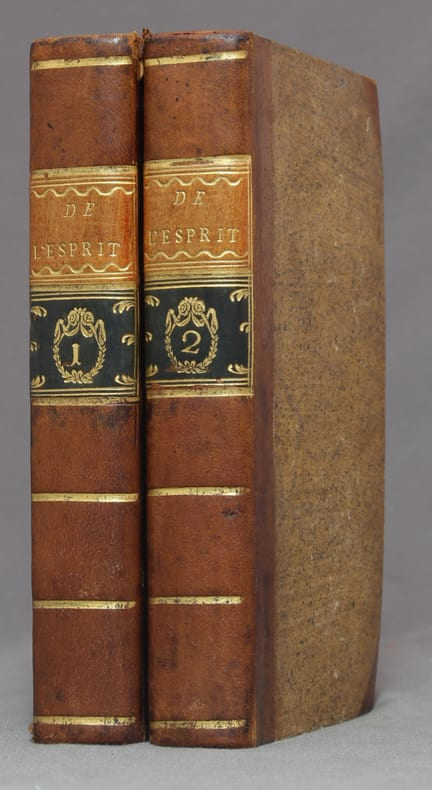
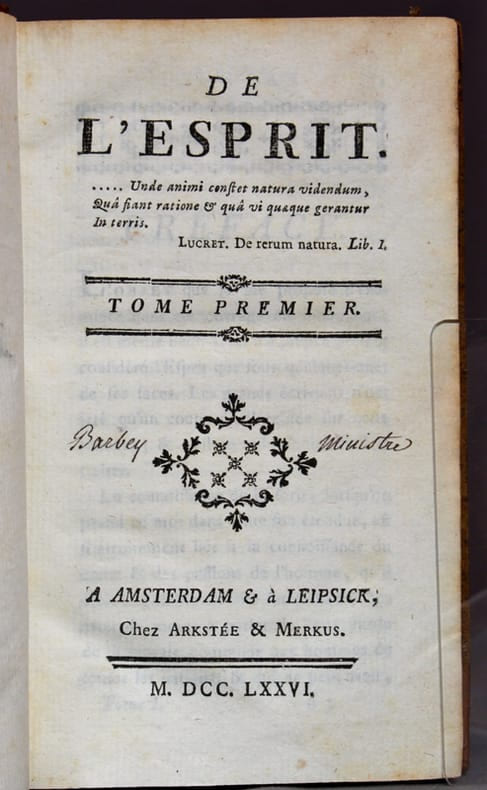
‎De l'esprit.‎

‎A Amsterdam & à Leipsick, chez Arkstée & Merckus, 1776. 2 volumes in-12 de XII-370 et [4]-379 pages, demi-veau moucheté à petits coins, dos lisses ornés de filets, roulettes, fleurons, titre et tomaison dorés, pièces de titre tabac, de tomaison noires, tranches mouchetées. ‎

Reference : 11333


‎ "Un arrêt du parlement, rendu le 6 février 1759, fit brûler, le 10 du même mois, cet ouvrage condamné de toutes parts, ce qui n'a pas empêché qu'il n'ait été réimprimer plusieurs fois depuis". Quérard La France littéraire IV, p.60 ; Barbier II, 178. Nom de possesseur aux titres, à la plume: "Barbey ministre". ‎

€268.47 (€268.47 )
Bookseller's contact details

ILLIBRAIRIE | Bombadil SA
Monsieur Alexandre Illi
20 Grand'Rue
1204 Genève
Switzerland

info@illibrairie.ch

+4122 310 20 50

Contact bookseller

Payment mode
Transfer
Others
Sale conditions

Conformes aux usages de la librairie ancienne et moderne, tous les ouvrages sont complets et en bon état, sauf mention contraire. Les prix indiqués sont nets, les frais d’expédition sont à la charge du destinataire et seront précisés au moment de la commande. Les commandes peuvent être transmises par téléphone, par correspondance et par courriel. Vous pouvez venir chercher vos livres à la librairie, après vous être assurés de leur disponibilité.

Contact bookseller about this book

Enter these characters to validate your form.
*
Send

5 book(s) with the same title

‎(HELVETIUS, CLAUDE ADRIEN).‎

Reference : 52026

(1758)

‎De l'Esprit. - [PRESENTATION-COPY OF THE EXCEEDINGLY RARE FIRST ISSUE]‎

‎Paris, Durand, 1758. Large 4to. Large-paper copy bound in a beautiful contemporary full calf binding with five raised bands to richly gilt spine. Triple gilt line-borders to boards, all edges of boards gilt and inner gilt dentelles. All edges gilt. A stunning, bright, clean, and fresh copy, with minimal wear and no restorations of any kind. Presentation-inscriptions to front free end-paper and to verso of title-page (see description in note below). Large woodcut title-vignette and many smaller vignettes throughout. (4), XXII, 643, (1) pp. + 40 ff. (i.e. the original, uncorrected leaves: pp. 1-16 35-38 59-62 67-70 75-78 139-142 145-154 169-176 187-190 233-34 227-230 459-462 547-550" 603-606 + 2 extra leaves that were printed incorrectly, namely p. 160 - reset & p. 239 - different vignette).‎


‎Extremely rare first edition, first issue, with manuscript dedication-inscription from the author, of this monumental work of the French Enlightenment. This magnum opus of modern thought is considered the founding work of modern Utilitarianism, as it is here that Helvétius articulates the greatest happiness principle (""the greatest happiness for the greatest number"") for the first time and becomes the first to define social welfare upon this utilitarian maxim, directly influencing Bentham and Mill.The materialistic philosophy of Helvétius' ""De l'Esprit"" also directly influenced Karl Marx, who had studied the work while in Paris and called the ideas presented in it ""the social basis of communism"".""De l'Esprit"" arguably constitutes the greatest ""succès de scandale"" of Western thought and one of the most influential works of Western philosophy.This magnificent copy is stunning in all ways. It contains all the extremely rare condemned and repressed leaves of the first issue (bound in the back), it is printed on large paper, contemporarily bound (presumably under instruction by Helvétius himself) in a stunning full calf gift binding and with two manuscript ex-dono- (presentation-) inscriptions by Helvétius himself. One of them, on the verso of the title-page, is crossed out, but is still legible (reading ""donum auctoris 17 avril 1760 Cl. Helvetius""), the second, on the front free end-paper reads ""ex dono auctoris 1761"" - thus indicating that Helvétius, who had the copy in his possession, to give away when he felt it appropriate, had first intended to give it away - perhaps late in the year - in 1760, and then ended up giving it away in 1761. The work lost its privilege almost immediately, and even though Hélvetius wrote three retractions, it was still condemned and publicly burnt. In spite of this, Helvétius still kept a few copies of the very first issue, with all the original leaves. According to Smith, 15 copies existed, and as Jacques Guérin also notes, these copies were all intended for his close friends and family (we know for instance that Rousseau received one of the copies). These copies, of which the present is one, are thus of the utmost scarcity. Only one other has been on the market within the last 25 years, namely that of Jacques Guérin, which, however, did not have a dedication-inscription from Helvétius.As Tchermerzine describes, the extremely rare copies of the first issue, which are either without the newly formulated leaves or with the original leaves preserved (our copy has them all!) are between 10 and 60 times as valuable as the later issues, depending on condition - these between 4 and 15 copies are the only ones to contain the 80 revolutionary pages that caused the work to be condemned and burnt and sent Helvétius into exile. Tchermerzine does not, however, account for copies with a presentation-inscription like the present. The work caused an immense uproar, when it appeared. It was considered so heretical, atheistic, and immoral that it lost its privilege within a fortnight" it was heavily condemned by the Church and the State and was burnt by the Hangman, the plan being to destroy all copies of it. Few books in the entire history of printing have been met with such opposition - it was condemned by both the son of Louis XV and the Sorbonne, and the priests succeeded in convincing the court that the doctrines were so dangerous that even though Helvetius wrote three retractions, the book was still publically burned" and when the Encyclopédie of Diderot and d'Alembert was suppressed for the second time, this had much to do with Helvétius' De l'Esprit and the scandal it had caused.This scandalous work, however, gained so much attention that it was almost immediately translated into all European languages, contributing to the immense influence it came to have on all European thought. ""The history of Helvetius's De l'esprit (1758), his first major work, is eventful, complicated and paradoxical. No book during the eighteenth century, except perhaps Rousseau's Emile, evoked such an outcry from the religious and civil authorities or such universal public interest. Condemned as atheistic, materialistic, sacrilegious, immoral and subversive, it enjoyed a remarkable succes de scandale. The work lost its privilege within a fortnight of its publication. It was attacked in Church periodicals and in polemical pamphlets, in the literary salons and in popular songs, from bishops' pulpits and from the stage of the Théâtre francais. Though Helvetius retracted his book three times, he was condemned by the Archbishop of Paris (Nov. 1758), the Pope (Jan. 1759), the Parlement of Paris (Feb. 1759), the Sorbonne (Apr. 1759) and by various bishops."" (Smith, p. 332).""In ""De l'ésprit"" (1758), Helvétius follows the Lockean sensationalism of Condillac and pairs it with the claim that human beings are motivated in their actions only by the natural desire to maximize their own pleasure and minimize their pain. ""De l'ésprit"", though widely read, gives rise to strong negative reactions in the time, both by political and religious authorities (the Sorbonne, the Pope and the Parlement of Paris all condemn the book) and by prominent fellow philosophes, in great part because Helvétius's psychology seems to critics to render moral imperatives and values without basis, despite his best attempts to derive them. Helvétius attempts to ground the moral equality of all human beings by portraying all human beings, whatever their standing in the social hierarchy, whatever their special talents and gifts, as equally products of the nature we share plus the variable influences of education and social environment."" (SEP).D. W. Smith, The Publication of Helvetius's De l'esprit, in French Studies, 1968, p. 105.Tschermerzine III:672.‎

Logo ILAB

Phone number : +45 33 155 335

DKK780,000.00 (€104,389.72 )

‎COLLECTIF‎

Reference : RO40262560

(1998)

‎MISSION DE L'EGLISE, N° 119, AVRIL 1998 (Sommaire: Vivre de l'Esprit Saint. L'Esprit Saint, guide de la mission dans les Actes des Apôtres, Claude Tassin. La vie dans l'Esprit selon la tradition orthodoxe, Sophie Deïcha. Confirmés par l'Esprit...)‎

‎UPM. 1998. In-8. Broché. Bon état, Couv. convenable, Dos satisfaisant, Intérieur frais. 80 pages. Illustré de nombreuses photos en couleur.. . . . Classification Dewey : 270-Histoire et géographie de l'Eglise‎


‎"Sommaire: Vivre de l'Esprit Saint. L'Esprit Saint, guide de la mission dans les Actes des Apôtres, Claude Tassin. La vie dans l'Esprit selon la tradition orthodoxe, Sophie Deïcha. Confirmés par l'Esprit, Michel Dujarier. Le charisme monastique, Paulinus Vadakepattany. Petite bibliographie sur l'Esprit Saint. DOSSIER. Toute l'Eglise est charismatique. I. Les charismes dans le Nouveau Testament, Jean Camus. II. Les charismes dans la vie ecclésiale, Étienne Garin. III. Le souffle de l'Esprit dans l'histoire, Abel Pasquier. IV. Lire le travail de l'Esprit. A. L'Esprit en Afrique du Sud, Emmanuel Lafont. B. Le cri de la terre au Brésil, Marie-Jo Hazard. C. En Algérie, l'Esprit Saint au-delà des frontières, Pierre Claverie. Lire les signes de l'Esprit. Le Cardinal Malula ""Père de l'Eglise de Kinshasa"", Maurice Cheza. Quand l'Esprit nous entraîne. L'Esprit souffle et désinstalle, Marie Luz Alvaredo. L'Esprit fait naître une Communauté, Geneviève Constant. Quand l'Esprit soutient ses témoins. Saisi par la parole de Dieu, Une communauté mexicaine. Père Alexandre Men, Anastasia Douroff. Classification Dewey : 270-Histoire et géographie de l'Eglise"‎

Logo SLAM Logo ILAB

Phone number : 05 57 411 411

EUR24.90 (€24.90 )

‎Pradines (Maurice)‎

Reference : 88190

(1954)

‎L'aventure de l'esprit dans les espèces‎

‎Flammarion , Bibliothèque de Philosophie Scientifique Malicorne sur Sarthe, 72, Pays de la Loire, France 1954 Book condition, Etat : Très Bon broché, sous couverture imprimée éditeur orange In-8 1 vol. - 282 pages‎


‎ 1ere édition, 1954 Contents, Chapitres : Préface - 1. L'esprit de la vie : Corps vivant et psyché - La circularité narcissique de la vie - La vitalisation de l'espace et du temps - Objections-germes et soma - Le rajeunissement, action de l'habitude, action des matériaux externes - 2. L'esprit automate : L'automatisme réflexe, le réflexe comme esprit, le réflexe comme matière - L'automatisme de l'habitude - L'automatisme de l'instinct - Faillite de l'automatisme - 3. Libération de l'esprit : L'esprit des mains - L'esprit des formes - L'esprit des sons - L'âme des odeurs - Le nouveau monde - 4. L'esprit pathétique : Pathétique de la douleur - Pathétique de l'émotion - Pathétique du plaisir - 5. L'art - 6. Science et puissance : De l'art à la science - La relation causale - La probabilité - L'indétermination - Les incertitudes de Heisenberg en psychologie - La raison authentique - Genèse de la raison causale - Conclusion : L'action du génie et celle du hasard - 7. La sagesse et la faute : La sagesse biologique - L'inversion morale - Epilogue et table - Maurice Pradines (Glovelier, Suisse, 1874 - Paris, 1958) est un philosophe français. Pradines, bien qu'original, s'inscrit dans la lignée des philosophes de l'esprit de l'entre-deux-guerres. Il a développé une philosophie de la connaissance à la lumière d'une problématique de la sensation. - Pradines soutient en 1909 une thèse de doctorat de philosophie sur le thème Les postulats métaphysiques de l'utilitarisme de Stuart Mill et de Spencer. Le problème de la sensation est renvoyé, chez Pradines, à celui de l'union de l'âme et du corps. Nombre d'auteurs classiques (Descartes et Malebranche) ont pensé théoriquement leur séparation. Pradines pose la thèse inverse : celle de l'immanence de l'esprit au corps. En effet, tout phénomène psychique qu'il soit primaire ou élaboré est avant tout celui d'un vivant. Comment alors le corps procède de l'esprit ? Pradines montre que pour expliquer ce rapport, il faut constituer une histoire ou une genèse de la vie de l'esprit. - La philosophie, selon Pradines, ne s'est jamais correctement interrogée sur le problème de la sensation. D'emblée, il vise les empiristes comme ceux qui ont manqué l'essentiel : ils ne tenaient la sensation que comme point de départ de la connaissance. En réalité, la philosophie s'attache presque toujours aux causes et jamais à la fonction. C'est que la sensation, en sa fonction, est justement primordiale puisque quelqu'un qui la provoque dans un corps vivant ne le fait que si cela l'intéresse et acquiert un sens pour sa vie. La sensation est ce phénomène psychique par lequel la vie se donne quelque chose à comprendre du réel auquel elle se confronte. Cependant, si elle s'avère primordiale, elle n'est pas la donnée première de l'esprit. (source : Wikipedia) bel exemplaire, couverture impeccable, intérieur propre, exemplaire non coupé, papier un peu jauni, cela reste un bel exemplaire‎

Librairie Internet Philoscience - Malicorne-sur-Sarthe
EUR12.00 (€12.00 )

‎MARTEAU, PIERRE.‎

Reference : 61732

(1693)

‎L'esprit de Luxembourg, ou Conference qu'il a eu avec Louis XIV sur les moyens de parvenir a la paix.‎

‎Cologne, Pierre Marteau, 1693. 12mo. In contemopirary floral painted wrappers. With a bit of loss of paper to front wrappers. Title-page with underlignings in red, otherwise internally nice and clean. 216 pp.‎


‎Uncommon first edition of this work on François-Henri de Montmorency, Duke of Luxembourg (a key French military commander during the reign of Louis XIV) and Louis XIV himself.Provenance: Valdemar's Castle, Denmark. Brunet II, 1065.‎

Logo ILAB

Phone number : +45 33 155 335

DKK2,800.00 (€374.73 )

‎(BESANCON, CHARLES DE).‎

Reference : 61607

(1699)

‎L'esprit des hommes illustres, ou les heures recreatives des honnetes gens.‎

‎A la Haye, Abraham, Arondeus, 1699. 8vo. In contemporary full calf with four raised bands with gilt lettering and ornamentation to spine. Previous owner's name (Peter Otto Rosenørn - owner of Hersomgård) in contemporary hand to front free end-paper. Parts of gilting worn off. Internally with a few occassional brownspots. (10), 235 pp. ‎


Logo ILAB

Phone number : +45 33 155 335

DKK1,800.00 (€240.90 )
Get it on Google Play Get it on AppStore
The item was added to your cart
You have just added :

-

There are/is 0 item(s) in your cart.
Total : €0.00
(without shipping fees)
What can I do with a user account ?

What can I do with a user account ?

  • All your searches are memorised in your history which allows you to find and redo anterior searches.
  • You may manage a list of your favourite, regular searches.
  • Your preferences (language, search parameters, etc.) are memorised.
  • You may send your search results on your e-mail address without having to fill in each time you need it.
  • Get in touch with booksellers, order books and see previous orders.
  • Publish Events related to books.

And much more that you will discover browsing Livre Rare Book !