 Write to the booksellers
RABIER Benjamin:
Poléon.
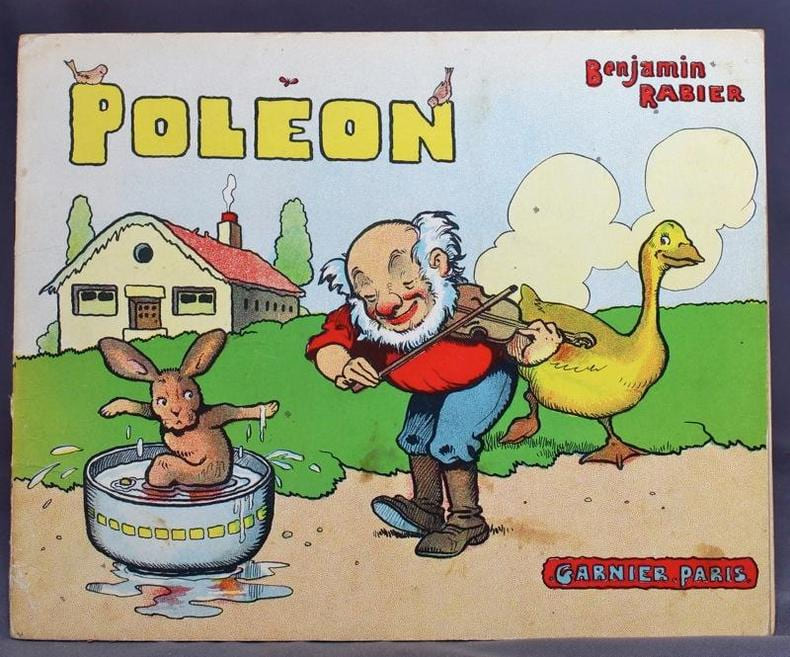
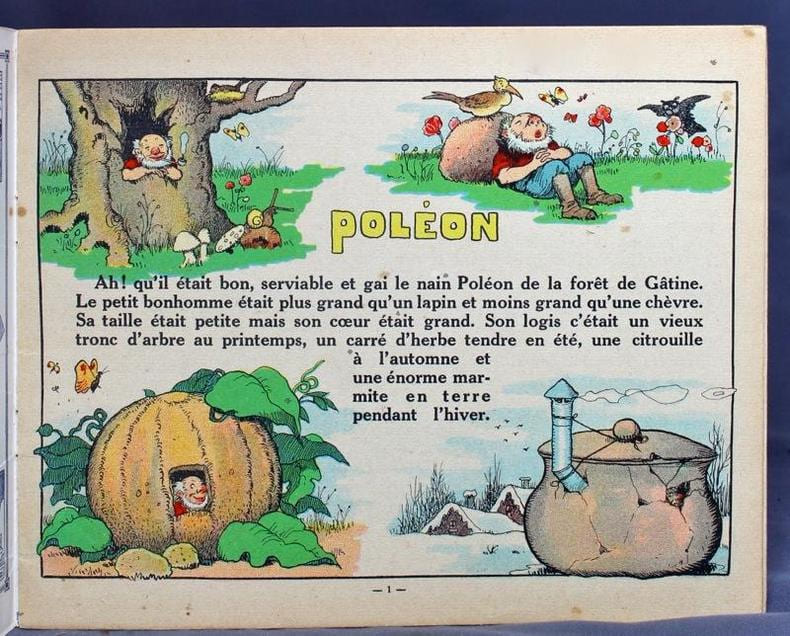
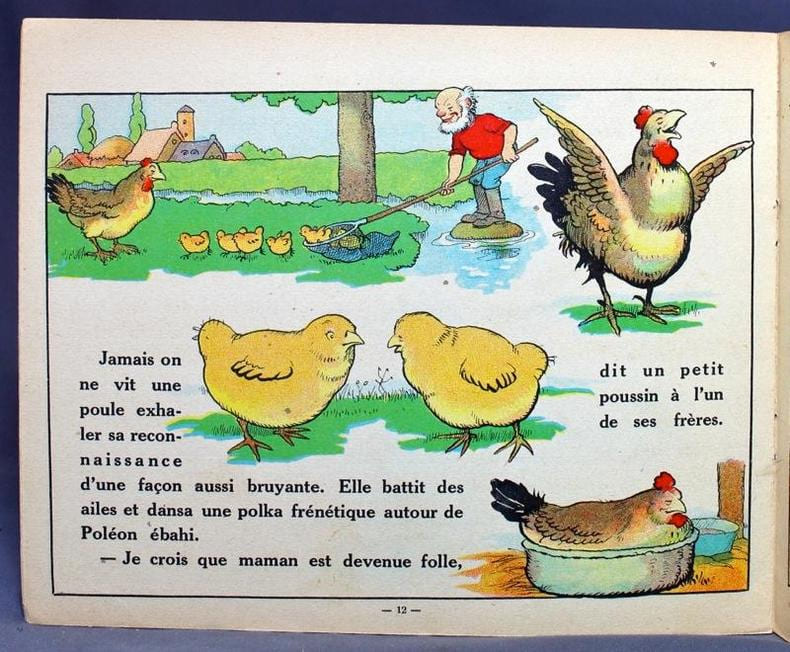
Paris, Garnier Frères, 1939. Petit in-4 broché à l'italienne de 16 pages, couverture illustrée en couleurs. Quelques rares taches, belle condition générale.
Reference : 11210
Illustré à toutes pages et en couleurs par Benjamin Rabier. Rare édition originale de cette histoire du nain... Poléon.
Bookseller's contact details
ILLIBRAIRIE | Bombadil SA
Monsieur Alexandre Illi
20 Grand'Rue
1204 Genève
Switzerland
+4122 310 20 50
Payment mode

Sale conditions
Conformes aux usages de la librairie ancienne et moderne, tous les ouvrages sont complets et en bon état, sauf mention contraire. Les prix indiqués sont nets, les frais d’expédition sont à la charge du destinataire et seront précisés au moment de la commande. Les commandes peuvent être transmises par téléphone, par correspondance et par courriel. Vous pouvez venir chercher vos livres à la librairie, après vous être assurés de leur disponibilité.
5 book(s) with the same title
CAHIER DE DEVOIRS DE LOUISA, CAROLINE ET ALICE DE POLEON POUR LES ANNEES 1851 A 1853 [Saint-Georges-du-Bois]
1853 Un volume, reliure d'époque demi-maroquin rouge in-quarto (binding half morocco in-quarto, dos à nerfs (spine with raised bands) décoration or (gilt decoration) et à froid (blind-stamping decoration) - entre-nerfs à caissons à froid, - titre frappé or (gilt title) - chiffre surmonté d'une couronne Baronnale or en pied, plats décorés d'un encadrement de filets à froid + le chiffre du baron de Poléon surmonté de la couronne Baronnale à froid (cover blind-stamping), plats légèrement tachés (traces d'humidité), papier gaufré aux plats de la même couleur que le dos (cover with embosed paper of the same color as spine), toutes tranches lisses (all smooth edges), cahier manuscrit à l'encre brune, avec des encadrements et calligraphies manuscrites à l'encre brune + des cartes de géographies manuscrites in et hors-texte dont 2 dépliantes (dont une colorée) , sans pagination (224 pages), fait au chateau de poléon entre 1851 et 1853, corrections en bleu et notes par leur professeur C. Camadet,
trés intéressante pièce d'histoire locale sur la Famille de Pauléon alias Poléon (enfants du Baron de Pauléon -Château de Poléon - Saint-Georges-du-Bois), à Saint-Georges-du-Bois (17)....... Le château de Poléon : En 1638, Jean Pascault fait démolir l'ancien château féodal et construire la château actuel. Celui-ci comprend alors deux corps de bâtiments; le principal subsiste encore aujourd'hui tandis que l'autre a été démoli vers 1840. En 1770, Jean-Charles Pascault, marquis de Poléon épouse Marie-Jeanne Coron-Dupuy, fille du seigneur de Courdault. Le château est resté jusqu'à une date récente propriété de la famille, Pauleon, Baronnie dépendante du Comté de Benon, " est une Terre très-seigneuriale "....charmant..Uniqueen bon état malgré le petit défaut signalé (very good condition in spite of the small defect indicated).
Stephanou Buzantiou Ethnika kat' epitomên. Stephani Byzantini Gentilia per epitomen, antehac Peri Poleôn, De urbibus, inscripta. Quae ex Mss Codicibus Palatinis ab Cl. Salmasio quondam collatis & Ms. Vossiano restituit, supplevit, ac Latina versione & integro commentario illustravit Abrahamus Berkelius. Accedunt collectae ab Jacobo Gronovio variae lectiones ex codice Ms. Perusino, & admixtae ejusdem notae.
Leiden (Lugduni Batavorum), Apud Danielem Gaesbeeck, 1688. (Colophon at the end: Ex typographia Danielis à Gaesbeeck)
Folio. (XVIII),772,(16 index). (VIII),(27),(1 blank) p. Contemporary marbled calf. 37 cm (Ref: STCN ppn 83342419X; Hoffmann 3,441; Brunet 5,531; Graesse 6/1 492; Ebert 21740) (Details: Back gilt and with 6 raised bands, gilt letter shield. Boards with gilt broad borders and rectangle. Marbled endpapers. 2 title pages, both printed in red and black. Woodcut printer's mark on both titles, depicting the entrance of a safe harbour; in the foreground a big wooden semaphore, the entrance is between 2 rocks on which 2 columns stand (the columns of Hercules?); in the distance 2 ships, ready to enter; the motto reads: 'Intelligentibus' (for those who understand, for initiated). Printed in 2 columns, Greek text with parallel Latin translation, with on the lower half of the page the commentary) (Condition: Binding scuffed and scratched. Small piece gone at the head & tail of the spine. Joints split. Corners bumped. Upper margin partly and slightly waterstained. Title page yellowing) (Note: The Greek grammarian Stephanus Byzantinus, who lived at Constantinople after the time of the Roman emperors Honorius and Arcadius (end 4th century), is the author of a well-known geographic lexicon, called 'Ethnika', of which work we only possess an epitome (kat' epitomên). The 'Ethnika', which is lost, consisted of between 50 and 60 books, and listed in alphabetical order place-names, with the adjectives derived from them. It offered information on foundation legends, etymologies, historical anecdotes, proverbs etc. The lexicon was epitomized ca. 530 A.D. by a certain Hermolaus, who dedicated his abridgement to the emperor Justinian. Stephanus Byzantinus was originally interested not so much in geography or history, but in grammar and etymology, i.e. the correct formation of ethnic adjectives derived from the names of places, islands, regions and countries in the ancient world. Stephanus Byzantinus' sources were Herodianus, Dionysius Periegetes, Strabo, Hecataeus, Pausanias, Polybius, and many other now lost grammarians and historians. The value of this compilation lies in the preservation of material from works otherwise lost. The title of the 'Ethnika' has been a matter of dispute ever since the Aldine 'editio princeps' of 1502, where it is entitled 'Peri Poleôn'. The Florentine Iunta edition of 1521 went 'Peri Poleôn kai Dêmôn', or 'de Urbibus et Populis', with which title Berkelius also headed his text. (p.1) Thomas de Pinedo, a Spanish Jew, 1614-1679, who was obliged to leave his native country and seek a refuge in Amsterdam from inquisitorial persecution, was the first to add a Latin translation to an edition of 'De Urbibus' (Amsterdam 1678). This edition of 1688 was edited by the Dutch scholar Abraham Berkelius (in Dutch Van Berckel or Van Berkel), together with his commentary and Latin translation. He adopted collations made by the French scholar Claudius Salmasius, 1588-1653, from manuscripts of the 'Bibliotheca Palatina' during his stay at Heidelberg, and notes and 'various readings' collected by the Dutch professor of Greek Jacobus Gronovius, 1645-1716, from the 'Codex Perusinus'. Berkelius, 1639/40-1686, studied Greek under Gronovius, and was appointed Rector of the 'Schola Latina' at Delft. Stephanus Byzantinus was not new to Berkelius. He had published earlier at the same publisher, Van Gaesbeek, in 1674 an edition that contained fragments of Stephanus Byzantinus' 'Ethnika', the 'Genuina Stephani Byzantini de Urbibus et Populis fragmenta', a small work of 25 pages. The involvement in the edition of 1688 of his master Gronovius also does not come as a surprise, for he published for Van Gaesbeek in 1681 a fragment of Stephanus Byzantinus on the Greek oracle at Dodona, with 3 Latin translations and a commentary) (Collation: Part 1: a4, b-c2, d1; A-5D4, 5E2; 6A2-6D2. Part 2: A-I2 (leaf I2 verso blank)) (Heavy book, may require extra shipping costs) (Photographs on request)
La famille Fanfare. Texte de Jean Nohain. Images de Poléon
Paris, Calmann-Lévy, impr. Fortin, Paris-Nevers, coll. « Albums Jaboune », n° 1 1952 Cartonnage éditeur, dos marron, premier plat illustré, [28] pp., non paginé. Dos passé.
Bon état d’occasion
Pourquoi Pas Toute l' Histoire De l' Europe ? -- III - De Na Poléon Aux Spoutniks
Serge Creuz Pourquoi Pas ?, Editeur Jaquette en très bon état broché Bristol Bruxelles 1967 306 pages en format 15 - 21 cm - nombreux dessins
Très Bon État
[Setz Lucien ] - Morel Max - Jost,Darsay H. - Briollet,Mortreuil Félix
Reference : 11804
(1894)
Partition de la chanson : Poléon Chansonnette Bataclan
Meuriot 1894 approx.
Bon état Petit format

