 Write to the booksellers
Mistler, Jean
Vermeer
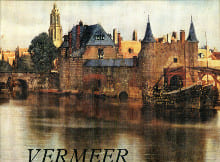
Henri Scrépel, collection "Le peintre et l'homme", Paris, 1973. In-4 de format carré, cartonnage éditeur illustré en couleurs, s.p. [150 pp. env.]. Sommaire - Introduction à Vermeer, par Jean Mistler : Delft. - Une vie obscure. - Un voyageur français. - Dernières années. - Une ville d'art. - Peintres de genre. - Une antithèse : Rembrandt. - La lumière. - La réalité ...
Reference : 906
Avec 35 planches "pleine page" en couleurs en hors-texte. --- Plus d'informations sur le site archivesdunord.com
Bookseller's contact details
Archives du nord - Librairie ancienne et moderne
M. François Legrand
01 42 73 13 41
Payment mode

Sale conditions
Vente uniquement par correspondance. Conditions de vente conformes aux usages de la librairie ancienne et moderne. Les prix indiqués sont en euros. Les frais de port sont à la charge de l'acquéreur.
5 book(s) with the same title
Vermeer and the Delft School
Liedtke, Walter: Vermeer and the Delft School. Exhibition: New York, Metropolitan Museum, 2001. 626pp with 87 colour plates, 138 colour and 301 monochrome illustrations. Hardback. 31x24.8cms. Portrait, interior, landscape, townscape and history paintings by De Hooch, Fabritius, van Aelst, Pynacker and de Witte are exhibited alongside lesser known artists, such as van Couwenbergh, Houckgeest, van Miereveld and Vosmaer in this superbly illustrated volume. The aim of the exhibition is to ascertain to what extent Vermeer was indebted to the artistic traditions of his native city, Delft, and to the character of its society. It also brings into question the significance and influence of Vermeer in the development of the Delft School, and concludes whether or not the Delft 'school' existed in any meaningful sense. The paintings are complemented by examples of contemporary decorative arts, drawings and prints, all of which have been drawn from major international museums. Detailed bibliography, index.
Portrait, interior, landscape, townscape and history paintings by De Hooch, Fabritius, van Aelst, Pynacker and de Witte are exhibited alongside lesser known artists, such as van Couwenbergh, Houckgeest, van Miereveld and Vosmaer in this superbly illustrated volume. The aim of the exhibition is to ascertain to what extent Vermeer was indebted to the artistic traditions of his native city, Delft, and to the character of its society. It also brings into question the significance and influence of Vermeer in the development of the Delft School, and concludes whether or not the Delft 'school' existed in any meaningful sense. The paintings are complemented by examples of contemporary decorative arts, drawings and prints, all of which have been drawn from major international museums. Detailed bibliography, index. Text in English

Closer to Vermeer
Closer to Vermeer. 2025. 320 pages, 200 illustrations. Hardback. 26.5 x 21.5cms. Looking at the research conducted during and after the Rijksmuseum's blockbuster 2023 Vermeer exhibition, this study discusses new insights into Vermeer's creative process, materials and painting techniques, exploring the meaning of his works and his evolving fame. It also addresses questions about the maps in his interiors, the role of the camera obscura, his choice of materials and newly discovered documents related to his patrons.
Looking at the research conducted during and after the Rijksmuseumâs blockbuster 2023 Vermeer exhibition, this study discusses new insights into Vermeerâs creative process, materials and painting techniques, exploring the meaning of his works and his evolving fame. It also addresses questions about the maps in his interiors, the role of the camera obscura, his choice of materials and newly discovered documents related to his patrons.
[Johannes Vermeer] - Wheelock, Arthur K
Reference : 053552
(1995)
ISBN : 0300065582
Johannes Vermeer
Wheelock, Arthur K: Johannes Vermeer. Exhibition: Washington, National Gallery of Art, 1995. 230pp with 60 colour plates and 127 monochrome illustrations. Cloth. 31.5x25cms. Beautifully illustrated and descriptive catalogue of 23 paintings from collections worldwide, accompanied by four essays considering Vermeer's life and artistry, his relatively modern themes and their tradition, his use of perspective and his critical reputation. Each exhibit is illustrated and given a detailed interpretation and bibliography..
Beautifully illustrated and descriptive catalogue of 23 paintings from collections worldwide, accompanied by four essays considering Vermeer's life and artistry, his relatively modern themes and their tradition, his use of perspective and his critical reputation. Each exhibit is illustrated and given a detailed interpretation and bibliography.. Text in English
Vermeer-Van Meegeren. Back to the Truth: Two Genuine Vermeers
Decoen, Jean: Vermeer-Van Meegeren. Back to the Truth: Two Genuine Vermeers. Rotterdam: Donker, 1951. 60 pp., 200 full page black and white plates. Cloth, 34 x 25.5cms.
Text in English
Closer to Vermeer
, , 2025 hardcover, 432 pages, 26,5 x 21,5 cm, Quadrichromie, Illustrated, text English, ISBN . ISBN 9789464941999.
The successor to the international bestseller Vermeer, featuring groundbreaking research on the Dutch master Closer to Vermeer explores the world of Johannes Vermeer, a painter whose work continues to fascinate more than 350 years after his death. Taking the landmark 2023 Rijksmuseum exhibition as a point of departure, this volume brings together new art-historical and technical research by leading international experts. How did Vermeer translate his creative ideas into paint? Did the seventeenth-century Dutch master truly rely on optical devices? What do the carefully rendered objects in his interiors reveal about the artist himself? And how has the perception of his small but extraordinary oeuvre evolved over time? Using the latest imaging techniques, researchers scrutinize Vermeer?s masterpieces, yielding compelling new insights into his artistic process, material choices, and technical virtuosity. These investigations contribute to a deeper understanding of Vermeer?s painting technique throughout his career. Other specialists revisit seventeenth-century sources, uncover new archival documents, and explore Vermeer?s patrons and the material world he portrayed. The objects depicted in his interiors ? maps, pearls, porcelain, kitchenware ? are examined not merely as visual motifs, but as clues to his worldview and working methods. At once scholarly and accessible, Closer to Vermeer offers a fresh, intimate perspective on one of the most enigmatic and beloved painters ? a vital resource and enduring reference for specialists and art lovers alike. With contributions by Christina L. An, Dina Anchin, Piet Bakker, Rachel Billinge, Quentin Buvelot, Frederico Car , Silvia A. Centeno, Gareth R. Davies, John K. Delaney, Alexandra van Dongen, Kathryn A. Dooley, Esther van Duijn, Francesca Gabrieli, E. Melanie Gifford, Lisha D. Glinsman, Catherine Higgit, Helen Howard, Paolo D'Imporzano, Jonathan Janson, Koen Janssens, Anna Krekeler, Paul van Laar, Rozemarijn J.W. Landsman, Alexandra Libby, Annelies van Loon, Dorothy Mahon, Daphne Martens, Marta Melchiorre Di Crescenzo, Sabrina Meloni, Steven De Meyer, Aimee Ng, Judith Noorman, Elke Oberthaler, David Peggie, Carol Pottasch, Justine Rinnooy Kan, Pieter Roelofs, Marika Spring, Maartje Stols-Witlox, David G. Stork, Ariane van Suchtelen, Paul Taylor, Katharina Uhlir, Abbie Vandivere, Frederik Vanmeert, Evelyne Verheggen, Ige Verslype, Marjorie E. Wieseman

