 Write to the booksellers
Peter Hunter Blair et al.
Anglo-saxon England
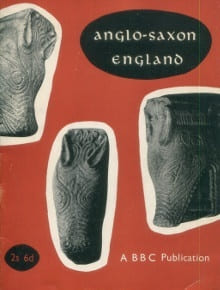
ABBC Publications, London, 1957. In-8, plaquette agrafée sous couverture illustrée en noir et blanc, 38 pp. Anglo-saxon England, by Peter Hunter Blair - Introductory notes for the broadcasts, by Maurice Barley : The Alfred Legend. - Kings, Lords and Peasants. - Towns and Trade. - Language and Literature. - The Age of Dunstan. - Anglo-saxon Studies ...
Reference : 4123
Illustrations en noir et blanc et en couleur. --- Plus d'informations sur le site archivesdunord.com
Bookseller's contact details
Archives du nord - Librairie ancienne et moderne
M. François Legrand
01 42 73 13 41
Payment mode

Sale conditions
Vente uniquement par correspondance. Conditions de vente conformes aux usages de la librairie ancienne et moderne. Les prix indiqués sont en euros. Les frais de port sont à la charge de l'acquéreur.
5 book(s) with the same title
Ideological Foundations of Early Irish Law and Their Reception in Anglo-Saxon England, c. 600-c. 900
, Brepols, 2025 Hardback, 322 pages, Size:156 x 234 mm, Language: English. ISBN 9782503607313.
Summary Old Testament Levites who considered the Law of Moses to be the living law: this has long been the established view among many scholars for how early Irish jurists perceived themselves, as well as how they saw the broader theoretical and religious bases of their jurisprudence. In this volume, however, Kristen Carella offers a timely reassessment of scholarly opinion, exploring Irish legal texts within the broader context of both vernacular Irish and Hiberno-Latin literature to argue that early Irish Christian intellectuals in fact saw themselves as gentile converts, subscribing to an orthodox Christian faith that was deeply infused with Pelagian theology. Certain aspects of Irish legal ideology, particularly Irish views of divine history and pseudo-historical ideas about their own ethnogenesis, moreover, extended out of Ireland and into Anglo-Saxon England; their impact can be seen on lawmakers such as Alcuin, when he helped draft the Anglo-Latin Legatine Capitulary of 786, and King Alfred of Wessex, when he composed the Old English prologue to his law code in the late-ninth century. Through this approach, this volume not only challenges long-held scholarly views on Irish legal ideology and its influences beyond Ireland, but also provides a new paradigm for intellectual relations between early medieval Ireland and England. TABLE OF CONTENTS Author's Preface Abbreviations Chapter 1. Introduction Part One: Early Irish Law Chapter 2. Background Chapter 3. Biblical Law Chapter 4. The Law of Nature Chapter 5. Pseudo-history Chapter 6. Conclusions Part Two. Anglo-Saxon Law Chapter 7. Background Chapter 8. Eighth-Century Northumbrian Law Chapter 9. The Court of King Alfred Chapter 10. The Alfredian Pseudo-historical Genealogies Chapter 11. Conclusions Works Cited General Index
Form and content of instruction in Anglo-Saxon England in the light of contemporary manuscript evidence Papers presented at the International Conference, Udine, 6-8 April 2006
, Brepols - Harvey Miller, 2007 Hardcover. XIII 546 p., 2 b/w ill. 4 colour ill., 165 x 240 mm, Languages: English, Including an index. Fine copy. ISBN 9782503525910.
The essays collected in this volume focus on a prominent aspect of Anglo-Saxon culture: educational texts and the Insular manuscripts which have preserved them. The English imported manuscripts and texts from the Continent, whilst a series of foreign masters, from Theodore of Tarsus to Abbo of Fleury, brought with them knowledge of works which were being studied in Continental schools. Although monastic education played a leading role for the entire Anglo-Saxon period, it was in the second half of the tenth and early eleventh centuries that it reached its zenith, with its renewed importance and the presence of energetic masters such as AEthelwold and AElfric. The indebtedness to Continental programs of study is evident at each step, beginning with the Disticha Catonis. Nevertheless, a number of texts initially designed for a Latin-speaking milieu appear to have been abandoned (for instance in the field of grammar) in favour of new teaching tools. Besides texts which were part of the standard curriculum, Anglo-Saxon manuscripts provide abundant evidence of other learning and teaching instruments, in particular those for a specialized class of laymen, the Old English laece, the healer or physician. Medicine occupies a relevant place in the book production of late Anglo-Saxon England and, in this field too, knowledge from very far afield was preserved and reshaped. All these essays, many by leading scholars in the various fields, explore these issues by analysing the actual manuscripts, their layout and contents. They show how miscellaneous collections of treatises in medieval codices had an internal logic, and highlight how crucial manuscripts are to the study of medieval culture.
The Art of the Anglo-Saxon Goldsmith: Fine Metalwork in Anglo-Saxon England, its Practice and Practitioners
Coatsworth, Elizabeth and Michael Pinder: The Art of the Anglo-Saxon Goldsmith: Fine Metalwork in Anglo-Saxon England, its Practice and Practitioners. Woodbridge: 2002. 298pp with 39 monochrome illustrations. Cloth, 24.4x16.4cms. Analysis by a specialist of the period and a practical craftsman of the surface and structure of artefacts both functional and decorative. Markings, inscription and design are also examined. Incorporates literary and visual sources of evidence with chapters on workshops, tools, techniques and processes.
Analysis by a specialist of the period and a practical craftsman of the surface and structure of artefacts both functional and decorative. Markings, inscription and design are also examined. Incorporates literary and visual sources of evidence with chapters on workshops, tools, techniques and processes. Text in English

Lapidge Michael Keynes Simon Blair John Scragg Donald
Reference : 100147825
(2001)
ISBN : 9780631224921
Encyclopaedia of Anglo-Saxon England
John Wiley &Sons 2001 556 pages 17 2x3 4x24 4cm. 2001. Broché. 556 pages. Cette encyclopédie éditée par Michael Lapidge et d'autres spécialistes est un ouvrage de référence essentiel sur l'Angleterre anglo-saxonne. Elle rassemble plus de 700 articles écrits par 150 universitaires couvrant l'histoire l'archéologie les arts l'architecture et les littératures de la période allant du retrait romain (vers 450) à la conquête normande (1066)
Bon état
England's Earliest Sculptors The Stone Carvings of Anglo-Saxon England,
Turnhout, Brepols, 2000 Hardback, XX+155 p., 32 colour ill., 17 x 25,5. ISBN 9780888449054.
The work provides an overview of Anglo-Saxon sculpture from its tentative beginnings in the seventh century to the Norman Conquest. The author identifies and illustrates the major influences on early English sculpture - the Christian Mediterranean, Merovingian, Carolingian and Scandinavian traditions - and shows how these combined with native English elements to create the particular aesthetic synthesis that is Anglo-Saxon carving in stone. Languages : English.

