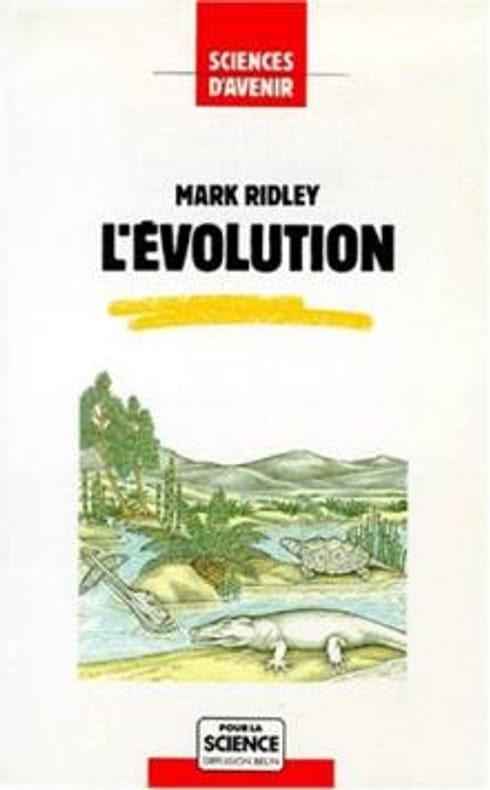
Pour la science / Regards sur la science 1989 176 pages in8. 1989. broché. 176 pages. Ce livre analyse avec lucidité les arguments de ceux qui annoncent périodiquement la mort du darwinisme. Pour l'auteur le darwinisme comme toute science s'adapte pour englober les nouvelles découvertes paléontologiques et biologiques
Reference : 86536
ISBN : 9782902918706
French édition -quelques marques de lecture et/ou de stockage sur couverture et coins mais du reste en bon état - Expédition soignée sous blister dans une enveloppe a bulles
Démons et Merveilles
M. Christophe Ravignot
contact@demons-et-merveilles.com
07 54 32 44 40
Rapidité d'envoi Tous nos articles sont expédiés le jour même de la confirmation de la commande Soin de l'emballage Un soin particulier est apporté à l'emballage, vos objets voyagent en toute sécurité. A votre écoute Si toutefois un incident devait survenir lors de l'acheminement de votre paquet, n'hésitez pas à nous contacter, nous mettrons tout en oeuvre pour vous satisfaire, en vous proposant un retour, un remboursement ou toute autre soluton à votre convenance. Professionnalisme Les livres que nous vendons sont pour la plupart des livres anciens, nous tâchons d'être le plus objectif possible quant à leur état.
Paris, 1907. 8vo. Bound uncut in a later brown half calf with gilt title-label and gilt lines to spine. Neat marginal repairs to a few leaves and first two leaveas trimmed at lower margin. Signed author's presentation-inscription to half-title. (4), VIII, 403 pp. + 31 pp. of advertisements from Félix Alcan.
Rare first edition, presentation-copy for Jean Baruzi, of Bergson's seminal main work, the ""Creative Evolution"", his most famous and influential book, which constitutes the great philosopher's cult-like showdown with Darwinian mechanism, which resulted in a theory of cosmic evolution that covered everything from biology and other sciences to metaphysics and religion.Jean Baruzi (1881-1953), an important French philosopher and historian of religion, specialized in Leibnitz and William James, was a student of Bergson. He was the author of a controversial dissertation, ""St. John of the Cross and the Problem of Mystical Experience"", which gave an existential-phenomenological description of religious andguish and the ""lived experience"" of the mystic. He was a professor at the Collège de Frace and held the Histoy of Religion chair after Alfred Loisy. In 1907, when Henri Bergson's third book, ""Creative Evolution"", was published, the seminal French philosopher, who had studied both mathematics and philosophy, possessed the professor chair of modern philosophy at the Collège de France. Though the book was the result of several years of extremely thorough research, Bergson himself could have hardly foreseen the effect that this book was going to have throughout the 19th century with an amazing revival in the 20th century, making him one of the most important philosophers of his time.Always committed to the reality of time as the basis and as a source of creative change, Bergson, in his magnum opus, sets out to free the sciences of psychology and biology from the materialism and mechanism that had dominated them in the late nineteenth century and due to which they had been made unable to explain creativity, growth and change. He makes an amazing new contribution to the theory of knowledge by providing an account of creative evolution and the creative mind, thereby freeing psychology and biology from a number of problems otherwise unsolvable through philosophical and scientific explanations. Bergson accepts the historical facts of evolution but rejects all the mechanistic and materialistic explanations of the evolutionary process. Like Darwin, he accepts natural selection as an explanation of extinction, but he does not accept it as an explanation of evolutionary change, and likewise with Lamarck, Spencer, and the orthogenesists, he accepts the foundational theories of evolution but only to the point at which mechanism or materialism sets in, instead of which, he basically explains further change and growth with a basic vital principle that accounts for creative changes.As such, ""Creative Evolution"" sets out to found a philosophy that can account for the continuity of all living things, for both the creation of life and the diversity that results from creation, and Bergson does this with his idea of an original vital principle, a governing immaterial force of life, a sort of natural creative impulse, that embraces the whole of life in one. The book was hugely popular when it appeared, and its immediate immense influence lasted a couple of decades, making Bergson an internationally acknowledged cult-like hero of a French intellectual. After the Second World War, though, the interest in Bergson decreased, only to be reawakened in the late 1960'ies where a growing interest in his works re-emerged, making him to this day one of the most read philosophers of the early 20th century. There can be no doubt as to the continued influence of his works.
London, Academic Press, 1964. 8vo. In the original grey printed wrappers. In ""Journal of Theoretical Biology"", Volume 7, Number 1, July 1964. Entire issue offered. A very fine and clean copy. Pp. 1-16"" Pp. 17-52. [Entire volume: 170, (2) pp.].
First printing of Hamilton's two seminal publications, perhaps the most important in evolutionary biology in the 20th century, on altruism in relation to kin selection. Hamilton is, primarily because of the present publication, widely regarded as being one of the most influential theoretical biologists of the twentieth century. ""Hamilton's principal achievement was so thoroughly to revise the language of evolutionary biology that it has become nearly impossible to speak in evolutionary explanations except in terms of the self-interest of the organism or gene."" (DSB)Hamilton's rule: k> 1/r, a gene causing an organism to benefit relatives at the expense of its own reproduction will be selected and increase in a population if the benefit to the ""altruist"" outweighs the discounted relationship, or as Hamilton himself described it: ""a gene causing altruistic behavior towards brothers and sisters will be selected only if the behavior and the circumstances are generally such that the gain is more than twice the loss" for half-brothers it must be more than four times the loss" and so on. To put the matter more vividly, an animal acting on this principle would sacrifice its life if it could thereby save more than two brothers, but not for less."" (DSB). Due to the complexity and advanced mathematics the paper was rejected twice until it was accepted by the reviewer's an it was not until the mid 1970ies that his theory became widely know and cited: ""Hamilton wrote up the theory of inclusive fitness in two versions. One was a lengthy, fully mathematical treatment that unified understanding of a considerable body of case studies of altruistic behaviors that Hamilton drew from the scientific literature, the fruit of his graduate research. The second was a short, mostly verbal abstract of the whole, containing only the mathematical relation of Hamilton's rule and some general, theoretical remarks on its applicability. He met difficulty in publishing both. The first he submitted to the Journal of Theoretical Biology, where it spent considerable time in the reviewing process"" ultimately the referee (John Maynard Smith, a mathematical biologist of similar interests) asked that it be split into two parts. After the revisions and splitting called for by the referee for the Journal of Theoretical Biology, that journal published ""The Genetical Evolution of Social Behaviour,"" parts 1 and 2, in 1964. The first part of the paper contained the mathematical arguments culminating in the derivation of Hamilton's rule"" its arguments were almost exclusively cast in the language and methodology of modern population genetics. The second part hearkened back in its methodology to Darwin's, as Hamilton used the theory of inclusive fitness to explain a diverse array of social traits recorded in the biological literature, including alarm calling, mutual grooming, the fusion of colony organisms, and postreproductive behavior in cryptic (camouflaged) moth species compared with that of aposematic species (bad-tasting with vivid warning colors). In each case, Hamilton argued that his theory of inclusive fitness could coherently explain the evolution of phenomena that had been disparate in the literature as aspects of a single principle at work, Fisher's fundamental theorem of natural selection, mandating the maximization of favorable genes under selection.Hamilton's influence began to grow among evolutionary biologists as the few who had read and understood the import of his papers worked to bring him from his initial scientific and social isolation into the networks of scientists interested in evolution and behavior. Wilson, for example, invited Hamilton to lecture at Harvard University in 1969, en route to a Smithsonian Institution conference on ""Man and Beast"" that brought together specialists from various fields to discuss the impact of recent biological work on understandings of human nature""From about 1974, citations of Hamilton's 1964 papers in the scientific literature began an exponential rise, reaching some four thousand total in the Institute for Scientific Information (ISI) Web of Science database by 2007, making ""The Genetical Evolution of Social Behaviour"" the most-cited paper ever published in the Journal of Theoretical Biology. Hamilton's principal achievement was so thoroughly to revise the language of evolutionary biology that it has become nearly impossible to speak in evolutionary explanations except in terms of the self-interest of the organism or gene."" (DSB)
(Litho, The American Physical Society), 1987. Royal8vo. In the original blue printed wrappers. In ""Physical Review Letters"" Vol. 59, Number 4, July 27, 1987. A few traces are having been bend to extremities. Small label with subscriber's name printed on to back wrapper. Otherwise a fine and clean copy. Pp. 381-84. [Entire volume: 381-519, (5) pp.].
First printing of Bak, Tang and Wiesenfeld landmark paper in which they proposed their self-organized criticality (SOC) theory or the Abelian sandpile model: the mechanisms by which complexity arises in nature. It is one of the very few evolutionary models to challenge Darwinism. It is regarded as one of the most profound and fundamental theories put forth in the later part of the 20th century and the paper is one of the most frequently-cited papers in the last few decades.Its concepts have been applied across fields as diverse as geophysics, physical cosmology, evolutionary biology and ecology, bio-inspired computing and optimization (mathematics), economics, quantum gravity, sociology, solar physics, plasma physics, neurobiology and many others.SOC is typically observed in slowly driven non-equilibrium systems with extended degrees of freedom and a high level of nonlinearity. ""The nonlinear dynamics approach encapsulated in GCT envisions self-organization as an asymptotic process of approaching stability through a series of intermediate states (also known as evolution). There exists, however, a fundamentally different process known as self-organized criticality (SOC) in which an avalanche-like transformation rapidly moves the system into a self-organized mode. A popular metaphor for SOC is the sandpile paradigm. If additional sand grains are randomly added on top of a sand pile then inevitably an instance will occur when local steepness of the slope surpasses a certain critical threshold thus causing local failure of structural stability. The excess of material will cascade into adjacent areas of the pile causing their failures as well. Thus an avalanche will occur, shifting the entire sandpile into a new stable state. What is fundamentally important in this process is that a random local event quickly propagates through the entire system, thus establishing longrange correlations within the system"" (Rosenfeld, Global Consensus Theorem and Self-Organized Criticality).""Ask the average person, What is the theory of evolution? and you are likely to get answers like ""natural selection"", or ""survival of the fittest"", or ""Darwin's theory"". Because these ideas are systematically taught in classrooms, they may represent the only evolutionary theory people know. But, ask, What is the theory of Earth evolution? you will likely get a blank stare, or at best a superficial discussion of the fossil record. The Earth as a multi-faceted evolutionary system that undergoes continuous change through time was incorporated in the National Science Education Standards, even if it is absent from many contemporary curricula and common perceptions. Darwinism, however, is not the only mechanism of evolution. If we define evolutionary change as any process that leads to increases in complexity, diversity, order, and/or interconnectedness then there are at least three distinct mechanisms, or theories of evolution: elaboration, self-organization, and fractionation."" (Journal of Geoscience Education, v. 58, n. 2, March, 2010, p. 58-64).
New York, J. Fitzgerald, 1882, in-8, Pagination multiple, Demi-chagrin vert à coins de l'époque, dos à faux nerfs orné de filets, roulettes et petits fleurons dorés, Recueil de numéros de la Humboldt Library of Popular Science Literature [n° 29, 32, 36, 38 et 39], comportant les éditions originales de : - N° 36 (sept. 1882) : Huxley "Lectures on evolution : with an appendix on the study of biology". Conférences expliquant la théorie de l'évolution aux classes populaires : The three hypotheses respecting the history of nature; The hypothesis of evolution. The neutral and the favorable evidence; The demonstrative evidence of evolution; On the study of biology. Huxley y traite des implications religieuses de la théorie de Darwin et définit sa position de doute raisonné. Il fut l'inventeur, en 1869, du terme "agnostique". - N° 38 et 39 (nov.-déc): Geikie, "Geological sketches at home and abroad. In two parts". Articles courts comportant notamment les remarques de l'auteur, le géologue écossais Archibald Geikie (1835-1924), sur les volcans britanniques. Volume contenant, en outre : "Six lectures on light" de Tyndall, reliées en tête du recueil (n° 37, oct. 1882); "Facts and fictions of zoology" par Andrew Wilson (n° 29, Fev. 1882); "Hereditary traits, and other essays" par Proctor (n° 32, mai 1882). Petits frottements au dos. Pages jaunies. Couverture rigide
Bon Pagination multiple
Paris, Masson et cie, 1944 ; grand in-12, 210 pp., br. Broché très bon états - 25 figures dans le texte 1ere édition Contents, Chapitres : Avertissement - Unité de plan biochimique des animaux - Dissemblances - L"évolution des constituants biochimiques - Les systèmes biochimiques à évolution ortho-génétique - Caractères biochimiques en concordance avec des caractères anatomiques, physiologiques ou oecologiques, adaptations biochimiques - Caractères systématiques - Perspectives - Index alphabétique des matières, index taxonomique, index onomastique bien complet du feuillet d"errata.
Broché très bon états - 25 figures dans le texte 1ere édition Contents, Chapitres : Avertissement - Unité de plan biochimique des animaux - Dissemblances - L"évolution des constituants biochimiques - Les systèmes biochimiques à évolution ortho-génétique - Caractères biochimiques en concordance avec des caractères anatomiques, physiologiques ou oecologiques, adaptations biochimiques - Caractères systématiques - Perspectives - Index alphabétique des matières, index taxonomique, index onomastique bien complet du feuillet d"errata.