 Write to the booksellers
Mgr Athanasius Schneider
Corpus Christi
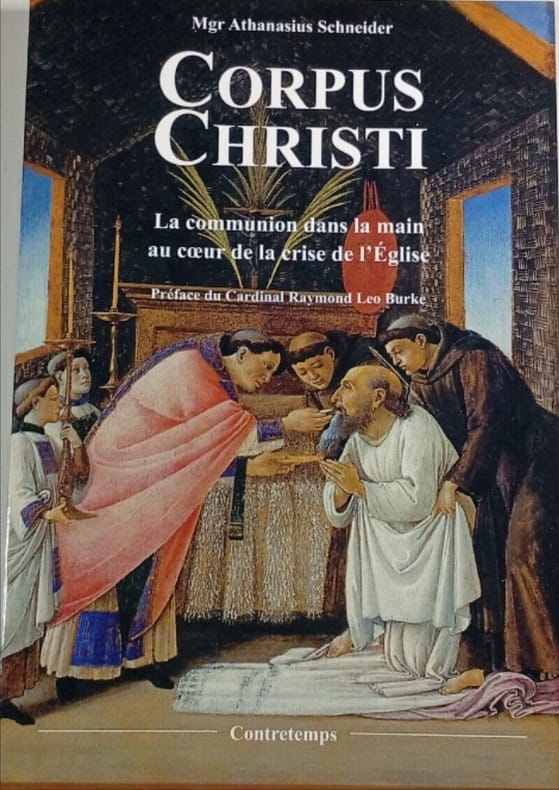
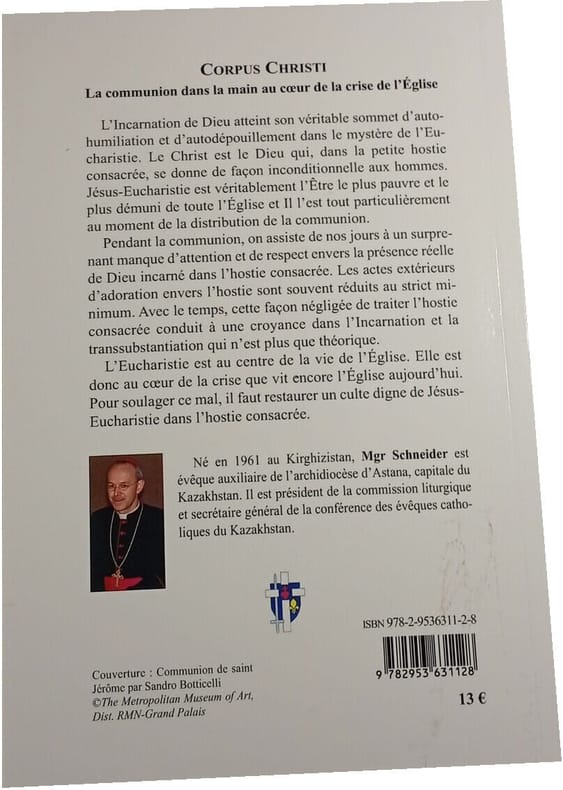
Contretemps Sans date.
Reference : 500371995
Très bon état
Bookseller's contact details
Démons et Merveilles
M. Christophe Ravignot
contact@demons-et-merveilles.com
07 54 32 44 40
Payment mode

Sale conditions
Rapidité d'envoi Tous nos articles sont expédiés le jour même de la confirmation de la commande Soin de l'emballage Un soin particulier est apporté à l'emballage, vos objets voyagent en toute sécurité. A votre écoute Si toutefois un incident devait survenir lors de l'acheminement de votre paquet, n'hésitez pas à nous contacter, nous mettrons tout en oeuvre pour vous satisfaire, en vous proposant un retour, un remboursement ou toute autre soluton à votre convenance. Professionnalisme Les livres que nous vendons sont pour la plupart des livres anciens, nous tâchons d'être le plus objectif possible quant à leur état.
5 book(s) with the same title
Judios y conversos en el Corpus Christi: la dramaturgia calderoniana ,
Turnhout, Brepols, 2013 Paperback, 300 pages., 156 x 234 mm. ISBN 9782503548142.
Depuis le XVe siecle on fait jouer en Espagne des pieces lors de la Fete-dieu, appelees autos sacramentales. Au debut les liens entre l'action dramatique et l'exaltation de l'eucharistie n'est pas toujours de mise mais la tendance sera de donner une coherence thematique au theatre et a la fete dans laquelle il s'inscrit. Theatre de devotion, theatre didactique mais theatre, c'est-a-dire une intrigue et des personnages capables de nous emouvoir, et c'est Calderon de la Barca, le dramaturge qui porte l'auto sacramental a maturite, qui va saisir que le moyen le plus apte pour reunir theologie et tension dramatique est de mettre le Christ au centre de l'action, ce qui entrainera chez lui une presence presque continuelle du Peuple Juif en tant qu'acteur de la Passion. Le propos de mon ouvrage est de retracer l'evolution de la construction de ce personnage, ses avatars sur une longue duree en prenant compte des pesanteurs de l'histoire, du contexte historique et social espagnol, ou les juifs et ses nombreux descendants baptises, les nouveaux chretiens, jouent un role si important (Premiere partie). Je consacre une deuxieme partie a l'analyse de l'image des juifs et des nouveaux chretiens dans l'auto sacramental calderonien. Je prete une grande importance aux liens que Calderon, poete de Cour, entretient avec le pouvoir et aux consequences qui en decoulent d'une telle proximite. Enfin, une troisieme et derniere partie se focalise sur les implications dramaturgiques: construction et type de personnages, jeu des acteurs; action dramatique; sequences types; costumes, afin de dresser un panorama le plus complet possible de la presence de juifs et nouveux-chretiens dans le theatre de la Fete-Dieu Desde el siglo XV se representan en Espana durante el Corpus Christi obras de teatro que andando el tiempo se conoceran con el nombre de autos sacramentales; progresivamente se iran estrechando los lazos entre el dialogo y la exaltacion de la Eucaristia. Teatro de devocion, teatro didactico, pero, teatro, esto es, una accion con personajes capaces de emocionarnos, y sera Calderon de la Barca, autor que lleva el auto sacramental a su madurez, quien comprendera que el modo mas seguro de reunir teologia y tension dramatica es situar a Cristo en el centro del conflicto, lo cual conlleva en su caso la presencia casi continua del Pueblo Judio como actor de la Pasion. Esta obra analiza en la primera parte la evolucion de dicho personaje alegorico durante dos siglos, teniendo en cuenta el peso del contexto historico y social espanol, y concretamente el papel desempenado por judios y conversos en aquel periodo. En la segunda se estudia la imagen de judios y cristianos nuevos en el auto sacramental calderoniano, prestandose particular atencion a los lazos que Calderon, poeta cortesano, mantiene con el poder, y a las consecuencias que de ello se derivan. Por ultimo, la tercera parte se dedica a la dramaturgia propiamente dicha: accion dramatica, secuencias tipo, construccion y clases de personajes, interpretacion, vestuario, a fin de dar la vision mas completa posible de la presencia de judios y conversos en el teatro del Corpus Christi. Language : Spanish.
John Dunstaple Reading Boethius. John Dunstaple's Annotations to Boethius's De institutione musica in the Manuscript Oxford, Corpus Christi College Library, MS 118
, Brepols, 2026 Paperback, Pages: 240, Size:178 x 254 mm, Illustrations:2 b/w, 50 col., 10 tables b/w., 2 tables col., 17 examples in colour, Language: English. ISBN 9782503624884.
Summary European theory of music up to ca.1550, in many respects, presents a history of the reception of Boethius's treatise De institutione musica (before 510). The annotations introduced to this treatise by John Dunstaple (d. 1453), eminent composer of the late Middle Ages, add to our knowledge of the English chapter of this history. The volume is composed of two parts. The first part includes the edition of Dunstaple's annotations paralleled with relevant parts of Boethius text and provided with the introduction comprising a detailed information on manuscript Oxford, Corpus Christi College 118 and the study of Dunstaple's hand. In the second part of the book, the selected glosses which have the strongest interpretive potential are translated and examined in a large context of music theory of Middle Ages. They present Dunstaple as a careful and competent reader of Boethius's arguments and a composer well-read in music theory current in his time. TABLE OF CONTENTS List of Figures List of Tables Preface and Acknowledgements Introduction (1) Dating, origin, and contents of the first part of Occ. 118 (2) Dunstaple's hand (3) Typology of Dunstaple's annotations and editorial policy Edition of Dunstaple's annotations to Boethius's De institutione musica in Occ.118 Liber I Liber II Liber III Liber IV Liber V Commentary on the Selected Glosses, Additions and Diagrams Chapter One. De musica, Book I 1) General remarks 2) 'republica, liber quidam Platonis' Republic, a certain book by Plato'. Mus. I, 1. 3) 'Musica bene morata' Music of good character. Mus. I, 1. 4) Decretum Lacedaemoniorum Spartan Decree. Mus. I, 1. 5) Diagram of the fundamental consonances. Mus. I, 10. 6) Descriptions of the consonances. Mus. I, 15; Mus. I, 16. 7) The division of the diatessaron and the proportion of the minor semitone. Mus. I, 17. 8) The tone as the difference between the diatessaron and the diapente. Mus. I, 18. 9) The diapason consists of five tones and two semitones. Mus. I, 19. 10) 'Those who make art should be named artifices'. Mus. I, 34. Chapter Two. De musica, Books II and III 1) General remarks 2) The order and positions of the consonances. Mus. II, 19-20. 3) The division of the tone. Mus. III, 1. 4) Calculating the difference between five tones and the bis-diatessaron, and six tones and the diapason. Adding and subtracting musical intervals. Mus. III, 3-4; Mus. III, 9. 5) Dividing the tone according to Philolaos. Mus. III, 5. 6) 'Unitas non est numerus' Unity is not a number. Mus. III, 11. Chapter Three. De musica, Books IV and V 1) General remarks 2) Calculating continuous sesquioctave ratios. Mus. IV, 2. 3) 'Extenta, id est relaxata' Extended means relaxed. Mus. IV, 3. 4) 'Dicciones, id est nomina cordarum' Words, that is, the names of strings. Mus. IV, 3. 5) Diagrams of the eight modes. Mus. IV, 15-17. 6) The division of the monochord. Mus. IV, 18. 7) The divisions of the genus diatonicum according to Martianus Capella. Mus. V, 18. Conclusions Bibliography General Index Permissions to reproduce
The history of the College of Corpus Christi and the B. Virgin Mary (commonly called Bene’t) in the University of Cambridge, From its Foundation to the present Time. In Two Parts I. Of its founders, benefactors and masters II. Of its other principal members. (With a list of the names, counties, times of admission, degrees, &c of all members of Corpus Christi College; & Appendix).
Cambridge, Bentham, 1753, in-4, relié plein veau époque, dos à nerfs avec pièce de titre, 2ff.-iv-428pp.-115pp.(appendix)-9ff.-54pp.-1f., illustrated with a view of the college in frontispiece and 6 engravings, rubbedand defects on the cover.
History of the College since his foundation with the list of the honorable members, scholars and Masters.
Catalogo artistico ilustrado del real colegio y seminario de corpus christi de valencia - segunda edicion - vol 1 seccion A (N.1)
SUCESOR DE VIVES MORA - ARTES GRAFICAN / CORPUS CHRISTI. 1951. In-12. Broché. Etat d'usage, Couv. convenable, Dos frotté, Quelques rousseurs. 107 PAGES de texte, en espagnol + XXXII PLANCHES illustrées en noir/blanc. . . . Classification Dewey : 460-Langues espagnole et portugaise
Classification Dewey : 460-Langues espagnole et portugaise


Living Saints of the Thirteenth Century The Lives of Yvette, Anchoress of Huy; Juliana of Cornillon, Author of the Corpus Christi Feast; and Margaret the Lame, Anchoress of Magdeburg,
Turnhout, Brepols, 2012 Hardback, IX+416 p., 156 x 234 mm. ISBN 9782503520773.
This volume presents translations, with accompanying introductions, of the Lives of three thirteenth-century figures: Yvette of Huy, Margaret the Lame of Magdeburg, and the anchoress Juliana of Cornillon. This volume presents the Lives of three women of the thirteenth century, all written by contemporaries. In the late Middle Ages, almost every town in Northern Europe had its own anchoress, who would keep in touch with the citizens through a window looking onto the churchyard or through a door and window looking into the church (as shown in the cover illustration). Such women, along with the beguines, Cistercian nuns and monks, reform-minded clergy, and devout laywomen, formed what Barbara Newman has termed 'close-knit networks of spiritual friendship that easily crossed the boundaries of gender, religious status, and even language'. This volume presents the lives of two recluses, Yvette of Huy, whose life was recorded by her spiritual friend, the Premonstratensian Hugh of Floreffe, and Margaret the Lame of Magdeburg, whose lessons were recorded by her confessor, the Dominican John of Magdeburg (introduced and translated by Jo Ann McNamara, and Gertrud Jaron Lewis and Tilman Lewis respectively). The anchoress Eve of Saint-Martin was an author herself. Her memoir in French on her friend Juliana's and her own labour for the new Feast of Corpus Christi forms the basis of the Latin Life of Juliana of Cornillon (introduced and translated by Barbara Newman). Languages : English, Latin.

