 Write to the booksellers
Mickey Williams
Visual C++ 6
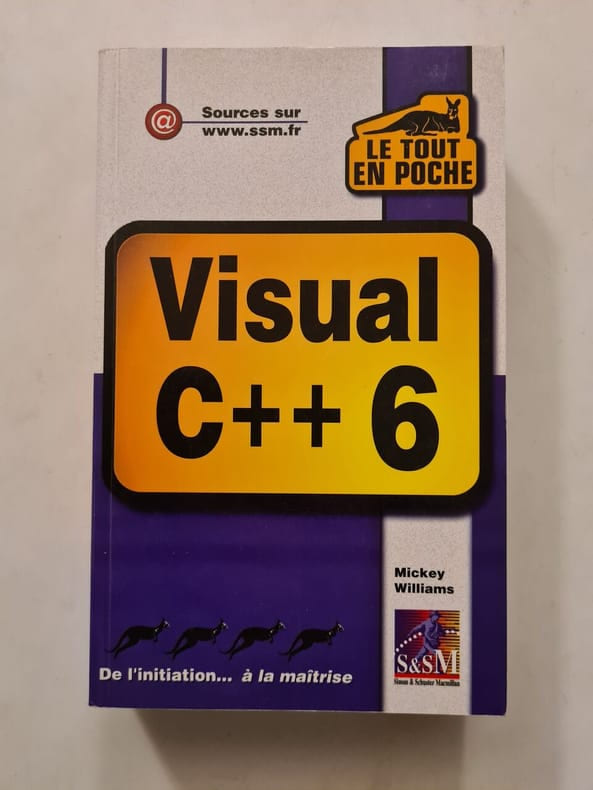
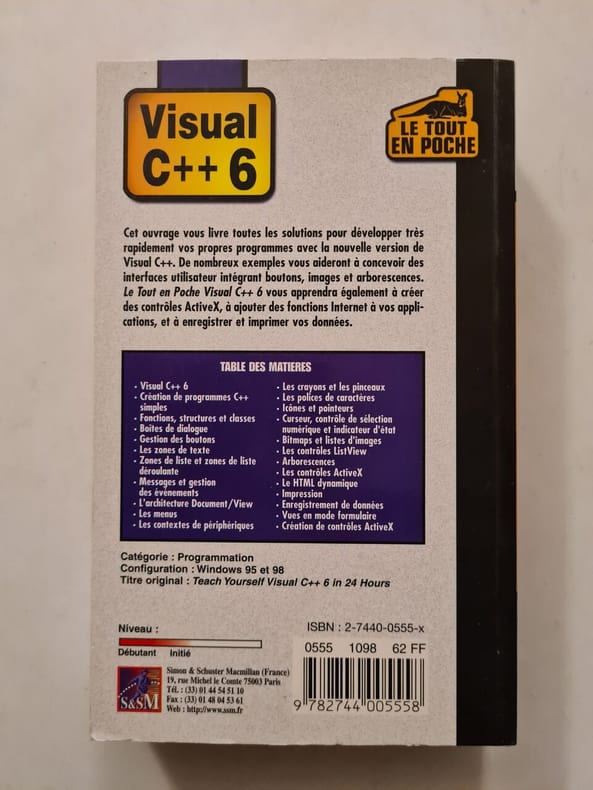
Simon & Schuster Macmillan Sans date.
Reference : 500364032
Très bon état
Bookseller's contact details
Démons et Merveilles
M. Christophe Ravignot
contact@demons-et-merveilles.com
07 54 32 44 40
Payment mode

Sale conditions
Rapidité d'envoi Tous nos articles sont expédiés le jour même de la confirmation de la commande Soin de l'emballage Un soin particulier est apporté à l'emballage, vos objets voyagent en toute sécurité. A votre écoute Si toutefois un incident devait survenir lors de l'acheminement de votre paquet, n'hésitez pas à nous contacter, nous mettrons tout en oeuvre pour vous satisfaire, en vous proposant un retour, un remboursement ou toute autre soluton à votre convenance. Professionnalisme Les livres que nous vendons sont pour la plupart des livres anciens, nous tâchons d'être le plus objectif possible quant à leur état.
5 book(s) with the same title
Feminist Friendships, Collaborations, and Networks in the Visual Arts. Essays in honor of Norma Broude and Mary D. Garrard
, Harvey Miller, 2026 Hardback, Pages: 240, Size:220 x 280 mm, Illustrations:11 b/w, 75 col., Language: English. ISBN 9781915487315.
Summary Since the late twentieth century, a mounting body of studies has demonstrated that women contributed notably to the visual arts of nearly every culture, despite the ubiquity of patriarchal structures. The present volume looks to collaboration as a key factor in women's ability to overcome those systemic obstacles in order to play decisive roles in the visual arts, whether as artists, patrons, art critics, gallerists, or interpreters in the public sphere. Until only recently, collaborations and other collective endeavors have largely been ignored by both the panoptic histories of art and the art markets, both of which are predicated on notions of individual agency and their implied prototype of idealized masculine autonomy. By means of seventeen case studies spanning from the Renaissance to the 1990s and covering several continents, the essays in this volume chronicle an enduring pattern of women artists, critics, and intellectuals pursuing their goals together. In elucidating the importance of the collaborative dynamic model, especially in its feminist iteration, these essays promote a fuller understanding of the visual arts across the globe and throughout the centuries. With contributions by Babette Bohn, Marilyn Dunn, Adelina Modesti, Lara C.W. Blanchard, Catherine Powell-Warren, Mary Sheriff, Melissa Hyde, Carina Reich, Ruth Iskin, Jacqueline Marie Musacchio, Elizabeth Otto, Julie Cole, Jennifer Griffiths, Giorgina Gluzman, Elizabeth Hamilton, Lisa Farrington, and Amy Tobin. This book is dedicated to the prominent feminist art historians Norma Broude and Mary D. Garrard, in admiration for their inspiring and influential collaborative publications on feminism and women in the visual arts. TABLE OF CONTENTS Foreword Norma Broude and Mary D. Garrard Introduction On Feminist Alliances in the Visual Arts Jennifer S. Griffiths and Andrea Pearson Chapter 1 Sisters in Art: Female Sodality in Early Modern Bologna Babette Bohn Chapter 2 Female Networks and Collaboration: Spiritual Philanthropy, Convents, and Art Patronage in Seventeenth-Century Rome Marilyn Dunn Chapter 3 A Female Maecenas: Vittoria della Rovere, Feminist Friendship, Collaboration, and the Arts in Baroque Florence Adelina Modesti Chapter 4 The Banana Garden Poetry Club and Women's Artistic Exchanges: Writing about Paintings and Friendships in Seventeenth-Century China Lara C. W. Blanchard Chapter 5 Illustrating Nature in the Dutch Seventeenth Century: The Collective Power of a Female Community Catherine Powell-Warren Chapter 6 Representations of Female Friendship: Vig e Le Brun's Portrait of Mrs. Chinnery (1803) Mary D. Sheriff Chapter 7 Brought into Friendship: Women, Social Networks, and Amiti in Some Portraits by Ad la de Labille-Guiard and Gabrielle Capet Melissa Hyde Chapter 8 'My Life Has Been Devoted to Friendship': The Danish Painter Bertha Wegmann and the Feminist Reinvention of the Friendship Image Carina Rech Chapter 9 Mary Cassatt and Louisine Havemeyer's Friendship: A Personal, Professional, and Political Alliance Ruth E. Iskin Chapter 10 An American Dantista and Her Friends Jacqueline Marie Musacchio Chapter 11 ringl + pit, from Their House to Bauhaus: Collaborative Partnership, Modernist Photography, and Queer Visual Forms Elizabeth Otto Chapter 12 Lesbian Collaboration as Subterfuge in the Works of Marcel Moore and Claude Cahun Julie Cole Chapter 13 The Force of Futurist Friendship: R??ena Z tkov , Natalia Goncharova, and Benedetta Jennifer S. Griffiths Chapter 14 We Shall Overcome: Women, Art, and Anti-Fascist Networks in Buenos Aires Georgina G. Gluzman Chapter 15 A Friendship Written in the Stars: The Artistic Constellation of Alma Thomas and Delilah Pierce Elizabeth Carmel Hamilton Chapter 16 Black Feminist Art: Negotiating Networks and Identities Lisa Farrington Chapter 17 Heresies' Heresies: Collaboration and Dispute in a Feminist Publication on Art and Politics Amy Tobin List of Illustrations
Reference : alba01ec0cb1383f7ce
5 language visual dictionary. (Visual dictionary in 5 languages: English, Frenc
5 language visual dictionary. (Visual dictionary in 5 languages: English, French, German, Spanish, Italian) In Russian /5 language visual dictionary.(Vizualnyy slovar na 5 yazykakh: angliyskiy, frantsuzskiy, nemetskiy, ispanskiy, italyanskiy ) 5 language visual dictionary. (Visual dictionary in 5 languages: English, French, German, Spanish, Italian). Contact us for details or to request photos of available books. Delivery of this book could take longer than normal due to additional handling time before shipping, and no rush delivery options are available. Please let us know if you have a specific date by which you need to receive your order. SKUalba01ec0cb1383f7ce
Theology, Modernity, and the Visual Arts
, Brepols, 2024 Hardback, 330 pages, Size:225 x 300 mm, Illustrations:78 col., Language: English. ISBN 9782503607122.
Summary In an increasingly visual age, images are the new lingua franca and Christian theology must ask how it can be 'spoken' with nuance and integrity. This book brings together theologians, biblical scholars, art historians, and curators to consider what questions about Christ and modernity might be posed by the visual arts, and what truths about Christ and modernity they might ask us to face. Its authors explore modern and contemporary artists from Pablo Picasso to Kent Monkman and Paul C zanne to Cornelia Parker, addressing questions of theory, practice, and interpretation. Their contributions are orientated by an enquiring and critical focus on how modern and contemporary visual art coexists with, counters, illuminates, and serves Christianity. TABLE OF CONTENTS Introduction Art with Christianity Thinking with Christianity: A Grammar of Doubt and Belief in Contemporary Art (Jonathan Anderson) The Right Eyes: Curating a Theology of Modernist Painting (Daniel A. Siedell) Making Pain Incarnate: An Iconophilic Interpretation of Pablo Picasso's Guernica (Christina Carnes Ananias) Secularization as Realization? (Johann H. Claussen) Art instead of Christianity Missionary Position: Kent Monkman and Christianity (Matthew J. Milliner) Monochromes and Monotheisms: An Apophatic Dialogue with Ad Reinhardt (Aaron Rosen) Lines of the Sacred: Toward a Heterology of Drawing (Jeremy Biles) Squinting at the Invisible: Spiritual Seeing and the Art of Michael Simpson (Jennifer Sliwka) Inheriting the Mantle: Modern and Contemporary Art as the Inheritor of the Prophetic and Apocalyptic Tradition (C.A. Strine) Art about Christianity How About...? R.G. Collingwood, T.J. Clark, and the Conditions of a Haveable World (Ben Quash) Scandalous Particularity: Visual Depictions of Jesus in Modern Art (Rebekah Eklund) Optical Allusions? Exploring the Ambiguity of Biblical Texts in Modern and Contemporary Art (Christine E. Joynes) A Search for Symbols and Images Adequate to Our Predicament (Neil MacGregor) Strange Flesh: The Body of the Risen Jesus in the Art of Edward Knippers (W. David O. Taylor) Art for Christianity Showing People Jesus: Sight and the Visual Arts at Canterbury (Felicity Harley-McGowan) Vision and Mission: Making Art for a World in Danger (Frances Spalding) Re-Visiting Creation (Chlo Reddaway) Bibliography Index
The Perception of the Visual World. - [PRESENTATION-COPY OF THE MODERN CLASSIC ON PERCEPTION]
Boston, etc., Houghton Mifflin, 1950. 4to. Original reddish-brown full cloth with black lettering to spine and front board. A bit of wear to extremities. Several pencil-underlinings in the text (presuambly Postman's). XII, (2), 235, (1), (6, -index) pp. Richly illustrated throughout. With presentation-insription to front free end-paper, as well as Leo Postman's ownership signature.
Excellent presentation-copy of the first edition of the most important work on perception since Helmholtz, Gibson's seminal classic, in which he rejected the theory of behaviorism and pioneered the idea that animals ""sampled"" information from the ""ambient"" outside world. Inscribed to Gibson's close friend, professor of psychology Leo Postman, one of the most dominant theoreticians of human memory: ""To Leo Postman/ You know all this already/ Jim Gibson"". American psychologist James Jerome Gibson (1904 -1979) is considered one of the most important 20th century psychologists in the field of visual perception. His classic work from 1950, ""The Perception of the Visual World"", Revolutionized the way of understanding visual perception and was responsible for the turn away from the otherwise dominating behaviorism. It is in this, his pioneering main work, that he presents his revolutionizing idea of animals ""sampling"" information from the outside world that surrounds them.Gibson is also famous for coining the term ""affordance"", which is the quality of an object or an environment that allows for an individual to perform an action (- a for the time unusually Aristotelian way of viewing objects, an example would be a tie which ""affords"" tying, or a knob that ""affords"" twisting). As Gibson's theories in psychology in general, the concept of ""affordance"" has been extremely influential in a large variety of fields: perceptual psychology, cognitive psychology, environmental psychology, industrial design, human-computer interaction (HCI), interaction design, instructional design and artificial intelligence.""The principal subject of this book is the visual perception of space. The essential question to be asked is this: How do we see the world around us? The question is at once a theoretical one, a factual one, and a practical one. The theories to be considered have to do with the history of philosophy and psychology. The applications extend to art, aviation, photography, and mountain-climbing. This book, however, is not a historical survey of the problem, nor a record of existing facts, nor a discussion of the applications. The intention is to formulate a consistent approach to the problem - a way of getting new facts and making new applications. [...] The writer has elected to study psychophysics rather than psychophysiologybecause he believes that it offers the more promising approach in the present state of our knowledge. [...] A psychophysics may sound to some readers like a contradiction in terms. This book undertakes, however, to justify and make possible such a science. "" (Gibson, in the Preface, pp. (vii)-viii). As is seen from Gibson's own preface, he himself viewed the work as revolutionary, which Hochberg also notes in is piece on Gibson: ""I believe [the] book was the most important work on perception since that of Helmholtz's volume three of Physiological Optics, approximately a century earlier. It was a comprehensive approach to the perception of surfaces, things, and movement through the environment, promarily the outcome of his observations and thoughts about the visual task involved in flying and landing aircraft. [...] The book was clearly intended to initiate a revolutionary moment. I believe that intention has, just as clearly, been successful. Some forty years after its publication, the book is still widely cited and controversial, the direct source of substantial current experimental research, and the starting point for more extreme departures from what had been the established way of thinking about perception."" (Julian Hochberg, ""James Jerome Gibson"", in: National Academy of Sciences Biographical memoirs 63, 1994, pp. 155-6). ""LEO JOSEPH POSTMAN, professor emeritus of psychology and a dominant figure in the study of human memory, died on April 22, 2004, of heart failure at his home in Marblehead, Massachusetts. He was 85.Postman was ""a major theoretician in the development of the theory of forgetting,"" said friend and colleague Donald Riley, professor emeritus of psychology. ""His contributions were monumental."" Postman was listed in a 2002 article in the Review of General Psychology as one of the 100 most eminent psychologists of the last century. ""Within the field of human memory, the range of his contributions has been vast,"" wrote one of his former students, Geoffrey Keppel, professor emeritus of psychology, in recommending Postman for the Berkeley Citation. Postman received the award, the highest honor given to University of California, Berkeley faculty and staff, upon his retirement in 1987.In 1961, Postman founded the Institute of Human Learning at Berkeley, which lives on today as the Institute for Cognitive and Brain Sciences, a center devoted to an interdisciplinary study of the mind and the brain.Postman primarily studied perception, learning, and memory. He participated in the beginnings of the ""new look"" school of perception that emphasized the role of cognitive factors such as emotions and expectations in determining what people perceive.His main interest, however, was forgetting. Based on studies he began in 1958, he became known as the principal spokesman for and architect of modern interference theory, the only comprehensive account of forgetting that exists today. The theory, Keppel wrote, holds that forgetting is the result of interference from a variety of sources, including past memories, various aspects of the current memory, and new memories acquired subsequently-that is, a dynamic interaction of the entire memory system, past and present. Postman was sensitive to the weaknesses of the theory, and spent the last part of his career investigating the mechanisms that conserve memory in the face of interference. Much of this research was conducted at the institute he founded and directed until 1977.Postman, who served as chair of the Department of Psychology for several years in the late 1950s, had a reputation for excellence in teaching, emphasizing clarity and organization.Born June 7, 1918, in St. Petersburg, Russia, Postman moved at an early age to New York City, obtaining his B.S. from the College of the City of New York in 1943 and his Ph.D. from Harvard University in 1946. He taught at Harvard from 1946 until 1950, interrupted by one year at Indiana University, and joined the Berkeley faculty in 1950.In his first years at Berkeley, Postman was recognized nationally as a major figure in the field of perception and the role of motivation in perception. His research shifted, however, and he embarked on a long series of studies on learning with and without the intent to learn (the latter being what is referred to as incidental learning). He later switched to the study of forgetting, which he pursued until his retirement.A member of the National Academy of Sciences and the American Psychological Association, he also served in 1968 as president of the Western Psychological Association, and in 1974 received the Warren Medal of the Society of Experimental Psychologists for outstanding achievement in experimental psychology."" (Robert Sanders, ""In Memoriam. Leo Postman"").

Laus ADGFAD. 2. Disseny Grafic i Comunicacio Visual. Diseno Grafico y Comunicacion Visual. Graphic Design and Visual Communication.
Barcelona: ADGFAD, s. d. [1983] in-4, 307 pages, très nombreuses illustrations. Cartonnage d'éd., très bon état. Deuxième édition de l'association ADGFAD contenant une sélection de travaux de design et de publicité présentés pour les prix LAUS. Textes catalan, espagnol et anglais.
Laus ADGFAD. 2. Disseny Grafic i Comunicacio Visual. Diseno Grafico y Comunicacion Visual. Graphic Design and Visual Communication. (Barcelona: ADGFAD, s. d. [1983]). [M.C.: design, publicité, graphisme, affiches, Espagne]

