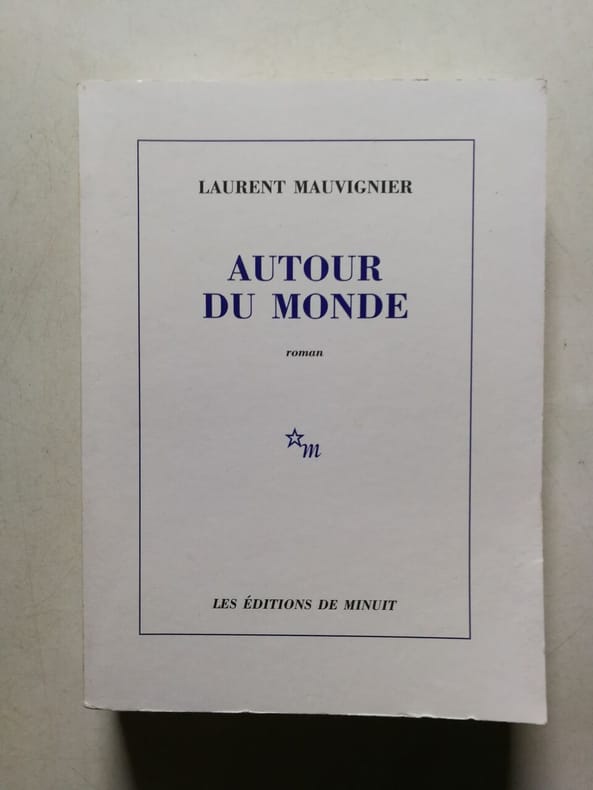
‎Laurent Mauvignier‎
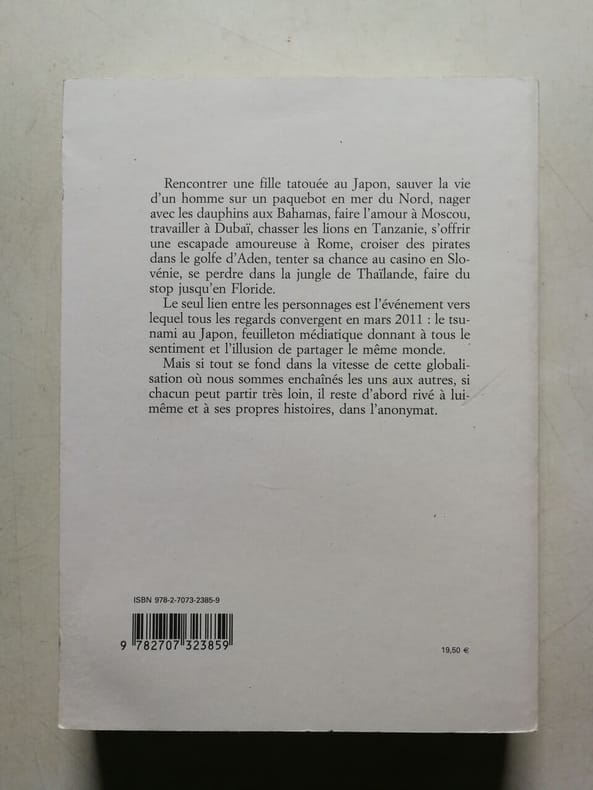
‎Autour du monde‎

‎Les Éditions de Minuit Sans date.‎

Reference : 500317380


‎Bon état‎

€14.00 (€14.00 )
Bookseller's contact details

Démons et Merveilles
M. Christophe Ravignot

contact@demons-et-merveilles.com

07 54 32 44 40

Contact bookseller

Payment mode
Cheque
Transfer
Others
Sale conditions

Rapidité d'envoi Tous nos articles sont expédiés le jour même de la confirmation de la commande Soin de l'emballage Un soin particulier est apporté à l'emballage, vos objets voyagent en toute sécurité. A votre écoute Si toutefois un incident devait survenir lors de l'acheminement de votre paquet, n'hésitez pas à nous contacter, nous mettrons tout en oeuvre pour vous satisfaire, en vous proposant un retour, un remboursement ou toute autre soluton à votre convenance. Professionnalisme Les livres que nous vendons sont pour la plupart des livres anciens, nous tâchons d'être le plus objectif possible quant à leur état.

Contact bookseller about this book

Enter these characters to validate your form.
*
Send

5 book(s) with the same title

‎[BOUGAINVILLE (Louis-Antoine de)].‎

Reference : 5814

(1772)

‎Voyage autour du Monde, par la Frégate du Roi La Boudeuse, et la Flûte l'Etoile ; en 1766, 1767, 1768 & 1769. Seconde édition augmentée. [Suivi de]. Supplement au voyage de M. de Bougainville ; ou Journal d'un Voyage autour du Monde, fait par MM. Banks & Solander, Anglois, en 1768, 1769, 1770, 1771. Traduit de l'Anglois, par M. de Fréville.‎

‎Paris, chez Saillant et Nyon, 1772. 1772 3 vol. in-8° (205 x 130 mm) de : I. [4] ff. (faux-titre, titre, épître) ; XLIII (discours préliminaire) ; 336 pp. ; II. [2] ff. (faux-titre, titre) ; 453 pp. ; [3] pp. (approbation, privilège, avis au relieur) ; III. [1] f. (faux titre) ; XVI (avertissement) ; 362 pp. ; [3] pp. (approbation, privilège) ; 3 planches et 21 cartes dépliantes (numérotées de 1 à 20, la 16 étant en deux parties). (Quelques tâches). Plein veau marbré d'époque, dos à nerfs orné, pièce de titre de maroquin rouge, tranches rouges, gardes de papier marbré. (Reliures très usées avec manques).‎


‎Première édition in-octavo (suivant l'in-quarto de 1771) du récit du célèbre navigateur Louis Antoine de Bougainville (1729-1811), premier Français à avoir effectué une circumnavigation. Suivie de l'édition originale en français du premier périple de James Cook autour du monde. Navigateur, mathématicien et soldat français, Bougainville a largement contribué aux progrès de la science et de la géographie du XVIIIe siècle en localisant avec précision quelques îles et archipels et en effectuant le relevé topographique dune partie des îles Salomon. Grâce à ses précisions, on a pu donner à la carte du Pacifique des mesures exactes. Le récit de voyage de Bougainville a jeté les assises des futures explorations françaises dans le Pacifique ; il est par ailleurs, à lorigine de la légende de Tahiti, île paradisiaque des mers du Sud. Mais Bougainville est peut-être avant tout un philosophe. Cest en tout cas ainsi que le décrit Diderot qui admire en lui toutes les qualités prisées alors par les grands esprits de ce siècle des Lumières en pleine expansion. Bougainville est en quelque sorte lenfant chéri des encyclopédistes et lorsquil quitte la France en 1766 pour son célèbre tour du monde, il va innover dans la manière de concevoir lexploration. Il est en effet le premier dans lhistoire des grands voyages maritimes à emmener avec lui trois véritables savants : le naturaliste Commerson (ami de Jussieu et disciple de Buffon), lastronome Véron, qui améliorera la méthode de calcul des longitudes, et le cartographe Romainville. Le tour du monde de Bougainville est resté célèbre, moins pour ses découvertes scientifiques que pour des raisons parallèles qui en font peut-être et avant tout, ce que lon pourrait appeler un « voyage littéraire ». Le présent récit des aventures de "La Boudeuse" et de "LEtoile" publié par Bougainville quelques années après son retour connaît un succès considérable, qui se poursuit dailleurs encore de nos jours : on trouve toujours en librairie son "Voyage autour du monde" et Bougainville est incontestablement un écrivain même sil est celui dun seul livre. Le troisième volume de cet ouvrage est constitué de la traduction, par La Touche de Treville, de la relation de la première expédition du célèbre capitaine Cook autour du monde, autre figure majeure des explorations maritimes de la seconde moitié du 18ème siècle. Il s'agit d'une édition pirate, parue deux ans avant la première édition officielle française en quatre volumes (1774). Le texte est accompagné dun « Vocabulaire de lîle de Tahiti » et dobservations linguistiques de Pereire sur un locuteur tahitien. Les deux premiers volumes sont illustrés de 21 cartes marines dont 16 dépliantes et de 3 planches gravées. 3 vol. 8vo (205 x 130 mm) of : I. [4] ff. (faux-titre, title, epistle) ; XLIII (preliminary speech) ; 336 pp. ; II. [2] ff. (false title, title) ; 453 pp. ; [3] pp. (approval, privilege, notice to bookbinder) ; III. [1] f. (false title) ; XVI (warning) ; 362 pp. ; [3] pp. (approval, privilege) ; 3 plates and 21 folding maps (numbered from 1 to 20, 16 being in two parts). (Some spotting). Contemporary full marbled calf, ornate ribbed spine, red morocco title-piece, red edges, marbled paper end-papers (Bindings very worn and missing). First in-octavo edition (following the in-quarto of 1771) of the account by the famous navigator Louis Antoine de Bougainville (1729-1811), the first Frenchman to complete a circumnavigation. Followed by the original French edition of James Cook's first voyage around the world. A French navigator, mathematician and soldier, Bougainville made a major contribution to the progress of 18th-century science and geography, accurately locating several islands and archipelagos and surveying part of the Solomon Islands. Thanks to his precision, the map of the Pacific was able to be accurately measured. Bougainville's account of his voyage laid the foundations for future French explorations in the Pacific, and is also the source of the legend of Tahiti, the paradise island of the South Seas. But Bougainville was perhaps above all a philosopher. At least, that's how Diderot describes him, admiring in him all the qualities prized by the great minds of the burgeoning Age of Enlightenment. Bougainville was, in a way, the encyclopedists' favourite child, and when he left France in 1766 for his famous round-the-world voyage, he broke new ground in the way he conceived exploration. In fact, he was the first person in the history of great maritime voyages to take three genuine scientists with him: the naturalist Commerson (a friend of Jussieu and disciple of Buffon), the astronomer Véron, who improved the method of calculating longitudes, and the cartographer Romainville. Bougainville's circumnavigation of the globe has remained famous not so much for its scientific discoveries as for parallel reasons, making it perhaps above all what might be called a literary voyage. The present account of the adventures of La Boudeuse and L'Etoile, published by Bougainville a few years after his return, met with considerable success, which continues to this day: his Voyage autour du monde is still available in bookshops, and Bougainville is undeniably a writer, even if he is the author of a single book. The third volume of this work is La Touche de Treville's translation of the report of the first expedition of the famous Captain Cook around the world, another major figure in the maritime explorations of the second half of the 18th century. This is a pirate edition, published two years before the first official four-volume French edition (1774). The text is accompanied by a Vocabulaire de l'île de Tahiti and linguistic observations by Pereire on a Tahitian speaker. The first two volumes are illustrated with 21 nautical charts, including 16 fold-outs, and 3 engraved plates.‎

J-F Letenneur Livres Rares - Saint Briac sur Mer
Logo SLAM Logo ILAB

Phone number : 06 81 35 73 35

EUR2,000.00 (€2,000.00 )

‎SPARRMAN (Anders).‎

Reference : 4265

(1787)

‎Voyage au Cap de Bonne-Esperance, et Autour du Monde avec le Capitaine Cook, et Principalement dans le pays des Hottentots et des Caffres.‎

‎Paris, Buisson, 1787. 1787 2 vol in-4° (263 x 203 mm) de: vol I. [2] ff. (faux titre, titre): XXI (préface, introduction); [3] pp. (approbation, privilège); 478 pp. (dont explication des planches, table); 1 frontispice gravé; 1 carte dépliante; 7 planches (dont 3 dépliantes); vol II. [2] ff. (faux titre, titre); 462 pp. (dont vocabulaire, table); 8 planches. Un total de 15 planches (dont 3 dépliantes), 1 carte dépliante et 1 frontispice gravé. (rousseurs). Pleine basanne marbrée d'époque, dos lisse orné, titres et tomaisons de maroquin rouge, frise dorée encadrant les plats, tranches marbrées. (Accidents aux coins, mors fendus ou faibles, travaux de vers sur 2 plats, quelques f.f roussis à la fin du vol. 2).‎


‎Édition originale en Français (traduite de langlais par Le Tourneur) de cette relation dun voyage au Cap de Bonne-Espérance due à Anders Erikson Sparrman (1747-1820), médecin, naturaliste et abolitionniste suédois. Fils dun vicaire, Sparrman étudie à luniversité dUppsala sous la tutelle du célèbre naturaliste suédois Carl Von Linné. Au cours de ses études, il effectue un premier voyage à Canton avec la Compagnie des Indes orientales suédoise. Il obtient son diplôme de médecine en 1770 et se rend dans la région du Cap de Bonne-Espérance en 1772 afin dy étudier les peuples et espèces animales. Sur place, il rencontre James Cook qui lui propose dêtre le botaniste de son second voyage autour du Monde. Cest à cette occasion quil rédige les notes qui donneront lieu au présent recueil. Celui-ci est composé de ses observations scientifiques, la majorité concernant la région du Cap de Bonne-Espérance. De retour en suède, il se consacre à la rédaction du présent ouvrage tandis quil obtient le poste de conservateur des collections de l'Académie royale des sciences de Suède à Stockholm. Dans le cadre de ses fonctions, il est envoyé en Afrique de louest pour y effectuer des observations. Si sa mission est un échec sur le plan scientifique, elle ouvre néanmoins les yeux de Sparrman sur la réalité de lesclavage. Ainsi, une fois rentré en Europe, il témoigne devant la Commission du commerce britannique en faveur de l'abolition de l'esclavage. Durant les 10 années qui suivent, il occupe différents postes à lAcadémie dont celui de Collegium Medicum de Stockholm. A la fin de sa vie, Sparrman se consacre aux pauvres du quartier de Klara en tant que médecin. Dans le présent ouvrage, Sparrman recueille en grande majorité ses observations effectuées dans la région du Cap de Bonne-Espérance. Son travail est illustré dune carte gravée dépliante du Cap de Bonne-Espérance et de 15 planches gravées représentant les outils, bijoux et accessoires des peuples hottentots (khoïkhoï) et cafre («Terrine à lait», «Collier de coquillages», «pipe à Tabac dun Boshi ou Hottentot sauvage», «Soulier de campagne», «Ornement de tête ou coiffure de Femme Hottentote», «Ceinturon de Hottento»), leurs armes («flèche», «Carquois», «Tête de flèche», «Hafsagay», sorte de lance) mais aussi la faune («Gazelle», «Spring-bok»«Termitière», «Gerboise», «Ratel, espèce de blaireau» ou encore «Lhippopotame»). Sparrman décrit également le physique de ces populations ainsi que leurs pratiques, notamment leur médecine à base de plantes ainsi que leurs rites spirituels et religieux. De plus, on trouve à la fin du deuxième volume un lexique de la langue Hottentote, cest à dire le groupe des langues khoïsan, dont la particularité unique au monde est lemploi des «clics» en tant que phonème (son distinctif dune langue), ainsi que des langues «cafres», correspondant au groupe des langues bantoues. Ouvrage riche de renseignements sur cette région de lAfrique, tant sur le plan botanique et zoologique que sur le plan ethnographique. 2 volumes 4to (263 x 203 mm) of: vol I. [2] ff. (half title, title) : XXI ( foreword, introduction) ; [3] pp. (approval, privilege); 478 pp. (including explanation of the plates, table); 1 engraved frontispiece; 1 folding map; 7 plates (3 of them folding); vol II. [2] ff. (half title, title); 462 pp. (including vocabulary, table); 8 plates. A total of 15 plates (including 3 folding), 1 folding map and 1 engraved frontispiece. (foxing). Full contemporary marbled basane, smooth spine decorated, labels in red morocco, gilt frieze framing the boards, marbled edges. ( damages to the corners, cracked or weak joints, worm tracks on 2 boards, a few pages browned at the end of vol. 2). First edition in French (translated from the English by Le Tourneur) of this account of a voyage to the Cape of Good Hope by Anders Erikson Sparrman (1747-1820), Swedish physician, naturalist and abolitionist. Sparrman was the son of a vicar and studied at the University of Uppsala under the tutelage of the famous Swedish naturalist Carl Von Linne. During his studies, he made his first trip to Canton with the Swedish East India Company.He obtained his medical degree in 1770 and went to the Cape of Good Hope in 1772 to study the people and animal species there. While there, he met James Cook who offered him to be the botanist for his second voyage around the world. It is on this occasion that he wrote the notes that will result in this book. It is composed of his scientific observations, the majority concerning the region of the Cape of Good Hope. Back in Sweden, he devoted himself to the writing of the present work while he obtained the position of curator of the collections of the Royal Swedish Academy of Sciences in Stockholm. As part of his duties, he was sent to West Africa to make observations. Although his mission was a scientific failure, it opened Sparrman's eyes to the reality of slavery. Once back in Europe, he testified before the British Trade Commission in favor of the abolition of slavery. During the next 10 years, he held various positions at the Academy, including that of Collegium Medicum in Stockholm. At the end of his life, Sparrman devoted himself to the poor of the Klara district as a physician. In the present work, Sparrman collected most of his observations made in the Cape of Good Hope region.While there, he met James Cook who offered him to be the botanist for his second voyage around the world. It is on this occasion that he wrote the notes that will result in this publication. It is composed of his scientific observations, the majority concerning the region of the Cape of Good Hope. Back in Sweden, he devoted himself to the writing of the present work while he obtained the position of curator of the collections of the Royal Swedish Academy of Sciences in Stockholm. As part of his duties, he was sent to West Africa to make observations. Although his mission was a scientific failure, it opened Sparrman's eyes to the reality of slavery. Once back in Europe, he testified before the British Trade Commission in favor of the abolition of slavery. During the next 10 years, he held various positions at the Academy, including that of Collegium Medicum in Stockholm. At the end of his life, Sparrman devoted himself to the poor of the Klara district as a physician. In the present work, Sparrman collects most of his observations made in the Cape of Good Hope region.His work is illustrated with an engraved fold-out map of the Cape of Good Hope and 15 engraved plates representing tools, jewelry and accessories of the Hottentots (Khoikhoi) and Cafre peoples ("Milk jug", "Shell necklace", "Tobacco pipe of a Boshi or wild Hottentot", "Country shoe", " Head ornament or headdress of a Hottentot woman ", " Hottento's belt "), their weapons (" Arrow ", " Quiver ", " Arrow head ", " Hafsagay ", a kind of spear) but also the fauna (" Gazelle ", " Spring-bok ", " Termite mound ", " Gerboise ", " Ratel, a kind of badger ", or " The hippopotamus "). Sparrman also describes the physical appearance of these populations as well as their practices, notably their herbal medicine as well as their spiritual and religious rites. In addition, at the end of the second volume there is a lexicon of the Hottentot language, that is to say the group of Khoisan languages, whose unique feature in the world is the use of "clicks" as a phoneme (distinctive sound of a language), as well as of the "Cafre" languages, corresponding to the group of Bantu languages. This book is rich in information on this region of Africa, both botanical and zoological, and ethnographic.‎

J-F Letenneur Livres Rares - Saint Briac sur Mer
Logo SLAM Logo ILAB

Phone number : 06 81 35 73 35

EUR1,500.00 (€1,500.00 )

‎Dumont D'Urville‎

Reference : 51178

‎VOYAGE AUTOUR DU MONDE. 2 VOLS.‎

‎Furne.1848.2 vols.in-8 demi-reliés.Frontispice.Gravures sur acier.Cartes rempliées dans chaque Tome .550 et 542 p.Demi-chagrin à coins.Dos à caissons.Caractères dorés.Etat moyen.‎


Logo SLAM Logo ILAB

Phone number : 33 05 56 81 68 79

EUR450.00 (€450.00 )

‎LARIGAUDIE (Guy de)‎

Reference : 30642

‎Vingt scouts autour du monde‎

‎Paris, Desclée de Brouwer, 1948 - in-8 broché, 231 pages, photos hors texte de Pol Charbonneaux - TBE, couv. très légèrement défraichie, intérieur très propre‎


Logo SLAM Logo ILAB

Phone number : 33 05 56 81 68 79

EUR10.00 (€10.00 )

‎COTTEAU Edmond‎

Reference : 38065

‎En Océanie. Voyage Autour du Monde en 365 Jours. 1884 - 1885.‎

‎Paris. Librairie Hachette. 1888. In-12. Demi-Chagrin rouge. 4 nerfs au dos. Titre et fleurons dorés. Contient 48 gravures et 4 cartes. 390 p. BE. Couverture frottée. ‎


Logo SLAM Logo ILAB

Phone number : 33 05 56 81 68 79

EUR180.00 (€180.00 )
Get it on Google Play Get it on AppStore
The item was added to your cart
You have just added :

-

There are/is 0 item(s) in your cart.
Total : €0.00
(without shipping fees)
What can I do with a user account ?

What can I do with a user account ?

  • All your searches are memorised in your history which allows you to find and redo anterior searches.
  • You may manage a list of your favourite, regular searches.
  • Your preferences (language, search parameters, etc.) are memorised.
  • You may send your search results on your e-mail address without having to fill in each time you need it.
  • Get in touch with booksellers, order books and see previous orders.
  • Publish Events related to books.

And much more that you will discover browsing Livre Rare Book !