 Write to the booksellers
Castarède Jean
Luxe (le)
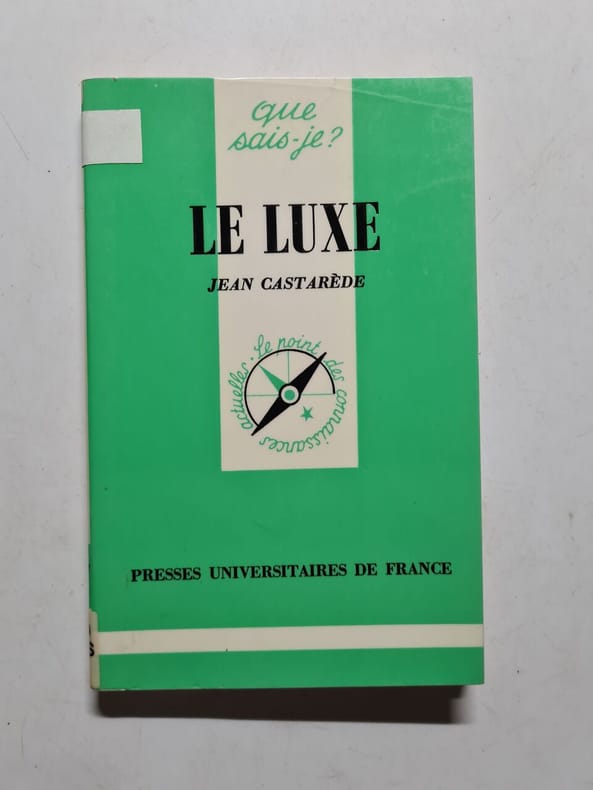
QUE SAIS JE 1992 128 pages 0x18x12cm. 1992. Broché. 128 pages.
Reference : 500279237
ISBN : 9782130449232
Bon état
Bookseller's contact details
Démons et Merveilles
M. Christophe Ravignot
contact@demons-et-merveilles.com
07 54 32 44 40
Payment mode

Sale conditions
Rapidité d'envoi Tous nos articles sont expédiés le jour même de la confirmation de la commande Soin de l'emballage Un soin particulier est apporté à l'emballage, vos objets voyagent en toute sécurité. A votre écoute Si toutefois un incident devait survenir lors de l'acheminement de votre paquet, n'hésitez pas à nous contacter, nous mettrons tout en oeuvre pour vous satisfaire, en vous proposant un retour, un remboursement ou toute autre soluton à votre convenance. Professionnalisme Les livres que nous vendons sont pour la plupart des livres anciens, nous tâchons d'être le plus objectif possible quant à leur état.
5 book(s) with the same title
Aphrodite. Moeurs antiques. Eaux-fortes originales en couleurs gravées par Edouard Chimot [Edition de grand luxe]
1929 Couverture Souple Paris, Editions d'Art de l'Intermédiaire du Bibliophile, 1929. In-4 (33,5 x 26 cm), en feuilles, sous chemise rempliée, papier cristal de protection d'origine, dans son étui d'origine, dos de l'étui manquant, marque brune au haut et au bas du dos de la chemise passée, petits manques au papier cristal. XIV (1) pages, 257 (2) pages, illustrées de 16 eaux-fortes en couleurs sous serpente, dont une en frontispice, une in-texte et 14 hors-texte. La présente édition de grand luxe d'Aphrodite a été achevée d'imprimer le 25 janvier 1929 sur les presses de Ducros et Colas. Elle a été composée, entièrement à la main, en caractère neuf Médiaeval hollandais, corps seize, acheté spécialement pour cette édition et utilisé en France pour la première fois. Les eaux-fortes d'Edouard Chimiot ont été tirées sous la surveillance de l'artiste, au cours des mois de décembre 1928 et janvier 1929. Les ornements et culs de lampe ont été extraits de la collection égyptienne Champollion Le Jeune. Le tirage de cette édition de grand luxe a été limité à 325 exemplaires. Le nôtre est un des 154 exemplaires numérotés sur papier de Rives à la forme teinté, avec un état couleurs des seize planches. Aphrodite connut un large succès lors de sa parution initiale au Mercure de France en 1896. Son auteur le considérait comme "un roman antique sur la femme et la lumière". Très bon état des planches et du texte, bon exemplaire.
Bon
Alechinsky à l'imprimerie [Edition de luxe, eau-forte signée par l'artiste]
2023 Couverture souple Paris, Gallimard, domaine de Chaumont sur Loire, 2023. Un volume in-8 (24 x 17 cm), broché, couverture illustrée, dans son étui cartonné avec motif gaufré au centre, tranches bleutées. 198 pages, illustrées de nombreuses reproductions d'oeuvres de l'artiste en noir et en couleurs. Cette édition de luxe comprend une eau-forte sous serpente, signée et numérotée par Alechinsky, imprimée à l'atelier Clot à Paris. Un des 99 exemplaires numérotés du tirage de tête (n°44). Ouvrage publié à l'occasion de l'exposition du 1er avril au 29 octobre 2023 au Centre d'arts et de nature du Domaine de Chaumont-sur-Loire. En tête d'ouvrage, texte d'Alechinsky "Vadrouille à l'âge lithique", dans lequel l'artiste revient sur son rapport concret à l'imprimerie. « Aller à l'imprimerie, c'est comme pousser la porte du bistrot, quitter l'égocentrisme de l'atelier d'artiste pour retrouver les mordus, les habitués du comptoir lithographique. On respire l'odeur de l'encre. On piétine le même plancher » (Ambidextre, 2019). Né en 1927 en Belgique, Pierre Alechinsky est une figure marquante de l'art contemporain, membre fondateur du groupe Cobra. Bel exemplaire, comme neuf, de cette édition originale.
Comme neuf
L'ART ET LES ARTISTES (Revue) ; DAYOT, Armand (Directeur) ; STEINLEN, Théophile-Alexandre ; NAUDIN, Bernard
Reference : 1858
(1918)
5 numéros spéciaux grand luxe sur papier Japon - La Guerre par Steinlen - Amiens, la Cathédrale - L'Amérique en France - Reims, le Musée - Bernard Naudin
1918 Couverture rigide Paris, L'Art et les Artistes, 1918, 1919. 5 numéros spéciaux de la revue regroupés dans un volume in-4 (30 x 21,5 cm), reliure demi-chagrin signée Louis Marchand, dos à 5 nerfs orné de caissons dorés, papier à la cuve aux plats et contreplats, tranche supérieure dorée, dos insolé avec quelques frottements, petits manques de papier au premier plat. Les 5 numéros grand luxe du volume sont numérotés sur papier de la Manufacture Impériale du Japon (tirage limité entre 25 et 40 exemplaires selon les numéros). LA GUERRE PAR STEINLEN, 52 pages, 2 états sur Japon d'une lithographie originale de Steinlen dont un avant la lettre, "La guerre", 2 hors-texte, 5 illustrations, texte de Camille Mauclair. AMIENS - LA CATHEDRALE, 48 pages, 2 états sur Japon d'après un bois original de Jacques Beltrand dont un avant la lettre, "la Cathédrale d'Amiens", textes de Paul Léon, 70 illustrations. L'AMERIQUE EN FRANCE, 52 pages, 2 états sur Japon d'un dessin original de Lucien Lantier dont un avant la lettre, "Le soldat du droit", 88 illustrations. REIMS - LE MUSEE, 44 pages, 2 états sur Japon d'un dessin original de Carlos Schwab dont un avant la lettre, "Justice", texte de Ambroise Vollard, 48 illustrations. BERNARD NAUDIN, 44 pages, 2 états sur Japon d'un dessin original de Bernard Naudin dont un avant la lettre, "Les ancêtres", hors-texte "Dans la tranchée" (étude de nu), texte de Robert de la Sizeranne, 44 illustrations. Fondée en 1905 par Armand Dayot, alors Inspecteur général des Beaux-Arts, la revue L'Art et les Artistes devient pendant la Grande guerre un organe de résistance intellectuelle et de témoignage, invitant auteurs et illustrateurs à s'exprimer sur le conflit en cours. Provenance : Adolphe Thalasso, proche collaborateur de la revue, écrivain et critique d'Art né à Constantinople, figure orientaliste à Paris dans le monde littéraire. Bel état du texte et des planches, bon exemplaire sur grand papier.
Très bon
5 numéros spéciaux grand luxe sur papier Japon - La Serbie Glorieuse - Russie (Art Ancien) - Le Maroc Artistique - Russie (Art Moderne) - Venise avant et pendant la Guerre - [Lithographie signée de Steinlen]
1917 Couverture rigide Paris, L'Art et les Artistes, 1917, 1918. 5 numéros spéciaux de la revue regroupés dans un volume in-4 (30 x 21,5 cm), reliure demi-chagrin signée Louis Marchand, dos à 5 nerfs orné de caissons dorés, papier à la cuve aux plats et contreplats, tranche supérieure dorée, dos insolé avec quelques frottements, coins légèrement émoussés. Les 5 numéros grand luxe du volume sont numérotés sur papier de la Manufacture Impériale du Japon (tirage limité à 25 exemplaires). LA SERBIE GLORIEUSE, 67 pages, 2 états sur Japon d'une lithographie originale de Steinlen dont un avant la lettre, "Le martyre de la Serbie" signé à la mine de plomb, 122 illustrations, quelques rousseurs marginales en tête sans atteindre le texte et les illustrations. RUSSIE - ART ANCIEN, 47 pages, 2 états sur Japon d'une gravure de Roublev dont un avant la lettre, "Trinité", textes de Louis Réau, 58 illustrations. LE MAROC ARTISTIQUE, 51 pages, 2 états sur Japon d'un dessin original d'Alfred Dehodencq dont un avant la lettre, "Une fête juive au Maroc", texte du Général Lyautey, 84 illustrations. RUSSIE - ART MODERNE, 47 pages, 2 états sur Japon d'un dessin original de Paul Dardé dont un avant la lettre, "Tolstoï", texte de Camille Mauclair, 77 illustrations. VENISE AVANT ET PENDANT LA GUERRE, 49 pages, 2 états sur Japon d'une gravure d'après un dessin du Titien dont un avant la lettre, "Le jugement de Pâris", texte de Henri de Régnier, 70 illustrations. Fondée en 1905 par Armand Dayot, alors Inspecteur général des Beaux-Arts, la revue L'Art et les Artistes devient pendant la Grande guerre un organe de résistance intellectuelle et de témoignage, invitant auteurs et illustrateurs à s'exprimer sur le conflit en cours. Provenance : Adolphe Thalasso, proche collaborateur de la revue, écrivain et critique d'Art né à Constantinople, figure orientaliste à Paris dans le monde littéraire. Bel état du texte et des planches, bon exemplaire sur grand papier, enrichi d'une puissante lithographie de Steinlen.
Très bon
5 numéros spéciaux grand luxe sur papier Japon - La Pologne Immortelle - La Lorraine Affranchie - Lille sous le Joug Allemand - Roumanie - L'Art Assassiné
1916 Couverture rigide Paris, L'Art et les Artistes, 1916, 1917. 5 numéros spéciaux de la revue regroupés dans un volume in-4 (30 x 21,5 cm), reliure demi-chagrin signée Louis Marchand, dos à 5 nerfs orné de caissons dorés, papier à la cuve aux plats et contreplats, tranche supérieure dorée, dos insolé avec quelques frottements. Les 5 numéros grand luxe du volume sont numérotés sur papier de la Manufacture Impériale du Japon (tirage limité entre 25 et 55 exemplaires selon les numéros). LA POLOGNE IMMORTELLE, 80 pages, 2 états sur Japon d'un bois original en deux tons de Jacques Beltrand dont un avant la lettre, représentant le poète Adam Mickiewicz, textes notamment de maurice Maeterlinck, 154 illustrations. LA LORRAINE AFFRANCHIE, 66 pages, 2 états sur Japon d'un dessin original de Bernard Naudin dont un avant la lettre, "L'Oriflamme", texte de Maurice Barrès, 128 illustrations. LILLE SOUS LE JOUG ALLEMAND, 48 pages, 2 états sur Japon d'un croquis original de Paul Renouard dont un avant la lettre, représentant des troupes en marche, textes de Robert Hénard, 48 illustrations. ROUMANIE, 68 pages, 2 états sur Japon d'un dessin original de Jacques Beltrand dont un avant la lettre, "portrait de la Reine Marie en paysanne roumaine", texte notamment de Marie Ionesco, 104 illustrations. L'ART ASSASSINÉ, 48 pages, 2 états sur Japon d'un bois original de Eugène Dété dont un avant la lettre, "La tête du Roi David", texte de Camille Mauclair, 58 illustrations. Fondée en 1905 par Armand Dayot, alors Inspecteur général des Beaux-Arts, la revue L'Art et les Artistes devient pendant la Grande guerre un organe de résistance intellectuelle et de témoignage, invitant auteurs et illustrateurs à s'exprimer sur le conflit en cours. Provenance : Adolphe Thalasso, proche collaborateur de la revue, écrivain et critique d'Art né à Constantinople, figure orientaliste à Paris dans le monde littéraire. Bel état du texte et des planches, bon exemplaire sur grand papier.
Très bon

