 Write to the booksellers
Jack ROUSSEL
Le Microscope
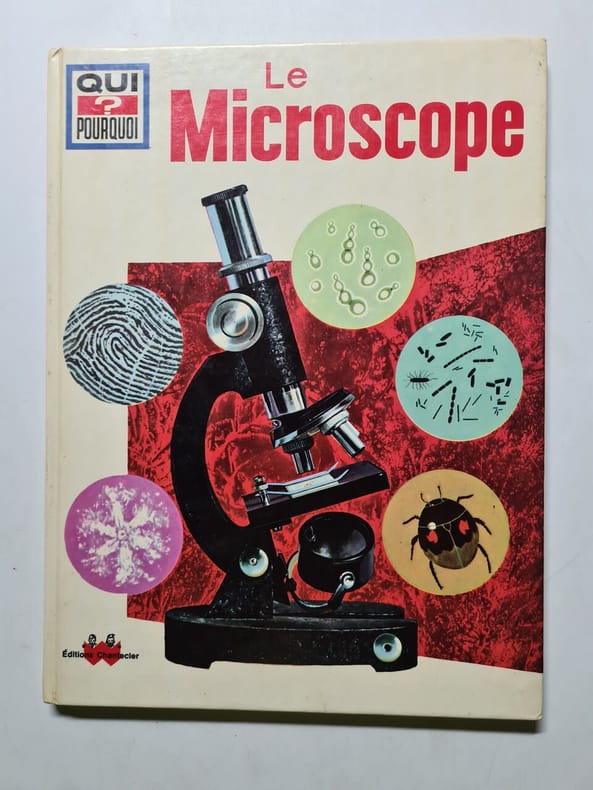
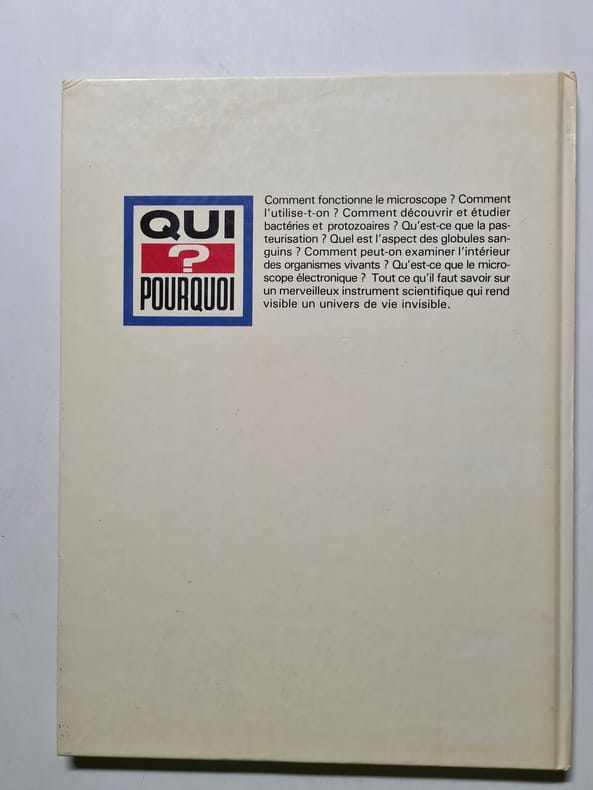
Sans date.
Reference : 500256384
Etat correct
Bookseller's contact details
Démons et Merveilles
M. Christophe Ravignot
contact@demons-et-merveilles.com
07 54 32 44 40
Payment mode

Sale conditions
Rapidité d'envoi Tous nos articles sont expédiés le jour même de la confirmation de la commande Soin de l'emballage Un soin particulier est apporté à l'emballage, vos objets voyagent en toute sécurité. A votre écoute Si toutefois un incident devait survenir lors de l'acheminement de votre paquet, n'hésitez pas à nous contacter, nous mettrons tout en oeuvre pour vous satisfaire, en vous proposant un retour, un remboursement ou toute autre soluton à votre convenance. Professionnalisme Les livres que nous vendons sont pour la plupart des livres anciens, nous tâchons d'être le plus objectif possible quant à leur état.
5 book(s) with the same title
LE MICROSCOPE à la portée de tout le monde ou description, calcul et explication de la nature, de l'usage et de la force des meilleurs microscopes ; avec les méthodes nécessaires pour préparer, appliquer, considérer et conserver toutes sortes d'objets et les précautions à prendre pour les examiner avec soin. Le détail des découvertes les plus surprenantes, faites par le moyen du microscope et un grand nombre d'expériences et d'observations nouvelles sur plusieurs sujets intéressans, traduit de l'anglais sur l'édition de 1743 où l'on a ajouté la figure du microscope solaire et plusieurs observations nouvelles sur le polype -- PREMIERE EDITION FRANCAISE -- BON EXEMPLAIRE
P., Jombert, 1754, un volume in 8 relié en plein veau marbré, dos orné de fers dorés, tranches rouges (reliure de l'époque), (cachet de cire aux armes dans la marge inférieure de la page de titre, petites épidermures sans gravité en bordure des plats) 17pp., (3), 356pp., 15 PLANCHES DEPLIANTES
---- PREMIERE EDITION FRANCAISE ---- BON EXEMPLAIRE ---- Traduit de l'anglais par le Père PEZENAS ---- "H. BAKER was in many respects a typical natural philosopher of the eighteenth century. This book is divided into two parts, the first dealing with the various kinds of microscopes, how each may be best employed, the adjustment of the instrument, and the preparation of specimens. Part II has chapters devoted to the examination of various natural objects, in the manner of Robert Hooke's Micrographia". (DSB I p. 411) - Clay & Court The history of microscope pp. 34, 52 et suivantes ---- Des microscopes en général - Des différentes sortes de microscopes - Microscope simple de M. Wilson - Nouvelle invention pour fixer le microscope de poche - Microscope double de réflexion - De la force des verres que l'on employe dans le microscope double - préparation et application des objets - Examen du sang dans les animaux - Découvertes que l'on a faites dans le sang en l'examinant avec le microscope - De la circulation du sang - Le battement du coeur - Fibres musculaires - De la muce, des araignées, de l'aiguillon des insectes, d'une abeille, du scorpion, de la vipère - etc**225.ARM1D
GLEICHEN, WILHELM FRIEDRICH von [RUSSWORM / GLEICHEN-RUSSWORM / RUSSWURM].
Reference : 48272
(1764)
Das Neueste aus dem Reiche der Pflanzen, oder Mikroskopische Untersuchungen und Beobachtungen der geheimen Zeugungstheile der Pflanzen in ihren Blüten, und der in denselben befindlichen Insekten" nebst einigen Versuchen von dem Keim, und einen Anhang ... - [GLEICHEN'S MICROSCOPE]
[Nuremberg], Christian de Launoy seel. Erben, 1764 [recte: 1763-66]. Folio. Contemporary half calf with gilt lines to spine. Corners a bit bumped. In magnificent, completely clean and fresh condition. (6), 8, (4), 72, 40, (8), 26 ff. + 51 magnificent engraved plates - all plates in astonishing, contemporary hand-colouring. Plates numbered as thus: 1-5 + 2b (i.e. 6 plates - depiting the microscope), I-XXX + A-E (i.e. 35 - details of floral structure and pollens), Anhang 1-10 (i.e. 10 - mainly insects). The plates are engraved by (and coloured by/under the auspices of) Christoph Keller after drawings by Gleichen-Russworm. With several beautiful, large engraved vignettes (by Johann Michael Stock, efter Keller).
The scarce first edition of this splendid work, in which the outstanding microscopist Baron Gleichen-Russworm recorded his observations of plants and insects. The 51 astonishingly beautiful hand-coloured copperplates show the morphology of plants and insects in great detail as well as his magnificent specially constructed microscope and its different parts, making it of the utmost importance to the history of the microscope as well as the fertilization processes in plants. With his thorough study of the pollen, stamens, and pistils as well as the process connected with them, magnificently presented in great detail on beautifully produced plates, the work became a great source of inspiration for many biologists and microscopists of the 18th century. The microscope described and depicted here was frequently reproduced from the detailed plates and Gleichen-Russworm's experiments widely repeated in order to investigate the true nature of the plant. The plates depicting the microscope are among the most frequently reproduced depictions of microscopes. The work appeared in three fascicles, between 1763 and 1766 and were issued with a title-page stating 1764. Wilhelm Friedrich von Gleichen, known as Russworm (1717 - 1783) belongs to the outstanding microscopists of the eighteenth century. He was the elder son of Heinrich von Gleichen and Caroline von Russworm. ""He received little formal education and in 1734, after some years as a page at the court of Prince Thurn und Taxis in Frankfurt, he decided to make his career in the forces of the margrave of Bayreuth. [...]. Gleichen-Russworm remained in the army until 1756, when he resigned his commission in order to devote himself to the management of the Greifenstein estates, inherited from his mother in 1748. His first published writings appeared after his departure from Bayreuth, in the periodical ""Fränkische Sammlung aus der Naturlehre, Arzneigelahrtheit, Ökonomie und der damit verbundenen Wissenschaften"""" they deal, inter alia, with natural history, physics, and chemistry but are, for the most part, quite fanciful.[...] In the summer of 1760 Gleichen-Russworm made the acquaintance of Martin Ledermüller, who had already begun publication of his ""Mikroskopische Gemüths- und Augenergötzungen"" (1759-1762)"" it was this work which led Gleichen-Russworm to concentrate on microscopy. Ledermüller visited Schloss Greifenstein in 1762, and Gleichen-Russworm continued to benefit from his advice until the former took offense at certain criticisms of his work which appeared in ""Geschichte der gemeinen Stubenfliege"" (1764).Gleichen-Russworm was particularly interested in the processes of fertilization in plants and animals, and in 1763 he published the first fascicle of Das neueste aus dem Reiche der Pflanzen. This work contains fifty-one colored plates illustrating numerous details of floral structure and various pollens"" in addition, his interest in the construction of the microscope is reflected in the six plates devoted to the different modifications and accessories which he designed for the instrument. His account of the pollen of Asclepias syriaca L. in Auserlesene mikroskopische Entdeckungen (1777-1781) contains what appears to be the first observation of a pollen tube, although he remained unaware of its significance."" (D.S.B.). Nissen BBI: 716. Pritzel: 3367 (merely stating 46 plates). Honeyman: 1515. Wellcome: III:125 (merely having an incomplete copy of the French translation).

Le Microscope à la portée de tout le monde, ou description, calcul & explication de la nature, de l'usage & de la force des meilleurs Microscopes É Le détail des découvertes les plus surprenantes faites avec le moyen du Microscope
Paris, Ch. A. Jombert, 1754, in-8, [2]-XVII-3-356pp, 15 pl, Basane de l'époque, dos fleuronné, pièce de titre rouge, Première édition française, rare. Quinze belles planches dépliantes gravées sur cuivre (numérotées de 1 à 14 avec une 3 bis), dont 5 représentent différents types de microscope. Avec la planche du microscope solaire, qui n'existait pas dans l'édition originale anglaise de 1742. La traduction française de cet ouvrage est du père Esprit Pézenas de la Compagnie de Jésus. Ami de Cuff, Henry Baker (1698-1774) était le type même du "polymathe" du XVIIIe siècle; il trouva, par l'étude de la nature au travers du microscope un "nouveau sens chez l'homme" (Harald Moe, Story of the Microscope, p. 92). Ces travaux, celui-ci en premier, contribuèrent à populariser l'usage du microscope. Étiquette ex-libris et signature de J. Laissus et cachet ex-libris de Pierre Bos. Dos frotté, coins émoussés, accroc à la coiffe supérieure. Intérieur très bien préservé. Rousseurs fines et éparses. Blake, 28 ; Wellcome II-88. Couverture rigide
Bon [2]-XVII-3-356pp., 15 pl.

Vers l'infiniment petit , dans la collection L'Avenir de la Science, n° 22 ( Anton von Leeuwenhoek, père de la micrographie - Evolution du microscope - Le condenseur - Fond noir et ultramicroscope - Microscopie binoculaire - Le microscopes métallographique - Le microscope polarisant - Dissociation, coloration et fluorescence - Microphotographie et états en surface - Photographie statistique - Interférences - L'onde associée de Louis de Broglie et le microscope électronique - Bactéries, virus et bactériophages - Désintégration et radioactivité artificielle)
Gallimard , L'Avenir de la Science Malicorne sur Sarthe, 72, Pays de la Loire, France 1945 Book condition, Etat : Bon broché, sous couverture imprimée éditeur blanche et grise In-8 1 vol. - 247 pages
Total de 75 figures, certaines sur 9 planches hors-texte (complet), les autres dans le texte 1ere édition, 1945, malgré une fausse mention de 4eme édition "Contents, Chapitres : Introduction - Anton von Leeuwenhoek, père de la micrographie - Evolution du microscope - Le condenseur - Fond noir et ultramicroscope - Microscopie binoculaire - Le microscopes métallographique - Le microscope polarisant - Dissociation, coloration et fluorescence - Microphotographie et états en surface - Photographie statistique - Interférences - L'onde associée de Louis de Broglie et le microscope électronique - Bactéries, virus et bactériophages - Désintégration et radioactivité artificielle - Conclusion - Antoine Auguste Agénor Armand de Gramont, duc de Guiche puis 12e duc de Gramont (1925) est un industriel et un scientifique français né le 29 septembre 1879 et mort le 2 août 1962 - En mars 1916, le Service des fabrications de l'aviation du ministère de la Guerre demande à Gramont de transformer son laboratoire d'aérodynamique en atelier de fabrication d'appareils optiques, en particulier de collimateurs de visée. Il observe l'insuffisance de l'équipement de l'armée française en instruments d'optique de précision et l'absence d'ingénieurs capables de les mettre au point. Il prend alors la tête d'un comité en faveur de la création d'un ""institut d'optique appliquée"" chargé de la formation d'un corps d'ingénieurs-opticiens. Si la décision de principe fut prise par le Gouvernement dès 1916, l'Institut d'optique théorique et appliquée (SupOptique), qu'il présida jusqu'à sa mort, ne commença ses activités qu'en 1920. Il fonde en 1919 et dirige la société OPL, « Optique et Précision de Levallois », qui prend la suite de l'atelier de fabrication d'appareils optiques. (source : Wikipedia)." couverture à peine jaunie avec d'infimes traces de pliures aux coins des plats et quelques rousseurs sur la couverture qui reste en bon état, intérieur propre, papier légèrement jauni, un collant au coin intérieur gauche du plat supérieur sans gravité, cela reste un bon exemplaire, bien complet des 9 planches hors-texte
Métallographie - Introduction à l'étude de la structure des métaux principalement à l'aide du microscope , Traduit et augmenté par E. Bazin, préface de A. Wencélius
Librairie Polytechnique Ch. Béranger éditeur, successeur de Baudry Malicorne sur Sarthe, 72, Pays de la Loire, France 1903 Book condition, Etat : Bon relié, cartonnage éditeur, pleine toile bordeaux imprimée In-8 1 vol. - 215 pages
96 gravures et 12 figures dans le texte en noir et blanc dont de nombreuses microphotographies 1ere édition française, 1903 Contents, Chapitres : Préface, viii, Texte, 207 pages - Introduction - Méthodes du Dr. Sorby, du professeur Martens, de M. Arnold, de M. Osmond (E. Bazin) - Polissage en bas-relief - Polissage-attaque - Attaque proprement dite - Méthodes de M. Stead, de Henri Le Chatelier, méthode sclérométrique, méthode de Charpy, attaque du laiton - Moteurs mécaniques - Coloration par la chaleur - Microscope - Historique du microscope - Microscope de Nachet, microscope métallographique de Nachet, microscope de H. Le Chatelier - Sources lumineuses - Photo-micrographie - Photographie - Structure du fer - Ferrite - Cémentite - Perlite, Sorbite, Troostite, Martensite, Austenite, etc.. Fonte et gueuse - L'acier, le cuivre, le bronze, le laiton - Maillechort,or et argent, etc... Alliages cartonnage en très bon état, mais avec une étiquette au centre du dos, débordant sur les plats, intérieur frais et propre, il manque les deux pages de gardes en début et fin d'ouvrage (pages vierges sans manque de texte), quelques cachets de bibliothèque sur les premières pages, cela reste un bon exemplaire de lecture, complet et sain

