 Write to the booksellers
Trevanian
The main
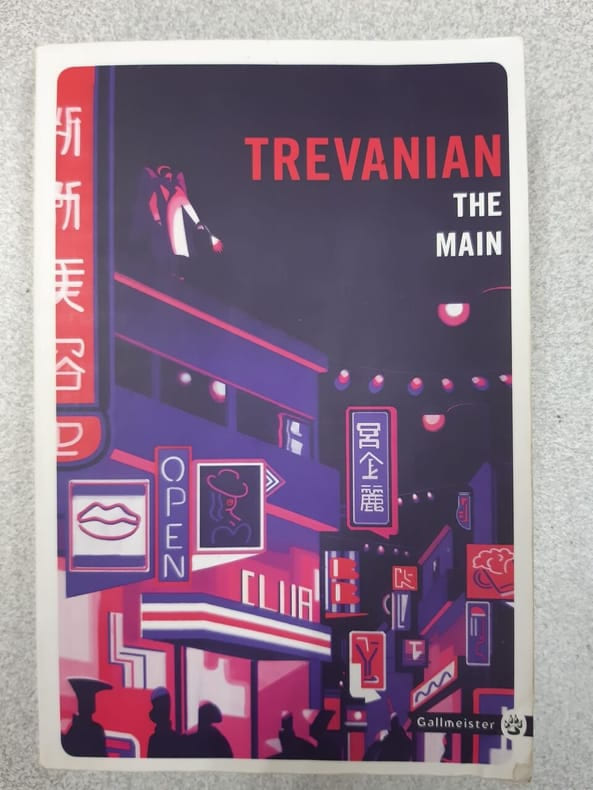
Gallmeister 2017 2017.
Reference : 500086629
ISBN : 9782351786284
Bookseller's contact details
Démons et Merveilles
M. Christophe Ravignot
contact@demons-et-merveilles.com
07 54 32 44 40
Payment mode

Sale conditions
Rapidité d'envoi Tous nos articles sont expédiés le jour même de la confirmation de la commande Soin de l'emballage Un soin particulier est apporté à l'emballage, vos objets voyagent en toute sécurité. A votre écoute Si toutefois un incident devait survenir lors de l'acheminement de votre paquet, n'hésitez pas à nous contacter, nous mettrons tout en oeuvre pour vous satisfaire, en vous proposant un retour, un remboursement ou toute autre soluton à votre convenance. Professionnalisme Les livres que nous vendons sont pour la plupart des livres anciens, nous tâchons d'être le plus objectif possible quant à leur état.
5 book(s) with the same title
Encyclopädie der philosophischen Wissenschaften im Grundrisse. Zum Gebrauch seiner Vorlesungen. - [THE ""MAIN WORK"" OF THE MAIN PHILOSOPHER OF THE 19TH CENTURY]
Heidelberg, (Druck und Papier von Brede in Offenbach), 1817. 8vo. Nice cont. cardboardbdg. w. title-label to back. Corners and capitals professionally restored. Hinges w. a bit of paper-loss. Occational brownspotting. Front free end-paper w. vast cont. annotations by former owner Fr. Selasinski.
The rare first edition of Hegel's immensely important work, the ""Encyclopaedia of the Philosophical Sciences"", by himself and his contemporaries considered his main work, and likewise an absolute main work of philosophy in general. Hegel is considered one of the four greatest philosophers of all times, and his contributions to philosophy are incomparable to other than perhaps those of Aristotle, Plato and Kant. In 1816 Hegel chose the professorship of philosophy at the University of Heidelberg, and here he taught his courses with great enthusiasm. He lectured no less than 16 hours a week, mostly over his own system, which is the object of this (chronologically speaking) third main work, generally just called the ""Encyclopaedia"".Hegel himself considered his ""Encyclopedia"" to be the most important of his works, and his contemporaries likewise judged it his actual main work. Hegel was considered the epitome of the great systematic thinker of the 19th century, and his ""Encyclopaedia"" forms the epitome of his work, at the same time as it, to his own mind, constitutes his greatest achievement. Hegel's main aim was to systematically comprise all spiritual and natural knowledge, and thus his philosophy peaks with his all-comprising Encyclopaedia, which remained of the greatest importance to himself throughout his life-time. He kept working on the book, and no less than three different altered editions appeared within his lifetime, the last in 1830, the year before he died, confirming his lasting devotion to this work.The book has belonged to one Friedrich Selasinski (perhaps a midshipman from the aristocracy), who has annotated the entire front free end-paper (ab. 1830).

Reference : bd-d6d247823b47215a
Chronicles of the Main Physical Observatory, published by G. Wild. 1882./Letopi
Chronicles of the Main Physical Observatory, published by G. Wild. 1882./Letopisi Glavnoy fizicheskoy observatorii, izdavaemye G. Vildom. 1882. Nikolaev Main Physical Observatory (St. Petersburg). Chronicles of the Main Physical Observatory published by G. Wilde, member of the Imperial Academy of Sciences and Director of the Main Physical Observatory. Part 1. Meteorological and magnetic observations of first-degree stations and extraordinary observations of second and third-degree stations.We have thousands of titles and often several copies of each title may be available. Please feel free to contact us for a detailed description of the copies available. SKUbd-d6d247823b47215a.
Reference : alb98c6ca00cafd26d3
Proceedings of the Main Committee for Army Supply. # 26-31. December 1 1916. Tr
"""Proceedings of the Main Committee for Army Supply. # 26-31. December 1 1916. Trustworthy In Russian (ask us if in doubt)/Izvestiya glavnogo komiteta po snabzheniyu armii. # 26-31. 1 dekabrya 1916 g. Doveritel'no.Na pravakh rukopisi. Nomernoy ekzemplyar.. description: In Russian (ask us if in doubt).M 1917 V. Durdenevsky: The Legal Nature of All-Russian Zemsk and City Unions; A. Vyshinsky: Mechanical Enterprises of Zemgora; E. Danilov: From the Practice of the Legal Department of the Main Committee; V. Lvov-Rogachevsky: The First All-Russian Congress on Inventions; Activities of the Main Committee: General Issues: Orders of the Military Department and the Commission of General Karachan. Special meeting under the Chairman of the Council of Ministers and Public Organizations. Request for information and materials on the activities of unions We have thousands of titles and often several copies of each title may be available. Please feel free to contact us for a detailed description of the copies available. SKUalb98c6ca00cafd26d3"""
Reference : alb47ccb9dbf893be67
Main Directorate of Hydrometeorological Service. Proceedings of the Main Geophy
Main Directorate of Hydrometeorological Service. Proceedings of the Main Geophysical Observatory named after A.I. Voeykov. Issue 38 In Russian /Glavnoe Upravlenie Gidrometeorologicheskoy sluby. Trudy Glavnoy Geofizicheskoy Observatorii imeni A.I.Voeykova. Vypusk 38. Sbornik statey Edited by the Candidate of Physical and Mathematical Sciences, Timofeeva M. L. Hydrometeorological Publishing House. 1953. We have thousands of titles and often several copies of each title may be available. Please feel free to contact us for a detailed description of the copies available. The delivery of this book might be delayed beyond the usual timeframe due to extended processing and preparation before shipment, and faster shipping options are not offered. Please inform us if you need the order by a certain date or have a deadline. SKUalb47ccb9dbf893be67
Reference : albbf75acd220e61f7b
Souzmultfilm. The Main Cartoons of the Country (Soyuzmultfilm cartoon catalogue) In Russian (ask us if in doubt)./Souzm
Souzmultfilm. The Main Cartoons of the Country (Soyuzmultfilm cartoon catalogue) In Russian (ask us if in doubt)./Souzmultfilm. The Main Cartoons of the Country (Soyuzmul'tfil'm katalog mul'tfil'mov) Souzmultfilm. The Main Cartoons of the Country. VLOOKUP (A719 [1] Sheet1 $A $2: $R $600 14 0). SKUalbbf75acd220e61f7b.

