 Write to the booksellers
A. Beaujean
Cornelii nepotis vitae excellentium imperatorum
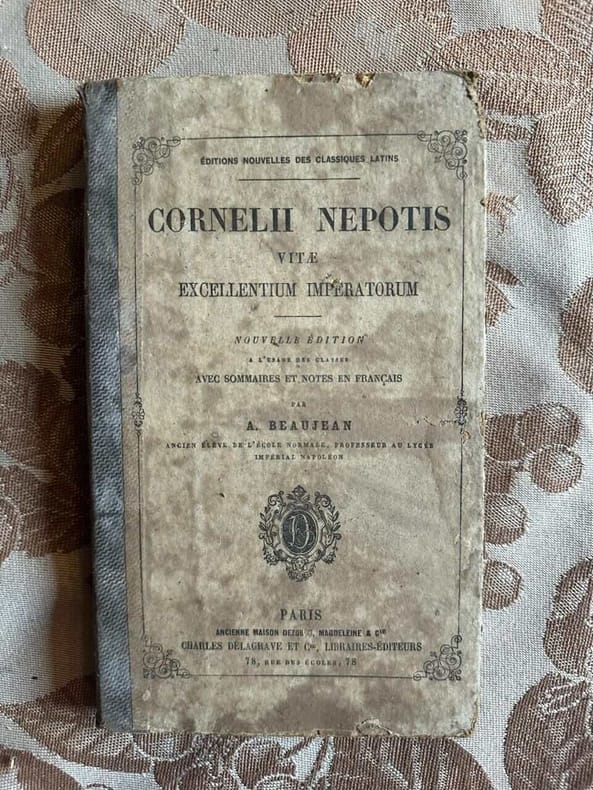
1868 1868.
Reference : 500044294
Bon état
Bookseller's contact details
Démons et Merveilles
M. Christophe Ravignot
contact@demons-et-merveilles.com
07 54 32 44 40
Payment mode

Sale conditions
Rapidité d'envoi Tous nos articles sont expédiés le jour même de la confirmation de la commande Soin de l'emballage Un soin particulier est apporté à l'emballage, vos objets voyagent en toute sécurité. A votre écoute Si toutefois un incident devait survenir lors de l'acheminement de votre paquet, n'hésitez pas à nous contacter, nous mettrons tout en oeuvre pour vous satisfaire, en vous proposant un retour, un remboursement ou toute autre soluton à votre convenance. Professionnalisme Les livres que nous vendons sont pour la plupart des livres anciens, nous tâchons d'être le plus objectif possible quant à leur état.
5 book(s) with the same title
Cornelii nepotis vitae excellentium imperatorum - texte revu avec notice arguments notes en français et les principaux fragments des ouvrages perdus
Lecoffre et cie 1864 in16. 1864. cartonné. Cornelii nepotis vitae excellentium imperatorum - texte revu avec notice arguments notes en français et les principaux fragments des ouvrages perdus
couverture défraîche ternie bords frottés intérieur propre
CORNELII NEPOTIS VITAE EXCELLENTIUM IMPERATORUM.
, Lugduni Batavorum, Samuelem Luchtmans, 1734.**, Relie de l' epoque, demi - maroquin brun a coins, plats marbre, dos orne de fil. dore, piece de titre dore maroquin rouge, coupes et coiffes dore, 12x20cm, 765pp (92), illustre n/b.
Cum integris notis Jani Gebhardi, Henr. Ernstii & Jo Andreae Bosii. Et selectis Andreae Schotti, Dionysii Lambini, Gilberti Longolii, Hieronymi Magii, Jo. Savaronis, aliorumque Doctorum: nec non Excerptis P. Danielis.
Cornelii Nepotis Vitae excellentium Imperatorum, observationibus ac notis commentatorum, quotquot hactenus innotuere, illustratae. Accesserunt huic editioni praecipuorum Graeciae Imperatorum icones aeri incisae; ut & index rerum & verborum praecedenti multo auctior & emendatior.
Amsterdam (Amstelodami), Ex Typographia P. & J. Blaeu, 1687.
8vo. (XXXII, including frontispiece),439,(XL),(1 blank) p. Vellum 20.5 cm (Ref: STCN ppn 101005326; Schweiger 2,299; Dibdin 2,245; Moss 2,319/20; Fabricius/Ernesti I,105: 'quae locupletissima est editio'; Graesse 2,270; Ebert 5262; Spoelder p. 593, Harderwijk 1) (Details: Nice prize binding, without the prize. 6 thongs laced through both joints. Back gilt. Boards with gilt double fillet borders, and corner pieces; coat of arms of Harderwijk on both boards. Engraved frontispiece, executed by J. Visscher, depicting Clio with a pen in her hand, she receives advice from Kronos, who holds his scythe, Fama blows her trumpet. Woodcut printer's mark on the title, depicting a celestial sphere, that is flanked by Hercules and Tempus; motto 'Indefessus agendo'. Small engraved portraits/illustrations on 12 p.) (Condition: Prize gone. Vellum age-toned. Some small spots on the upper board. Gilt on the covers almost completely worn away. All four ties gone) (Note: This is an edition with commentary of the only surviving complete work of the Roman historian Cornelius Nepos, ca. 100-24 B.C., 'De excellentibus ducibus exterrarum gentium'. He is the author of the first surviving ancient collection of biographies. 'De excellentibus etc.' contains the lives of 20 Greek generals, and the Carthaginians Hamilkar and Hannibal. Nepos corresponded with Cicero and was close with Cicero's friend Atticus. The collection served probably as a model for Plutarch's Vitae Parallelae. In his own days and in late antiquity Nepos was considered to be a source of importance. The churchfather Hieronymus, included him in his 'De viris illustribus' (392 A.D.) in the list of great authors and historians. Already in late antiquity this collection was ascribed to the grammarian Aemilius Probus, and the 'editio princeps' of 1471 bears his (Probus') name. The simple style of writing of Nepos has made him a standard choice for schools. The biographies provided the pupils also models of behaviour. Schweiger mentions numerous editions. This edition is a socalled 'Variorum' edition, an edition which contained everthing a student required. Such an edition offers the 'textus receptus' which is widely accepted, accompanied with the commentary and the annotations of specialists, taken from earlier useful, normative or renewing editions. Editions like these, 'cum notis Variorum', were useful, but never broke new ground. The production of this kind of editions was the specialty of Dutch scholars of the 17th and 18th century. The compilers seldom were great scholars, but often hard working schoolmasters. Such an edition was published in 1658 in Leiden by the Hackius brothers. It was produced by the young Dutch scholar R. Keuchenius (1636-1673), who matriculated in 1654, and was later in life appointed professor of Roman History at the 'Athenaeum Illustre' of Amsterdam. The edition of 1654 was revised and augmented by an anonymous editor, and published in 1675 by the same Hackius brothers. The preface of Keuchenius to the edition of 1658 (and the testimonia) was repeated, but now anonymously. The anonymous editor seems to be Keuchenius, for the main body of his work and his own notes have been preserved. In a short 'ad lectorem' (signed 'Keuchenius' in 1658, anonymous in 1675) the editor explains that he based his edition on those of Lambinus and Longolius, and that he passim added selected observations of Gifanius, Savarus, Schottus, Boeclerus, Gebhardus, Ernesti and Bosius. He also elucidated the Lives with passages from ancient Greek historians, like Herodotus, Thucydides, Xenophon and Plutarch. The edition of 1675 became the model of a line of clones, including the frontispiece and illustrations. It was reprinted verbatim, line by line, page by page, with the same layout and the same kind of typeface by the Blaeu brothers in 1687, probably Mortier in 1704, by Janssonius van Waesberge in 1705, by Samuel Luchtmans in 1728. The frontispiece and the illustrations of the 1687 edition are however no copies, but they are exactly the same as in the edition of 1675. Blaeu had perhaps come into the possession of the plates which belonged to the edition of 1675 after the death of Cornelius Hackius in 1668, and used them for this 1687 edition. He also might have hired them) (Collation: *-2*8; A-2G8 (leaf 2G8 verso blank)) (Photographs on request)
Cornelii Nepotis Vitae excellentium Imperatorum, observationibus & notis commentatorum omnium, quotquot hactenus innotuere, illustratae. Accesserunt huic editioni praecipuorum Graeciae Imperatorum icones aeri incisae; ut & index rerum & verborum auctior & emendatior.
Amsterdam (Amstelodami), Prostant apud Wetstenios, 1707.
8vo. (XXXII, including frontispiece),439,(40 index),(1 blank) p. Modern half calf. 19 cm (Ref: STCN ppn 186438281; Schweiger 2,299; Dibdin 2,245; Moss 2,319/20; Fabricius/Ernesti I,105: 'quae locupletissima est editio'; cf. Graesse 2,270, ed. Keuchenius) (Details: The engraved frontispiece is dated 1704, and is executed by J. Visscher, depicting Clio with a pen in her hand, she receives advice from Kronos, who holds his scythe, Fama blows her trumpet. Small engraved illustrations on 12 p.) (Condition: Name on the blank margin of the frontispiece. Oval stamp on the title. Paper slightly warped and yellowing) (Note: This is an edition with commentary of the only surviving complete work of the Roman historian Cornelius Nepos, ca. 100-24 B.C., 'De excellentibus ducibus exterrarum gentium'. He is the author of the first surviving ancient collection of biographies. 'De excellentibus etc.' contains the lives of 20 Greek generals, and the Carthaginians Hamilkar and Hannibal. Nepos corresponded with Cicero and was close with Cicero's friend Atticus. The collection served probably as a model for Plutarch's 'Vitae Parallelae'. In his own days and in late antiquity Nepos was considered to be a source of importance. The churchfather Hieronymus, included him in his 'De viris illustribus' (392 A.D.) in his list of great authors and historians. Already in late antiquity this Nepos collection was ascribed to the grammarian Aemilius Probus, and the 'editio princeps' of 1471 bears that name. The simple style of writing of Nepos has made him a standard choice for schools. The biographies provided the pupils also models of behaviour. Schweiger mentions numerous editions. This edition is a so-called Variorum edition, an edition which contained everthing a student required. Such an edition offers the 'textus receptus' which is widely accepted, accompanied with the commentary and the annotations of specialists, taken from earlier useful, normative or renewing editions. Editions like these, 'cum notis Variorum', were useful, but never broke new ground. The production of this kind of editions was the specialty of Dutch scholars of the 17th and 18th century. The compilers seldom were great scholars, but often hard working schoolmasters. Such a useful edition was published in 1658 in Leiden by the Hackius brothers. It was produced by the young Dutch scholar R. Keuchenius (1636-1673), who matriculated in 1654, and was later in life appointed professor of Roman History of the 'Athenaeum Illustre' at Amsterdam. The edition of 1658 was revised and augmented by an anonymous editor, and republished in 1675 by the same Hackius brothers. The preface of Keuchenius to the edition of 1658 (and the testimonia) was repeated, but now anonymously. The anonymous editor seems to be Keuchenius, for the main body of his work and his own notes have been preserved. In a short 'ad lectorem' (Keuchenius in 1658, and anonymous in 1675) the editor explains that he based his edition on those of Lambinus and Longolius, and that he passim added selected observations of Gifanius, Savarus, Schottus, Boeclerus, Gebhardus, Ernesti and Bosius. He also elucidated the Lives with passages from ancient Greek historians, like Herodotus, Thucydides, Xenophon and Plutarch. The edition of 1675 became the model of a line of clones, including the frontispiece and illustrations. It was reprinted 'verbatim', line by line, page by page, with the same layout and the same kind of typeface by the Blaeu brothers in 1687, probably Mortier in 1704, by Janssonius van Waesberge in 1705, by Wetstein in 1707 (this edition), and by Samuel Luchtmans in 1728) (Provenance: On the frontispiece: 'B.L.W. Mensing'. Between In the second half of the 19th century B.L.W. Mensing exploited a boarding school in Schoonoord, an estate in the Dutch city of Rijswijk. (See Wikipedia, Buitenplaats Schoonoord) On the title the stamp of: 'Huize Katwijk, De Breul, Zeist'. This school still exists, and is now called Katholieke Scholengemeenschap De Breul. (See Wikipedia) The school was established as a boarding school in 1831 in 'Katwijk aan den Rijn', and was in 1842 transfered to the Jesuits. The school moved to The Hague in 1928, then to Noordwijkerhout in 1941, and finally in1946 to 'De Breul', an estate between Zeist and Driebergen in the province Utrecht) (Collation: *-2*8; A-2G8 (leaf 2G8 verso blank)) (Photographs on request)
Cornelii Nepotis vitae excellentium imperatorum ad optimas editiones collatae praemittuntur vita a G. I. Vossio scripta et notitia leteraria accedunt indices studiis spcietatis Bipontinae. Editio accurate.
Biponti (Zweybrücken), Ex Typographia Societatis 1782, 195x120mm, XXXIV - 268pages, cartonnage. Pièce d’auteur doré au dos. Bel exemplaire.
texte en latin, Pour un paiement via PayPal, veuillez nous en faire la demande et nous vous enverrons une facture PayPal

