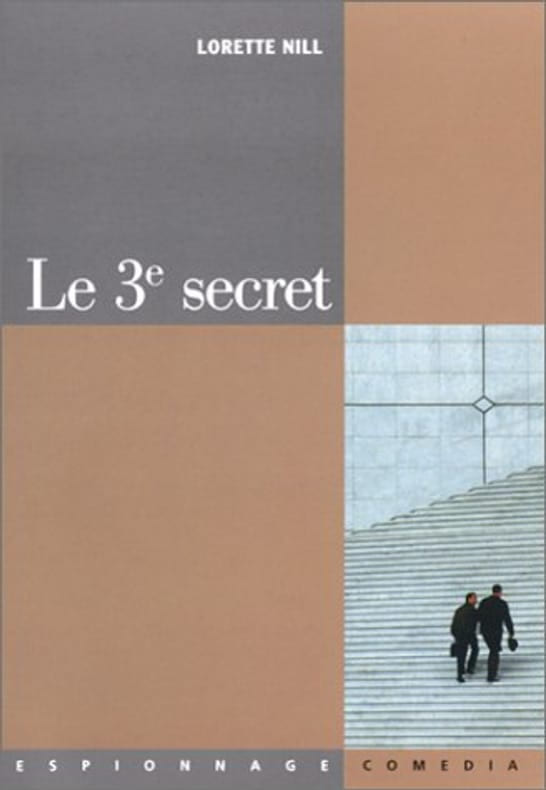
Editions Comedia 2001 190 pages 20x14x1cm. 2001. Broché. 190 pages.
Reference : 24319
ISBN : 9782913595040
french édition - très légères marques de lecture et/oude stockage mais st du reste en très bon état d'ensemble. - Envoi rapide et soigné dans une enveloppe à bulle depuis France
Démons et Merveilles
M. Christophe Ravignot
contact@demons-et-merveilles.com
07 54 32 44 40
Rapidité d'envoi Tous nos articles sont expédiés le jour même de la confirmation de la commande Soin de l'emballage Un soin particulier est apporté à l'emballage, vos objets voyagent en toute sécurité. A votre écoute Si toutefois un incident devait survenir lors de l'acheminement de votre paquet, n'hésitez pas à nous contacter, nous mettrons tout en oeuvre pour vous satisfaire, en vous proposant un retour, un remboursement ou toute autre soluton à votre convenance. Professionnalisme Les livres que nous vendons sont pour la plupart des livres anciens, nous tâchons d'être le plus objectif possible quant à leur état.
2006 Les éditions de surcroît, 2006. 21 x 15 cm, 62 pp. En feuilles sous couverture imprimée. Couverture légèrement salie sinon bon exemplaire. Édition originale, tirage limité à 150 exemplaires. Envoi autographe signé de Georges-Henri Morin.
Bruxelles, Éditions Labor, sans date. 18,5 x 12 cm, 168 pp. Broché en bel état. Édition originale. Marie de Vivier, nom de plume de Marie Joséphine Jacquart, née à Ixelles le 14 octobre 1899, et morte dans la nuit du 16 au 17 janvier 1980 à la clinique du Lys de la Vallée, à La Celle-Saint-Cloud est une romancière et poétesse belge. Marie Joséphine Jacquart, fille d'Arthur Ursmar Jacquart, chapelier, et de Jeanne Du Vivier, fille d'un médecin, naquit en 1899. Elle choisit son pseudonyme d'après le nom de sa mère qui à l'origine s'écrivait de Vivier. Marie de Vivier produisit une œuvre littéraire composée de poésies et de romans. Elle participa aux activités de la revue Tribune fondée par Jean Groffier. Plusieurs de ses romans sont inspirés par la passion qu'elle éprouvait à l'égard de l'écrivain André Baillon avec lequel elle échangea une correspondance à partir de 1930 et auquel elle consacra des écrits biographiques. Selon le journal Le Soir « Marie de Vivier avait été la compagne de notre confrère le journaliste Frédéric Denis après le décès duquel elle s'était fixée en France où elle a vécu une vingtaine d'années ».
2002 Babel Éditeur, 2002. 13,5 x 11 cm, 18 pp. Plaquette brochée avec une cordelette, accompagnée d'une enveloppe et d'une feuille vierge. Tirage limité à 500 ex. sur papier Matline longues fibres de Tex Libris.
1518 Collection du Collège réservée à ses plus éminents membres, sollicités de la “conserver à l’abri des regards". 12 plaquettes sur les 26 parues. Nous avons : - JEAN FERRY. Vue cavalière sur la Mignonette. Esoterica 11. Collège de Pataphysique, sans lieu, 23 clinamen LXXXV. 14 x 10 cm, 16 pp. Non coupé. Un des 99 ex, seul tirage. Avec son enveloppe. - Alfred JARRY. Léda. Fragments de brouillon d'une Opérette-Bouffe introuvable. Esoterica 13. Collège de Pataphysique, sans lieu, 8 phalle LXXXV. 14 x 10 cm, 20 pp. Non coupé. Un des 99 ex, seul tirage. Avec son enveloppe. - L'Affaire de la Gazette de Lausanne. Esoterica 14. Collège de Pataphysique, sans lieu, Jel Musical LXXXVI. 10,3 x 8 cm, 16 pp. Non coupé. Un des 99 ex, seul tirage. - QUENEAU. Inventaire sommaire des papiers déchirés, brûlés, jetés, etc. en juin 1918. Esoterica 15. Collège de Pataphysique, sans lieu, 18 as LXXXVI. 14 x 10 cm, 14 pp. Broché couverture blanche imprimée rouge et tamponnée en violet. Exemplaire en bel état de ce Queneau méconnu pour cause d’Interdiction Holocratique de communication, cette plaquette avec celle de Vian, sont là les deux plus rares et les plus recherchées de cette série. La page 14 en contient un signe manuscrit inventés par l’auteur et quatre fois répétés au stylo bille. Édition originale. 1/99 exemplaires, seul tirage. Non coupé. Avec son enveloppe. - JEAN FERRY. Lettres Hyperphate. Esoterica 16. Collège de Pataphysique, sans lieu, 23 clinamen LXXXV. 14 x 10 cm, 16 pp. Non coupé. Un des 99 ex, seul tirage. - BORIS VIAN. J'irai cracher sur vos tombes. Document folk-lorique & folliculaire. Esoterica 17. Collège de Pataphysique, sans lieu, 29 tatane LXXXVII. 14 x 10 cm, 12 pp. Non coupé. Un des 99 ex, seul tirage. Avec son enveloppe. - RUY LAUNOIR. Le grand Pan est mort. Esoterica 18. Collège de Pataphysique, sans lieu, 9 as CIV. 10,3 x 8 cm, 16 pp. Non coupé. Un des 111 ex, seul tirage. - THIERI FOULC. MNHETHP ou L'enigme du sphinx. Esoterica 19. Collège de Pataphysique, sans lieu, 12 as CIV. 10,3 x 8 cm, 16 pp. Non coupé. Un des 111 ex, seul tirage.- CARADEC. La parfaite secrétaire. L'alphabet par les Méthodes actives. Non numéroté. Collège de Pataphysique, sans lieu, 22 phalle LXXXVIII. 10,3 x 8 cm, 16 pp. Non coupé. Un des 111 ex, seul tirage. Avec son enveloppe d'origine.- DINGUIRARD. Hébert restitué. Esoterica 20. Collège de Pataphysique, sans lieu, 2 decervelage de l'an cent & quatre. 10,3 x 8 cm, 16 pp. Non coupé. Un des 111 ex, seul tirage. - A propos de Emmanuel Peillet. Esoterica 21. Collège de Pataphysique, sans lieu, 24 decervelage CXVI. 10,3 x 8 cm, 16 pp. Un des 111 ex, seul tirage. - La preuve par IX (31). Esoterica 22. Collège de Pataphysique, sans lieu, 23 gueules 116. 10,3 x 8 cm, 16 pp. Un des 111 ex, seul tirage.
Warszawa, March (27th and 31st) 1956. 8vo. Original printed wrappers. With ""Wylacznie do uzytku organizacji partyjnych"" (""Exclusively for inner-party use"") printed to top of front wrapper. Stamped serial number to front wrapper: 12861. A few light creases to wrappers. A A very nice, clean, and fresh copy.Previous owner's name to title-page. 95, (1) pp.
Extremely scarce second impression, printed for private circulation only (""exclusively for inner-party use""), of one of the most important documents of the 20th century, namely Khrushchev's so-called ""Secret Speech"", also known as the ""Khrushchev Report"". This seminal speech was delivered at an unpublicized closed session of Communist Party delegates, with guests and members of the press excluded, and the present Polish version, which appeard in two different printings, of it was the only one that circulated during the Cold War, the official Russian text being unknown until its 1989 publication. The CIA counterfeit edition [falsely stating Moscow 1959] was in fact a translation into Russian from the present Polish text, which was smuggled out of Moscow and leaked, via Israel, to the USA. There are two impressions of the first edition of Khrushchev's speech, both bearing the date March 1956 and both ordered by the Polish communist party authorities in the span of March 27 - March 31. As opposed to the even scarcer first priting of the text, this second priting of 96 pages was edited to give only Khrushchev's speech (without the recorded interjections and ovations), but containing also a second part, ""Unpublished materials"" with Lenin's ""Testament"", Lenin's ""On the National Question"", and Stalin's notes.The present publication shook the Western world and changed our history for good. ""Its consequences, by no means fully foreseen by Khrushchev, shook the Soviet Union to the core, but even more so its communist allies, notably in central Europe. Forces were unleashed that eventually changed the course of history. But at the time, the impact on the delegates was more immediate. Soviet sources now say some were so convulsed as they listened that they suffered heart attacks"" others committed suicide afterwards."" (John Rettie, in The Observer, Sunday 26 February 2006 ).On February 24, 1956 before assembled delegates at a secret session of the Communist Party's Twentieth Congress, Nikita Khrushchev delivered his so-called ""Secret Speech"", denouncing Stalin for his transgressions. The public session of the 20th Congress had come to a formal end on 24 February 1956 when word was spread to delegates to return to the Great Hall of the Kremlin for an additional ""closed session,"" to which journalists, guests, and delegates from ""fraternal parties"" from outside the USSR were not invited. Special passes were issued to those eligible to participate, with an additional 100 former Party members, recently released from the Soviet prison camp network. The speech was thus secretly held in this closed session, without discussion, and it was neither published as part of the congress' proceedings nor reported in the Soviet press. The speech that sent shock waves through the congress participants denounced Stalin, describing him as satanic despot and terrorist who had committed the greatest of crimes. Quoting from correspondence, memoranda and his own observations, Khrushchev gave details of Stalin's horrible actions during the Terror of the late 1930'ies, the unpreparedness of the country at the time of the Nazi invasion in June 1941, numerous wartime blunders, the deportation of various nationalities in 1943 and 1944, and the banishing of Tito's Yugoslavia from the Soviet bloc after the war. Absolving the party itself of these grave actions, Khrushchev attributed them to the ""cult of personality"" that Stalin encouraged and his ""violations of socialist legality"". According to Khrushchev's speech, Stalin was a tyrant, a murderer and torturer of party members.Khrushchev gave his grim tale of the obscene crimes committed by his predecessor, Josef Stalin, only three years after the death of Stalin, who was then celebrated as a great leader and whose death was mourned by the great majority of Soviet citizens, who saw him as a divine father. It is no wonder that this lengthy speech from their new leader completely shocked Soviet communists, being told so soon after his death that far from far from being divine, their hero Stalin was actually outright satanic. The leaders who inherited the party from the old dictator had agreed - after months of furious argument - that Khrushchev should make the speech, but on the condition that it should never be published.Khrushchev read from a prepared report and no stenographic record of the closed session was kept. No questions or debate followed Khrushchev's presentation, and it is reported that delegates left the hall in a state of complete disorientation. It is even said that several delegates suffered heart attacks and that some even committed suicide upon listening to the horrifying speech. On the evening of the congress, delegates of foreign Communist parties were called to the Kremlin and given the opportunity to read the prepared text of the Khrushchev speech, which was treated as a top secret state document. Reports of the speech soon reached the West and as early as March the contents were reported in Western media. ""The content of the speech reached the west through a circuitous route. A few copies of the speech were sent by order of the Soviet Politburo to leaders of the Eastern Bloc countries. Shortly after the speech had been disseminated, a Polish journalist, Viktor Grayevsky, visited his girlfriend, Lucia Baranowski, who worked as a junior secretary in the office of the first secretary of the Polish Communist Party, Edward Ochab. On her desk was a thick booklet with a red binding, with the words: ""The 20th Party Congress, the speech of Comrade Khrushchev."" Grayevsky had heard rumors of the speech and, as a journalist, was interested in reading it. Baranowski allowed him to take the document home to read.As it happened, Grayevsky, who was Jewish, and had made a recent trip to Israel to visit his sick father, decided to emigrate there. After he read the speech, he decided to take it to the Israeli Embassy and gave it to Yaakov Barmor who had helped Grayevsky make his trip to visit Grayevsky's sick father. Barmor was a Shin Bet representative"" he photographed the document and sent the photographs to Israel. By the afternoon of April 13, 1956, the Shin Bet in Israel received the photographs. Israeli intelligence and United States intelligence had previously secretly agreed to cooperate on security matters. James Jesus Angleton was the Central Intelligence Agency's (CIA) head of counterintelligence and in charge of the clandestine liaison with Israeli intelligence. The photographs were delivered to him. On April 17, 1956, the photographs reached the CIA chief Allen Dulles, who quickly informed U.S. President Dwight D. Eisenhower. After determining that the speech was authentic, the CIA leaked the speech to The New York Times in early June.""""In the West, the impact of the speech received a colossal boost from the publication of the full, albeit sanitised, text in The Observer and the New York Times. This was the first time the full text had been available for public scrutiny anywhere in the world. Even local party secretaries who read it to members had to return their texts within 36 hours. (Those texts were also sanitised, omitting two incidents in the speech that Orlov related to me.)According to William Taubman, in his masterly biography of Khrushchev, the full text leaked out through Poland where, like other central European communist allies, Moscow had sent an edited copy for distribution to the Polish party."" (John Rettie, in The Observer, Sunday 26 February 2006).The speech sent shock waves throughout the Communist world and caused many Western Communists to abandon the movement. In central Europe, the impact of the speech was enormous. By autumn Poland was ready to explode and in Hungary an anti-communist revolution overthrew the Stalinist party and government, replacing them with the short-lived reformist Imre Nagy.""Some may doubt that Stalin's Soviet Union could ever have been reformed, but Khrushchev was not among them - and neither, indeed, was Gorbachev. But after two decades of decay under Brezhnev, even he could not hold the country together. It can well be argued that the 'secret speech' was the century's most momentous, planting the seed that eventually caused the demise of the USSR."" (John Rettie, in The Observer, Sunday 26 February 2006).It is the present version of the seminal text that leaked behind the Iron Curtain. Allegedly the CIA offered USD 1.000.000 for a copy, before they came into possession of the text through other channels. Khrushchev himself stated: ""It was supposed to have been secret, but in fact it was far from being secret.. our document fell into the hands of some Polish comrades who were hostile towards the Soviet Union. They used my speech for their own purposes and made copies of it. I was told that it was being sold for very little.""Like the first impression, almost all the copies of this extremely scarce publication - which were all numbered and strictly registered - were withdrawn and destroyed after 11 April 1956. We have been able to locate no copies of either impression outside of Poland and can find no copies registered in OCLC.