 Write to the booksellers
Morice James
Polish
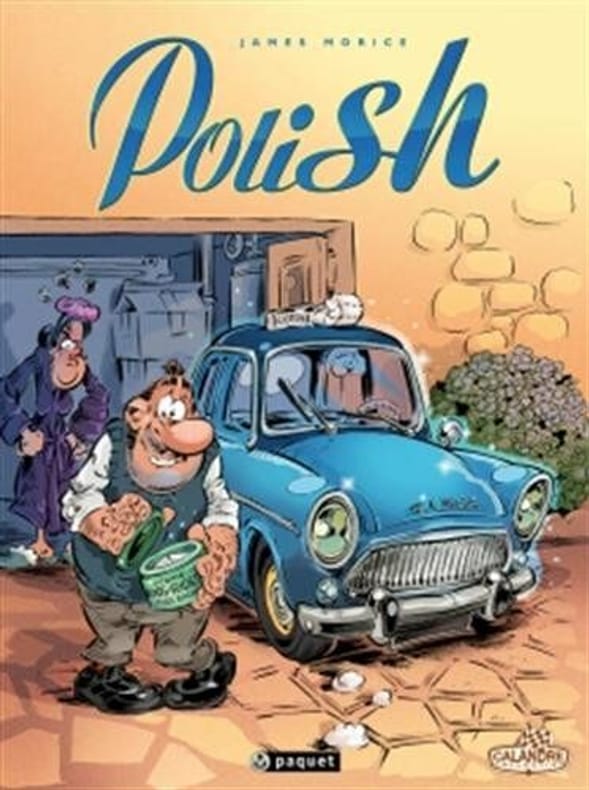
Paquet 2026 48 pages 24x32x1cm. 2026. Broché. 48 pages.
Reference : 100095881
ISBN : 9782888905042
French édition - Livre issu de déstockage JAMAIS LU présentant des marques de manipulation sur la couverture et/ou les pourtours mais demeurant en très bon état d'ensemble.Expédition sous blister dans une enveloppe matelassée depuis la France
Bookseller's contact details
Démons et Merveilles
M. Christophe Ravignot
contact@demons-et-merveilles.com
07 54 32 44 40
Payment mode

Sale conditions
Rapidité d'envoi Tous nos articles sont expédiés le jour même de la confirmation de la commande Soin de l'emballage Un soin particulier est apporté à l'emballage, vos objets voyagent en toute sécurité. A votre écoute Si toutefois un incident devait survenir lors de l'acheminement de votre paquet, n'hésitez pas à nous contacter, nous mettrons tout en oeuvre pour vous satisfaire, en vous proposant un retour, un remboursement ou toute autre soluton à votre convenance. Professionnalisme Les livres que nous vendons sont pour la plupart des livres anciens, nous tâchons d'être le plus objectif possible quant à leur état.
5 book(s) with the same title
Lucjan Paff (edited and translated by), Józef Piłsudski (signed by)
Reference : 517
(1945)
W Walce O Wolnosc / In Fight For Freedom / In Lotta Per La Libertà + three original Polish WW2 pictures, including a photograph of Marshal Jozef Pilsudski signed by himself
This is a set which belonged to Janusz Gluchowski, a high-ranking Polish military officer at the time of the WW2. The set contains three original B&W pictures. First one: undated postcard showing Marshal Jozef Pilsudski, signed by himself in black ink, 8.5 x 13.5 cm, with two embossed mentions above and below. Second picture: undated postcard showing Poland President Gabriel Narutowicz, with a written mention on the back. Third picture: 11 x 15.5 cm photograph. General Tadeusz Bór-Komorowski inspecting a British Cromwell tank, accompanied by Polish officers of the 3rd Armored Regiment (3 puk pancerny). The image was captured during an official ceremony in the city of Kelso, Scotland, in the immediate post-war period, on June 15, 1945. The scene shows the General in an observation position, climbing onto the tank while surrounded by Polish soldiers. The tank corresponds to a British model widely used by Polish forces in exile during the Western European campaign. On the reverse, the following handwritten inscriptions appear: VI 1945, Kelso. N. Wódz gen. Bór-Komorowski dokonuje inspekcji 3 p. panc. N. Wódz w towarzystwie bryg. puku na czogu." / June 15, 1945, Kelso The book is an illustrated three-languages (Polish, English and Italian) set commemorating the struggles of the Polish II Corps. Edited by Wyda Rererat [Referat] Kultury i Prasy Kresowej Dywizji Piechoty in Rome, 1945. Oblong book of 21 x 19 cm, unpaginated (144 pp.). Cover detached. Endpapers and first page show Janusz Gluchowski's stamp. In publisher's photographically illustrated wrappers. Each page contains a photographic image or a photomontage accompanied with a short text in three languages. Front cover shows some wear and tear, the binding is a bit loose - we would advise having this book bound. The Polish II Corps was a major tactical and operational unit recruited from Polish deportees in the Soviet Gulags in 1943. First they fought in the Middle East, and in 1944 February they were transferred to Italy and as independent part of the British Army to fight in the Italian campaign, in the battles of Monte Cassino and Ancona and also the Battle of Bologna during the final offensive in Italy in 1945. The book goes through the story of Poland and the later established Polish II Corps, starting with the German and Soviet occupation in 1939. It shows the deportation of Poles to forced labour to the Gulag and, after the Polish-Russian Military Agreement in 1941, the establishment of the Polish Army on Soviet soil, also their military training and their fights in various battles. Janusz Julian Gluchowski was a Major General in the Polish Army during the Second Polish Republic. He was born on August 6, 1888, in Bukowa. He fought in the Polish Legions in World War I, the Polish-Ukrainian War, the Polish-Soviet War, and the invasion of Poland by Nazi Germany, Slovakia, and the Soviet Union in 1939, which culminated in the start of World War II. In his adolescence, he attended high school in Czstochowa. In 1905, he became a member of the Combat Organization of the Polish Socialist Party and was wounded in the hand during an attack near Czstochowa. To avoid arrest by the Russian authorities, he left for Belgium, where he studied at the University of Liège. He returned to divided Poland around 1910 and settled in Austrian Galicia. In 1912 he graduated from the Officers' School of the Riflemen's Association in Stroza, near Krakow. In the early hours of August 1914, he commanded a platoon in Oleandria and was Wadysaw Belina-Pramowski's representative during the legendary attack of the so-called Seven Lancers of Belina (Uaska siódemka). On August 6th, together with the First Cadre Company, he left Krakow and marched to Miechów. In October 1914 he was promoted to Lieutenant (Poruchik) and, in November 1916, to Rittmeister (Cavalry Master). Until 1917 he served in the First Uhlan Regiment of the Polish Legions. After the Oath Crisis (Kryzys przysigowy) he was interned first in Fort Beniaminów and later in Werl. Released in October 1918, he went to Lublin, where, in early November, he formed the Third Ulan Regiment (later renamed the Seventh Ulan Regiment of Lublin). Along with his unit, he fought in the Polish-Soviet War. On May 29, 1920, he was promoted to Polkovnik. He was transferred in July 1920 to Eastern Galicia, taking command of the First Cavalry Brigade, fighting against the Soviets in Galicia and Volhynia. After the war, he remained in this position until 1925, when he was transferred to the Fourth Cavalry Brigade. Promoted to Brigadier General on March 16, 1927. Appointed commander of the Center for Higher Military Studies on June 4, 1930, and three years later, after the death of General Stanislaw Tessaro, he was appointed commander of Military District X in Przemyl. In October 1935, he became Deputy Minister of Military Affairs. In the early days of the 1939 invasion of Poland, Gluchowski ordered General Walerian Czuma to prepare the defense of Warsaw. In mid-September 1939, he fled to Romania. After his escape, he managed to travel to the Middle East and, in January 1941, received orders to go to London. In October 1941, he was appointed Commander of the Training Brigade stationed in Scotland. On September 23, 1943, he was appointed commander of all Polish Army units stationed in Great Britain, except the First Independent Parachute Brigade, which remained under the authority of the Commander-in-Chief. He was promoted to Major General on June 1, 1945. He decided not to return to Soviet-occupied Poland and remained in Great Britain. He frequently criticized the Soviet regime and the Soviet occupation authorities in postwar Poland. Furthermore, he was one of the founders and president of the Jozef Pilsudski Institute in London. He was, therefore, an active member of the Polish community in Great Britain. He was president and honorary member of several Polish veterans' organizations. He died on June 11, 1964, in London, England.
An incredible set. Hold some high Polish history between your hands!
Kapital. Krytyka ekonomii politycznej. Tom Pierwszy. Ksiega I. Wytwarzanie kapitalu. - [FIRST POLISH EDITION OF THE BIBLE OF MARXISM]
[Weimar, Gustaf Uszman] for E.L. Kasprowicz, Lipsk [Leipzig], 1884-[89]. Large 4to. Bound in a very nice recent red half calf with five raised bands and gilt title to spine. Title-page with repair to inner margin and with a few closed tears. Outer margin discreetly reinforced. Verso of title-page with ""1942 D. 1513"" in pencil. Last leaf also with a couple of closed/repaired tears, with minor loss of text, and reinforced in margin. Apart from the nicely restored flaws to the first and last leaf, this is an excellent, very nice and clean copy. VII, 325, (1) pp.
Very rare first edition of the first Polish translation of Marx' revolutionizing main work, ""The Capital"", which was clandestinely printed in Germany and then smuggled into Poland. The Polish translation, which is much rarer than the first Russian edition, and thus of the utmost scarcity, was illegally printed in Germany, with the mediation of the translator Kasprowicz (who worked for Brockhaus), by G. Uszman in Weimar (far enough from Prussia for the government not to be too concerned with the socialist activities of Polish students) and was then smuggled, mostly via Leipzig and Torún, into Russian Poland. It appeared in three parts, from 1884 to 1889. The translation, which was mainly done from the French, was the work of the hugely influential Polish socialist group, the Krusinsk-ites, which counted Stanislaw Krusinski, Ludwik Krzywicki (who corresponded directly with Marx himself), Mieczyslaw Brzezinski, Kazimierz Plawinski, and Jozef Siemaszko. Ludwik Krzywicki (1859-1941) was the editor-in-chief of this great collaborative work. He is credited with being the leading Marxist of the period and one of the greatest Marxist thinkers of Poland. In 1883 he was expelled from Warsaw University, after which he went to Germany, Switzerland and France, before returning to Poland in 1893, where he continued his political activities and took part in the 1905 revolution. While in Leipzig (from 1883), working on the translation of the Capital into Polish, he began corresponding with Marx, and after Marx died (March 1883), he continued corresponding with Engels, who provided direct suggestions of improvements and corrections.The publication of the first Polish translation of Marx' Capital not only came to influence Polish politics and economics, it also marked an important divide in Polish socialism and constitutes one of the earliest printings within organized Polish Marxism. ""In 1882 Ludwig Warýnsk (1856-89) organized in the former Congress Kingdom the first Polish workers' party under the name Social-Revolutionary Party ""Proletariat"". At the same time in the Russianized Imperial University of Warsaw a circle of young Polish socialists established itself. Its main theoretician was Stanislaw Krusinski (1857-86) after whom the group were called ""Krusinski-ites"". The most important among them was later to become one of the greatest scholars in the field of the social sciences. In 1884 the Krusinski-ites published in Leipzig the Polish translation of volume one of ""Capital"".In the ideology of the first Polish Marxists two different tendencies are to be distinguished"" a social-revolutionary and a social-democratic one. The first was prevalent in Warzynski's ""Proletariat"""" after the secession of a social-democratic group named ""Solidarity"" and led by Kazimierz Puchewicz it was unanimously accepted by this party. The second tendency was dominant in Krusinski's circle. The differences dividing them were profoundly theoretical and not merely tactical. Generally speaking, the social revolutionaries emphasized the important role of the ""subjective factor"" in history while the social democrats insisted on the necessity of a gradual ""ripening"" of the economic conditions of the socialist revolution. The social revolutionaries closely collaborated with the Russian populist party, The People's Will, and, under its influence, endorsed political terrorism"" the social democrats were resolutely opposed to this. Even more important was the controversy concerning the basic theoretical assumptions of Marxism and their applicability to an economically backward country. The social democrats were convinced that the objective conditions for a socialist revolution would not be ripe until the given country had passed through all phases of capitalist development..."" (Walicki, Stanislaw Brzozowski and the Polish Beginnings of ""Western Marxism"", pp. 41-42).

The History of Polish Literature Updated edition
University of California Press 1983 622 pages 15 4x4 2x22 2cm. 1983. Broché. 622 pages.
Bon état couverture défraîchie dos un peu creusé et ridé intérieur propre rousseurs sur la tranche
Provinces (1991) + The witness of poetry (1983) + Postwar polish poetry (1983) --- 3 livres
Ecco 80 pages in8. Sans date. Broché. 80 pages.
Bon état bonne tenue
O Powstawaniu Gatunków. [i. e. Polish: ""Origin of Species""]. [Translated by Szymon Dickstein]. - [FIRST FULL POLISH TRANSLATION OF DARWIN'S ""ORIGIN OF SPECIES""]
Warszawa, Przegladu Tygodniowego, 1884. Large8vo. In contemporary half calf. Spine with wear, lacking the upper 1 cm. Small stamp to title-page. Hindges weak and back board detached from bookblock. Verso of title-page and first leaf on content. 437, (1), XVI [Including the plate] pp.
First edition of the first full Polish translation of Darwin's ""Origin of Species"". An attempt to publish a Polish translation was made as early as 1873. This was, however, never completed and only half of the work was published (Freeman 739), thus making the present copy the very first full Polish translation. As seen in several other countries (especially in Japan) the majority of Polish intellectuals adopted a Social Darwinism perspective at a very early stage, rather than appreciating the English naturalist's caution in applying his ideas to human society.""Before the first translations of Darwin's appeared [...], many Polish intellectuals, such as positivist writer Eliza Orzeszkowa (1841-1910) complained about the increasing confusion over the essence of the English naturalist's ideas, which had all too often been mixed up with all sorts of ideological debates. However, when Darwin's books were actually available in Polish translations, the novelty of his concepts gradually wore off, making room for more serious attempts to come to terms with evolutionary theory."" (Glick, The Reception of Charles Darwin in Europe). ""It appears that the struggle for or against Darwinism in partitioned Poland prefigured a pattern that is relevant for Polish thinking up to the present day: the conflict of striving for progress with the help of powerful allies abroad and of virulently rejecting all foreign advice for fear of losing one's cultural identity."" (Ibid.).Translation was begun by Szymon Dickstein who in the processe of the translation committed suicide. It was completed by Józef Nusbaum who also translated 'The Variation of Animals and Plants under Domestication' in 1888.Freeman 740

