 Write to the booksellers
O.W.Milosz
Les éléments
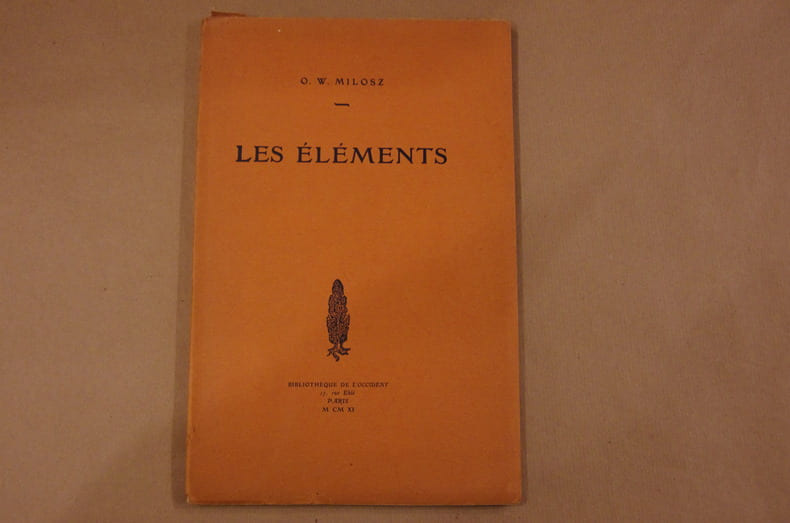
in-4 broché (voir photo)96 pages Edition Originale sur vélin (N°213/260) Excellent état
Reference : ILQ-244
Bookseller's contact details
Librairie l'odyssée
160 Avenue Parmentier
75010 Paris
France
01 42 40 10 68
Payment mode

Sale conditions
Règlement à la commande.Frais de port à la charge de l'acheteur. Envois en mode Colissimo ou lettre-max pour la France métropolitaine. IMPORTANT:Nous expédions en Colissimo avec A.R tout livre dont le prix de vente est au moins égal à 80 Euros. REGLEMENT : Exclusivement par virement bancaire ou chèque d'une banque sise en France métropolitaine. RESERVATION :7 jours à dater de la commande.Passé ce délai l'ouvrage commandé sera remis en vente. DROIT DE RETOUR :L'acheteur dispose d'un délai de 7 jours ouvrables à compter de la date de réception pour retourner un produit qu'il jugerait non conforme.Remboursement dès réception du retour.Passé le délai sus-indiqué les retours ne seront pas acceptés. Adresse de retour: Librairie l'Odyssée,160 Avenue Parmentier 75010 Paris
5 book(s) with the same title
"MOSELEY, H.G.J. - ESTABLISHING ORDER IN THE PERIODICAL TABLE OF ELEMENTS (PMM 407).
Reference : 41566
(1913)
The High-Frequency Spectra of the Elements. - [INTRODUCING ""ATOMIC NUMBERS""]
London, 1913. Without wrappers, but stitched. In ""Philosophical Magazine and Journal of Science"", Vol. 26, No. 156. December 1913. Pp. 937-1058 a. 6 plates.(= the whole issue No 156). Moseley's paper: pp. 854-860 a. 1 plate. Fine and clean.
First edition of this groundbreaking paper which Rutherford considered A WORK ON PAR WITH THE VERY DISCOVERY OF THE PERIODICAL TABLE, introducing the concept 'Atomic Number'.Moseley notes a regularity in the shifting of spectral lines when the elements (he examines 50 elements) are arranged according to atomic weight. He finds that bombardments of the various elements with cathode rays yeilds a systematic sequence of vibration frequencies, and from this he derives the concept of atomic number, which he recognizes as equal to the nuclear charge.""Moseley, working under Rutherford at Manchester, used the method of X-ray spectroscopy devised by the Braggs to calculate variations in the wave-lenght of the rays emitted by each element. These he was able to arrange in a series according to the nuclear charge of the element. Thus if the nuclear charge of hydrogen is 1, in helium it is 2, in lithium 3, and so on by regular progression to uranium as 92. These figures Moseley called atomic numbers.he pointed out that they also represented a corresponding increase in extra-nuclear electrons and that it is the number and arrangement of these electrons rather than the atomic weight that determines the properties of an element. It was now possible to base the periodical table on a firm foundation, and to state with confidence that the number of elements up to uranium is limited to 92. When Moseley'stable was completed, six atomic numbers had no corresponding elements"" but Moseley himself was able to predict the nature of four of the missing elements.""(Printing and the Mind of Man No. 407). Another paper on the same subject was published by Moseley the next year (1914).An important paper by Rutherford and Richardson is withbound: Analysis of the gamma rays of Thorium and Actinium Products. Pp.937-948 and 1 plate.

Architecture Gothique. [ Lot de 10 beaux lavis originaux ] Eléments de l'art gothique. Fenêtre à lancette. Triforium et clérestory de Notre-Dame d'Amiens - Fenêtres flamboyantes. Eglise Saint-Ouen de Rouen. Claire-voie continuant les fenêtres supérieures - Fenêtre rayonnante. Sainte-Chapelle de Paris - Eléments de l'art ogival. Théorie de l'arc-boutant - Rose rayonnante XIVe siècle - Art gothique. Eléments du style ogival tertiaire (XVIe siècle) - Art gothique. Tombeau de François II et de Marguerite de Foix par Michel Colombe. - Eléments du Style ogival : Contreforts et arcs-boutants. Coupe de la Cathédrale de Bourges - Piliers et Colonnes gothiques (Types) - Les Voûtes. Voûte ogivale cupoliforme, domicale ou Plantagenêt
10 lavis sur beau vélin à lavis Canson & Montgolfier au format, 49,5 X 29 cm, datés de 1906-1907, numérotés 96, 94, 88, 82, 95, 97, 100, 81, 89, 83 (partie d'une série de lavis originaux), signée J. Bonnet.Rappel de la liste des oeuvres : Eléments de l'art gothique. Fenêtre à lancette. Triforium et clérestory de Notre-Dame d'Amiens - Fenêtres flamboyantes. Eglise Saint-Ouen de Rouen. Claire-voie continuant les fenêtres supérieures - Fenêtre rayonnante. Sainte-Chapelle de Paris - Eléments de l'art ogival. Théorie de l'arc-boutant - Rose rayonnante XIVe siècle - Art gothique. Eléments du style ogival tertiaire (XVIe siècle) - Art gothique. Tombeau de François II et de Marguerite de Foix par Michel Colombe. - Eléments du Style ogival : Contreforts et arcs-boutants. Coupe de la Cathédrale de Bourges - Piliers et Colonnes gothiques (Types) - Les Voûtes. Voûte ogivale cupoliforme, domicale ou Plantagenêt
Beaux lavis d'architecture originaux, d'une belle exécution et très décoratifs. Voir nos nombreuses oeuvres du même artiste dans notre catalogue.
Les éléments chimiques et le monde vivant. (groupement des notions sur les éléments chimiques cités - composition élémentaire des organismes : éléments majeurs, éléments mineurs (oligo-éléments) - éléments biogènes : recherches sur les végétaux inférieurs - recherches sur les végétaux supérieurs, ...)
Flammarion In-8 couronne, broché, couverture souple rouge brique de la collection, ensemble renforcé judicieusement par son propriétaire et offrant un ensemble solide (tranche de titre muette), 266 pages.
Bon Etat Mise à jour du Samedi 27 Juin 2026. Paiement PayPal immédiat, Mondial Relay pour : France, Allemagne, Autriche, Belgique, Espagne, Italie, Portugal, Luxembourg, Pays-Bas, Pologne (Communiquer votre point ou locker si connu). Une participation supplémentaire peut être demandée pour les colis lourds hors France où les envois compris entre 5 et 25 kg sont dégressifs : 2 à 4 kilogrammes - 7.99 / 5 à 10 kg - 15.99 / 15 -25 kg - 25.99. Certaines de nos collections ( Vian, Céline, Camus (...) peuvent être expédiées en Franco de port. Pour linternational hors Europe (Suisse, Canada, Japon, Etats-Unis, les frais dexpéditions peuvent varier selon le poids (mise à jour : 1 juin 2026).
The High-Frequency Spectra of the Elements, I-II. - [ESTABLISHING ORDER IN THE PERIODICAL TABLE OF ELEMENTS - PMM 407]
London, 1913 & 1914. 8vo. 2 volumes, uniformly bound with the original wrappers in recent full blue cloth. In ""The London, Edinburgh and Dublin Philosophical Magazine"", Sixth Series, Vol. 26, no. 156, December 1913 & vol. 27, no. 160, April 1914. Lower part of index (pp. 1059-1064) in vol 26 with horisontal repair to lower part, affecting last three line (but legible). A fine and clean set. Moseley's papers: pp. 703-13" pp. 1024-1034. [Entire issues: pp. 937-1064" pp. 541-756].
First edition of these groundbreaking papers, in which the arrangement of the elements in the periodic table was based on the atomic number and which thus placed the atomic table on a firm scientific foundation. ""Moseley, working under Rutherford at Manchester, used the method of X-ray spectroscopy devised by the Braggs to calculate variations in the wave-lenght of the rays emitted by each element. These he was able to arrange in a series according to the nuclear charge of the element. Thus if the nuclear charge of hydrogen is 1, in helium it is 2, in lithium 3, and so on by regular progression to uranium as 92. These figures Moseley called atomic numbers.he pointed out that they also represented a corresponding increase in extra-nuclear electrons and that it is the number and arrangement of these electrons rather than the atomic weight that determines the properties of an element. It was now possible to base the periodical table on a firm foundation, and to state with confidence that the number of elements up to uranium is limited to 92. When Moseley'stable was completed, six atomic numbers had no corresponding elements"" but Moseley himself was able to predict the nature of four of the missing elements.""(PMM 407). “In a very short time, Moseley produced the first of his two famous papers in which he showed the spectra of K radiation of ten different substances … Moseley arranged the spectra, one below the other in a step-like fashion, in such a way that a given wavelength was in the same position for all spectra. It then became clear by simple inspection of this ‘step ladder’ that the spectrum of K radiation of each element contains two strong lines (which Moseley called Ka (for the longer wavelength) and Kß (for the shorter) and that this pair of lines moves to shorter and shorter wavelengths in a monotonic fashion if one moves step by step from calcium to zinc Moseley's work made it clear once and for all that indeed the position number in the Periodic Table is equal to the number Z of positive elementary charges in the nucleus of an atom. It also showed that Z is more important for the spectroscopic and chemical properties of an atom than the atomic mass number A. This is evident in the case of the elements cobalt (Z = 27, A = 58.9) and nickel (Z = 28, A = 58.7), where even the order in A differs from that in Z.” (Brandt, The Harvest of a Century: Discoveries in Modern Physics in 100 Episodes) PMM 407Evans 62Norman 1599
MENDELEJEFF, (MENDELÉEV, MENDELEYEV, MENDELÉEFF), DIMITRY IVANOVICH. - A CLASSIC IN CHEMISTRY.
Reference : 50071
(1871)
Die periodische Gesetzmässigkeit der chemischen Elemente" (Aus dem Russischen von Felix Wreden). (On the periodical law of the chemical elements).
Leipzig und Heidelberg, C.F. Winter'sche Verlagshandlung, (1871) 1872. Recent marbled marbled boards. Spine gilt and with titlelabel in leather with gilt lettering: ""Annalen der Pharmacie VIII Suppl. Band. In ""Annalen der Chemie und Pharmacie. Hrsg. und Redigiert von Friedrich Wöhler, Justus Liebig und Hermann Kopp"", VIII. Supplementband. Pp. (4),392 pp. (entire volume offered). 2 small stamps on title-page. Mendelejeff's paper pp. 133-229, 2 (periodic) tables on p. 149 a. 151. Internally fine and clean.
First printing of the first German translation of this milestone paper, ONE OF THE GREAT CLASSICS OF CHEMISTRY, in which Mendelejeff first coined the word ""periodic"", and in which he, for the first time, presented his great discovery of the periodicity of the elements in its full and complete form. At the same time the paper is the first to present his discoveries in a western language. In the paper he described and predicted the properties of a number of undiscovered elements - three of them were discovered in his lifetime. His periodic table was more complete than any of the preceding ones, and more thoroughly founded on experiment. The periodicity of the elements he himself formulated as ""Elements placed according to the value of their atomic weights present a clear periodicity of properties.""The offered paper is the German translation of his paper which was issued in ""Journal of the Russian Chemical Society"", vol. 3, pp. 25-56, the same journal in which he first announced his discovery (vol. 1, pp.66-77 (1869) ).""In March 1871, two years after his discovery of the law, Mendeleev first named it ""periodic"". That summer he published in Justus Liebigs Annalen der Chemie his article ""Die periodische Gesetzmässigkeit der chemischen Elemente."" - the paper offered - which he later characterized as ""the best summary of my views and ideas on the periodicity of the elements and the original after which so much was written later about this system. This was the main reason for my scientific fame, because much was confirmed - much later.""""(DSB IX, p. 289-90)""Lothar Meyer and Dimitri Mendeleev independently discovered the periodic system, but ""Meyer did not publish this work until after the appearance of Mendeleev's first paper on the subject in 1869. His table was very similar to that of Mendeleev, but it contained some improvements and was, perhaps, influential in causing some of the revisions made by Mendeleev in the second version of his table, published in 1870. In general, Meyer was more impressed by the periodicity of the physical properties of the elements, while Medeleev saw more clearly the chemical consequences of the periodic law.""(Source Book in Chemistry, p. 434).Horblitt, ""100 Books famous in Science"" (the Russian paper 1869) No 74. - Dibner, ""Heralds of Science"" No 48 (only the later book of 1891) - Partington IV: pp. 891-897. - Source Book in Chemistry pp. 442 ff. - PMM: 407 (under Moseley). - Neville ""Historical Chemical Library"" II: p. 162 (only the French edition from 1879).

