 Write to the booksellers
Albert Camus
L'été; Les essais LXVIII
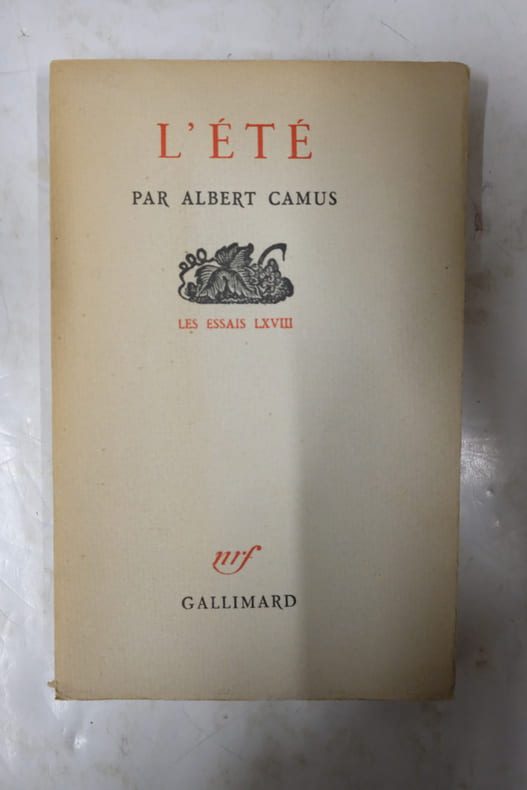
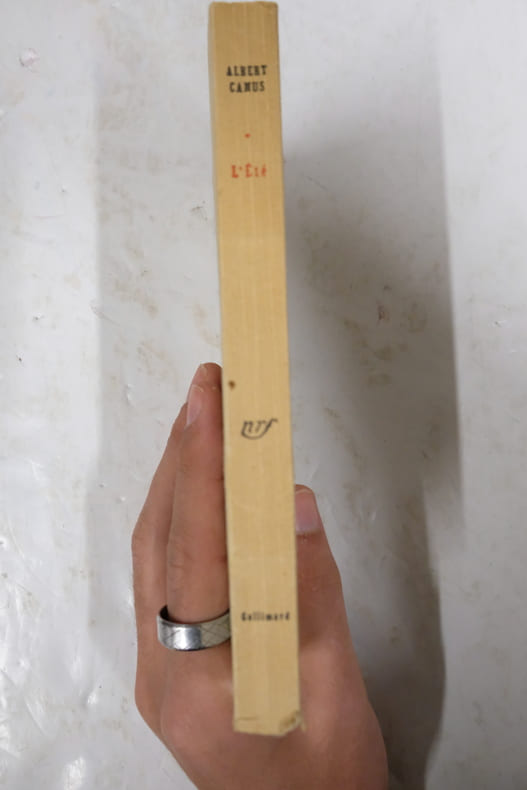
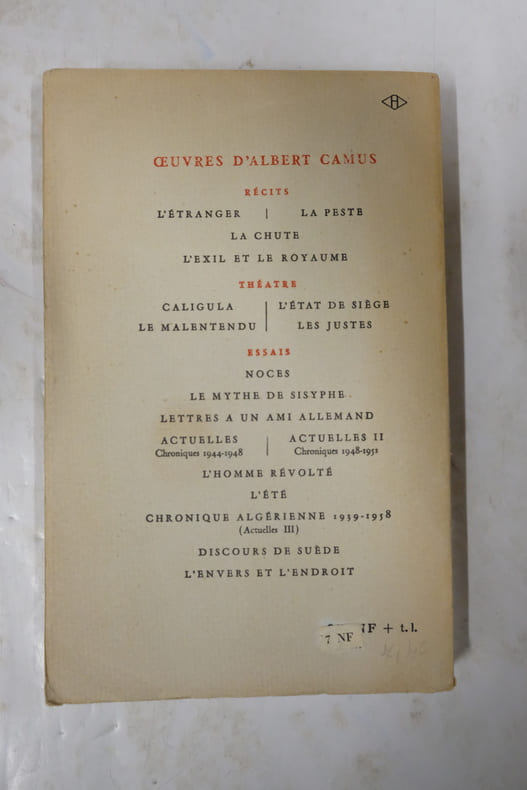
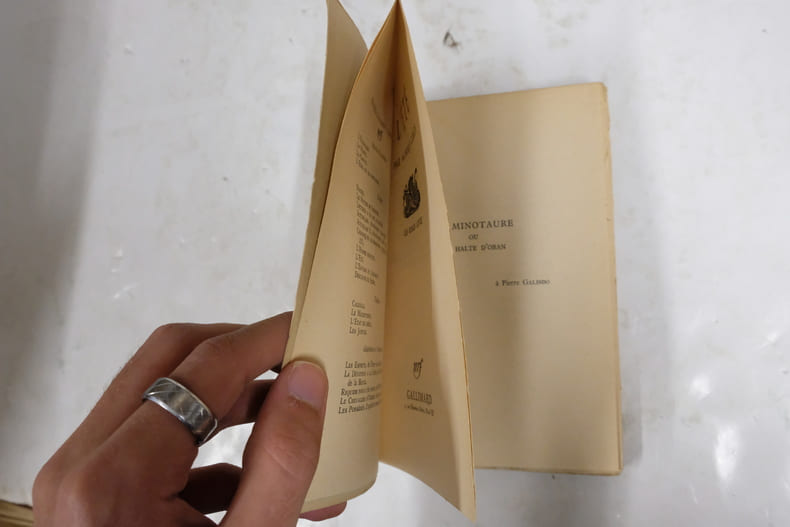
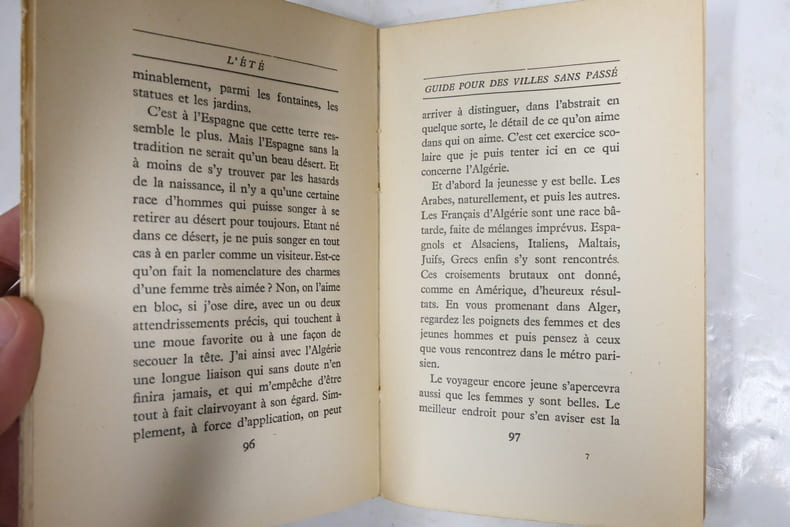
Broché, 188 pages, paru en 1954 chez Gallimard, non coupé, très bon état pour l'ancienneté du livre, intérieur frais, quelques légers frottements.
Reference : LIT9551M
Bookseller's contact details
Librairie du Levant
M. Yannick RENAUD
15 rue Marengo
64100 Bayonne
France
+33 5 59 03 69 40
Payment mode


Sale conditions
We accept payments in € by bank transfers, remote Credit Card, Paypal or checks. Checks made payable to and addressed to: Librairie du Levant 15 rue Marengo 64100 Bayonne France Bank transfers to: Banque Courtois, 1 pl du Réduit 64100 Bayonne / RIB / 10268 02696 62711600200 13 / IBAN / FR76 1026 8026 9662 7116 0020 013 / SWIFT BIC / COURFR2T PAYPAL via the address: librairiedulevant@orange.fr For any remote payment by Credit Card, informations communicated are automatically deleted as soon as payment is made and validated. Shipping upon receipt of payment. Member of the Syndicat des Libraires Anciens et Modernes (SLAM) and of the International League of Antiquarian Booksellers (ILAB), our sales are made according to the customs of the profession. All our books and objetcs are guaranteed to conform to the description which appears in each sheet; if, as a result of an error or an oversight, this was not the case, order will be taken back (within fifteen days) and reimbursed (including the costs of redirection), provided that it is returned in the same condition as the purchase. For obvious technical reasons (format, colors, cropping, viewing angle, etc.), the photographs presented on this site are not contractual. Our prices are in Euros, packaging included. Shipments, made under the responsibility of the buyers, are made by Colissimo Post, registered with insured value from € 50 and up to € 5,000 (delivery against signature, package tracking and insured value); for works less than 50 €, shipments are made by registered letter; works whose value exceeds € 5,000 must be sent by special carrier with insured value and delivery against signature. For any shipment outside mainland France, shipping and insurance costs remain the responsibility of the customer. Shipments are made under the same conditions set out above. Possibility to collect the orders on site. Do not hesitate to keep up to date with our news, finds, curiosities, catalogs and various thematic lists by leaving your contact details by email at librairiedulevant@orange.fr
5 book(s) with the same title
L'été - les essais lxviii in-8° br. 191 pp. [Paperback] Camus, Albert
BROCHE, ETAT CORRECT. COUVERTURE TACHEE, DOS JAUNI. NOM SUR LA PAGE DE GARDE. CONTENU PROPRE. NRF GALLIMARD, LES ESSAIS LXVIII, 1954. 188 PAGES. PHOTOS SUR DEMANDE
Merci de nous contacter à l'avance si vous souhaitez consulter une référence dans notre boutique à Authon-du-Perche.
L'Été. Les essais LXVIII. - [PRESENTATION-COPY]
Paris, Gallimard, 1954. Uncut in the original printed wrappers. A very nice copy housed in a beautiful brown half morocco box with gilt lettering to spine and gilt super ex-libris to front board.
First edition, Service de presse-copy, i.e. review-copy (""S.P"" to bottom of title-page and to verso of back wrapper), of Camus' magnificent and highly influential collection of essays entitled ""Summer"", inscribed to the famous critic of literature and drama, the writer Guy Dumur (1921-1991): ""à Guy Dumur/ l'une des/ [ÉTÉ]s [ÉTÉ being printed an L' crossed out in front, with s added in Camus' hand]/ son vieil et fidele ami/ Albert Camus"" on half-title.The younger Guy Dumur was a close friend of Camus, who hired him to work on ""Combat"" with him. It is reported that he had a great talent for discovering new talent. Since childhood, he was extremely passionate about the theatre and came to work with all the great dramatic figures in Paris at the time. He is also famous for a number of well respected novels. The essays in ""L'été"" are devoted to Algiers and represent a very personal side of Camus, who provides a marvelous poetic and humorous picture of the provincial simplicities of Oran and Algiers. For many Camus-devotees, ""L'Été"" constitutes one of the most beloved works, as it gives the feel of a certain intimacy with the author that few of his other works does. ""In ""Return to Tipasa"", perhaps the most confessional essay in ""Summer"", which dates from a long trip to Algeria in December 1952, Camus issues his now famous testimony of survival - ""In the depths of winter, I finally learned that within me lay an invincible summer"" (Hawes: Camus, A Romance, 2009, pp. 181-82).

L'Été. Les essais LXVIII. - [PRESENTATION-COPY WITH A MOST SPLENDID PROVENANCE]
Paris, Gallimard, 1954. Uncut in the original printed wrappers. Excellent copy.
First edition, Service de presse-copy, i.e. review-copy (""S.P"" to bottom of title-page and to verso of back wrapper), with an excellent presentation-inscription, of Camus' magnificent and highly influential collection of essays entitled ""Summer"". The copy is inscribed to Camus' close friend and ally in numerous respects, Jean Paulhan: ""a Jean Paulhan/ en affectueuse pensée/ Albert Camus"" on half-title. The famous French writer, literary critic and publisher Jean Paulhan (1884-1964) shared many things with Camus, with whom he grew very close. Not only did he participate actively in the publication of Camus' first books by Gallimard, was one of the first to see the true value of Camus' ""The Stranger"", he was also a confidante of Camus, who considered Paulhan one of the main reasons that he became a proper author. In a letter to Paulhan dated September 17, 1952, at the moment of break with Sartre, Camus writes: ""Ever since I (thanks to you) became what is called an author, I have not ceased to be astonished by my brethren. Sometimes, it is true, in the sense of admiration. Today it is in another sense."" (Depuis que je suis devenu (en peu grâce à vous) ce qu'on apelle écrivain, je n'ai pas cessé d'être étonné par mes confrères. Parfois dans le sens de l'admiration, il est vrai. Aujourd'hui c'est dans un autre sens.).Paulhan was an early and active member of the French Resistance, director of the literary magazine Nouvelle Revue Française (NRF) (from 1925 to 1940 and again from 1946 to 1968) and a great translator of Malagasy poetry, which attracted the interest of the likes of Guillaume Apollinaire and Paul Éluard. He also wrote numerous works of literary criticism, ""The Flowers of Tarbes, or Terror in Literature"" (1941) probably being the most famous, and he wrote several autobiographical short stories. After the war, Paulhan he founded ""Cahiers de la Pléiade"", and in 1953 he re-launched NRF.Interestingly, especially in connection with Camus' famous essays in ""L'été"", which are devoted entirely to his beloved Algiers, Paulhan was loudly against independence for Algeria. He caused great controversy by opposing independence and supporting the French military during the Algerian War. This not only caused public problems for him, it also cost him on the personal front, as for instance Maurice Blanchot denounced him. The essays in ""L'été"" are devoted to Algiers and represent a very personal side of Camus, who provides a marvelous poetic and humorous picture of the provincial simplicities of Oran and Algiers. For many Camus-devotees, ""L'Été"" constitutes one of the most beloved works, as it gives the feel of a certain intimacy with the author that few of his other works does. ""In ""Return to Tipasa"", perhaps the most confessional essay in ""Summer"", which dates from a long trip to Algeria in December 1952, Camus issues his now famous testimony of survival - ""In the depths of winter, I finally learned that within me lay an invincible summer"" (Hawes: Camus, A Romance, 2009, pp. 181-82).
l' été - Les Essais LXVIII
Gallimard broché Couverture Illustrée Paris 1965 184 pages en format 12 - 19 cm - jaquette à trois pans
Très Bon État
L'été. Collection Les Essais, LXVIII.
Paris, Librairie Gallimard 1954, 180x115mm, frontispice, 188pages, reliure d'éditeur. Un des 1050 exemplaires sur papier vélin Labeur des Papeteries Navarre de Voiron reliés d’après la maquette de Mario Prassinos, numéroté n.° 827 / 1190. Dos insolé, autrement intérieur propre. Bel exemplaire.
Pour un paiement via PayPal, veuillez nous en faire la demande et nous vous enverrons une facture PayPal

