 Write to the booksellers
QUINTILIANUS Fabius
Institutionum oratoriarum
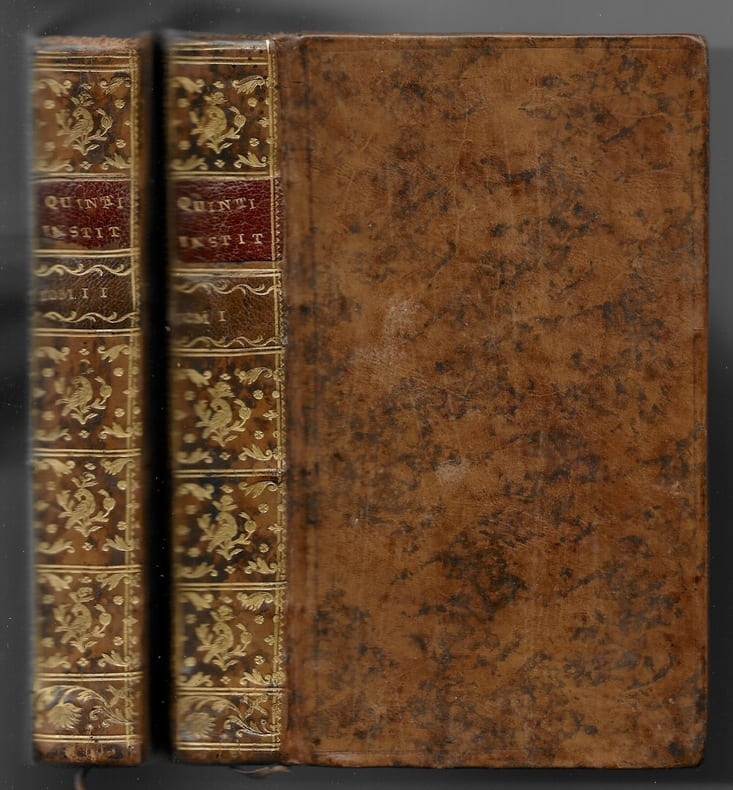
Notes de Charles Rollin.Texte en latin. Plein veau moucheté d'époque, dos longs très ornés avec un fer à l'oiseau. Très bon Paris Estienne 1754 2 volumes in-12°
Reference : 12504
Bookseller's contact details
Librairie Seigneur
Martine Seigneur
Payment mode

Sale conditions
Conforme aux usages de la profession.
5 book(s) with the same title
QUINTILIANI.ORATORIS ELOQUENTISSIMI DECLAMATIONES.INSTITUTIONUM ORATORIARUM.2 textes.
Lyon.1579 et 1580.In-12 en velin d'époque.108 et 734 pages.Index alphabétique.Bon exemplaire.Ecriture à l'encre au dos.Lettre de bibliothèque colléeDos usagé avec petits manques de peau.Ex-libris.


Institutionum oratoriarum libri duodecim. Summa diligentia ad fidem vetutissimorum codicum recogniti ac restituti. Accesserunt huic renovatae editioni declamationes, quae tam ex P. Pithoei, J. C. clarissimi, quam aliorum bibliothecis & editionibus colligi potuerunt. Cum Turnebi, Camerarii, Parei, Gronovii, & aliorum notis. Cum indice locupletissimo, tam in textum, quam notas [Avec :] Declamationes undeviginti. M. Fabii Avi et Calpurnii Flacci declamationes. Auctoris incerti Dialogus de causis corruptae eloquentiae. Cum variorum notis
Leyde et Rotterdam, Hack, 1665 2 forts vol. in-8, [16] ff. n. ch. (titre-frontispice gravé, titre, préface de Politien, dédicace, vie de Quintillien), 916 pp., [15] ff. n. ch. de table ; [2] ff. n. ch. (titre-frontispice gravé par Perlyn, titre), 784 pp.,[4] ff. n. ch. de table, veau fauve, dos lisses cloisonnés et fleuronnés, pièces de titre cerise, tranches rouges (rel. du XVIIIe siècle). Une coiffe rognée, coins légèrement émoussés.
Edition estimée, avec les variantes de Schrevelius et Gronovius.Brunet IV, 1025-1026. - - VENTE PAR CORRESPONDANCE UNIQUEMENT - LIEN DE PAIEMENT, NOUS CONSULTER.
M. Fabii Quintiliani Institutionum oratoriarum libri duodecim, summa diligentia ad fidem vetustissimorum codicum recogniti, ac restituti. Novae huic editioni adiecit Fabianarum notarum spicilegium subcisivum Daniel Pareus Phil. Fil. Accesserunt etiam Quintilianorum declamationes.
London (Londini), Typis E.G. Impensis R. Whitakeri, 1641.
8vo. 2 parts in 1: 569,(6 index),(1 blank); 722,(2 blank); (58 index),(2 blank) p. Modern half vellum 18 cm 'Practical, humane, fascinating, still of signifance'. (Ref: ESTC Citation No. R16191; Schweiger 2,839; Fabricius/Ernesti 2,273; cf. Graesse 5,527 for the edition Franktfurt 1629 with exact the same title) (Details: Back with 3 raised bands) (Condition: Endpapers renewed. Old ownership entries, and some small notes on the title. Paper yellowing. Right lower corner of 3/4 hardly visibly waterstained. Small hole in the blank margin of p. 13/14) (Note: The Roman orator Marcus Fabius Quintilianus, ca. 35 - ca. 100 A.D., was under emperor Vespasian probably the first holder of the chair of Latin rhetoric in Rome paid by the fiscus. (salarium e fisco accepit, Suetonius, Vesp. 17-19) His most celebrated work is the 'Institutio Oratoriae', in 12 books. It 'covers the complete training of the orator from the earliest preparation by the grammarian to his most mature aspirations for oratorical preeminence'. (The Classical Tradition, Cambr. Mass., 2010, p. 827) The ideal was a public speaker who was skilled not only in eloquence, but who was also a good man. This is summarized in the famous maxim that an orator is a 'vir bonus dicendi peritus'. Quintilian still makes all that has been written on education from Rousseau to the latest pseudo-psychologist rather worthless. (H.J. Rose, A handbook of Latin literature, London, 1967, p. 399) 'Book 1 discusses childhood education. (...) In book 2 the boy enters the school of rhetoric'. In book 3 follows an account of the art of rhetoric, 'its origin, its parts, and its functions. Book 4-6 deal with the detailed structure of a speech, (...) Book 7 is concerned with arrangement (dispositio) and status-lore. Book 8 discusses style (...) while in book 9 figures of thought and speech are illustrated'. Book 10 contains a critique of Greek and Latin writers. 'Book 11 discusses memory, delivery, gesture and dress (...) The concluding book shows the complete Orator in action, a man of highest character and ideals, (...). Roman gravitas at its noblest'. (OCD 2nd ed., p. 907) The 19 'Declamationes maiores' which have come down to us under the name of Quintilian are certainly not his work. The 'Declamationes minores', a corpus of 145 smaller rhetorical exercises are probably the work of a contemporary rhetorician. The 'Institutio Oratoria' of Quintilian was known throughout the Middle Ages, especially in the summarizing works of the encyclopedists like Cassiodorus and Isidorus of Sevilla. In 1416 the Italian humanist Poggio Bracciolini discovered in Sankt Gallen a complete text, after which Quintilian came 'to exert a deep and lasting influence on rhetorical theory and practice'. (The Classical Tradition, p. 829) The treatise influenced authors like Erasmus and Vives. The humanist Poliziano lectured on him, and Lorenzo Valla preferred him to Cicero. His ideas were absorbed by Piccolomini, Agricola, Erasmus (De pueris instituendis), and Melanchthon. He was also used by Ben Jonson (Discoveries), Alexander Pope (Essay on criticism), Du Bos, and Goethe. 'Seine Wirkung geht mit der Verfehmung der Rhetorik im 19. Jh. zurück, doch bleibt Quintilian eine respektierte Grösse bis heute'. (Neue Pauly, 10,719) Daniel Pareus, German philologist, historian and schoolmaster, son of the classical scholar Johann Philipp Pareus, was born in 1605. He must have been a young scholar of some promise, for the Dutch professor Gerard Vossius, who endeavoured to find publishers for his works, failed to gain him a professorship in the Netherlands. He then went to Kaiserslautern and founded there a Latin School, but not yet 30 years old, he was in 1635 murdered at the occupation of that city by soldiers, or stabbed by a gang of brigands. In his short career he produced an edition of Musaeus (1627), Herodian (1627), 'Mellificium Atticum', a collection of sentences of Greek authors reduced into commonplaces (1629), notes on Quintilian (first published in 1629), Heliodorus's Aethiopica, notes on Lucretius. He added his 'Animadversiones' to his father's edition of Sallust. His historical works are: 'Universalis historiae profanae medulla' (1631), 'Universalis historiae ecclesiasticae medulla' (1633), and his excellent 'Historia Palatina' on the history of the 'Pfalz' (1633). (ADB 25,167)) (Provenance: On the title in faint ink: 'Sum conventus Angiae', and 'Bibliothecae Augustianae Angiae', and 'Fr. Jodocus Anthonii Ord. Eremit. S. Augustini', who wrote also beneath the imprint 'Requisitus Lovanii 1643', and 'Fr. Leverd prior'. The city of Enchien, Flemish Edingen, in the province Hainaut (Belgium) once housed a convent of the 'Ord. FF. Eremitarum S.P.N. Augustini'. This Augustine convent, rue des Augustins no. 2, still is a monument. Frater Jodocus perhaps was the librarian of the convent, he records that it was acquired in Louvain in 1643. On front flyleaf the name of 'Lennart Hakanson', 1939-1987, professor of Latin at the university of Uppsala. He published in Lund in 1974 'Textkritische Studien zu den grösseren Pseudoquintilianischen Deklamationen') (Collation: A8 (+-A1), B-2N8 (leaf 2N8 verso blank). A-2Y8 (between 2O and 2P has been inserted a gathering of two leaves signed (pp); leaf 2Y8 blank); 3A-3C8, 3D6 (leaf 3D6 blank) There are two issues of this edition of 1641: ESTC R233485 and ESTC R16191. The first one starts with the 'Institutio Oratoriae', followed by the 'Declamationes', the other is the other way round, first the Declamationes and then the 'Institutio Oratoriae'. R16191 calls for a title page with a heart-shaped ornament, and with the printer's error 'accesserum' instead of 'accesserunt'. Our copy has the construction of R16191, but has the title page of R233485, which shows a flower-shaped ornament and has the corrected 'accesserunt'. This title page is a cancel, this means that the faulty title was removed and replaced by another corrected title) (Photographs on request)
Institutionum Oratoriarum libri duodecim (...) Declamationum liber eiusdem.
Lyon, [Genève, Jacob Stoer pour] Louis Cloquemin, 1580-1579. 2 parties en 1 fort vol. petit in-8°, veau fauve, dos à nerfs orné de petits fleurons dorés et de fiets à froid, encadrement d'un filet doré sur les plats, médaillon doré au centre. Reliure de l'époque, réparations (visibles) au dos. Ex-libris ms. sur le titre. 734 pp., (32) ff. d'index, (1) f. blanc ; 107 ff., (1) f. blanc. Signatures : *8 [a-z]8 [A-Z]8 [Aa-Dd]8 ; [A-N]8 O4. Galerie de vers en tête des ff. de la seconde partie, ayant grignoté quelques caractères.
Nouvelle édition des Institutions oratoires de Suintilien dans la version établie et commentée par Pierre Galland (1510-1559), professeur de grec et d'éloquence latineau Collège Royal de France, prédécesseur de Turnèbe à la chaire de grec. Il avait donné la première édition de ce savant commetaire à Paris en 1549. Baudrier IV, 55 et 58; UTSC, 156296 ; Goujet, Collège royal I, 438 et suiv.
Institutionum oratoriarum libri duodecim. Summa diligentia ad fidem vetustissimorum codicum recogniti ac restituti. Accesserunt huic renovatae editioni. Declamationes, quae tam ex P. Pithoei, J.C. Clarissimi, quam aliorum Bibliohtecis & editionibus colligi portuerunt. Cum Turneri, Camerarii, Parei, Gronovii & Aliorum Notis.
Leiden und Rotterdam, Hackiana 1665. 8°. 16 n.n. Bl., 916 S., 15 n.n. Bl. Index, mit einem gestochenen Vortitel. Pergamentband der Zeit.
Graesse 5, 529. - Im gleichen Jahr erschien noch ein zweiter Band bei Hack. - Exemplar mit handschriftlichem Schenkungsvermerk eines Viti Reverend. Wolfii, qui dono dedit an Johann Georg Jacobi, datiert 24. September 1784. - Mit Unterstreichungen und Annotationen von verschiedenen Händen.Mit verschiedenen anderen Besitzvermerken auf dem Vorsatz. Vordere äussere Rückenkante auf ca. 5 cm. angebrochen.

