 Write to the booksellers
-
Type
Book (5672)
Magazine (65)
-
Latest
Last 3 days (1)
Last month (58)
Last week (10)
-
Language
Dutch (1)
English (1)
French (5733)
Italian (1)
Latin (1)
-
Century
16th (11)
17th (3)
18th (48)
19th (379)
20th (1582)
21st (1219)
-
Countries
Belgium (652)
Canada (29)
Côte d'Ivoire (5)
Denmark (1)
France (4657)
Germany (1)
Greece (1)
Netherlands (1)
Switzerland (390)
-
Syndicate
ALAC (29)
CLAM (1)
CLAQ (2)
ILAB (1223)
SLAM (1182)
L'herbier fou : A la poursuite de la mouche mange-couleurs
RUSTICA 2020 32 pages 22 7x30 6x0 9cm. 2020. Relié. 32 pages.
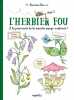
Très bon état
FOUFOUNE DU BALLET
BOOMERANG JEUNE 2019 13x19 4x2 4cm. 2019. Broché.
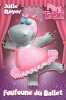
Très bon état - légères marques de lecture et/ou de stockage mais du reste en très bon état- expédié soigneusement depuis la France
Histoire de Anne de Bretagne, Reine de France. Nouvelle édition.
Tours, Mame, 1867, in 8°, cartonnage vert décoré de léditeur, 192 pages ; frontispice ; infimes frottis.
Bel exemplaire. PHOTOS SUR DEMANDE ...................... Photos sur demande ...................


Phone number : 04 77 32 63 69
Histoire singuliere de la chevalerie
Jean de Bonnot 1994 In8 reliure éditeur pleine peau dos et plats ornés tranche dorée 488 pages illustrations dans le texte
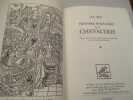
texte suivi d'une étude sur les structures de la france médiévaleétat neuf
La France au douzième siècle pendant les règnes de Louis Le Gros et de Louis le Jeune. Sixième édition.
Tours, Mame, 1876, in 12 relié pleine percaline verte décorée de l'éditeur, 287 pages ; frontispice et 5 gravures hors-texte ; rousseurs.
PHOTOS sur DEMANDE. ...................... Photos sur demande ...................
Phone number : 04 77 32 63 69
L'an mille.
Formation de la légende de l'an mille - Etat de la France de l'an 950 à l'an 1050. P.Hachette 1885. In-12 (18/11cm). 500 pages. Reliure d'époque : Demi lustrine rouge, coins.
"De la collection ""Bibliothèque des merveilles"". Orné de 36 gravures, la plupart hors texte. Bon état."
Law and Sovereignty in the Middle Ages and the Renaissance ,
Turnhout, Brepols, Hardback, XVIII 302 p., 13 b/w ill., 156 x 234 mm. ISBN 9782503533094.
This volume offers an interdisciplinary collection of original essays by both new and established scholars that surveys the complex relationships between law and sovereign power in medieval and early modern Europe. Sovereignty, law, and the relationship between them are now among the most compelling topics in history, philosophy, literature and art. Some argue that the state?s power over the individual has never been more complete, while for others, such factors as globalization and the internet are subverting traditional political forms. This book exposes the roots of these arguments in the Middle Ages and Renaissance. The thirteen contributions investigate theories, fictions, contestations, and applications of sovereignty and law from the Anglo-Saxon period to the seventeenth century, and from England across western Europe to Germany, France, Italy, and Spain. Particular topics include: Habsburg sovereignty, Romance traditions in Arthurian literature, the duomo in Milan, the political theories of Juan de Mariana and of Richard Hooker, Geoffrey Chaucer?s legal problems, the accession of James I, medieval Jewish women, Elizabethan diplomacy, Anglo-Saxon political subjectivity, and medieval French farce. Together these contributions constitute a valuable overview of the history of medieval and Renaissance law and sovereignty in several disciplines. They will appeal to not only to political historians, but also to all those interested in the histories of art, literature, religion, and culture. Robert Sturges is Professor of English at Arizona State University, where he teaches late medieval literature and literary theory. Arizona Studies in the Middle Ages and the Renaissance (ASMAR 28). New.
Eglise et société chrétienne d'Agobard à Valdès.
2003 Presses Universitaires de Lyon, 2003, broché, couverture illustrée, 15,5x24 cm, 550 pages. Illustrations en noir et blanc.
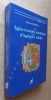
bon état.
End of the Kura-Araxes Phenomenon. The Chrono-Cultural Aspect of the EB/MB Transition in the South Caucasus
, Brepols, 2024 Paperback, xviii + 338 pages, Size:216 x 280 mm, Illustrations:182 b/w, 28 col., 19 tables b/w., 14 maps b/w, 7 maps color, Language: English. ISBN 9782503606736.
Summary This thematic volume focuses on the demise of the Kura-Araxes culture and the beginning of the Middle Bronze Age, a period between about 2600 and 2000 cal BC that saw the gradual disappearance of millennia-long traditions in the region. Specialists reassess the chrono-cultural attribution of several complexes in the region, together with the absolute chronology of the whole sequence. Through this approach, the volume offers a nuanced insight into the changes and continuities of a crucial period between the Early and Middle Bronze Age. The chapters gathered together here also explore the abandonment of long-established settlements, the production of lavishly endowed funerary complexes, testament to the emergence of growing inequalities in society, and the adoption of a far more mobile way of life as revealed by archaeology. TABLE OF CONTENTS List of Illustrations 1. For a Reassessment of the EB/MB Transition in the Kura-Araxes oikumene: The Chrono- Cultural Aspect RUBEN BADALYAN & B RENG RE PERELLO 2. Understanding the End of the Kura-Araxes Phenomenon: The Radiocarbon Perspective ANNA PAOLA PASSERINI 3. Archaeology at the Frontiers : Investigations at Rabati, Southern Caucasus and Evidence of Cultural Memory GIORGI BEDIANASHVILI, ANDREW JAMIESON & CLAUDIA SAGONA 4. The Post-Kura-Araxes Period in the Southern Caucasus : Reflections on Definitions and Terminology, and a View from Shida Kartli ELENA ROVA 5. The Final Stage of the Kura-Araxes Culture from Kvemo Kartli NINO SHANSHASHVILI & GODERDZI NARIMANISHVILI 6. The Eastern Shores of Lake Sevan during the Early Bronze Age : Preliminary Reflections MARIAM AMIRYAN, REN KUNZE, ARSHAVIR HOVHANNISYAN, HAYK MELIKADAMYAN, ROMAN HOVSEPYAN & ARSEN BOBOKHYAN 7. Late Kura-Araxes Sub-Complexes of Armenia : Synchronization Problems in the Light of New Data RUBEN BADALYAN, PAVEL AVETISYAN, B RENG RE PERELLO, ANNAPAOLA PASSERINI, ARMINE HARUTYUNYAN, ARSEN BOBOKHYAN & LEVON AGHIKYAN 8. The Chronology of the Archaeological Complexes of Armenia of the Last Quarter of the Third and the First Half of the Second Millennium bce in the Context of Transformation and Fragmentation of the Archaeocultural Environment PAVEL AVETISYAN & RUBEN BADALYAN 9. Shengavit from Kura-Araxes to Early Kurgan Periods HAKOB SIMONYAN & MITCHELL S. ROTHMAN 10. Preliminary Results of the Excavations at Qara inar (Azerbaijan) and New Data on the 'Kura- Araxes-Early Kurgans' Transition on the Eastern Piedmont of the Lesser Caucasus GIULIO PALUMBI, BAKHTIYAR JALILOV, MUZAFFAR HUSEYNOV, ALEXIA DECAIX, MODWENE POULMARC'H & ANDREA RICCI 11. Metamorphism of the End : A Close Look at the Final Phases of the Kura-Araxes Cultural Tradition SEPIDEH MAZIAR 12. The Later Phases of the Early Trans-Caucasian: A View from Yanik Tepe in North-West Iran GEOFFREY D. SUMMERS 13. Notes on the End of the Kura-Araxes ('Khirbet Kerak') Presence in the Southern Levant RAPHAEL GREENBERG Index
Between Near East and Eurasian Nomads. Representation of Local Elites in the Lori Berd Necropolis during the First Half of the First Millennium BC
, Brepols, 2024 Paperback, xxvi + 358 pages, Size:216 x 280 mm, Illustrations:333 b/w, 77 col., 3 tables b/w., 8 tables col., 6 maps color, Language: English. ISBN 9782503608037.
Summary The site of Lori Berd, located in northern Armenia, is home to an extraordinary necropolis that once housed the dead of the local elite during a period that spanned from 2200 to 400 BC. Influenced both by Urartian conquests from the south and by invasions from the Eurasian nomadic tribes from the north, the people of this region buried their dead with prestigious artefacts, complex customs, and a particular reverence shown during the later stages of the Early and Middle Iron Ages (1000-550 BC). This volume offers a detailed account of the archaeological significance of the site, providing detailed accounts of thirty-one tombs, the majority of which have never before been comprehensively published, and seeking to set Lori Berd in its broader historical and material context. Through this approach, the book offers a comprehensive exploration of the Iron Age in the South Caucasus, unravelling the interconnected themes of wealth, power, and cultural expressions. TABLE OF CONTENTS List of Illustrations Acknowledgements List of abbreviations Chapter 1. Introduction The Aims of this Work The Contemporary Research Framework The Actuality of the Question Methods Chapter 2. The Necropolis of Lori Berd Research History State of Research Description of Early and Middle Iron Age tombs Evaluation of the Tombs Chapter 3. Vessels Types of Pottery Metal Vessels Chapter 4. Weaponry and Tools Swords Daggers Scabbards Knives Spears Axes Maceheads Arrowheads Bidents Flesh Hook Arm Guards Ferrules Chisels Helmet Phaleras Quiver pin Reflections on Weapons Chapter 5. Jewellery and Art Objects Idols Bone Plaques Seals Beads Pendants Rings Clothing and its Fittings Silver Torc Temple Ornaments Band Diadems Assessment of Results of Geochemical Analysis of Gold and Silver Samples Chapter 6. Varia Tripod Fittings Sceptres Toiletry Items Chapter 7. Horse Sacrifices and Horse-Related Objects Historical Sources Zooarchaeological Investigations on Horses Horse Bits Belts Horse Torcs Horse Bridle Fasteners Horse Adornments Foot Bandages Visualization of Horse-Related Objects on Selected Horses Horse Warriors and the Notion of Gender Chapter 8. Assessment of Results of Wet Chemistry Analysis of Samples from Copper Objects Samples and Analysis Chemical Composition and Element Ratios Lead Isotope Analysis Chapter 9. Social Change and the Representation of Elites at Lori Berd Lori Berd Tombs Grouping Evidence of Social Inequality among the Tombs Chronology of Tombs Main Aspects of Representation in the Lori Berd Tombs Chapter 10. Lori Berd in its Regional Context The Nature of Foreign Influences in Lori Berd Lori Berd and Urartu South Caucasus as Imperial Periphery of the Urartian State Chapter 11. Main Results Appendix Works Cited Index
Tiphaine, l'amour de Bertrand Du Guesclin.
P., Plon, 1967, in 8°, cartonnage de l'éditeur, jaquette illustrée, 249 pages.
Bel exemplaire. PHOTOS sur DEMANDE. ...................... Photos sur demande ...................
Phone number : 04 77 32 63 69
Le grand Coeur
Gallimard 2012 512 pages in8. 2012. Broché. 512 pages. Le Grand Cœur est un roman historique de Jean-Christophe Rufin qui retrace sous forme de pseudo-mémoires la vie exceptionnelle de Jacques Cœur. Fils d'un modeste pelletier devenu l'homme le plus riche de France et argentier du roi Charles VII il contribua à la fin de la guerre de Cent Ans et ouvrit de nouvelles perspectives sur l'Orient. Le récit qui commence alors qu'il se cache sur une île grecque explore son destin hors du commun et ses rêves d'un monde nouveau
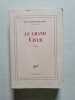
Bon état
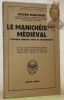
Le Manichéisme médiéval. L’hérésie dualiste dans le christianisme. Coll. Bibliothèque Scientifique.
Paris, Payot 1949, 225x140mm, 206pages, broché. Bel exemplaire.
Pour un paiement via PayPal, veuillez nous en faire la demande et nous vous enverrons une facture PayPal
- Ordonnance et reglement general de la police de la Ville de Lyon, & Faux-bourgs d'icelle; Fait Par Messieurs Les Juges, & commissaires deputez de ladite Police suivant l'Edit de sa Majesté.Dernière Edition à laquelle sont adjoutées diverses ordonnances & Tarif, comme aussi à la fin de la Table des Tiltres, Chapitres, & choses plus importantes, / TARIF PROVISIONNEL, SUR LE PRIX Des trois sortes de pain, que doivent débiter les boulangers de la Ville de Lyon, & Faux-Bourgs d'icelle; Suivant & Conformément à l' Acte Consulaire de Messieurs les Prevost des Marchands & Eschevins. Du 7. Septembre 1677.
A Lyon, De l'Imprimerie de Michel Goy, & aux despens de l'Aumosne Generale -1662 - / A Lyon, De l'Imprimerie de Jean Ayme' Ollier, & aux despens de l'Aumosne Generale - 1677 - Deux livres reliés en un volume petit In-4° ( 170 x 230mm ) 4f 156-4 p puis 22 1f, 8 pages , puis 4 feuillets ( paginé de 27 à 33) agréables lettrines et bandeaux, reliure plein veau, armoiries royales anciennement dorées au centre des plats estampés aux armes de Jean-Pierre Marie Ruolz Seigneur des trois fourneaux ( conseiller au siège présidial de Lyon en 1726 et mort en 1726 ) et encadrés de doubles filets dorés, dos à 4 nerfs richement orné de motifs répétés, tranches dorées, les deux coins supérieurs sont émoussés et la tranche de titre présente une gerce à la charnière sur cinq centimètres On notera également que lor des têtes et des motifs sont passés, moins sur le second plat Les coiffes sont intègres et lensemble offre une apparence solide et saine.Rousseurs sans gravité .
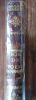
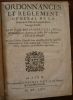
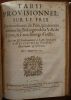
Ce volume titré « Règle de police» sur la tranche, réunit au demeurant une somme dinformations appréciables sur les métiers exercés dans la ville et alentours, concernant les fleuves, le commerce, lartisanat etc , englobant lhygiène, la vie, la sécurité la page 101 à 128 étant consacrée à la boulangerie Une autre partie concerne également le pain ( Tarifs , Variétés..) .Il est à noter quune série de feuillets ont été reliés à cet ouvrage avec un pagination disparate (27-33), peut-être en manière de complément sous le titre « Ordonnance De Messieurs Les Présidents, Juges & Commissaires Députés suivant lédit de sa majesté, pour le fait de la Police de la Ville & Faux-bourgs de Lyon.» Mise à jour du Samedi 27 Juin 2026. Paiement PayPal immédiat, Mondial Relay pour : France, Allemagne, Autriche, Belgique, Espagne, Italie, Portugal, Luxembourg, Pays-Bas, Pologne (Communiquer votre point ou locker si connu). Une participation supplémentaire peut être demandée pour les colis lourds hors France où les envois compris entre 5 et 25 kg sont dégressifs : 2 à 4 kilogrammes - 7.99 / 5 à 10 kg - 15.99 / 15 -25 kg - 25.99. Certaines de nos collections ( Vian, Céline, Camus (...) peuvent être expédiées en Franco de port. Pour linternational hors Europe (Suisse, Canada, Japon, Etats-Unis, les frais dexpéditions peuvent varier selon le poids (mise à jour : 1 juin 2026).
Dernières (Les) chances de l’homme. Traduit de l’anglais par Marcel Péju.
Paris, Pierre Horay Flore, 1952 ; in-8, broché, jaquette imprimée en rouge et noir ; 255 pp.
Edition originale en français. Exemplaire en bon état, non coupé malgré un tout petit manque manque de papier sur le premier plat de la jaquette.
Russell (Bertrand, 1872-1970 - Prix Nobel de Littérature 1950) :
Reference : 14989
(1960)
Pourquoi je ne suis pas chrétien. Traducteur Guy Le Clec'h.
Paris, Guilde Ernest Renan (Genève, Krundig), collection "Raison et Croyance" dirigée par le Professeur Louis Rougier, 1960 ; in-8, plein skinvertex vert, décor de grecque dorée au dos, titre doré (reliure éditeur) ; 380, (6) pp., imprimé sur vélin fin.
Un des grands textes "philosophiques" de Russell : la négation de l'existence de Dieu !
Oeuvres Complètes deux volumes
Paris Picard 1977 In-8 582 pp + 349 pp, publication de la Fondation Singer-Polignac par Edmond Faral et Julia Bastin
Bon Couverture souple
RUTEBEUF (avant 1230 - mort vers. 1285), Grand poète du Moyen Âge - Edmond FARAL et Julien BASTIN (Oeuvres Publiées par)
Reference : 48759
(1985)
Oeuvres Complètes de Rutebeuf, Publiées par Edmond FARAL et Julien BASTIN
1985 PARIS, Ed. A. & J. Picard & Cie - 1985 & 1977 -4 ème & 8ème tirages - 2 volumes In-8 - Brochés - 582 & 349 pages - très frais, comme neuf - Réf. 48579
Cnformément à nos conditions générales de vente :Les frais de port sont affichés à titre indicatif. Il se peut que nous devions vous contacter pour vous informer du coût de laffranchissement supplémentaire en fonction du poids et du nombre de livres, surtout pour les envois internationaux Cependant vu l'augmentation des tarifs postaux à l'internationale, nous pouvons expédier les ouvrages en point relais MONDIAL RELAY pour les pays suivants : Allemagne, Autriche, Belgique, Espagne, Italie, Luxembourg, Pays-Bas, Pologne, et Portugal. Merci de nous indiquer en retour le point relais choisi ainsi que votre numéro de téléphone mobile & adresse Courriel pour assurer le suivi du colis.N'hésitez pas à nous interroger.In accordance with our general terms and conditions of sale:Shipping costs are displayed for informational purposes only. We may need to contact you to inform you of the additional postage costs depending on the weight and number of books, especially for international shipments.However, given the increase in international postal rates, we can ship books via Mondial Relay to the following countries: Germany, Austria, Belgium, Spain, Italy, Luxembourg, Netherlands, Poland, and Portugal. Please provide us with your chosen Mondial Relay point, as well as your mobile phone number and email address to ensure package tracking.Please feel free to contact us with any questions
Rutebeuf. Collection les grands écrivains français.
P. , Hachette, 1891, in 12, relié demi basane cerise, dos lisse, 200 pages ; petits accidents à la reliure, cachets.
...................... Photos sur demande ...................
Phone number : 04 77 32 63 69
Poèmes concernant l'Université de Paris.
Paris, Librairie Nizet, 1952. 12 x 18, 137 pp., broché, non coupé, bon état (papier jauni, couverture légèrement défraîchie).
texte établi et commenté par H.H. Lucas.
Oeuvres complètes de Rutebeuf, publiées par Edmond FARAL et Julia BASTIN. Tome Premier [seul]. (Cinquième tirage)
1977 Paris, Picard (Fondation Singer-Polignac), 1977, fort volume grand in 8° broché, 582 pages ; 5 lignres surlignées
...................... Photos sur demande ...................
Phone number : 04 77 32 63 69
Ruteboeuf. Le miracle de Théophile.
1933 P., Centre de Documentation Universitaire, CDU (Cours de la Faculté des Lettres de Paris), 1933, 5 fascicules en 1 volume in 4° broché, 207 feuillets dactylographiés au recto.
...................... Photos sur demande ...................
Phone number : 04 77 32 63 69
Chaucer and the Discourse of German Philology A History of Reception and an Annotated Bibliography of Studies, 1798-1948,
Turnhout, Brepols, 2002 Hardback, XXII+446 p., 160 x 240 mm. ISBN 9782503510866.
This publication focuses on the genesis of modern Chaucer criticism, which was heavily formed by German philologists, and emphasizes the 'Chaucerphilology of 1870-1914. In the nineteenth and early twentieth century, German-speaking scholars played a decisive role in founding and shaping the study of medieval and early modern English language and culture. During this process, aesthetic and literary enthusiasms were gradually replaced, first by broadly comparative and then by increasingly narrow scientistic practices, all confusingly subsumed under the term 'philology'. Towards 1871, German and Austrian Anglicists were successful at imposing-- for about 30 years -- many of their philological discoursive practices on their English-speaking counterparts by focusing on strict textual criticism, chronology, historical linguistics, prosody, and literary history. After World War I, these philological practices were rejected in the U.K. and the United States because they were 'Made in Germany', but have remained essential features of German medieval scholarship until the present day. This book offers a case study of these foundational developments by investigating the reception of Geoffrey Chaucer by eminent scholars such as V.A. Huber, W. Hertzberg, B. ten Brink, J. Zupitza, E. Fluegel, and J. Koch. The narrative of their nationalist, scientist, and self-fashioning efforts is complemented by a comprehensive annotated bibliography of German Chaucer criticism between 1793 and 1948. Languages : English.
Medievalism in the Modern World Essays in Honour of Leslie Workman,
Turnhout, Brepols, 1998 Hardback, XIV+452 p., 165 x 245 mm. ISBN 9782503501666.
This interdisciplinary collection of essays from leading scholars in Europe, North America, and Australia examine the phenomenon of medievalism from the perspective of history, politics, scholarship, art, and literature. The twenty-six essays in this volume examine the process of creating the Middle Ages. In doing so, they honour Leslie Workman, who has led the revival of the study of medievalism in the past two generations, and leads this sub-discipline towards the comprehensiveness that Lord Acton as early as 1859 had promised: ?Two great principles divide the world, and contend for the mastery: antiquity and the Middle Ages. These are the two civilizations that have preceded us, the two elements of which ours is composed. All political as well as religious questions reduce themselves practically to this. This is the great dualism that runs through our society. While using differnt approaches and discussing topics in a variety of specialised fields, the contributions clearly centre on negotiating the reception of medieval culture in the Early Modern, Modern and Contemporary periods, thus presenting a broad and representative picture of current research in medievalism. Languages : English.

