 Write to the booksellers
-
Century
16th (2)
17th (9)
18th (55)
19th (101)
20th (637)
21st (147)
-
Countries
Belgium (260)
Brazil (2)
Denmark (230)
France (492)
Netherlands (145)
Switzerland (16)
-
Syndicate
ILAB (420)
NVVA (145)
SLAM (179)
The Impossibility of Informationally Efficient Markets.
Nashville, American Economic Association, 1980. Lex8vo. In the original printed wrappers. In ""The American Economic Review, June 1980"". Pp. (4), 269-554, (14)]. Entire issue offered. A very fine and clean copy. Grossman and Stiglitz's paper: Pp. 393-408.
First printing of Grossman and Stiglitz's influential paper in which they showed that informationally efficient prices lead to a paradox: ""if the market aggregated their information perfectly, individuals' demand would not be based on their own information, but then, would it be possible for markets to aggregate information perfectly"". Joseph Eugene Stiglitz an American economist and a professor at Columbia University, recipient of the Nobel Memorial Prize in Economic Sciences in 2001), former Senior Vice President and Chief Economist of the World Bank. He is known for his critical view of the management ofglobalization, free-market economists, whom he calls ""free market fundamentalists"", and some international institutions like theInternational Monetary Fund and the World Bank. Stiglitz is one of the most frequently cited economists in the world. Stiglitz has to a large extent been influenced Keynes and has himself influenced famous and influential economist such as Paul Krugman, Jason Furman and Stephany Griffith-Jones.
Le Droit de la Guerre et de la Paix. Divisé en trois livres, Où il explique le Droit de la Nature, le droit des Gens, & les principaux Points du Droit public, ou qui concerne le gouvernement public d'un Etat. Traduit dy Latin en Francois, par Monsieu... - [THE FOUNDATION OF INTERNATIONAL LAW]
Paris, Arnould Seneuze, 1687. 4to. Two contemporary uniform full calf bindings with five raised bands to richly gilt spines. All edges of boards gilt. Hinges and capitals worn, with some loss, but still tight. A damp stain to first and last leaves of both volumes (affecting about 17 leaves in all, mostly marginal). Otherwise a nice and clean copy with just the occassional brownspotting. Engraved frontispiece in vol. 1, engraved title-vignettes, large engraved vignette to verso of title-page of vol. 1, engraved portrait in vol. 1, woodcut vignettes and initials. Printed on good paper and with wide margins. (48), 621, (3) pp. + frontispiece and portrait" (4), 197, (3) pp.
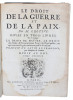
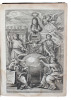

The very rare first edition of the first French translation of Grotius' groundbreaking magnum opus, ""De Jure Belli ac Pacis"", the founding work of international law. The profoundly influential masterpiece - written during the Thirty Years' War, in the hope that rational human beings might be able to agree to legal limits on war's destruction - ""made him famous throughout Europe... [t]he questions which he put forward have come to be the basis of the ultimate view of land and society. This was the first attempt to lay down a principle of right, and a basis for society and government, outside Church or Scripture... Grotius's principle of an immutable law, which God can no more alter than a mathematical axiom, was the first expression of the ""droit naturel"", the natural law which exercised the great political theorists of the eighteenth century, and is the foundation of modern international law."" (PMM 125). This magnum opus of legal philosophy played a tremendous role in French law and politics and in the entire development of international law in general. ""It is on the DIB (De Iure Bellis) that the bulk of Grotius' reputation rests. It consists of an introduction and three books, totaling more than 900 pages in translation. As with DIP, the introduction or ""Prolegomena"" holds the greatest interest for philosophers, for it is here that Grotius articulates and defends the philosophical foundations of the DIB. While philosophers are naturally attracted to the ""Prolegomena,"" the body of the DIB is also redolent with themes of philosophical interest. Book One defines the concept of war, argues for the legitimacy of war, and identifies who may legitimately wage war. Book Two deals with the causes of war, the origins of property, the transfer of rights and more, while Book Three is dedicated primarily to the rightful conduct of belligerents in war. After the initial publication in 1625, Grotius ushered several more editions to press during his life, each time adding more references without substantially changing the arguments."" (SEP).Living in the times of the Eighty Years' War between Spain and the Netherlands and the Thirty Years' War between Catholic and Protestant European nations (Catholic France being in the otherwise Protestant camp), Grotius was deeply concerned with matters of conflicts between nations and religions. His magnum opus was a monumental effort to restrain such conflicts on the basis of a broad moral consensus. It was begun in prison and published during his exile in Paris. ""In the dedication of his great work, ""De Jure Belli ac Pacis"", to Louis XIII of France, Grotius addresses the king as ""everywhere known by the name Just no less than that of Louis ... Just, when you call back to life laws that are on the verge of burial, and with all your strength set yourself against the trend of an age which is rushing headlong to destruction" ... when you offer no violence to souls that hold views different from your own in matter of religion" ... when by the exercise of your authority you lighten the burden of oppressed peoples.""When writing this dedication and the Prolegomena to ""De Jure Belli ac Pacis"" (originally published in Paris in 1625), Grotius was living in exile. Europe was war-torn and depression and suffering from hunger and cold prevailed in many regions, justifying Grotius' description of international law as such: ""in our day, as in former times, there is no lack of men who view this branch of law with contempt as having no reality outside of an empty name."" The treaty of peace, embodying many of the universal and permanent principles which Grotius abstracted ""from every particular fact"" in those dark days of the early part of the Thirty Years' War, was not concluded till 23 years later. The year 1624 was, in the negotiation of the treaty, assumed to be the norm year for restoration of the ""Status quo"".The more than three centuries since Grotius wrote his magnum opus seem to bear witness to his views upon war peace, in spite of the fact that many a state has not yet realized that the state is ""Truly fortunate which has justice for its own boundary line."" In 1625 Grotius famously stated: ""there is no state so powerful that it may not sometime need the help of others outside itself, either for the purposes of trade, or even ward off the forces of many foreign nations united against it.""Grotius's paramount influence upon international law is widely acknowledged worldwide. For instance, since 1999 the American Society of International Law holds an annual series of Grotius Lectures. Because of his theological underpinning of free trade, he is also considered an ""economic theologist"".""To those desirous of understanding the fundamental principles which have motivated some of the greatest statesmen of modern time and the bases upon which a state which is to remain essentially sound must rest, a reading of Grotius' Prolegomena to the ""Law of War and Peace"" is commended."" (George Grafton Wilson: ""Grotius: Law of War and Peace."", p. 1. In: The American Journal of International Law, vol. 35, nr. 2, 1941).
Le Droit de la Guerre et de la Paix. Divisé en trois livres, Où il explique le Droit de la Nature, le droit des Gens, & les principaux Points du Droit public, ou qui concerne le gouvernement public d'un Etat. Traduit du Latin en Francois, par Monsie... - [THE FOUNDATION OF INTERNATIONAL LAW]
Paris, Arnould Seneuze, 1687. 4to. Two contemporary uniform full calf bindings with five raised bands to richly gilt spines. Capitals and upper front hinge of volume one worn and boards with a few scrapes. Internally very nice and clean with just the occasional light brownspotting. Engraved frontispiece in vol. 1, engraved title-vignettes, large engraved vignette to verso of title-page of vol. 1, engraved portrait in vol. 1, woodcut vignettes and initials. Printed on good paper and with wide margins. (48), 621, (3) pp. + frontispiece and portrait" (4), 197, (3) pp.
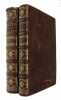
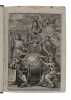
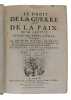
The very rare first edition of the first French translation of Grotius' groundbreaking magnum opus, ""De Jure Belli ac Pacis"", the founding work of international law. The profoundly influential masterpiece - written during the Thirty Years' War, in the hope that rational human beings might be able to agree to legal limits on war's destruction - ""made him famous throughout Europe... [t]he questions which he put forward have come to be the basis of the ultimate view of land and society. This was the first attempt to lay down a principle of right, and a basis for society and government, outside Church or Scripture... Grotius's principle of an immutable law, which God can no more alter than a mathematical axiom, was the first expression of the ""droit naturel"", the natural law which exercised the great political theorists of the eighteenth century, and is the foundation of modern international law."" (PMM 125). This magnum opus of legal philosophy played a tremendous role in French law and politics and in the entire development of international law in general. ""It is on the DIB (De Iure Bellis) that the bulk of Grotius' reputation rests. It consists of an introduction and three books, totaling more than 900 pages in translation. As with DIP, the introduction or ""Prolegomena"" holds the greatest interest for philosophers, for it is here that Grotius articulates and defends the philosophical foundations of the DIB. While philosophers are naturally attracted to the ""Prolegomena,"" the body of the DIB is also redolent with themes of philosophical interest. Book One defines the concept of war, argues for the legitimacy of war, and identifies who may legitimately wage war. Book Two deals with the causes of war, the origins of property, the transfer of rights and more, while Book Three is dedicated primarily to the rightful conduct of belligerents in war. After the initial publication in 1625, Grotius ushered several more editions to press during his life, each time adding more references without substantially changing the arguments."" (SEP).Living in the times of the Eighty Years' War between Spain and the Netherlands and the Thirty Years' War between Catholic and Protestant European nations (Catholic France being in the otherwise Protestant camp), Grotius was deeply concerned with matters of conflicts between nations and religions. His magnum opus was a monumental effort to restrain such conflicts on the basis of a broad moral consensus. It was begun in prison and published during his exile in Paris. ""In the dedication of his great work, ""De Jure Belli ac Pacis"", to Louis XIII of France, Grotius addresses the king as ""everywhere known by the name Just no less than that of Louis ... Just, when you call back to life laws that are on the verge of burial, and with all your strength set yourself against the trend of an age which is rushing headlong to destruction" ... when you offer no violence to souls that hold views different from your own in matter of religion" ... when by the exercise of your authority you lighten the burden of oppressed peoples.""When writing this dedication and the Prolegomena to ""De Jure Belli ac Pacis"" (originally published in Paris in 1625), Grotius was living in exile. Europe was war-torn and depression and suffering from hunger and cold prevailed in many regions, justifying Grotius' description of international law as such: ""in our day, as in former times, there is no lack of men who view this branch of law with contempt as having no reality outside of an empty name."" The treaty of peace, embodying many of the universal and permanent principles which Grotius abstracted ""from every particular fact"" in those dark days of the early part of the Thirty Years' War, was not concluded till 23 years later. The year 1624 was, in the negotiation of the treaty, assumed to be the norm year for restoration of the ""Status quo"".The more than three centuries since Grotius wrote his magnum opus seem to bear witness to his views upon war peace, in spite of the fact that many a state has not yet realized that the state is ""Truly fortunate which has justice for its own boundary line."" In 1625 Grotius famously stated: ""there is no state so powerful that it may not sometime need the help of others outside itself, either for the purposes of trade, or even ward off the forces of many foreign nations united against it.""Grotius's paramount influence upon international law is widely acknowledged worldwide. For instance, since 1999 the American Society of International Law holds an annual series of Grotius Lectures. Because of his theological underpinning of free trade, he is also considered an ""economic theologist"".""To those desirous of understanding the fundamental principles which have motivated some of the greatest statesmen of modern time and the bases upon which a state which is to remain essentially sound must rest, a reading of Grotius' Prolegomena to the ""Law of War and Peace"" is commended."" (George Grafton Wilson: ""Grotius: Law of War and Peace."", p. 1. In: The American Journal of International Law, vol. 35, nr. 2, 1941).
Sviluppo e sottosviluppo in Europa e fuori d'Europa dal secolo XIII alla rivoluzione industriale
Firenze, Le Monnier 1983 751pp., dans la série "Istituto Internazionale di Storia Economica 'F.Datini', Prato. Atti delle "Settimane di Studio' e altri Convegni" vol.10, bel état
De la possibilité d'améliorer les transactions immobilières et commerciales; par l'introduction dans les contrats de l'ordre et de la garantie et par l'économie des ressources. Précédé d'observations sur l'état actuel des affaires et sur l'insuffisance des moyens pratiques jusqu'à ce jour. Divers propositions organiques applicables à des cas particuliers.
Lyon, Lithographie Lepagnez, 1855. Lithographed manuscript of 86 pp. 4to. Modern boards. The author has written his name in full himself on the title of this copy, which has on verso of the title also an autograph dedication from the author to Victor Schoelcher. The text is entirely lithographed, apparently in a small number of copies and not put into the trade, as is stated in the first lines: 'Ce travail n'est point destiné à la publicité, il est adressé à quelques amis intimes .....' It contains a project for the organisation of general credit facilities.


(NVVA, )
Phone number : 31 20 698 13 75
Savoir et mémoire. N° 4. Mathématique sociale.
Couverture souple. Broché. 39 pages.
Livre. Centre National du Livre, 1993.
Economie internationale: Commerce et macroéconomie
Dunod 2009 15 4x2 2x24cm. 2009. Broché.
Comme neuf
Economie politique [2 tomes]
Paris, Dalloz 1960 548 + 540pp., 2e éd., dans la collection "Précis Dalloz", br.orig., bon état
Le développement du sous-développement : l'Amérique Latine
Editions François Maspero Textes à l'appui Broché 1968 In-8 (14 x 21.7 cm), broché, couverture illustrée à rabats, 302 pp. ; coiffes et bords frottés, dos et bords des plats insolés, des marques d'usage sur la couverture défraîchie, assez bon état. Livraison a domicile (La Poste) ou en Mondial Relay sur simple demande.
Pourquoi le franc belge est tombé
Bruxelles, Nouvelle Société d'éditions 1935 118pp., dans la série "Documents", br.orig., 20cm., cachet, bon état, B42188
RECETTES ET TRUCS plus de 1000 solutions à vos problèmes ménagers
1980 broché (paperback) in-octavo carré, dos et couverture verts imprimés (spine and cover printed) et première de couverture illustrée (front cover illustrated), tranches lisses (smooth edges), illustrations : petites figures (small pictures), 128 pages, 1980 à Paris Editeur CNCA,
Collection "Dossier Familial" Hors série - préface de Léon Zitrone - bon état (very good condition)
Guyot-Tabet Bernard Levresse Estelle
Reference : 500058913
(2009)
ISBN : 9782710120513
Toutes les cles de l auto entrepreneur ned
ESF PRISMA 2009 14x1x21 2cm. 2009. Broché.
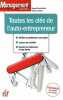
Comme neuf - livre issu de destockage - pouvant présenter d'infimes traces de stockage - Expédié soigneusement dans emballage adapté
Decision Probability and Utility: Selected Readings
Cambridge University Press 1988 462 pages in8. 1988. Broché. 462 pages.
dos un peu creusé légère terniessure en bas du dos intérieur propre
Prosperidad y depresion - Analisis teorico de los movimientos ciclicos (traduccion del orignal publicado por la Sociedad de Nationes)
Buenos Aires (Mexico), Fondo de Cultura Economica 1945 xv + 541pp., br.orig., texte en espagnol, bel état, [2e édition en espagnol]
Haberler Gottfried Koo Anthony Y. C
Reference : 100139965
(1986)
ISBN : 9780262111058
Selected Essays of Gottfried Haberler (The MIT Press)
MIT Press 1986 672 pages in8. 1986. Cartonné jaquette. 672 pages.
proche du très bon état intérieur propre bonne tenue
A Critical Essay on Modern Macroeconomic Theory (Studies in Contemporary German Social Thought)
MIT Press 1995 158 pages in8. 1995. broché. 158 pages.
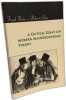
proche du très bon état intérieur propre
Theory of Financial Decisions
McGraw-Hill Inc. US 1979 507 pages 16 764x3 302x24 13cm. 1979. Broché. 507 pages.
Bon état dos insolé intérieur propre bonne tenue
Placat, indeholdende nogle nærmere Bestemmelser med Hensyn til Anordningerne om den islandske Handel og Skibsfart. - Opid Bréf innihaldandi nokkrar nákvæmari Ákvardanir, med tilliti til Tilskipananna um thá Íslendsku Kauphøndlun og Skipaferdir. Kjøben...
Kjøbenhavn, Jens Hostrup Schultz, (1836). 4to. 23 pp. Med kgl. laksegl til slut. Papiret over lakseglet løst.
Denne forordning er ikke tilsted hos Fiske.
Teoria monetaria y politica fiscal
Buenos Aires (Mexico), Fondo de Cultura Economica 1954 275pp., br.orig., texte en espagnol, bel état, [1ère édition en espagnol]
The Structure of Post-Keynesian Economics: The Core Contributions of the Pioneers
Cambridge University Press 2006 216 pages in8. 2006. Cartonné jaquette. 216 pages.

Comme neuf avec sa jaquette intérieur propre
What Must Gorbachev Do?: A Discussion Paper (CRCE Occasional Paper Band 2)
Centre for Research into Post Communist Economies 1989 27 pages in8. 1989. Agrafé. 27 pages.
Bon état
Economics of social security - The relation of the American Program to Consumption, Savings, Output, and Finance
New York/ London, McGraw-Hill Book Company 1941 xxvi + 455pp., 1st edition, cloth, VG
Umweltökonomie und Fachökologie als Gegenstände philosophischer Aufhebung zu einer Ökonomie der Natur - Eine philosophische Studie zum Ökologieproblem der Industriegesellschaft
Kassel, 1980 xviii + 459pp., VG, [Inaugural-dissertation, Gesamthochschule Kassel 1980]

