 Write to the booksellers
-
Type
Autograph (1)
Book (175)
Maps (1)
Music sheets (2)
-
Latest
Last 3 days (1)
Last month (21)
-
Century
18th (5)
19th (78)
20th (13)
21st (1)
-
Countries
Belgium (2)
Denmark (5)
France (163)
Switzerland (9)
-
Syndicate
CLAM (1)
CNE (1)
ILAB (93)
NVVA (1)
SLACES (1)
SLAM (85)
SNCAO (4)
"SAUSSURE, HORACE-BÉNÉDICT DE. - ONE OF THE GREATEST SCIENTIFIC WORKS OF THE EIGHTEENTH CENTURY (CUVIER)
Reference : 44413
(1783)
Essais sur L'Hygrometrie. I-IV. (I. Description d'un nouvel Hygrometre comparable. II. Théorie de l'hygrométrie. III. Théorie de l'évaporation. IV. Application des théories précédentes à quelques phénomenes de la météorologie.).
Neuchatel, Samuel Fauche, 1783. 4to. Bound in fine contemp. full sprinckled calf, raised bands and richly gilt spine. Wear to head of spine. Without the 2 free endpapers. Halftitle present and with stamps. XXIV,367 pp., 2 engraved plates (1 folded). The folded plate depicts his two types of Hair-Hygrometers a. 1 engraved vignette. A fine clean and wide-margined copy.
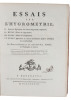
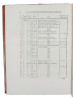
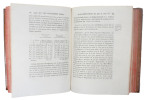
First edition of a fundamental work in Meteorology in which Saussure describes how to construct a hygrometer from human hair that can measure the relative humidity, and discussing the principles behind it. Cuvier regarded this book as one of the greatest contributions to science of the eighteenth century.""A milestone work in chemistry, physics, and meteorology, which established hygrometry as an exact science. Primarely a geologist who explored and published on the Alps, Saussure (1740-1788) was the first to prove that air expands and becomes less dense the more humidity it contains. In these Essais (the work offered) he describes his experiments with the hair hygrometer of his invention and his theory of the evaporation and hygrometry with their applications to meteorology. he also enunciates his theory of the evaporation of water in hydrogen, carbon dioxide, and other gases.""(Neville II, p. 427 a).""In his essay on the theoretical principles of hygrometry (which he conceives as ""the art of measuring the absolute quantity of water suspended in the air""), De Saussure distinguishes three classes of methods of determining humidity, which respectively utilize (i) observations of changes in the weight, dimensions, or shape, of a hygroscopic body" (ii) observations of the capacity of the air for taking up water" and (iii) observations of the quantity of water condensing from the air under given conditions on a cold surface, or of the degree of cold necessary to start such an condensation...""(Wolf ""A History of Science , Technology, & Philosophy in the 18th Century"" I, p. 326 ff.).Partington III, 763. - Partington ""Breakthroughs"" 1783 M - Poggendorff II, 755-56.

VORLESUNGEN UBER VERGLEICHENDE ANATOMIE.
Leipzig, Bey Paul Gotthelfkummer, 1809-1810 ; in-8, 512-696-745-734-141 pp., cartonné. Les 5 volumes. Cartonnage d'éditeur bon état - rousseurs - Gesammelt und unter seinen augen herausgegeben von C. Duméril - Uebersetzt und mit anmerkungen und zutatzen vermert von L.H. Froriep und I.S. Meckel - edition sans gravures (les gravures sur cuivre sont annoncées mais ne sont pas intégrés dans les volumes) joint index de 1824 même éditeur , par F.O. Lietzau.
Cartonnage d'éditeur bon état - rousseurs - Gesammelt und unter seinen augen herausgegeben von C. Duméril - Uebersetzt und mit anmerkungen und zutatzen vermert von L.H. Froriep und I.S. Meckel - edition sans gravures (les gravures sur cuivre sont annoncées mais ne sont pas intégrés dans les volumes) joint index de 1824 même éditeur , par F.O. Lietzau.
Le TRESOR LITTERAIRE de la FRANCE : Les PROSATEURS
Un ouvrage de 961 pages, format 180 x 260 mm, illustré de 40 gravures sur bois tirées à part par E. Bayard, relié cartonnage, publié en 1866, Librairie L. Hachette et Cie, bon état
Recueil en prose et en vers de morceaux empruntés aux écrivains les plus renommés et aux personnages les plus remarquables de notre pays depuis le XIIIe siècle jusqu'à nos jours (fin du XIXe siècle)
Phone number : 04 74 33 45 19
Charles Touzot (1885-1941)
Villefranche-sur-Saône, Editions du cuvier, 1948, 20 x 28,5, 190 pages cousues sous couverture souple imprimée. Portrait photographique en frontispice. Préface d'Edouard Herriot. Inauguration du médaillon de Charles Touzot le 27 avril 1946 au palais de la foire ; témoignages ; quelques articles de Charles Touzot. Un des 400 exemplaires sur pur fil de Lana (n° 72).
![Charles Touzot (1885-1941). [TOUZOT Charles] COLLECTIF](https://static.livre-rare-book.com/pictures/LCS/lyon794613012230224_1_thumb.jpg)
![Charles Touzot (1885-1941). [TOUZOT Charles] COLLECTIF](https://static.livre-rare-book.com/pictures/LCS/lyon794613012230224_2_thumb.jpg)
![Charles Touzot (1885-1941). [TOUZOT Charles] COLLECTIF](https://static.livre-rare-book.com/pictures/LCS/lyon794613012230224_3_thumb.jpg)
Très bon état.

