 Write to the booksellers
-
Type
Book (5287)
Magazine (45)
Maps (17)
Old papers (1)
-
Latest
Last 24h (2)
Last month (37)
Last week (4)
-
Language
Dutch (1)
English (19)
French (5321)
German (1)
Hungarian (1)
Italian (3)
Portuguese (2)
Spanish (2)
-
Century
16th (1)
17th (5)
18th (47)
19th (668)
20th (2289)
21st (76)
-
Countries
Belgium (282)
Canada (1)
China (14)
Côte d'Ivoire (15)
Denmark (240)
France (3647)
Greece (1)
Switzerland (1150)
-
Syndicate
ALAC (1)
CLAM (3)
ILAB (2888)
NVVA (727)
SLACES (727)
SLAM (1820)
SNCAO (2)
La Géologie au Congrès scientifique de Blois en 1884. L'homme tertiaire de Thenay
Auxerre, Imprimerie de Georges Rouillé, 1885 in-8, 23 pp., broché.
Extrait du Bulletin de la Société des sciences historiques et naturelles de l'Yonne, 1er semestre 1885.L'"homme tertiaire" de Thenay forme l'une des "trouvailles" de l'abbé Louis Bourgeois (1819-1878), qui n'eut de cesse de le faire admettre.Juge au tribunal civil de Coulommiers (1853) puis au tribunal civil d’Auxerre (1867), Gustave-Honoré Cotteau (1818-1894) s'intéressa en amateur à la géologie et à la paléontologie. - - VENTE PAR CORRESPONDANCE UNIQUEMENT - LIEN DE PAIEMENT, NOUS CONSULTER.
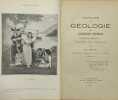
Notions de géologie et d'archéologie préromaine. spécialement appliquées au Canton de Pertuis
Aix-en-Provence, Jourdan, 1912 in-8, 179 pp., 16 planches dont 1 fronstispice, ill. in-t., broché. Frontispice, page de titre et préface en double. Rousseurs éparses.
- - VENTE PAR CORRESPONDANCE UNIQUEMENT - LIEN DE PAIEMENT, NOUS CONSULTER.
Leçons élémentaires d'histoire naturelle.
A Paris, chez J. Barbou, 1787. Un vol. au format in-12 (173 x 103 mm) de 1 f. bl., viii - 471 pp. et 1 f. bl. Reliure de l'époque de pleine basane marbrée brune, plats jansénistes, dos à nerfs orné de filets gras à froid, caissons d'encadrement dorés, filets verticaux dentelés dorés, fleurons dorés, semis de pointillés dorés, palette dorée en queue, jeu de petits filets obliques dorés sur les coupes, toutes tranches mouchetées.
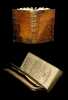
Edition originale. ''Ces Leçons sont accompagnées d'un Manuel d'histoire naturelle qui contient les tableaux systématiques des différents objets décrits dans les leçons et auxquels je renvoie pour ne faire connaître l'ordre et l'enchaînement ; j'y ai joint quelques Tables qui faciliteront l'étude des insectes liée nécessairement avec celle des plantes : on y trouvera aussi un catalogue où les plantes sont rangées selon la méthode de M. Tournefort''. Quérard II, La France littéraire, p. 303. Table (non exhaustive) : Minéraux - Théorie de la Terre - Examen des Systèmes - Burnet - Whiston - Wodward - Leibnitz - Scheuchzer - Pluche - Régularité de la surface sèche de la Terre - Engel - Examen des systèmes cosmologiques - Formation des continents - Le Cat - Formation des montagnes - Telliamed - Maillet - Feux souterrains - Lazzaro Moro - Buffon - Des eaux - Terres - Sables - Pierres - Coquillages - Coraux - Botanique - Insectes - etc. Angles émoussés. Légers frottements affectant dos et plats. Pièce de titre absente. Marque d'eau sur les plats. Laquelle se retrouve sur les premiers et derniers feuillets (sans toutefois entraver la lecture). Du reste, bonne condition.
La construction physique de la terre.
P., Albin Michel, 1952, petit in 8° broché, 284 pages ; figures ; carte dépliante.
PHOTOS sur DEMANDE. ...................... Photos sur demande ...................


Phone number : 04 77 32 63 69
L'EAU ET LES GRES.
PIROT. 1986. In-8. Broché. Bon état, Couv. convenable, Dos satisfaisant, Intérieur frais. 313 pages - ouvrage recouvert d'un plastique transparent - nombreuses photos en noir et blanc dans et hors texte.. . . . Classification Dewey : 551-Géologie
Photos de Jean François Donny. Classification Dewey : 551-Géologie
PRECIS DE GEOLOGIE
1917 reliure pleine toile verte petit in-octavo , dos long, titre en vert sombre au dos et sur le premier plat, nombreuses illustrations dans le texte, 67 pages, 1917 Paris Librairie Vuibert Editeur,
deuxième édition, parfait état.
COUREL (L.), FEUILLEE (P.), SEDDOH (F.) TRESCARTES (J.), RAT (P.)
Reference : 99687-C3338
Les salbes albiens dans le Sud-Est du BAssin parisien analyse sédimentologique essai paléogéographique
Extrait de la "Revue de géographie physique et de géologie dynamique" Vol.XVI, fasc.2 - Mars-Avril 1972, agrafé, pages paginées de 171 à 188, 21 x 27 x 0.15 cm, très bon état.
Explorations géologiques dans l'Amérique du Sud, suivi de tableaux météorologiques.
Mission scientifique G. de Créqui Montfort et E. Sénéchal de la Grange. Paris, Imprimerie nationale, Librairie H. le Soudier, 1907, broché, 19x28 cm, 208 pages , figures, graphiques, VIII planches, une carte couleur dépliante.
Rousseurs sur tranches.
Cours de géologie et de minéralogie
Eyrolles Paris Librairie de l'Enseignement Technique, Eyrolles éditeur, 1926. Grand In-8 broché de 349 pages. 21 planches hors texte de fossiles. Index alphabétique. Très bon état.
Toutes les expéditions sont faites en suivi au-dessus de 25 euros. Expédition quotidienne pour les envois simples, suivis, recommandés ou Colissimo.
La Planète Océan. La dérive des continents
LAFFONT Robert. 1983. In-4. Relié demi-cuir. Très bon état, Couv. fraîche, Dos impeccable, Intérieur frais. 129 pages. Nombreuses photos, illustrations et cartes en couleurs dans le texte et en planches hors-texte. Illustrations couleurs en planches dépliantes. Dos en cuir noir.. . . . Classification Dewey : 551-Géologie
"Collection ""Sciences"". Classification Dewey : 551-Géologie"
Sur l'antériorité du granite porphyroïde de la Margeride par rapport au granite à cordiérite du Vely (Massif Central français) - Extrait C.R.Acad.Sc.Paris t.269 15 décembre 1969 Série D.
C.R. Acad.Sc.Paris. 1969. In-4. Broché. Bon état, Couv. convenable, Dos satisfaisant, Intérieur frais. Tiré à part de 3 pages + 1 planche en noir et blanc - pages agrafées - tampons sur le 1er plat.. . . . Classification Dewey : 551-Géologie
Classification Dewey : 551-Géologie
Symposium on the Precambrium-Cambrium Boundary.
1978 72 p., numerous figures, paperbound. Published in: Geological Magazine (Special Issue). Good copy from the ex library of Dr. A. Brouwer (with his signature).With nine contributions discussing these boundaries in Morocco, California, Siberia, Scandinavia, Greenland & Australia.
James Hutton - Present and Future.
1999 viii, 184 p., numerous figures (several coloured), hardbound. Geological Society Special Publication. Ex library Steve Donovan (with his name on first free endpaper). Very good copy.
Géologie de la région de Fribourg. Thèse Univ. Fribourg.
Fribourg, St.-Paul, 1959, in-8°, 120 p. avec 28 figures + 4 planches dépl. (e.a. Carte géologique de la région fribourgeoise), brochure originale.
(SLACES, NVVA)
Phone number : 41 (0)26 3223808
Elemente der Geologie.
1883 (5th ed.) xx, 790 p., 497 woodcut figs, cloth (rubbed). Ex library of J.M. van der Vlerk.
Elemente der Geologie. Neunte, neub. Aufl. Mit 624 Abb. im Text.
Leipzig, 1902. Lex8vo. Cont.hcalf. XVIII,802 pp.
Geologische Untersuchungen an der Alpen-Apenningrenze in Ligurien (Italien).
Zürich, 1955, in-8vo, 140 S. 21 Fig. + 4 gef. Tafeln, Widmung an Johannes Neher auf Umschlag, Original-Broschüre.
(SLACES, NVVA)
Phone number : 41 (0)26 3223808
Mémoire sur l'établissement des travaux dans les terrains vaseux de Bretagne
Dunod Broché 1864 "In-8 (23 x 14 cm), broché, 128 pages plus nombreux schémas et graphiques dépliants en noir et blanc ; ex libris, tampon et mention manuscrite ""L. Arbey"" en divers endroits dont les plats, assez bon état général. Livraison a domicile (La Poste) ou en Mondial Relay sur simple demande."
ETUDES GEOLOGIQUES SUR LE DEPARTEMENT DE L'ARIEGE ET EN PARTICULIER SUR LE TERRAIN CRETACE - PROPOSITIONS DONNEES PAR LA FACULTE - THESES PRESENTEES A LA FACULTE DES SCIENCES DE PARIS POUR OBTENIR LE GRADE DE DOCTEUR ES SCIENCES NATURELLES .
G.MASSON. 1884. In-8. Broché. Etat d'usage, 2ème plat abîmé, Dos abîmé, Rousseurs. 304 pages - petite déchirure sur le 1er plat - coins frottés - tampon sur le 1er plat - coiffes et dos abîmés - rousseurs sans réelle conséquence sur la lecture - 5 planches dépliantes en noir et blanc en fin d'ouvrage - quelques figures en noir et blanc dans le texte.. . . . Classification Dewey : 551-Géologie
Théses soutenues le 3 juillet 1884 - Sommaire : roches cristallines - formations éruptives - roches granitoïdes - gneiss - micaschiste - calcaires cipolins - terrain jurassique - terrain crétacé - fer limonite - néocomien - infra lias - turonien - danien etc... Classification Dewey : 551-Géologie
NOTE SUR LE DEPLACEMENT LATERAL DES COURS D'EAU VERS L'EST AU MIOCENE DANS LE BASSIN D'AQUITAINE
Laboratoire de Géologie de L'ICT. 1951. In-8. Broché. Etat d'usage, 1er plat abîmé, Dos satisfaisant, Intérieur acceptable. Plaquette paginée de 94 à 99, illustrée de quelque schémas en noir et blanc. Etiquette de code sur le 1er plat. Tampons et annotation de bibliothèque sur le 1er plat et en 1re page.. . . . Classification Dewey : 551-Géologie
Labo. de Géologie de l'Institut Catholique de Toulouse. Classification Dewey : 551-Géologie
OBSERVATIONS SUR LES TERRAINS QUATERNAIRES DE LA FEUILLE D'AUCH AU 80.000e
Librairie Polytechnique Ch. Béranger. 1953. In-8. Broché. Bon état, Couv. convenable, Dos satisfaisant, Intérieur acceptable. Plaquette paginée de 208 à 218, illustrée de quelques dessins en noir et blanc. Etiquette de code sur le 1er plat. Tampons et annotation de bibliothèque en 1re page.. . . . Classification Dewey : 551-Géologie
Extrait du 'Bulletin de la Carte Géologique de France', n° 237, tome L (1952). Classification Dewey : 551-Géologie
Concepts in Climatology.
1971 xx, 589 p., 160 figs, paperbound. Previous owner's name on first page.
La faune de Mammifères de l'Abri Moula (Soyons Ardèche) - Extrait Bull.Soc.Et.Sci.nat.Vaucluse 1986.
Bull.Soc.Et.Sci.nat.Vaucluse. 1986. In-8. Broché. Etat d'usage, Livré sans Couverture, Dos satisfaisant, Intérieur frais. Tiré à part paginé de 41 à 87 - quelques figures en noir et blanc dans le texte - tampons + annotation sur la page 41.. . . . Classification Dewey : 551-Géologie
Classification Dewey : 551-Géologie
Crétin des Alpes !BILLIET (Alexis) - MOREL (Benedict-Auguste).
Reference : 12899
(1855)
Influence de la constitution géologique du sol sur la production du crétinisme. Lettres de Mgr Alexis Billiet, Archevêque de Chambéry. Suvi de : Réponses de M. le Dr Morel, médecin en chef de l'asile de Maréville.
1855 P., Victor Masson, 1855, 1 vol. in-8° (220 x 140 mm) broché sous couverture verte imprimée en noir, de XX pp. (titre et introduction de Morel « A Monsieur le Docteur Ferrus, inspecteur général des asiles daliénés en France ») - 81 pp. - (1) f. (annonce de publication de louvrage de Morel).Petite déchirure en bas du dos, coins légèrement écornés, bon exemplaire par ailleurs.
Très rare édition originale de cet échange dobservations de cas de goitres et de crétinismes dans la commune de Rosières-aux-Salines (Meurthe-et-Moselle), par le Docteur Morel et dans les vallées alpines, par Mgr Alexis Billiet, qui préconise un apport diode. Après avoir défendu la thèse de lhérédité, le Docteur Morel se rangera du côté de lArchevêque/homme de sciences.
Statistique minéralogique et géologique du département des Ardennes Mézières, Trécourt, imprimeur 1842
in8 reliure dos toilé à pièce de titre papier, plats marbrés, 5 planches nb et couleurs dépliantes in fine
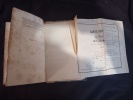
rousseurs éparses, une trace de mouillure sur le coin inférieur sur les premières pages, sans dommage pour la lecture. Découpure sur le haut de la page de titre sur 1 cm. coins un peu frotté, ouvrage solide néanmoins. COMPLET - GEOLOGIE - SCIENCES - ARDENNES - GRAND EST - ARDENNES - MINERALOGIE - PLANS - CARTES

