 Write to the booksellers
-
Type
Autograph (1)
Book (2524)
Drawings (1)
Magazine (54)
Photographs (2)
-
Latest
Last month (77)
Last week (3)
-
Language
English (2)
French (2578)
Italian (2)
-
Century
17th (2)
18th (35)
19th (258)
20th (998)
21st (73)
-
Countries
Belgium (352)
Brazil (1)
Canada (9)
Côte d'Ivoire (6)
Denmark (213)
France (1691)
Switzerland (310)
-
Syndicate
ALAC (9)
CLAM (1)
CLAQ (1)
ILAB (752)
NVVA (133)
SLACES (133)
SLAM (366)
Sur la Nutrition des Vegétaux. Premier- Troisieme Mémoire. (all).
Paris, Rue et Hotel Serpente, 1792. 8vo. 2 contemp. hcalf. Spines gilt. Light wear to spines. In: ""Annales de Chimie"", tome 13 + 14. 336 pp. + 2 plates and pp. 335 + 2 plates. (2 entire volumes offered).Hassenfratz' papers: pp. 178-192, 318-330 (tome 13) and pp. 55-85 (tome 14). Stamps to verso of titlepages. Scattered brownspots, some leaves in vol. 13 with a faint dampstain to upper margins.
First printing of these 3 memoirs in which Hassenfratz set forth the ""Humus theory of vegetation"". From Hassenfratz' theory Thaer later derived his theoretical basis for plant nutrition.The volumes also contains Hassenfratz's importent paper on chemical affinities ""Explications de quelques Phénomenes qui paroissent contrarier les loix des affinités chimiques"", 1.-2. memoir, pp. 3-25 a. 25-38. Also papers by Pelletier, Vauquelin, van Mons, Berthollet, Fourcroy, Haüy etc.
A bibliography of plant genetic resources.
Rome, IBPGR Secretariat, 1976, in-4°, 179 p., paperback.

(SLACES, NVVA)
Phone number : 41 (0)26 3223808
Illustrated trees in colour.
Hokuryukan Co., Ltd., 1985, gr. in-8vo, 878 p., richement ill. de dessins d’arbres et de plantes en couleurs, reliure en demi-cuir avec étui.
(SLACES, NVVA)
Phone number : 41 (0)26 3223808
Précis de Physique Biologique
Octave Doin 1899 in12. 1899. Cartonné.
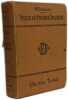
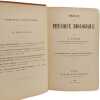
couverture défraîchie intérieur propre accroc sur la toile du dos
Les Animaux Sauvages en Captivité. Introduction a la Biologie des Jardins Zoologiques
Paris, Payot, 1953, in-8, 245pp, Broché, Très bel exemplaire. Abondamment illustré. 245pp
Sur les traces de la vie. La biologie d'aujourd'hui
Buchet / Chastel 1964 in8. 1964. Cartonné jaquette.
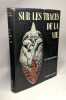
livre en bon état de conservation intérieur propre jaquette défraîchie (bords frottés accroc en haut du dos)
Salmo Salar Lin., seine Parasitenfauna und seine Ernährung im Meer und im Süsswasser. Eine parasitologisch-biologische Studie. Diss.
Stuttgart, 1917, 245x165mm, 137Seiten, broschiert.
Pour un paiement via PayPal, veuillez nous en faire la demande et nous vous enverrons une facture PayPal
Beiträge zur Anatomie und Systematik der Laemargiden.
Halle, 1904. Folio. Uncut, no wrappers. Paart of Nova Acta Leopoldina Bd. 82, Nr. 4. (190) pp., 2 plates, 42 textillustr.
"Physiologie végétale; tome 1 : Nutrition; tome 2 : développement; (2 volumes). Collecion ; Abrégé de."
Paris, Masson, 1977. 13 x 21, 2 volumes, 244 + 215 pages, très nombreuses figures, broché, bon état (couvertures légèrement défraîchies).
Handbuch der Physiologischen Optik. Bearbeitet. Mit 213 in den text eingedruckten Holzschnitten und 11 Tafeln.
Leipzig, Leopold Voss, 1867. Lex8vo. Contemporary hcloth. Some cracks along hinges neathly repaired. A stamp on titlepage and last page. XIV,874,(1) pp., 213 textillustr. in woodcut and 11 folded plates. Plate 1 with a faint dampstain, otherwise clean and fine. The copy also having the series-title: ""Allgemeine Encyclopädie der Physik...Hrsg. von Gustav Karsten. IX. Band. Handbuch der Physiologischen Optik.""
First edition of a main work by the ""Patriarch of German Science"". It is ""Considered the most importent book on the physiology and physics on vision."" (Horblit, 100 Books famous in Science). It incorporates Helmholtz's studies on physiological Optics, starting in the year 1851, the year in which he published his invention of the ophthalmoscope. - ""When Helholtz abandoned physiology for physics in 1871, the former science, he complained, had already grown too complex for any individual to embrace in its entirety. At his death in 1894, that complexity had become true of virtually all fields, Helmholtz was the last scholar whose work, in the tradition of Leibniz, embraced all the sciences, as well as philosophy and the fine arts."" (R. Steven Turner in DSB). -""One of the greatest book on physiological optics"" (Garrison & M., 1513). Helmholtz' contributions to science covers a wide range. ""His work in physiological optics, which he embodies in a great, is of fundamental value"" (Magie: A Source Book in Mathematics). In the authors introduction to the work,dated 1866, he states that it originally appeared in three parts, the first in 1856, the second in 1860 and the third in 1816, and incorporates his researches in his investigations on colours, the physiology of vision and the dioptrics of the eye. The first part contains besides the papers on physiological optics, that were published the years before, an admirable review of all previous work comprised under this heading, the book contains a store of new and most importent results, which provided a firm mathematical basis for the whole structure of physiological optics....In the first part he is principally concerned with the problem of of the refraction of the light-rays, or the dioptrics of the eye. Part II deals with the theory of visual sensation and treats in the first place of the various forms of stimulation of the optic nerve, and then of its excitation by light in particular, after which Helmholtz gives a connected development of the theories previously published by himself and others on simple and compound colours. Part III deals with the connections between the sensations and the external objects, that is with the the representations of objects by the perceptions caused by them, in other words, what kind of truth are we to describe to our ideas and perceptions ? (Based on Leo Koenigsberger: Hermann von Helmholtz).- Horblit No 49b - Garrison & M. No 1513. -
Eclaircissemens concernant la manière dont l'air agit sur le sang dans les poulmons. Pour servir de réponse aux objections contenues dans une lettre de M. Michelotti à M. de Fontenelle.[i.e. Éclaircissements concernant la manière dont l'air agit sur le sang dans les poumons].
1728 In-4, broché, couverture de papier marbré de l'époque, (1) f., 69, (3) p. Paris, Barois, 1728.
Édition originale. La fin de l'ouvrage (p. 57-69) contient une lettre en latin adressée par Helvétius à Jacques-Bénigne Winslow : 'De structura glandulae epistola () Ad () J.-B. Winslow'.Père du philosophe des Lumières Claude Adrien, l'auteur devint premier médecin de Marie Leczinska et membre de l'Académie des Sciences(Wellcome, 'Online Catalogue', 14332289).Rousseurs et petites auréoles.Bon exemplaire, tel que paru.
Louis Pasteur. Collection : Figures de l'histoire, N° 1.
Paris, Editions Hatier, 2002. 12 x 17, 96 pp., quelques illustrations en N/B et en couleurs, broché, très bon état.
La vie cellulaire. Eléments de cytologie.
P., Payot, 1923, petit in 12 cartonnage de léditeur, 160 pages.
Avec 12 figures dans le texte. ...................... Photos sur demande ...................

Phone number : 04 77 32 63 69
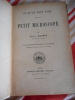
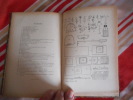
Ce qu'on peut voir avec un petit microscope
Charles-Mendel, non daté. Demi-bradel amateur, dos muet, 136 pages, dont 10 planches in-fine. Papier jauni, mais très bon état.
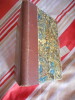
Ref 074.
Le vieillissement du monde vivant
Hermann 1943 in8. 1943. Broché.
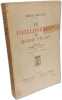
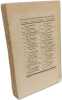
Bon état cependant premier plat réparé au scotch couverture défraîchie intérieur propre pages non-coupées
HENRY Charles. (18589-1926, préparateur de Claude Bernard, puis de Paul Bert).
Reference : 12858
Psycho-Biologie et Energétique.
Essai sur un principe de méthode intuitive de calcul. P. Hermann, 1909. Grand in-8, 216 pages. Broché. Exemplaire un peu dérelié, quelques infimes rousseurs.
Envoi d'auteur adressé à Jules Courtier.
Eléments d'agriculture coloniale. Plantes à huile.
sd Librairie Armand Colin, Collection "Armand Colin", n°5 - Sans date - Petit in-12, cartonnage brun avec pièce de titre contrecollée sur le 1er plat et le dos - 219 p. - Riche iconographie in et hors texte en N&B
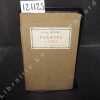
Bon état - Cartonnage très légèrement insolé
Notices pour servir à l’étude des Polypiers Nageurs ou Pennatulides.
s.d. (1857), in-folio, 30 p. + 1 ff. (tableau des espèces) + 7 planches, petite timbre d’anulation d’un musée sur titre, cartonnage original, piece de titre sur dos (bibl.).
(SLACES, NVVA)
Phone number : 41 (0)26 3223808
Mycologia belgica 1986 - Actes du Colloque de Mycologie MONS 15.XI.1986 / mémoires de la société Royal de Botanique de Belgique VOLUME 9
Universa / Wetteren - Bruxelles-Brussel 1987 in4. 1987. Broché. iconographie en noir et blanc
proche du très bon état insolé sur le pourtour intérieur propre bonne tenue 4e plat marqué
Septième colloque de l'association des diatomistes de langue française centre de recherche et d'éducation pour la conservation de la nature à Vierves-sur-Viroin 22-25.IX.1987
Universa / Wetteren - Bruxelles-Brussel 1988 in4. 1988. Broché. mémoires de la société Royal de Botanique de Belgique --- iconographie en noir et blanc
Très bon état couverture insolée sur son pourtour intérieur propre bonne tenue
Lehrbuch der Entwicklungsgeschichte des Menschen und der Wirbeltiere. Zehnte umgearb. u. erw. Aufl. Mit 696 teils farbigen Abb. im Text.
Jena, G. Fischer, 1915. Lex8vo. Orig. full cloth. Top of spine rubbed. XV,782 pp.
Traité d’Embryologie ou Histoire du développement de l’Homme et des Vertébrés. Deuxième édition française complètement remaniée d’après la sixième édition allemande par Charles Julin. Ouvrage orné de 415 figures dans le texte et de 2 planches en chromolithographie.
Paris, Librairie C. Reinwald - Schleicher Frères 1900, 260x165mm, XXI- 738 + 36pages, reliure d'éditeur. Très bel exemplaire.
Pour un paiement via PayPal, veuillez nous en faire la demande et nous vous enverrons une facture PayPal
Über den Befruchtungs- und Teilungsvorgang des tierischen Eies unter dem Einfluss äusserer Agentien.
Jena, Gustav Fischer, 1887. Gr.-8°. (2) Bl., 156 S. Mit 7 lithogr. Tafeln (davon 6 doppelblattgross). Neuer Halbpergamentband.
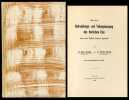
Aus der Reihe: «Untersuchungen zur Morphologie und Physiologie der Zelle», Heft 5.
Traité d'embryologie ou histoire du développement de l'homme et des vertébrés.
2° édition française complètement remaniée d'après la 6° édition allemande par Ch. Julin. Paris, Reinwald. 1900. Fort grand in-8 (25x16). XIX-738 pages. Demi-basane tabac de l'époque, dos à nerfs.
2 planches en chromolithographie et 415 figures dans le texte. Très bon état du texte , mais quelques passages soulignés au crayon de couleur.
Mitteilungen der naturforschenden Gesellschaft in Freiburg. Botanik. Vol. I. Heft 4.
Freiburg S., Fragnière 1902, 230x155mm, 65Seiten, broschiert.
Pour un paiement via PayPal, veuillez nous en faire la demande et nous vous enverrons une facture PayPal

