 Write to the booksellers
-
Type
Autograph (1)
Book (2529)
Drawings (1)
Magazine (54)
Photographs (2)
-
Latest
Last 3 days (1)
Last month (78)
-
Language
English (2)
French (2583)
Italian (2)
-
Century
17th (2)
18th (35)
19th (258)
20th (1003)
21st (73)
-
Countries
Belgium (352)
Brazil (1)
Canada (9)
Côte d'Ivoire (6)
Denmark (213)
France (1696)
Switzerland (310)
-
Syndicate
ALAC (9)
CLAM (1)
CLAQ (1)
ILAB (756)
NVVA (133)
SLACES (133)
SLAM (370)
Encyclopédie par l'image : Pasteur.
Couverture souple. Broché. 64 pages.
Livre. Librairie Hachette (Collection : Encyclopédie par l'image), 1937.
Le froid.
Couverture rigide. Cartonnage de l'éditeur. 64 pages. Cachets.
Livre. Librairie Hachette (Collection : Encyclopédie par l'image), 1929.
Le froid.
Couverture rigide. Cartonnage rouge de l'éditeur. 64 pages. Cachets.
Livre. Librairie Hachette (Collection : Encyclopédie par l'image), 1929.
[Encyclopédie de la Pléiade : BIOLOGIE] - ROSTAND (Andrée) et TETRY (Guy), sous la direction de.-
Reference : 86742
(1965)
Encyclopédie de la Pléiade : BIOLOGIE.
1965 Paris, NRF, Gallimard (Encyclopédie de la Pléiade), 1965, fort volume in 12 relié plein cuir de l'éditeur, jaquette rhodoid XXI-2036 pages.
...................... Photos sur demande ...................


Phone number : 04 77 32 63 69
EPHE. Biologie et Evolution des Insectes (principalement Rhynchota ou Hemipteroidea). Nos 1-14.
1988-2001 In issues, 8vo & 4to, paperbound. Four issues with author’s dedication to Dr. H. Duffels.
"Exposés de biologie; IV : Phénomènes d'intégration dans les cultures des tissus. Actualités scientifiques et industrielles, 240."
Paris, Hermann, 1935. 17 x 25, 24 pp., 5 figures, broché, bon état.
LA CULTURE DES TISSUS
Paris Gauthier-Villars et Cie, éditeurs 1932 in 8 (21x16,5) 1 volume broché, couverture imprimée, VI et 233 pages [1], avec 95 figures dans le texte, et un tableau dépliant. Collection des actualités biologiques. Bel exemplaire ( Photographies sur demande / We can send pictures of this book on simple request )
Très bon
Une lecon élémentaire sur le Darwinisme
Bruxelles, Lamertin 1904 85pp. avec 22 figures, 2e édition revue et considérablement augmentée, 27cm., brochure originale (petite manque de papier aux bouts du dos) bien protégée par une couverture de papier cristal, bon état, rare, W62035
Biologie. 5 e. (Cinqiuième). Equipe de rédaction animée par Jacques Escalier.
Couverture souple. Broché. 144 pages. Cachet de collège.

Livre. Editions Fernand Nathan, 1983.
Biologie. 6e. Equipe de rédaction animée par Jacques Escalier.
Couverture rigide. Cartonnage de l'éditeur. 144 pages.
Livre. Editions Fernand Nathan (Collection : Sciences naturelles), 1977.
La Reine Christine.-
Etude médicale et biologique. Ornée de 7 gravures. Editions Hippocrate. 1937. In-8 br.70pp. Tirage à petit nombre.
Biological Indicators of Environmental Quality: Bibliography of Abstracts
Imprint unknown 1973 264 pages 15 494x2 286x23 114cm. 1973. Cartonné jaquette. 264 pages.
Bon état intérieur propre jaquette défraîchie frottée
CLIPPERTON L'atoll Du Bout du Monde
Paris Seuil 2005 In 8 Collection " 7° continent " . Isolé sur l'Océan Pacifique , Clipperton est un atoll , sauvage , inhabité ( par les humains ) , défendu par une forteresse coralienne qui le rend inaccessible . C'est là qu'une quarantaine de chercheurs vont se relayer pour étudier l'ensemble des espèces qui y vivent . Complet de son carnet de photographies en couleurs hors-texte .Zoologie . Ornithologie . Biologie . - 216 p. , 550 gr.
Couverture souple Très bon 1ère Édition
Analyse chimique minérale qualitative et quantitative - choix de méthodes
Librairie polythecnique Ch. Béranger 1905 in8. 1905. Cartonné.
Bon Etat de conservation couverture défraîchie tranche ternie intérieur propre texte en bosniaque selon traducteur
Les fermentations
Presses Universitaires de France 1967 collection Que sais-je #524. in12. 1967. broché. Cet ouvrage d'Eugène Aubel publié par les Presses universitaires de France traite des fermentations. Il s'agit d'une réédition numérique d'un livre paru au XXe siècle initialement disponible en version imprimée et qui aborde ce sujet scientifique

État correct intérieur propre
La vie sur une planète mal connue. Adapté de l'américain par Paule Fougère.
Paris, Stock, 1970, in-8 broché, 236 pp, illustrations par Arnold Klapman. Petite marque au stylo sur le premier plat, sinon bon état.
Silva or, a discourse of forest-trees, and the propagation of timber in his Majesty's dominions: As It Was Delivered in the Royal Society on the 15th Day of October, 1662. Upon Occasion of certain queries propounded to that Illustrious Assembly, by th... - [SHAPING THE LANDSCAPE]
York, Printed by A. Ward for J. Dodsley T. Cadell J. Robson and T. Durham, London. W. Creech and J. Balfour, Edinburgh, 1776 Large4to. In contemporary full calf with black leather title-label with gilt lettering to spine. Gilt ornamentation to spine, forming 6 compartments. Front and back board loose. Overall wear and soiling to extremities. Two paper-labels with description of the work and two ex-libris [John Leigh Philips] pasted on to pasted down front end-paper. Waterstain affecting first 8 leaves, otherwise internally fine. [2 blanks], Frontiespiece, (54), 649, (10), [2 blanks] pp. + 40 copper-engraved plates by Johann Sebastian Muller, including one folding. [Keynes Evelyn 47 (calling for 39 plates) Henrey 137 (calls for 40 plates)" Nissen BBI 615 (calling for 41 plates though almost all copies have 40)].
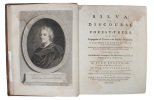
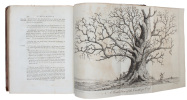
First Hunter edition, sixth overall, of this landmark work on forestry, one of the most influential texts ever published on the subject. The work shaped both the knowledge and the landscape of an entire nation throughout centuries.""There can be no doubt that John Evelyn, both during his own lifetime and throughout the two centuries which have elapsed since his death in 1706, has exerted more individual influence, through his charming ""Sylva"", ... than can be ascribed to any other individual."" (Nisbet, in the preface to the 1908 reprint of the 1706-edition).Apart from its pivotal importance to forestry, reforestration, the history of planting in Europe and the direct benefits from that, the book is famously the first book to be printed by the Royal Society, which had been founded in 1664 (the second being Robert Hooke's ""Microscopia""). The book was a huge success and it became immensely influential, making Evelyn famous among his contemporaries - such as Pepys, Hooke, and Locke - as a horticultural pioneer . ""If you take a stroll through one of the nation's long-established woodlands, there is a good chance its management was inspired, influenced or even instructed by John Evelyn's Sylva.Widely recognised as the first comprehensive study of UK trees, Sylva, or - to give its full title - A Discourse of Forest Trees, and the Propagation of Timber in his Majesty's Dominions, made its first public appearance in 1662 as a paper submitted to the newly formed Royal Society. Two years later, it was published as the Royal Society's first book and went on to not only shape people's knowledge but the landscape itself.And it was an instant success, proving popular beyond its intended audience of wealthy aristocratic landowners, who were urged by Evelyn to plant trees in order to replenish the nation's depleted timber stock.Four editions were produced during Evelyn's lifetime, and the book is still widely quoted and remains in print and freely available online 350 years after its first publication....He designed his first garden when he was 22 years old, two decades before he penned Sylva.It was as a young man, after deciding fighting as a Royalist in the Civil War was not the best career choice, that he travelled across Europe and became fascinated by the formal gardens of France and the expansive grounds of Italy.On his return to England, he continued his work in the garden of his home at Sayes Court in Deptford, South-East London.Being located near the Royal Dockyard on the Thames allowed Evelyn to experiment with newly arrived botanical delights, testing how the flora fared in his English country garden.His attention to detail, and the careful recording of his observations reflected the appetite for empirical evidence among the early pioneers of modern science. ""He was one of the early fellows of the Royal Society, which was created in 1660 as a scientific organisation, and Evelyn had spoken with the fellows about his work in this area and it very much chimed with the Society's early objectives,"" explained Royal Society head librarian Keith Moore.What we do now will have a knock-on effect for generations to come Dr Gabriel Hemery, The New Sylva co-author:""Quite clearly, Evelyn's work in planting forest trees and harvesting the products from them - whether it was wood or apples - really hit the mark"" it was exactly what the Royal Society was interested in at that time.""And so the seeds of Sylva's success were planted, as landowners heeded Evelyn's advice.""Of course, you have to remember that this was after the Civil War so trees across the nation had been denuded as part of the war effort but, as Evelyn himself says in the book, as a result of industrial activities - such as glass making - people were chopping down trees, therefore they had to be replaced,"" he told BBC News. ""Also, he uses the phrase 'wooden walls' - [trees] were very important for the defence of the nation through ship building.""...The lasting legacy of Evelyn's vision to sustain the nation's timber supplies was highlighted in 1812 when the book was republished as a call to arms to the nation's landowners as the Napoleonic Wars took their toll on timber supplies.And there were echoes of Evelyn in 1919, the year in which the UK's Forestry Commission was established to increase tree cover, which had fallen to just 5% as a result of the demand for timber during World War One.Today, trees are back in the headlines and on the political agenda. To coincide with the original book's 350th anniversary, two authors have written The New Sylva, a timely updated version for the 21st Century to highlight the strategic, economic and ecological importance of trees."" (Mark Kinver, BBC News, Science & Environment: Trees: A personal and national legacy of Evelyn's Sylva. 2014)Graesse II, 535Pritzel, 2766.Kress 7209
Les cirrhoses pigmentaires du foie. Etude clinique et expérimentale.
Paris, E. Le François, 1932, gr. in-8°, 160 p. + 6 planches (1 dépl.), brochure originale.
(SLACES, NVVA)
Phone number : 41 (0)26 3223808
La sélection naturelle. Essais traduit de l'anglais sur la deuxième édition avec l'autorisation de l'auteur par Lucien de Candolle.
Paris, C. Reinwald et Cie, 1872. In-8 de [4]-XIII-[3]-420 pages, pleine percaline verte de l'éditeur, dos lisse orné, filets à froid sur les plats, liste des ouvrages en vente à la librairie Reinwald (Darwin, Carl Vogt, Louis Buchner) proprement collée au contre-plat. Cartonnage d’éditeur signé Lenègre.
![La sélection naturelle. Essais traduit de l'anglais sur la deuxième édition avec l'autorisation de l'auteur par Lucien de Candolle.. [Evolutionisme] ...](https://static.livre-rare-book.com/pictures/KUA/15484_1_thumb.jpg)
![La sélection naturelle. Essais traduit de l'anglais sur la deuxième édition avec l'autorisation de l'auteur par Lucien de Candolle.. [Evolutionisme] ...](https://static.livre-rare-book.com/pictures/KUA/15484_2_thumb.jpg)
Edition originale de la traduction française sur la seconde édition anglaise, par L. de Candolle, de Genève. Avec Darwin, Wallace est considéré comme le père de la théorie de l’évolution. Exemplaire en parfaite condition. Du 26 septembre au 5 octobre, le libraire est absent il prendra connaissance de vos commandes dès le 6 octobre au matin. Et durant cette période, l'horaire de fermeture sera 17h30 du lundi au vendredi. – From September 26 to October 5, the bookseller is absent; he will take note of your orders as early as the morning of October 6. And during this period, the closing time will be 5:30 p.m. from Monday to Friday.
EXBRAYAT JEAN-MARIE & D'HOMBRES EMMANUEL ET REVOL FABIEN SOUS LA DIRECTION DE
Reference : 011836
(2011)
EVOLUTION ET CREATION : DES SCIENCES A LA METAPHYSIQUE
PARIS ET LYON LIBRAIRIE PHILOSOPHIQUE VRIN ET INSTITUT INTERDISCIPLINAIRE D'ETUDES EPISTEMOLOGIQUES 2011 Un volume grand in-8 broché de 312 pages , bon exemplaire . Bon Couverture souple
Exposition Universelle et Internationale de San Francisco. La SCIENCE FRANCAISE.
P., Larousse, 1915, 2 volumes in 8° reliés pleine percaline bordeaux de l'éditeur, têtes dorées, 397 et 405 pages ; 35 portraits hors-texte, dont les 2 frontispices ; qq. rares rousseurs ; on trouve, à la fin de chque "chapitre", une bibliographie.
Tome premier : La Science française à l'Exposition de San Francisco - La Philosophie - La Sociologie - La Science de l'Education - Les Mathématiques - L'Astronomie - La Physique - La Chimie - La Minéralogie - La Géologie - La Paléobotanique - La Paléontologie Zoologique - La Biologie - Les Sciences médicales - La Science géographique. Tome second : Les Etudes Egyptologiques - L'Archéologie classique - Les Etudes historiques - Histoire de l'art - La Linguistique - L'Indianisme - La Sinologie - L'Hellénisme - La Philologie Latine - La Philologie Celtique - Les Etudes sur la Langue Française - Les Etudes sur la Littérature française du Moyen Age - Les Etudes sur la Littérature française moderne - Les Etudes italiennes - Les Etudes hispaniques - Les Etudes anglaises - Les Etudes germaniques - Les Sciences Juridiques et Politiques - Les Sciences Economiques. PHOTOS sur DEMANDE. ...................... Photos sur demande ...................
Phone number : 04 77 32 63 69
The Habits of Necturus Maculosus. Reprinted from The American Naturalist.The Gastrulation and Embryo Formation in Amia Calva. Reprinted from The American Journal of Anatomy. 4 PlatesThe Development of Chromatophores in Necturus. With 7 Figures. Reprinted from The American Journal of Anatomy.The Cytoplasmic and Nuclear Changes in the Striated Muscle Cell of Necturus. 4 plates. Reprinted from The American Journal of Anatomy.
Boston - St. Louis, Ginn 1904-1906, 240x175mm, 250x180mm, 14 + 29 + 7pages, paperback.
+ 25 pages, Pour un paiement via PayPal, veuillez nous en faire la demande et nous vous enverrons une facture PayPal
The early development of Lepidosteus osseus.The university of Chicago. The Decennial Publications.
Chicago, TheUniversity Chicago Press 1903, 285x220mm, 17pages, paperback.
2 Plate, Pour un paiement via PayPal, veuillez nous en faire la demande et nous vous enverrons une facture PayPal
[Imprimerie E. Drouillard] - EYME, Jean [ Eymé, Jean (1920-2018) ]
Reference : 31134
(1954)
Recherches cytologiques sur les Mousses. [ Livre dédicacé par l'auteur ]
Extrait du Botaniste, série XXXVIII, 1 vol. in-8 br., Imprimerie E. Drouillard, Bordeaux, 1954, 166 pp. et XIX planches
![Recherches cytologiques sur les Mousses. [ Livre dédicacé par l'auteur ]. EYME, Jean [ Eymé, Jean (1920-2018) ]](https://static.livre-rare-book.com/pictures/CDL/31134_thumb.jpg)
![Recherches cytologiques sur les Mousses. [ Livre dédicacé par l'auteur ]. EYME, Jean [ Eymé, Jean (1920-2018) ]](https://static.livre-rare-book.com/pictures/CDL/31134_2_thumb.jpg)
![Recherches cytologiques sur les Mousses. [ Livre dédicacé par l'auteur ]. EYME, Jean [ Eymé, Jean (1920-2018) ]](https://static.livre-rare-book.com/pictures/CDL/31134_3_thumb.jpg)
Envoi de l'auteur. Etat très satisfaisant (petites annotations de classement sur couv., qq. rouss., bon état par ailleurs).

