 Write to the booksellers
-
Type
Autograph (1)
Book (2541)
Drawings (1)
Magazine (54)
Photographs (2)
-
Latest
Last 24h (1)
Last month (92)
Last week (3)
-
Language
English (2)
French (2595)
Italian (2)
-
Century
17th (2)
18th (35)
19th (258)
20th (1015)
21st (73)
-
Countries
Belgium (352)
Brazil (1)
Canada (9)
Côte d'Ivoire (6)
Denmark (213)
France (1708)
Switzerland (310)
-
Syndicate
ALAC (9)
CLAM (1)
CLAQ (1)
ILAB (752)
NVVA (133)
SLACES (133)
SLAM (366)
Ce qu'il faut savoir des insectes. Volume I : Papillons. Volume II : Coléoptères et hémiptères. Volume III : Orthoptères, hyménoptères-diptères et insectes inférieurs. (3 volumes)
1938 - 1939 - 1942 A Paris, Paul Lechevalier, éditeur, Collection "Savoir en Histoire Naturelle", Volume II, III et IV - 1938, 1939 et 1942 - 3 volumes in-8, broché - 188 p. + XX pl., 307 p. + XIV pl. et 255 p. + XVII pl. - Planches en couleurs in fine + quelques figures in texte en N&B
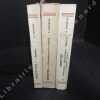
Bon état - Légères rousseurs sur les tranches du volume 3 - Petites salissures et discrètes rousseurs sur les couvertures
Untersuchung von C-4-Dimethylaminoantipyrinmetaboliten im Urin beim Menschen. Inaugural-Dissertation.
Chemischen Abteilung des Pharmazeutischen Institut der Universitaet Bern, 1983, in-4to, 117 S. auf 117 Bl., Original-Broschüre.

(SLACES, NVVA)
Phone number : 41 (0)26 3223808
Recueil des principales oeuvres de Ch.H.G. Pouchet, précédé d'une notice biographique et publié par les soins du Docteur Auguste Pettit
P., Masson, 1902; un volume in 8, broché, couverture muette moderne, 1 portrait, (3), 14pp., 406pp., figures dans le texte
---- EDITION ORIGINALE ---- Fils de Félix-Archimède Pouchet, G. POUCHET fut l'élève de ROBIN et d'OWEN. Il est reçu docteur en médecine et docteur ès sciences en 1864, puis devient chef des travaux anatomiques au Muséum de Paris en 1865. Il fut maître de conférence à l'Ecole normale supérieure. En 1897, il est nommé professeur d'anatomie comparée au Muséum . (Dictionnaire historique des médecins) ---- Notice biographique - Protistologie ; recherches sur les péridiniens - Histologie - Physiologie générale - Tératologie - Biologie générale - Liste des publications par ordre chronologique**6354/4301/B5DE
Hétérogénie ou traité de la génération spontanée, basé sur de nouvelles expériences.
P. J.B. Baillière, 1859. In-8, XXXII-672 pages. Demi basane noire de l'époque, dos à nerfs orné de fleurons dorés.
Edition originale, 3 planches in fine dont 1 en couleurs, 28 figures. Principal ouvrage sur la question et celui qui a incité Pasteur à entreprendre ses célèbres expériences, qui sont à la base de tous ses immortels travaux sur les microorganismes. Importante bibliographie.
Nouvelles expériences sur la génération spontanée et la résistance vitale -- EDITION ORIGINALE -- ENVOI DE F.A. POUCHET A Monsieur REIZET -- BON EXEMPLAIRE
P., Masson, 1864, un volume in 8 relié en demi-chagrin marron (reliure de l'époque), 15pp., 256pp., figures dans le texte, 1 PLANCHE DOUBLE EN COULEURS
---- EDITION ORIGINALE ---- ENVOI DE POUCHET à Monsieur REIZET ainsi libellé : "A Monsieur Reizet, hommage de l'auteur - signé Pouchet" ---- BON EXEMPLAIRE ---- "Pouchet's most significant work is Nouvelles expériences de génération spontanée et la résistance vitale (1864), a sequel to the Hétérogénie of 1859... The lasting value of the work of Pouchet and his supporters was that it gave a great impetus to improving experimental technique in microbiology, which contributed to the rapid development of the subject during the last decades of the nineteenth century". (DSB XI pp. 109/110) ---- Bulloch History of bacteriology p. 391 ---- Expériences anciennes (contre-expérience de Schultze, de Schwann, expériences de Pasteur) - Résistance vitale des organismes inférieurs - Dénégation de la panspernie - Micrographie atmosphérique - Dénégation des ensemencements - Démonstration de la génération spontanée (démonstration anatomique, biologique, mathématique, chimique, géologique)**6355/6356/B4-6357/CART7-6366/MAIS
Nouvelles expériences sur les animaux pseudo-ressuscitants faites au Muséum d'histoire Naturelle de Rouen -- EDITION ORIGINALE -- BEL EXEMPLAIRE -- TIRE-A-PART (OFFPRINT) des actes du Muséum d'histoire naturelle de Rouen
Rouen, Rivoire, 1860; un volume in 8 cartonnage bradel (reliure postérieure), 31pp., figures dans le texte
---- EDITION ORIGINALE ---- TIRE-A-PART (OFFPRINT) des actes du Muséum d'Histoire Naturelle de Rouen ---- Suite des recherches de F.A. Pouchet sur les animaux pseudo-ressuscitants commencées en 1859 et pour lesquelles il apporte de nouvelles preuves. Dans sa préface, il rappelle brièvement que c'est Spallanzani qui en 1775 vérifia le phénomène entrevu par Needham en 1743" ---- "A prolific author, Pouchet covered many areas of botany, zoology, physiology and microbiology... The lasting value of the work of Pouchet and his supporters was that it gave a great impetus to improving experimental technique in microbiology, which contributed to the rapid development of the subject during the last decades of the nineteenth century". (DSB XI p. 110)**6351/6157/B4
Recherches et expériences sur les animaux ressuscitants faites au Muséum d'Histoire Naturelle de Rouen -- EDITION ORIGINALE -- BEL EXEMPLAIRE
P., Baillière, 1859; un volume in 8 relié en DEMI-MAROQUIN A COINS MARRON, TETE DOREE (reliure de l'époque), (2), 92pp., figures dans le texte, 4 tableaux dans le texte
---- EDITION ORIGINALE ---- TRES BEL EXEMPLAIRE ---- "A prolific author, Pouchet covered many areas of botany, zoology, physiology and microbiology... The lasting value of the work of Pouchet and his supporters was that it gave a great impetus to improving experimental technique in microbiology, which contributed to the rapid development of the subject during the last decades of the nineteenth century". (DSB XI p. 110) ---- Historique - De la résistance vitale des animaux pseudo-ressuscitants - Des causes d'erreurs dans les expériences sur les pseudo-résurrections - Expériences sur la résistance vitale des animalcules pseudo-ressuscitants aux transitions de température - Expériences sur les pseudo-ressuscitants : animalcules vivants desséchés à l'ombre, animalcules vivants desséchés, au soleil, résistance des animalcules aux températures élevées**6352/6355/B4
Théorie positive de la fécondation des mammifères basée sur l'observation de toute la série animale -- EDITION ORIGINALE -- ENVOI DE F.A. POUCHET
P., Roret, 1842; un volume in 8, broché, couverture imprimée (défraîchie, quelques rousseurs), 8pp., 161pp., (1)
---- EDITION ORIGINALE ---- ENVOI DE POUCHET sur la page de couverture à la Société statistique de Marseille ainsi libellé : "Hommage de l'auteur à la société statistique de Marseille - Hommage de la haute considération - signé POUCHET" ---- Cet ouvrage semble avoir échappé aux bibliographes notamment à Hoefer qui cite un ouvrage de Pouchet sur le même sujet publié 5 ans après (1847)---- "Pouchet qualified in medicine in 1827 after studying at Rouen and at Paris. Almost immediately he became director of the Muséum d'Histoire Naturelle at Rouen, an institution with which he was associated throughout the remainder of his life... A prolific author, Pouchet covered many areas of botany, zoology, physiology and microbiology... A great deal of Pouchet's more specialized biological writing awaits detailed assessment, but it undoubtedly contains much of value : for instance, his clear recognition that human ovulation occurs within a limited period in the menstrual cycle...". (DSB XI pp. 109/110) ---- Etude physiologique de la fécondation ; exposition des principales lois - Lois physiologiques fondamentales (au nombre de 10) : Il n'y a point d'exception pour l'espèce humaine ; les phénomènes de sa génération suivent des lois analogues à celles qui s'observent chez les divers animaux ; La génération se produit chez tous les animaux à l'aide d'oeufs. Quelques êtres inférieurs font seuls exception ; Dans toute la série animale les ovules pré-existent à la fécondation ; Dans toute la série animale l'ovaire émet ses ovules indépendamment de la fécondation ; Dans tous les animaux les ovules sont émis à des époques déterminées et en rapport avec la surexcitation périodique des organes génitaux... - Lois physiologiques accessoires (au nombre de 3) - Résumé et conclusions**6358/4398/B4-6351/cart5
MICROCHIMIE VEGETALE - GUIDE POUR LES RECHERCHES PHYTO-HISTOLOGIQUES
Paris Octave Doin 1883 In-12 Broché Satisfaisant
Couverture gris-bleu imprimée, défraichie ; titre en long sur le dos ; papier froissé et légèrement déchiré (sans gravité) ; XX (introduction, bibliographie)+119pp ; Ouvrage à l'usage des étudiants, traduit d'après le texte allemand par J.-Paul Lachmann ; édition française, considérablement augmentée (en collaboration avec l'auteur) ; le corps d'ouvrage est assez frais, malgré quelques les tranches un peu poussiéreuses paru dans la collection "Bibliothèque biologique internationale", N°XI
Écologie du plancton des eaux continentales. Préface du Pr. M. Lamotte
Paris, Masson, coll. « Collection d'écologie », n° 16 1982 In-8 broché 24 cm sur 16. IX-198 pages. Ouvrage illustré. 73 in-textes. Très bon état d’occasion.
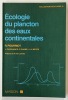
Bibliographies, index alphabétique des matières, table des matières. Très bon état d’occasion
Etres vivants végétaux et animaux. Volume de l'encyclopédie Clartés, mis à jour jusqu'en 1969.
Couverture rigide. Fort volume en reliure mobile. Taché sur la tranche.
Livre. Editions techniques (Collection : Encyclopédie Clartés), 1958-1969.
Les problèmes généraux de l'hérédité psychologique
Paris, Félix Alcan 1921 305pp., dans "Bibliothèque de philosophie contemporaine", partiellement non coupé, dos réparé, cachet, P38944
Traité d'histologie - I. Cytologie générale et spéciale - II. Histologie et anatomie microscopique -- EDITION ORIGINALE -- 2 VOLUMES (COMPLETE SET)
P., Masson, 1904/1911, 2 fort volumes grand in 8 reliés en demi-chagrin noir (reliures de l'époque), T.1 : 32pp., (1), 977pp., 791 FIGURES DANS LE TEXTE DONT 172 EN COULEURS, T.2 : 40pp., 1199pp., 572 FIGURES DONT 31 EN COULEURS
---- EDITION ORIGINALE ---- "A. Prenant wrote a valuable treatise on histology". (Castiglioni p. 775). "A. Prenant, médecin et histologiste français (1861/1927), découvrit divers éléments cellulaires ; le premier, il orienta ses recherches vers l'histophysiologie, l'histologie comparée, l'histochimie et l'histophysique. Il a mis au point de nombreuses méthodes de fixation et de coloration". (Bariéty & Coury pp. 759 & 834) ---- "En physiologie cellulaire, mention doit ête faite de P. Bouin...". (Bariéty & Coury pp. 835, 741, 758, 759)**7016/A7AR
Annélides.
Hermann & Cie, Editeurs, 6, rue de la Sorbonne Hermann & Cie, Editeurs, 6, rue de la Sorbonne - Actualités scientifiques et Industrielles. 1935. Grand In-8 , broché, 95 pages, enrichi de 86 figures dans le texte et au trait ( Légendé). Très propre.
Actualités Scientifiques et Industrielle -Brochure N° 196 -Leçons de Géologie Bon Etat Mise à jour du Samedi 27 Juin 2026. Paiement PayPal immédiat, Mondial Relay pour : France, Allemagne, Autriche, Belgique, Espagne, Italie, Portugal, Luxembourg, Pays-Bas, Pologne (Communiquer votre point ou locker si connu). Une participation supplémentaire peut être demandée pour les colis lourds hors France où les envois compris entre 5 et 25 kg sont dégressifs : 2 à 4 kilogrammes - 7.99 / 5 à 10 kg - 15.99 / 15 -25 kg - 25.99. Certaines de nos collections ( Vian, Céline, Camus (...) peuvent être expédiées en Franco de port. Pour linternational hors Europe (Suisse, Canada, Japon, Etats-Unis, les frais dexpéditions peuvent varier selon le poids (mise à jour : 1 juin 2026).
"Leçons de zoologie; protozoaires flagellés. Actualités scientifiques et industrielles, 296."
Paris, Hermann, 1935. 17 x 25, 57 pp., 68 figures, broché, bon état.
Protozoaires-Flagellés
Hermann & Cie, Editeurs, 6, rue de la Sorbonne Grand In-8,broché,56pages,68 figures à l'encre, très bel exemplaire.
Actualités Scientifiques et Industrielle -Brochure N° 296- Leçons de Zoologie Très Bon Etat Mise à jour du Samedi 27 Juin 2026. Paiement PayPal immédiat, Mondial Relay pour : France, Allemagne, Autriche, Belgique, Espagne, Italie, Portugal, Luxembourg, Pays-Bas, Pologne (Communiquer votre point ou locker si connu). Une participation supplémentaire peut être demandée pour les colis lourds hors France où les envois compris entre 5 et 25 kg sont dégressifs : 2 à 4 kilogrammes - 7.99 / 5 à 10 kg - 15.99 / 15 -25 kg - 25.99. Certaines de nos collections ( Vian, Céline, Camus (...) peuvent être expédiées en Franco de port. Pour linternational hors Europe (Suisse, Canada, Japon, Etats-Unis, les frais dexpéditions peuvent varier selon le poids (mise à jour : 1 juin 2026).
Darwin. Collection Socialisme et Culture.
Paris, Editions Sociales Internationales, 1938. 12 x 19, 322 pp., broché, état moyen (dos légèrement abîmé, papier jauni).
Laboratoriumsbuch für den Lebensmittelchemiker
Theodor steinkopff 1939 in8. 1939. Cartonné.
Bon état couverture défraîchie intérieur propre
La vie cellulaire - bibliothèque de philosophie scientifique
Flammarion 1947 in12. 1947. Broché.
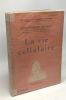
Bon Etat de conservation sous papier de soie couverture défraîchie intérieur propre pages non coupées
Some experiments on the changes which take place in the fixed principle of the egg during incubation. Read June 20, 1822.
(London, W. Nicol, 1822). 4to. No wrappers as extracted from ""Philosophical Transactions"" 1822 - Part II. Pp. 377-400.
First printing of a major paper in inorganic chemistry and biology.Prout is most widely known for ""Prout's hypothesis"" which states that specific gravities of elementary gases (i.e., their atomic weight) were evenmultiples of of that of hydrogen. The experimental errors in the data then available were such asto make the hypothesis appear plausible. Prout concluded, therefore, that hydrogen isthe fundamental constituent from which all other elements are compounded..Prout’s other significant contributions included unpublished thoughts on the unity of sensations (1810), on the distinction between taste and flavor (1812), on elaborate self-experiments regarding carbon dioxide output (1813, 1814), on a study of the chemical changes in an incubating egg (1822), (the paper offered)""(DSB).
L'évolution humaine
Paris, P.U.F. 1942 xxiii + 264pp., br., 1e éd., dans la série "Bibliothèque de Philosophie contemporaine", dos peu touché
L'évolution humaine
Presses Universitaires de France - P.U.F., Bibliothèque de Philosophie Contemporaine, 1942 14 x 22,5, 265 pp., broché, Bon état - dos décoloré, petit accroc couverture avant et pramières pages
savoir-faire - évolution des sociétés - structures psycho-sociales
MANUEL DE CLASSIFICATION ET DE DÉTERMINATION DES BACTÉRIES ANAÉROBIES
Paris Masson et Cie 1957 in 8 (25x16) 1 volume broché, 362 pages [1], petites traces d'adhésif sur les pages de garde, petit cachet ex-libris. Monographie de l'Institut Pasteur. Bel exemplaire
Très bon
Chimie générale thermodynamique chimique
Masson et cie 1961 in8. 1961. Broché.

bon état couverture défraîchie salie petite note sur la garde intérieur propre par ailleurs
Promenade au marché aux fleurs, ou le Botaniste du second âge
Paris, Madame Vve Le Petit, 1811. In-12, 408 pp., basane racinée fauve de l'époque, frises dorées en encadrement sur les plats, dos lisse orné de caissons et fleurons dorés, pièce de titre rouge (épidermures, rousseurs, gravures parfois rognées un peu court).
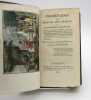
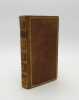
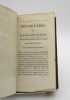
Édition originale de ce petit ouvrage destiné à instruire à la jeunesse en botanique. Pujoulx avait auparavant publié une Botanique des jeunes gens à laquelle il fut reproché d'être trop scientifique et étendue. Il a donc décidé de faire de cet ouvrage un délassement instructif. Il a divisé son étude en douze promenades dans le Marché aux fleurs durant lesquelles il aborde divers concepts d'histoire naturelle. Ce exemplaire comprend le frontispice, dessiné par Monet, gravé par Adam qui représente le Marché aux fleurs et les 12 planches de plantes (reliées avant la table générale). Elles ont toutes été artistiquement rehaussées de couleurs à la main, les couleurs étant encore très fraîches. Les Livres de l'enfance du XVe au XIXe siècle, 4648. Voir photographie(s) / See picture(s) * Membre du SLAM et de la LILA / ILAB Member. La librairie est ouverte du lundi au vendredi de 14h à 19h. Merci de nous prévenir avant de passer,certains de nos livres étant entreposés dans une réserve.

