 Write to the booksellers
-
Type
Art print (2)
Autograph (4)
Book (34359)
Magazine (146)
Manuscript (3)
Maps (1)
Photographs (8)
-
Latest
Last 24h (3)
Last 3 days (18)
Last month (402)
Last week (205)
-
Language
Chinese (1)
Dutch (3)
English (108)
French (34272)
German (9)
Greek (1)
Italian (112)
Japanese (1)
Latin (4)
Polish (1)
Portuguese (4)
Russian (3)
Spanish (3)
Swedish (1)
-
Century
16th (34)
17th (75)
18th (572)
19th (4349)
20th (11519)
21st (1706)
-
Countries
Belgium (7834)
Brazil (14)
Canada (11)
Côte d'Ivoire (35)
Denmark (146)
France (25217)
Germany (9)
Greece (3)
Netherlands (1)
Switzerland (1253)
-
Syndicate
ALAC (11)
CLAM (15)
CLAQ (3)
CNE (18)
ILAB (13872)
NVVA (532)
SLACES (531)
SLAM (13089)
SNCAO (64)
Adrien-Antoine de Blocquel de Croix de Wismes (1697-1778), mayeur d'Arras, élu d'Artois, membre fondateur de l'Académie des Sciences, Lettres et Arts d'Arras.
Reference : 019933
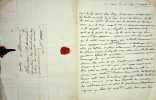
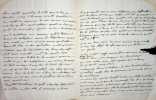
Lettre autographe
Adrien-Antoine de Blocquel de Croix de Wismes (1697-1778), mayeur d'Arras, élu d'Artois, membre fondateur de l'Académie des Sciences, Lettres et Arts d'Arras. L.A., Paris, 6 février 1734, 3p in-4. A Charles d'Aumale (1688-1750), militaire, directeur général du Génie, chargé des fortifications, son beau-frère (qui a épousé son unique soeur). Longue lettre donnant des nouvelles, tant militaires (guerre en Italie) qu'amicales (mort de M. de Salmon) ou matérielles (livraison de vitres, d'une chaise de poste). Beau document avec cachet armorié au dos. [476]
Art Oceanien, L' Art Oceanien.
, Citadelles & Mazenod, 1993 Hardcover+dusjact+slipcase, Couverture reliee sous jaquette, 637 pages, Texte en Francais, Illustrations en couleurs en noir & blanc nombreuses illustrations dans et hors texte,** tres bon etat. ISBN 9782850880612.
Pour les grands voyageurs du XVIe au début du XIXe siècle, l'exploration des îles du Pacifique avait été une aventure exceptionnelle, pour de Queiros, Cook, La Pérouse, Bougainville et Dumont d'Urville qui avaient bravé ces mers inconnues pour découvrir ce qu'ils crurent être le paradis. Aujourd'hui, le voyageur peut suivre leurs traces, et pourtant de nombreux aspects de ces cultures insulaires demeurent aussi peu familiers qu'autrefois. Parmi ces aspects méconnus, l'un des plus intéressants est l'extraordinaire richesse artistique créée par les habitants de ces îles. Le monde océanien recouvre des milliers d'îles, de l'immense Nouvelle-Guinée à de simples atolls coralliens. Les indigènes y développèrent plus de cultures autonomes et variées que partout ailleurs dans le monde. Dans la plupart d'entre elles, les arts tiennent une place fondamentale car ils sont un facteur essentiel d'intégration à la vie sociale et religieuse. Ils incluent non seulement l'architecture, la peinture et la sculpture, mais aussi la musique, la danse, la prière, et l'ornement du corps. Presque tous les matériaux disponibles sont utilisés, durables ou éphémères. Cependant, pour des raisons principalement historiques, l'art des îles du Pacifique a été relativement négligé. Si un grand nombre de publications spécialisées, techniques ou anthropologiques existent, principalement sous forme d'articles, aucune synthèse d'ampleur n'a été publiée depuis trente ans. Et cela en dépit des nombreuses découvertes importantes et des études approfondies sur l'art de ces communautés passées et présentes. Présenter au grand public l'art océanien à partir des recherches et des théories contemporaines sur cet ensemble complexe de sociétés et de cultures, c'est ce qu'accomplit cet ouvrage à travers des textes de grande qualité et une iconographie qui réunit les chefs-d'?uvre dont un bon tiers d'?uvres inédites. Une documentation précise sur les principaux groupes culturels apportent le complément indispensable pour une bonne découverte de ce continent éparpillé entre ciel et océan.
Scarlett Hooft Graafland Mesmerizing
, Waanders Uitgevers, 2025 Flexi (Pb luxe) Dimensions 280 x 240 mm Illustrations 40 col.ill. 96 Pages, Language(s) Eng/ NL ed. *new. ISBN 9789462626164.
Zoutvlaktes, ijskappen en woestijnen: Scarlett Hooft Graafland (1973) fotografeert magische landschappen in de meest afgelegen gebieden ter wereld. Scarlett Hooft Graafland werkt altijd nauw samen met de lokale bevolking, en legt hun verhalen vast. Haar persoonlijke levensinzichten komen terug in haar werk. Met humor en verwondering raakt ze actuele onderwerpen aan, zoals klimaatverandering, ongelijkheid, of de positie van vrouwen.
Byzantine Century Political, Colonial, and National Uses of Neo-Byzantine Architecture, 1820s-1920s
, Brepols, 2026 Paperback, 258 p., 210 x 270 mm, Illustrations:44 b/w, 146 col., Language(s):English. *New . ISBN 9788028007973.
This volume explores what it meant to invoke Byzantium during a century of restless political, cultural, and imperial transformation. From the 1820s to the 1920s, the ?Neo-Byzantine? style was more than a matter of architectural taste in an age of eclecticism. It became a language of power and identity, called upon to serve colonial empires such as Britain, France, Russia, and Austria-Hungary, as well as contested regions like the Caucasus, the Balkans, and the Ottoman capital itself, where Byzantium was at once heritage and provocation. Far from being a marginal curiosity, the Neo-Byzantine revival was a crucible in which nations, religions, and empires negotiated their pasts and imagined their futures. Monumental churches, synagogues, and civic buildings across Europe, North Africa, and Western Asia were not simply constructed in a borrowed style: they materialized competing dreams of Byzantium, becoming instruments of political ambition, religious authority, national mythology, and cultural colonization. Through a series of case studies ranging from Dublin to Istanbul, from Marseille to Tbilisi, and from Prussian churches to diasporic Armenian projects, the contributors move between the macro and the micro, situating the style within broad historical currents while grounding it in the specificity of local histories. Together, they demonstrate how Byzantium was not only reinvented but actively contested ? its image refracted through the shifting concerns of a global century.
Entangled Histories at Conques. Interdisciplinary Perspectives on a Unique Site of Medieval Heritage
, Brepols, 2024 Paperback, 185 pages, Size:210 x 270 mm, Illustrations:10 b/w, 76 col., 1 tables b/w., 3 tables col., Languages: English, French. ISBN 9788028005832.
Summary Conques has been an important node, a singularity within many entangled histories from late antiquity to the present. This volume publishes papers expanding on the second conference of the project "Conques in the Global World. Transferring Knowledge: from Material to Immaterial Heritage" (Marie Sk?odowska-Curie Research and Innovation Staff Exchange H2020). Held in October 2023 at the Centre européen in Conques, the workshop brought together international experts from a variety of disciplines and geographies, indicating the directions future studies of this site might take and reflecting on its material, literary, and historiographical legacy. The collected essays in this volume reflect scholarly and artistic fascination with Conques. They question, open, and reopen important dossiers, bringing fresh insights and perspectives on the site's material, literary, and performative culture. These range from Bernard of Angers's Miracles of Sainte Foy and the scholarly reception of this text to charged discussions of the architectural sources and models for the abbey-church and its role in regional and interregional dynamics. From the heated architectural history, the essays segue into the other hot topic of Conques: rethinking the elusive Majesty of Sainte Foy. Essays examine its fabrication history, its specific perception during the eleventh and twelfth centuries, and its staging and geographical anchoring. These analyses give way to an essay devoted to Conques' nineteenth-century reconstruction. The present volume closes with a text devoted to the mediation of medieval literary culture within contemporary contexts. In their disciplinary diversity, this volume unites scholarly traditions, opening new avenues for the study of a medieval site which, through its entangled histories, captivates scholars around the world. TABLE OF CONTENTS Introduction Adrien Palladino, Objects Evading Interpretation: Conques and Sainte Foy Articles Sébastien Fray, Applying the Anthropological Concept of the "Trickster" to the Miracles of Sainte Foy? William J. Diebold, "Wicked and Absurd": A Surprising Paragone in Bernard of Angers's Miracles of Sainte Foy Martin Naraschewski, Bamberg, Conques, and the Hohenstaufen Dynasty: A Model of Transregional Dynamics Éric Sparhubert, The Chevet of Sainte-Foy of Conques and its Models: Materializing Sanctity and Promotional Strategies in Romanesque Architecture Benoît-Michel Tock, Présence et intervention des laïcs auprès de l'abbaye de Conques (Xe-XIIe siècles) Kris N. Racaniello, A Translike Object? Composing the Majesty of Sainte Foy and Staging Gender Erik Thunø, Localism and Sainte Foy at Conques Xavier Barral i Altet, La basilique Sainte-Foy de Conques agressée ou restaurée? Interventions et attitudes qui ont transformé le monument (XIXe-XXe siècles) : architecture, sculpture, vitraux Valérie Fasseur, La Chanson de sainte Foy pour le public d'aujourd'hui : rééditer, traduire, commenter Chronicles & debates Kris N. Racaniello, Conques Acoustic Analysis: Impulse Response Data & Field Observations
Adrien Palladino, Ruben Campini, Annalisa Moraschi, Ivan Foletti (eds)
Reference : 64336
Re-Thinking Late Antique Armenia: Historiography, Material Culture, and Heritage
, Brepols, 2023 Paperback, 191 pages, Size:210 x 270 mm, Illustrations:30 b/w, 125 col., 2 maps color, Language: English. ISBN 9788028003067.
Summary This book questions the place of Armenian visual and material culture in the period known as Late Antiquity, at a time when Armenia is usually presented as an in-between space defined by surrounding external entities: the Roman and the Persian, and later Arab world. The volume includes articles that confront this notion both from the perspective of art history, architecture, and archaeology, and from a historiographical point of view, which examines the reception of Armenian arts by scholars from Italy, Russia, and France. The articles in this richly illustrated volume aim to reposition Armenia as one of the forces of artistic creation and mediation to be reckoned with within the Mediterranean and Eurasian space of Late Antiquity. This project draws on the papers presented at the conference ?Re-Constructing Late Antique Armenia (2nd-8th Centuries CE). Historiography, Material Culture, Immaterial Heritage? that took place in February 2022 at the Center for Early Medieval Studies in Brno, Czech Republic. TABLE OF CONTENTS Introduction Ivan Foletti & Adrien Palladino Late Antiquity and Armenia. From Marginalized Region to Creative Force Articles Patrtick Donabédian Culmination of a Late Antique Legacy? The Golden Age of Armenian Architecture in the Seventh Century Nazénie Garibian The First Armenian Christian Sanctuaries and Shrines. Reconsidering the Received Tradition Lilit Mikayelyan Greco-Roman Ornamental Motifs in Armenia and Iran. Commonality and Sustainability of Tradition (5th-11th Centuries) Zaruhi Hakobyan The Image of St Christopher Cynocephalus in Early Medieval Sculpture of Armenia Adrien Palladino From Desperate Solidarity to Dispassionate Eye. Shifting French Perspectives on Early Medieval Armenian Art (ca 1894-1929) Annalisa Moraschi A Mutual Presentation. Precocious Interests for Medieval Armenia in Nineteenth-Century Italy Beatrice Spampinato A Theoretical Topography of Architecture. On the Problematic Connections between Rome, Byzantium, and Armenia in Italian Historiography (1914-1945) Ruben Campini Art from the Borders? Wolfgang Fritz Volbach and the Localization of a Group of Early Christian Ivory Pyxides in the Caucasus Ivan Foletti & Pavel Rakitin Re-Inventing Late Antique and Early Medieval Armenia in World War II Soviet Union Afterword Christina Maranci Late Antique Armenia. Past, Present, and Future
Oligothéraphie - Précis de clinique et de thérapeutique
Maloine, 1988, in/8 reliure éditeur, 320 pages.
"L'oligothérapie est une pratique de médecine alternative, élaborée par le médecin Jacques Ménétrier, consistant en des complémentations alimentaires en oligo-éléments, et s'appuyant sur des notions telles que la « nature » ou le « terrain » du patient à traiter."
Ferromagnetisme van dunne nikkellaagjes bij lage temperaturen.
, Brussel, Paleis der Academien, 1955., Gebrocheerd, originele uitgeversomslag, 18x26cm, 49 p., 11 fig.
Verhandelingen van de Koninklijke Vlaamse Academie voor Wetenschappen, Letteren en Schone Kunsten van Belgie. Klasse der Natuurwetenschappen, tweede reeks, n?° 52.
Metingen van het coercitief veld in dunne laagjes van ferromagnetische metalen.
, Brussel, Paleis der Academien, 1959., Gebrocheerd, originele uitgeversomslag, 18x26cm, 62 p., 26 fig., 8 tab.
Verhandelingen van de Koninklijke Vlaamse Academie voor Wetenschappen, Letteren en Schone Kunsten van Belgie. Klasse der Natuurwetenschappen, tweede reeks, n?° 59.
Man and His Manuscripts. The Notebooks of Ademar of Chabannes (989?1034)
, Brepols, 2020 Paperback, 338 pages, Size:216 x 280 mm, Illustrations:154 col., Language: English. ISBN 9782503587790.
Summary This book is devoted to the life, autograph notebooks and manuscripts of Ademar of Chabannes (989-1034), a monk of Saint-Cybard in Angoulême and Saint-Martial in Limoges. Together Ademar's writings bear witness to his enormous productivity and to his many talents as a historian, preacher, musical composer, liturgist, teacher and artist. His notebooks in particular, assembled in manuscript VLO 15 at the University Library of Leiden, shed a unique - and neglected - light on Ademar's capacities as a teacher. An analysis of the texts in VLO 15 shows that Ademar was interested in an extended curriculum (including medicine and Arabic astrology) and that he used a variety of techniques and methods to instruct his pupils. In this study extensive attention is paid to a critical, palaeographical and codicological investigation of the extant manuscript evidence, including some newly discovered material. Ademar's versatile writing habits, his way of preparing his parchment and the flexible way in which he constructed and used his quires are discussed, with detailed descriptions of palaeographical samples and numerous colour plates. These will enable the reader to follow the investigations into past ascriptions of manuscripts to Ademar. The evidence here presented offers a more positive and nuanced view of Ademar, who in recent years has been portrayed as a solitary forger leading a marginal life at Saint-Cybard, his place of exile, on account of his attempts to promote his patron saint St Martial to a position as one of Christ's disciples. Allegedly, the ensuing conflict led to his decision to depart for the Holy Land, never to return. However, the evidence of the manuscripts makes this unlikely and proves that Ademar had every intention of returning to his beloved monastery to continue his work there. TABLE OF CONTENTS Chapter I. Ademar of Chabannes: Enigma or Open Book? Chapter II. The Corpus of Ademar's Manuscripts Chapter III. Unity in Diversity: the Manuscript Vossianus Latinus Octavo 15 Chapter IV. Recognizing Ademar's Hand Chapter V. Ademar as a Teacher: Collecting, Storing and Transmitting Knowledge Chapter VI. Epilogue Appendix 1. List of Ademar's Autographs (Texts and Drawings) Appendix 2. Summary Table of Scribal Features Appendix 3. The Stratigraphy of VLO 15: Quire and Text Diagram Appendix 4. Contents of VLO 15 Appendix 5. Tironian Notes in VLO 15 Bibliography Index of Manuscripts General Index
Manuel de perspective, du dessinateur et du peintre
Paris, Roret, 1825. In-18° broché de 230 + 10 pages. 8 planches dépliantes en fin de volume. Trés frais.
"Collection de manuels formant une encyclopédie des sciences et des arts".
André Metthey, la quête du feu et de la couleur.
, Lienart , 2022 softcover, 216 PAGES illustrations en noir et blanc et en couleurs /28X21CM. ISBN 9782359063776.
La diversité de l'oeuvre du céramiste André Metthey (1871-1920), reconnu pour sa collaboration avec les peintres Fauves, reste à découvrir. Cet ouvrage met ainsi en lumière l'ensemble de ses créations, de ses premiers grès à ses terres vernissées richement décorées. Constituant la première monographie dédiée à l'artiste, il ambitionne, un siècle après la rétrospective au Palais Galliera et suite au recueil illustré, André Metthey, décorateur et céramiste, d'Henri Clouzot, de devenir une référence. Une première partie met en perspective l'ensemble de la carrière du céramiste, de sa formation de sculpteur jusqu'à la découverte de la céramique, de ses premiers essais et premières pièces en grès jusqu'à sa collaboration naturelle avec des sculpteurs (Denys Puech, Albert Marque, etc.) ou son travail sur le grand décor. Sa production la plus célèbre avec les peintres fait l'objet d'une remise en contexte inédite et démontre la richesse d'une contribution ayant réuni près d'une vingtaine d'artistes, parmi lesquels Henri Matisse, André Derain, Maurice de Vlaminck, Mary Cassatt, Auguste Renoir, Maximilien Luce, Kees van Dongen, Georgette Agutte, Pierre Girieud. Ses amitiés avec certains collectionneurs ou peintres, comme Maurice Denis, Aristide Maillol ou Jean Puy, seront évoquées permettant au lecteur de rentrer au coeur de l'atelier d'Asnières et de découvrir la richesse unique de l'oeuvre d'André Metthey.
LES ORIGINES DE L'HOMME : LE CHAINON MANQUANT
FRANCE LOISIRS / TIME LIFE. 1984. In-4. Relié. Bon état, Couv. convenable, Dos satisfaisant, Intérieur frais. 159 pages. Nombreux dessins et photos en couleurs et noir et blanc, dans et hors texte.. . . . Classification Dewey : 570-Sciences de la vie
Classification Dewey : 570-Sciences de la vie
Le mysticisme - bibliothèque de Philosophie scientifique
Flammarion 1952 in12. 1952. Broché.
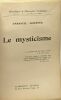
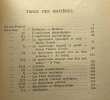
Bon état (BE) sous papier de soie intérieur propre
LE MYSTICISME. COLLECTION : BIBLIOTHEQUE DE PHILOSOPHIE SCIENTIFIQUE.
FLAMMARION .. 1952.. In-12. Broché. Etat d'usage, Couv. légèrement passée, Dos satisfaisant, Intérieur acceptable. 250 pages. 1ère de couverture illustrée en blanc et rouge. Quelques traces de crayon de papier dans le texte. Trace de stylo sur la page de titre. Léger manque sur le 2nd plat de couverture.. . . . Classification Dewey : 500-SCIENCES DE LA NATURE ET MATHEMATIQUES
Fondée par Gustave Le bon. Dirigée par Paul Gaultier. Classification Dewey : 500-SCIENCES DE LA NATURE ET MATHEMATIQUES
Verwondering en rekenschap. Opstellen over Nederlandse letterkunde.
Leuven, Universitaire Pers, 1978 Hardback, Nederlands, originele uitgeversomslag, 16x24 cm., 385 pp. ISBN 9789061860679.
Symbolae Facultatis Litterarum Lovaniensis - Series A : 07.
Aeschlimann, A. - Sommerlatte, H. - Emmenegger, F. - Lutz, H. - Winkler, U.
Reference : 59326
Bulletin de la Société Fribourgeoise des Sciences Naturelles. Vol. 61. Fasc. 1.Bulletin der Naturforschenden Gesellschaft Freiburg.- A. Aeschlimann. Le rôle des tiques en médecine humaine et vétérinaire.- H. Sommerlatte. Geologie - Erze - Weltwirtschaft.- F. Emmenegger. Synthetische Kristalle.- H. Lutz. Pesticides et reproduction chez les oiseaux.- U. Winkler. Lärm- und Schallschutz.
Fribourg, 1972, 225x150mm, 72pages, broché.
illustré, Pour un paiement via PayPal, veuillez nous en faire la demande et nous vous enverrons une facture PayPal
Recherches sur la notion de système physique.
P., Gauthier-Villars, 1960, grand in 8° broché, IX-251 pages ; traces de ruban adhésif sur les gardes.
PHOTOS sur DEMANDE. ...................... Photos sur demande ...................


Phone number : 04 77 32 63 69
SCIENCES APPLIQUEES
Un ouvrage de 508 pages, format 130 x 200 mm, illustré, relié cartonnage, publié en 1942, Librairie Hachette
Programmes du 16 août 1941. Deuxième Cycle, certificat d'Etudes. Ecoles urbaines
Phone number : 04 74 33 45 19
Gabriël Metsu
, Rijksmuseum Amsterdam / National Gallery of Ireland, 2010 Softcover, 210 pagina's, 29 x 25 cm, Nederlands. Redelijke staat. ISBN 9789071450303.
Gabriël Metsu
Façade Reliefs of Orvieto Cathedral
, Brepols - Harvey Miller, 2009 Hardcover with dusjacket, 245 pages., 199 b/w ill., 220 x 280 mm, Languages: English. ISBN 9781905375271.
This book presents in word and image the façade of Orvieto Cathedral, the reliefs of which are considered to be among the most beautiful and powerful of the Trecento. The town of Orvieto, located half-way between Rome and Florence, played an important and strategic role in the political struggles in Italy during the latter part of the thirteenth century. Frequently the place of residence for popes and their Angevins allies, it became the seat of the Curia under Pope Nicholas IV, which brought wealth and economic growth to the community. Moreover, it enabled earlier plans for a new cathedral, initiated around 1285, to be finally realised. It was Pope Nicholas himself who laid the foundation stone of the new Duomo in 1290, and although building activity continued until well into the seventeenth century, most of the main portion of the building was complete by 1308, creating a dazzling and unique Gothic structure. The façade of the Cathedral in particular, is a masterpiece of design and relief sculpture. Its rich decorative carving is of outstanding quality and the innovative, compelling iconographic programme spreads across all four piers of the lower façade. The corpus of photographs by David Finn, taken specially for this publication, shows the skill and narrative details of this vituoso display of relief carving, while the text by Anita Fiderer Moskowitz, Professor of Art History at the State University of New York, Stony Brook, explains the building in the context of related Italian Gothic architecture, and discusses the problems and controversies regarding the design and ornamentation of the façade as well as the puzzling question as to its artistic attribution. The author also interprets the basic iconography of the sculptures and provides full descriptions for the detail images.
Etude de la nature.
Mégard et cie. 1873. In-12. Cartonnage d'éditeurs. Etat passable, Plats abîmés, Dos satisfaisant, Rousseurs. 142 pages - illustration en noir et blanc en frontispice - papier jauni - plats désolidarisés - coins frottés.. . . . Classification Dewey : 500-SCIENCES DE LA NATURE ET MATHEMATIQUES
Classification Dewey : 500-SCIENCES DE LA NATURE ET MATHEMATIQUES
Creation of Space and the Connection between Models and Drawings as Design Tools
, Brepols, 2023 Paperback, 168 pages, Size:216 x 280 mm, Illustrations:31 b/w, 52 col., Language: English. ISBN 9782503606200.
Summary The essays in this volume address the problem of three dimensions in architecture and the ways architects in the 16th century (and before and after) solved this problem during the design process. Two-dimensional drawings were used as the most helpful element in the design process, as well as for the presentation of designs. Those involved, not only patrons but also construction workers, should be able to understand what a two-dimensional design would turn out to result in three dimensions. Both drawings in two dimensions and three-dimensional models are well-known tools to architects, but the way in which they employed them together is not always clear. Sometimes architects limited themselves to the making of models only when they believed that these would suffice to communicate the design to others. In other instances, drawings and models were used jointly. Topics of study in this volume include examples of these practices in the work of the Sangallo, Raphael, Vasari, and others. TABLE OF CONTENTS Introduction Lex Bosman Drawings for Models Lex Bosman Baldassare Peruzzi's Projections Ann Huppert Combining the intrinsic and the extrinsic: Francesco di Giorgio's model drawings Elizabeth Merril ?Not as beautiful as those made by painters??: graphic innovations in carpenters' drawings in the early sixteenth century in the Low Countries Merlijn Hurx ?Accommodate the Stories to the Spaces and Not the Spaces to the Stories?. Plans, Models and Drawings for Giorgio Vasari's Decorations in the Palazzo Vecchio in Florence Laura Overpelt The Mellon Codex and the creation of space with drawings and models Lex Bosman ?Come praticarono molti?. The use of Paper Architectural Models in Early Modern Italy Giovanni Santucci
Sciences physiques. Classes de 3 e (troisième). Livre du professeur
Couverture souple. Broché. 314 pages.
Livre. Librairie Hachette (Collection : Libres parcours), 1980.

